

Lift Retention 3–5 Percentage Points: Gamification for Gym Owners

Yes, well-designed gamification increases gym attendance and member retention, and it can pay for itself within months. The catch is that “designed well” and “measured correctly” do the heavy lifting. Run it as a pilot, track a handful of KPIs, and scale only what the numbers back up.
TL;DR:
- Starting with simple methods like whiteboard streaks and themed challenges is effective before moving to advanced app-based or hardware systems.
- Fairness and social accountability are crucial for sustained engagement, requiring careful segmentation and opt-in social features.
- Measuring a core behavior such as members hitting the same class twice in a week provides quick insight into gamification success.
- Avoid overcomplication by focusing on one challenge mechanic at a time and continuously reviewing data to prevent declines in participation.
- Using an integrated platform like Fitness Flow streamlines gamification, saves administrative time, and helps track its impact on retention and attendance.
Table of Contents
- Why Gamification for Gyms Actually Works
- How Do You Gamify a Gym, Step by Step?
- What Technology Do You Need to Run It?
- How Do You Roll Out Gamification Without Wasting a Budget?
- What Does Gamification Cost, and What’s the ROI?
- Why Fitness Flow Is a Practical Starting Point
- Should You Run Weekly or Monthly Challenges?
- What Psychology Actually Drives Gym Gamification?
- Which Gyms Have Made Gamification Work?
- How Do You Customize Gamification for Different Member Types?
- What Goes Wrong With Gym Gamification?
- What Legal and Privacy Issues Should You Watch For?
- An Operator’s Take: Start Small, Fix Fairness First
- Get Started With Fitness Flow’s Gamification Tools
- Sources
Why Gamification for Gyms Actually Works
Gamification for gyms works because it exploits three things human brains already respond to: small visible wins, social pressure, and the dopamine hit of a status update. A streak counter on a whiteboard gives a member proof of progress that a treadmill display never will. A leaderboard turns a solo 6 a.m. session into a competition your member actually thinks about at work. None of this is new psychology. It is just rarely applied deliberately in a gym setting.
The business case follows directly from that. Members who show up more often churn less, refer more friends, and buy more premium classes. Gamification (leaderboards, points, badges, challenges) increases motivation, attendance, and community engagement when it is applied correctly, and that “correctly” is the operative word: fairness and pacing matter more than flashy tech.
Pro Tip: Track one behavior change before you launch anything else: how many members hit the same class or floor slot twice in one week. That number moves first, and it moves fast when gamification lands.
Gyms using Getfitnessflow’s built-in engagement tools have reported an average increase in member retention alongside notable time savings on admin work that used to go into manually tracking challenges and rewards.
How Do You Gamify a Gym, Step by Step?
Start cheap, then add technology only where it earns its keep. The order below is roughly how most gyms should sequence their rollout.
- Whiteboard streaks and punch cards. Post a physical board tracking consecutive weekly visits. Zero cost, immediate visibility, and it works because everyone in the gym sees it.
- Themed monthly challenges. “January Squat Streak” or a step-count push tied to a charity donation. Simple to run, easy to explain to new members.
- Points and badges inside a member app. Automate what the whiteboard was doing manually: check-ins earn points, milestones unlock badges, and a leaderboard updates itself.
- Team-based competitions. Split members into small squads for a shared point goal. Team formats pull in people who would never compete solo.
- Referral bonuses tied to point systems. Reward the referring member and the new signup, both redeemable through the same points engine.
- Interactive hardware. LED-lit training floors, sensor walls, and active game rooms turn a workout into a real-time scored event. Interactive hardware like this can dramatically increase engagement and support premium class pricing, but it only pays off in studios that can charge for the exclusivity or run it as a signature offering.
Design decisions matter more than the tactic itself. Keep competitive categories fair by age, tenure, or fitness level, not just raw performance, or you will demotivate the exact members you are trying to retain. And keep a social layer somewhere, even informal, because app-driven gamification patterns using quests, XP, and leaderboards only sustain engagement when there is someone to compare progress with.
What Technology Do You Need to Run It?
You do not need custom software to gamify a gym, but you do need a few non-negotiable pieces working together, whether you buy one platform or stitch several tools yourself.
- A single member ID that ties check-ins, class bookings, payments, and points into one profile, not three disconnected systems.
- An automated points engine that awards points on check-in, class completion, or referral without a staff member manually logging it.
- A redemption flow members can see and use themselves, whether that is a discount, merchandise, or a free class credit.
- A staff admin view to adjust point balances, resolve disputes, and launch new challenges without calling a developer.
- Analytics that break out attendance, active days per member, and redemption rates by segment.
Integration is where most DIY setups fall apart: wearables need to sync automatically, class bookings need to feed the points engine in real time, and payment status needs to gate reward eligibility so lapsed members do not keep earning. Leaderboards and social sharing should default to opt-in, not opt-out. Some members love public rankings; others find them a reason to quit. An all-in-one platform like Fitness Flow handles this by routing check-ins, bookings, and gamified points through one branded member app, which is exactly the kind of consolidation that keeps this from becoming a second full-time job.
How Do You Roll Out Gamification Without Wasting a Budget?
A phased rollout protects you from sinking money into a program members ignore.
- Pick a pilot segment and window. Run one challenge format with one member segment (new joiners, a specific class, or one location) for four to six weeks.
- Limit the tactics. One point system and one leaderboard. Resist adding badges, teams, and hardware all at once.
- Set your KPIs before launch. Track attendance frequency, active days per month, 90-day retention, redemption rate, and Net Promoter Score.
- Train staff and communicate clearly. Front desk and coaches need to explain the rules in one sentence, and rewards need a defined fulfillment process so nobody waits three weeks for a prize.
- Review at the pilot’s end against a scale rule. If attendance frequency or retention moved by a margin you defined in advance, expand to the next segment or location. If it didn’t, adjust one variable and run again before scrapping the idea.
Iterate on a monthly cadence once scaled. Gamification programs decay if left static. The same challenge every month becomes wallpaper.
What Does Gamification Cost, and What’s the ROI?
Costs break into four buckets: staff time to administer and monitor challenges, physical or digital rewards, a software subscription if you are using a platform, and premium hardware if you go that route. A whiteboard-and-punch-card program can run for the cost of printer paper and someone’s Tuesday afternoon. A mid-tech app-based points system typically runs alongside a gym management subscription. Interactive floors and sensor walls represent a serious capital investment, and gyms only see strong ROI on that hardware when it matches their membership’s willingness to pay a premium.
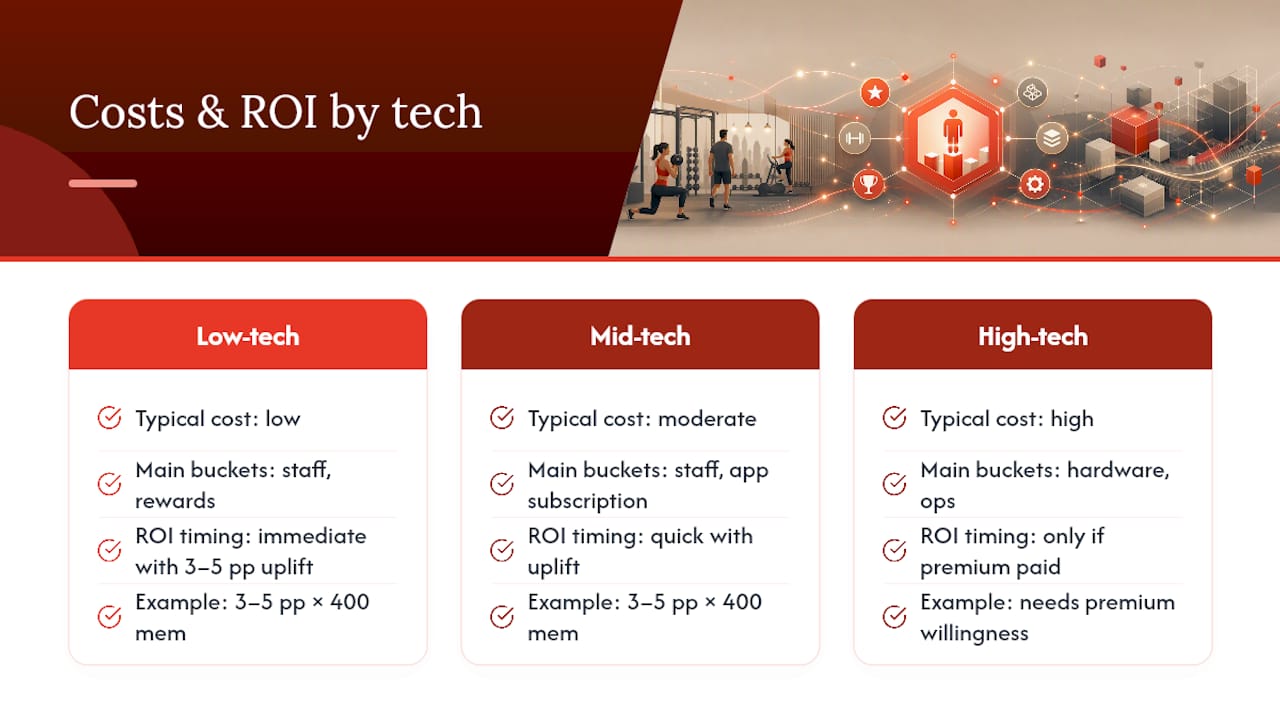
A simple ROI formula: (retention rate uplift × average member lifetime value × affected member count) minus (program cost). If gamification lifts monthly retention by even 3 to 5 percentage points across 400 members, the math tends to favor the low and mid-tech tiers almost immediately, well before hardware enters the conversation. Set reward redemption thresholds high enough that the cost of fulfilled rewards stays below the retained-revenue gain. If your top prize costs more than three months of membership dues, the math has stopped working in your favor.
Why Fitness Flow Is a Practical Starting Point
Most gyms trying to gamify member experience end up duct-taping together a CRM, a separate points app, and a spreadsheet for redemption tracking. Fitness Flow consolidates that into one subscription: a branded member app with points, badges, and leaderboards, live and on-demand class streaming, and analytics that show which challenges actually move attendance.
That consolidation is where the reported numbers come from. During a pilot, that means your staff sets up one challenge inside the app, points and leaderboards run themselves, and you watch the same dashboard you’d use for billing and scheduling to see whether attendance actually moved.
Should You Run Weekly or Monthly Challenges?
Weekly challenges suit habit formation. A “5 check-ins this week” push keeps the loop tight enough that members feel the reward cycle almost immediately, which matters most in the first 90 days of a new membership when churn risk is highest. Monthly challenges suit bigger, more social formats: a squat volume competition, a step-count push tied to a cause, or a themed event around a holiday. The tradeoff is pacing. Weekly formats need almost no setup but can burn out staff attention if run indefinitely. Monthly formats justify more planning and a bigger prize, but members lose the thread if you don’t remind them regularly.
Team formats deserve their own line item because they solve a problem individual leaderboards create: they demotivate the middle and bottom of the pack. Put four or five members with mixed fitness levels on a team chasing a combined point total, and the strongest member’s contribution lifts everyone instead of just outranking everyone. This is also where fairness design matters most. Weight team point totals by percentage improvement rather than raw volume, or your newest, least fit members will opt out of team challenges entirely rather than drag their team down. Seasonal formats, like a quarterly “league” structure with promotion and relegation between tiers, borrow directly from the gaming world and give long-tenured members a reason to keep competing instead of plateauing once they’ve won the same monthly challenge three times.
What Psychology Actually Drives Gym Gamification?
Three behavioral mechanisms explain why this works better than motivational posters ever did. The first is the “endowed progress effect”: people who see a partially filled progress bar, streak count, or point balance are more likely to keep going just to avoid losing what they’ve already built. A five-day streak feels like something to protect, not just a number.
The second is variable and immediate feedback. Traditional gym membership offers almost no feedback loop between a workout and a visible outcome, sometimes for weeks. A points ping after check-in, a badge unlock after a milestone, or a leaderboard shift after a class closes that gap to seconds, which is closer to how habit-forming apps and games are built.
The third is social accountability, and it’s the one owners underrate most. Public commitment, even something as small as a name on a shared leaderboard, raises the cost of skipping a session because someone else might notice. This is the same principle behind workout partners and group classes, just made visible and persistent instead of confined to the one hour you’re both in the room. Immersive systems built around real-time scoring and seasonal leagues lean hard into this, explicitly designing for the social accountability and dopamine-driven micro-wins that keep members returning week over week rather than dropping off after the initial novelty fades.
None of this replaces good coaching or a clean facility. It sits on top of both, and it fails fast if either is weak underneath it.

Which Gyms Have Made Gamification Work?
Boutique studios and consulting-backed independents provide the clearest examples, mostly because they’re small enough to test fast and track results without a corporate approval chain. A common pattern from gym consulting case work: an attendance streak challenge combined with a team format and a charity tie-in drives a measurable bump in class bookings within the first month, because the format hits three levers (progress tracking, team accountability, and a feel-good cause) at once. Documented consulting examples point to reward economics and community programming as the two ingredients that separate a gamification push that sticks from one that fizzles after the prize is handed out.
On the hardware side, studios that installed interactive LED floors or sensor-based active game rooms have turned what used to be a standard class slot into a premium, ticketed experience members pay extra to access. The lesson from that segment isn’t “buy the hardware.” It’s that the studios seeing real return matched the investment to a membership base already willing to pay boutique pricing, then built a class format around it rather than bolting gamified hardware onto an existing class that didn’t need it.
App-based case examples follow a different but complementary pattern. Fitness RPG-style apps that use quests, levels, and avatars show that gamification doesn’t require a physical space at all. It scales across a member base that trains partly at home and partly in the gym, which matters for any studio trying to keep members engaged on the days they don’t walk through the door.
How Do You Customize Gamification for Different Member Types?
A single leaderboard rewards one kind of member and alienates the rest. New joiners need small, frequent wins, so a “first 30 days” streak challenge with a modest, easily reachable reward keeps them past the point where most cancellations happen. Competitive, tenured members want harder stakes: seasonal leagues, PR-based challenges, or team captain roles that give them status without requiring a prize.
Members focused on general health rather than performance respond better to consistency metrics than leaderboards. Track their attendance streak or active days per month instead of ranking them against powerlifters. Parents and time-constrained members often disengage from anything requiring extra app interaction, so keep their gamification passive: automatic point accrual on check-in, no manual logging required.
The practical move is building two or three challenge tracks running simultaneously rather than one program for everyone. A points-based leaderboard for the competitive segment, a streak tracker for newer members, and a low-effort passive rewards track for busy members covers most of a typical gym’s membership base without requiring three separate systems if your member app supports segmented challenges natively.
What Goes Wrong With Gym Gamification?
The most common failure is overcomplication. Owners get excited, launch five simultaneous challenge types, three badge tiers, and a points shop on day one, and members can’t figure out what they’re supposed to do. Start with one mechanic, prove it moves attendance, then layer in the next one.
The second failure is ignoring the data once the novelty wears off. A challenge that drove real engagement in month one but shows flat participation by month three needs to be retired or redesigned, not left running on autopilot because it’s easy to leave alone.
Unfair competitive design is the third trap, and it’s the one that actively drives people away rather than just failing to engage them. If the same three fittest members win every leaderboard every month, everyone else eventually stops checking it. Segment by tenure, fitness level, or percentage improvement instead of raw output.
Reward fulfillment delays cause quiet damage too. A member who wins a challenge and waits three weeks for a promised reward learns not to bother next time. Build a fulfillment process before you launch, not after the first winner is waiting.
What Legal and Privacy Issues Should You Watch For?
Public leaderboards and social features touch personal data, and gyms should treat that seriously even outside strictly regulated health information. Make leaderboard visibility and social sharing opt-in by default, not opt-out. Some members are glad to see their name at the top of a board; others consider that a privacy violation, and forcing it can trigger complaints or cancellations.
If your gamification program touches biometric or health-adjacent data, such as heart rate from wearables or body composition tied to a challenge, be explicit in your membership agreement about what’s collected, how it’s used, and who can see it. Rewards involving prize values, sweepstakes-style drawings, or cash incentives can trigger state-level promotional or gaming regulations depending on structure, so run larger prize programs past a lawyer familiar with your state before launch rather than after a complaint arrives. Keep a clear opt-out path for any member who wants their check-in and performance data excluded from public boards or team totals, and honor it without friction.
An Operator’s Take: Start Small, Fix Fairness First
The two lessons that matter most: launch one mechanic before adding a second, and get your fairness categories right before you get your reward budget right. Most failed programs died from complexity or an unfair leaderboard, not lack of member interest.
Watch for the same two traps every time: reward systems so complicated staff can’t explain them in one sentence, and owners who launch a challenge, then never look at the data again. Pilot one thing, measure it against a number you picked in advance, and only then decide whether to scale.
— Louis
Get Started With Fitness Flow’s Gamification Tools
Getfitnessflow is the alternative to juggling a CRM, a separate points app, and a spreadsheet for reward tracking. One subscription runs your member app, points and leaderboards, class scheduling, billing, and analytics together, so a gamification pilot doesn’t turn into a second software project.
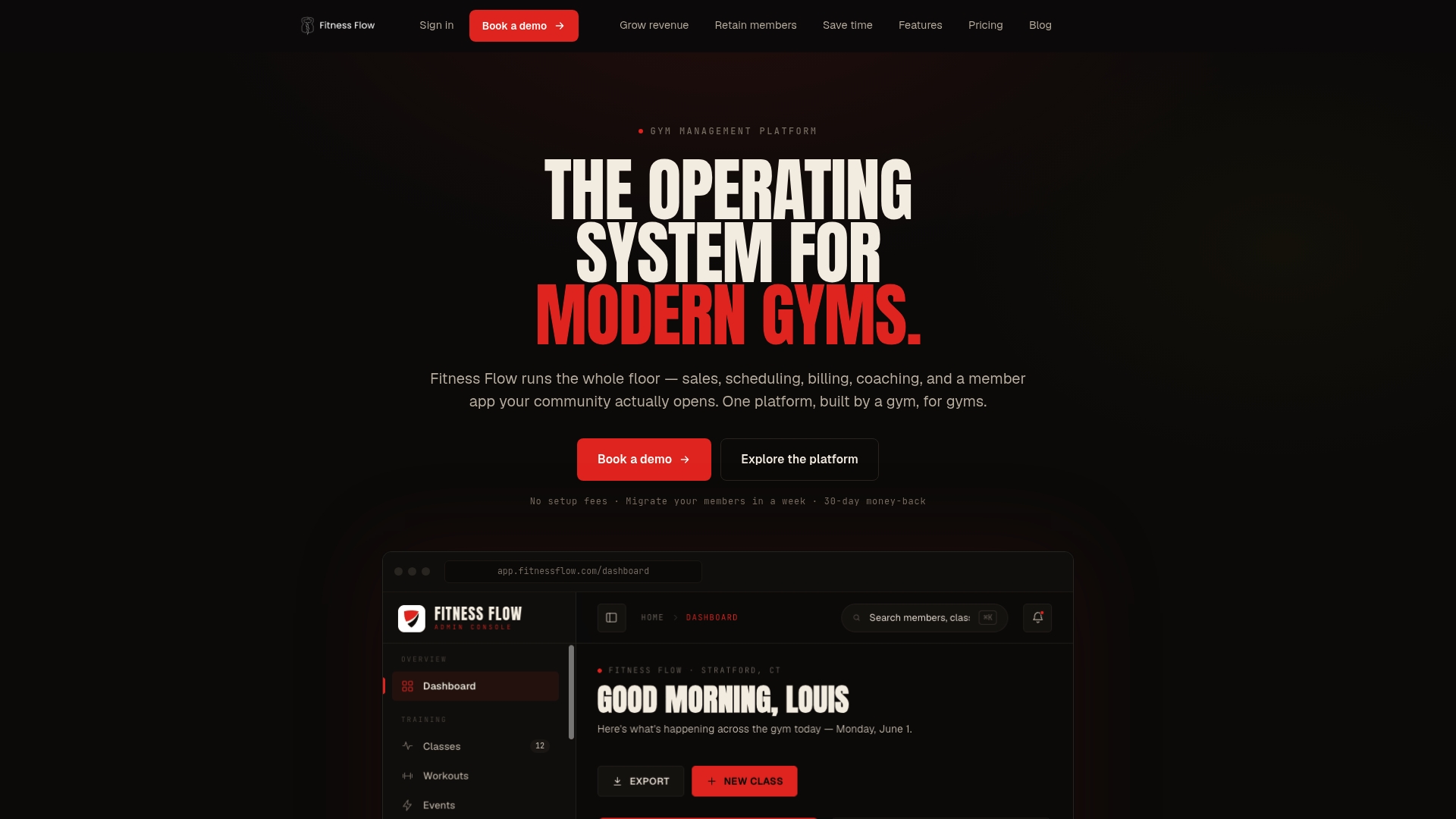
That matters most for gyms trying to prove ROI to a partner or investor before committing more budget. You’re not asking staff to learn a fourth tool. You’re turning on a feature inside the same system already running check-ins and billing, then watching the same dashboard to see whether attendance and retention actually moved. Gyms already on the platform report an average retention increase and significant admin time savings each week, numbers that come directly from automating what used to be manual challenge tracking and reward fulfillment.
If you’re ready to pilot a challenge without stitching together separate tools, see how Fitness Flow’s member app and gamified features work and set up your first challenge inside a platform you’re probably already paying for pieces of anyway.