

Gym Member Segmentation: How to Group Members and Keep Them

Gym member segmentation means sorting your members into groups that share traits or behavior, so you can treat each group differently: different messages, different offers, different programming. Start with two or three segments built from data you already have (join date, visit frequency, membership type), give each group one clear action, and measure whether retention improves. That is enough to beat blanket emails sent to everyone.
This guide covers the segment types worth building, the data behind them, a step-by-step setup, and how to tell whether it is working.
Getfitnessflow
Keep Members Engaged Between Visits
Fitness Flow brings scheduling, billing, analytics, and a branded member app together to help gyms support member engagement and retention.
TL;DR
- Segment first by status and behavior (new, active, slipping, lapsed). These change fastest and tell you who needs a message today.
- Add goals, demographics and membership tier later, once the behavioral groups are running.
- Keep each segment big enough to act on (we use 50 to 100 members as a floor) and give every segment one owner and one action.
- Judge success by retention and reactivation per segment, not by open rates alone.
- Software does not create retention. Your team’s follow-through does. The software just makes the follow-through possible at scale.
Table of Contents
- Why segmenting members pays off
- The segments that matter most
- Does risk segmentation actually predict who leaves?
- What data to collect
- How to build your first segments, step by step
- Putting segments to work
- Choosing a method as your data grows
- Common mistakes
- How to tell if it is working
- Our perspective: start with behavior, keep it human
- Run segments from one system
- FAQ
- Sources
Why segmenting members pays off
The U.S. market is large and varied. According to the Health & Fitness Association’s 2026 consumer report, 81 million Americans belonged to a fitness facility in 2025, a membership penetration of 26.1% of people ages 6 and older. Those 81 million people did not join for the same reasons, and they do not use your club the same way.
The basic logic is old and simple. Market segmentation groups people with shared characteristics and similar needs, which lets a club tailor programs, services and promotions to each group. The same article argues that data often shows an owner’s assumptions about their best member group are wrong. That matches what we see: owners are frequently surprised that the members they think of as their core are not the ones who stay longest.
For a gym, the payoff shows up in three places:
- Retention. You reach the member whose visits are tapering before they cancel, with a message that fits their situation.
- Acquisition. You learn which kinds of members join, stay and refer, and you aim your ads and trials at more of them.
- Programming. You stop building the schedule for an imaginary average member.
The segments that matter most
There is no single correct list. Most gyms end up working with five families of segments. The first two do the heavy lifting.
Status and tenure
This is the simplest cut and the one to build first. Where is the member in their life with you?
- Prospects and trial members: have not paid yet.
- New members (first 90 days): the highest-risk window, so they deserve their own onboarding path. Our 90-day retention playbook goes through it week by week.
- Established members: past the first quarter, visiting steadily.
- Lapsed or frozen members: paused, expired or cancelled recently.
The national picture shows why status matters even beyond your own walls. The Fitness Industry Technology Council’s 2025 research, The Fitness Membership Divide, splits the U.S. market into current members, former members and never members. It surveyed 2,500 adults ages 18 to 79 and found the three groups differ in behavior, spending, motivations and barriers. Your former members are not just current members who left. They have a different story, and your win-back message should reflect it.
Behavior and engagement
Behavior changes more often than anything else about a member, which makes it the most useful for timely action. Useful behavioral segments include:
- Frequency bands: for example 3+ visits per week, 1 to 2, under 1.
- Trend: visits rising, steady or falling over the last 30 days.
- Format: open-gym only, classes only, or both.
- Time of day: early, midday, evening, weekend.
- Extras: personal training, retail, recovery add-ons.
A falling trend is the most valuable signal in the list. If you track visits consistently, a member who dropped from three visits a week to one is flagged weeks before they cancel. Our guides on attendance tracking that works and class attendance tracking explain how to set that up. Tools that log attendance, rosters and engagement patterns in one place make it easier to spot who is drifting.
Goals and motivation
This is psychographic segmentation: why does this person come? Typical answers are weight loss, strength, stress relief, community, sport performance, rehab or simply structure. The goal a member gave at sign-up is a good first field to capture, and it costs nothing to ask. A person who joined for stress relief wants a very different invitation than someone training for a race.
The broader industry is moving in this direction. The Health & Fitness Association’s analysis of how 77 million members work out points to members who care about balance, longevity and overall quality of life rather than intensity alone. If your messaging is all “crush it,” you are speaking to a shrinking slice of your base.
Demographics and household
Age, gender, occupation, ZIP code and household type are the easiest fields to pull and the weakest predictors on their own. Use them as a second layer. A 28-year-old who visits four times a week and a 28-year-old who visited twice last month are the same demographic and need different treatment. Where demographics help is in scheduling (when is your over-55 crowd actually in the building?) and local marketing (which ZIP codes send you the most members?).
Value and membership tier
Membership level, price paid, add-on spending and referrals tell you who is worth the most to the business. This segment is less about who deserves attention and more about where to put your best effort. Les Mills’ analysis of 2.6 million member journeys across 1,312 clubs found that its “Most Valuable Participants” stayed 23 months against 16 for typical members, visited 65% more often, and generated 27% more lifetime value. That is one company’s data from its own programs, so treat the exact figures as directional. The pattern is the useful part: a small group of highly engaged members carries outsized value, and you should know who yours are.
Does risk segmentation actually predict who leaves?
There is academic support for grouping members by what they look like at the start. A 2016 study in Preventive Medicine Reports, identifying groups at risk for one-year membership termination, found four classes of members at enrollment: healthy, unhealthy, poor psychological wellness and poor physical wellness. Members in the unhealthy and poor psychological wellness groups were significantly more likely to end their membership within a year.
The takeaway for an owner is practical, not clinical. Members who arrive with the most to gain, and who may feel the most self-conscious or overwhelmed, are the ones who need the most support early. A short intake question, a first-week check-in and an introduction to a coach or a class costs little and targets exactly that group. We would not try to diagnose anyone. Just notice who looks nervous, who has no routine yet and who has no friend at the club, and plan outreach around that.
What data to collect
You do not need a data science team. A useful starting set, which mirrors what American Spa’s segmentation guide lists, includes age, gender, income, home location, behavior and program use. For a gym with a member system, that translates to:
Data pointWhere it comes fromWhat it tells you
Join date and tenure
Membership record
Lifecycle stage, onboarding needs
Visit frequency and trend
Check-ins, class bookings
Engagement and churn risk
Membership type and price
Billing
Value, upgrade candidates
Class or area preferences
Bookings
Programming and offer fit
Stated goal
Sign-up form or survey
Message and program match
ZIP code
Address
Trade area, local campaigns
Referral source
Sign-up form
Which channels bring members who stay
Payment status
Billing
Failed-payment and freeze risk
Collect only what you will use. Every extra field is one more thing your front desk has to enter and one more thing to keep accurate. If you want to go deeper on reading these numbers, our gym analytics guide covers three KPIs that matter most, and our cohort analysis playbook shows how to compare groups of members who joined at the same time.
How to build your first segments, step by step
- Pull a clean member list. Export active members with join date, membership type, last visit date and visits in the last 30 days. Fix obvious errors first, such as duplicate profiles and old trial entries.
- Start with rules, not algorithms. Simple filters work. “Joined in the last 90 days and fewer than 6 visits” is a segment. “No visit in 14 days” is a segment. You can add engagement scoring or clustering later if your data supports it.
- Name each segment by what you will do. “New and quiet” is more useful than “Segment 3.” The name should suggest the action.
- Check the size. A group of eight members is a list of people to call, not a segment. As a rule of thumb we like a floor of 50 to 100 members for anything you plan to market to, because smaller groups produce noise rather than patterns. In a small studio, combine groups or handle small ones personally.
- Assign one action and one owner per segment. A coach calls the new and quiet. The manager sends the lapsed offer. If nobody owns it, nothing happens.
- Set a review date. Look at results after 30 days and again at 90.
The American Spa guide describes the same loop in broader terms: analyze membership data and program use, assess competitors and the trade area, select priority segments, tailor marketing and programming, and keep measuring.
Putting segments to work
A segment with no action attached is a spreadsheet. Here is how the common groups translate into real operations.
SegmentExample ruleAction
New and on track
Joined under 90 days, 2+ visits per week
Milestone recognition, invite to a class or challenge
New and quiet
Joined under 30 days, fewer than 3 visits
Coach call or text, book a first session together
Slipping regulars
Visits down by half over 30 days
Personal check-in from a coach, not a mass email
Class-only members
Books classes, never uses open gym
Offer a floor orientation or a program that mixes both
Open-gym-only members
No class bookings in 60 days
Invite to a beginner-friendly class at their usual hour
Lapsed 30 to 90 days
Cancelled or expired recently
Two or three emails tied to their past attendance
High-value regulars
Top visit frequency, long tenure, referrals
Ask for referrals, early access, thank-yous
Two details matter here.
Personal beats automated for the at-risk group. Fairview’s 2026 analysis, summarized in its operating intelligence report, says operators who watch signals like falling check-in frequency and send personalized outreach, such as a message from a coach or milestone recognition, see retention 6 to 8 percentage points higher than those relying on automated win-back campaigns. That is a vendor’s analysis rather than an independent study, so treat the size of the gap with care, but the direction fits our experience. Use automation to detect and to schedule, and use people to speak.
Lapsed members need a different message than slipping ones. Someone who left 45 days ago does not want a “we miss you” blast. They want a reason and an easy way back. Our post on win-back emails tied to attendance shows how to build a short, specific sequence, and our guide to member surveys covers how to ask at-risk members what is getting in their way.
The Health & Fitness Association’s 2018 piece on how gyms use member data to increase retention offers a useful warning. Its view is that technology itself does not affect retention: it gives you tools, and results depend on how well your team uses them. Segments only work if someone acts on them on Tuesday morning.
Choosing a method as your data grows
You can grow into more sophisticated approaches as your records improve.
- Rules-based segments are filters on fields you already have. Start here. They are transparent, and your staff can explain them.
- Engagement scoring gives each member a score from 0 to 100 based on visits, bookings, recency and other signals. It suits gyms that want a consistent trigger for outreach, for example “call anyone who drops below 40.”
- Clustering (K-means and similar methods) finds natural groups across many variables at once. It is useful for multi-location operators with thousands of members, and overkill for a single studio.
The trade-off is control versus discovery. Rules do what you tell them. Statistical grouping can surprise you with a segment you would never have thought to define, but it takes more data and more care to interpret. Most gyms get 80% of the value from rules and a simple score.
Common mistakes
- Too many segments. Twelve groups no one can remember are worse than three that everyone uses.
- Static labels. A member who was “new” in January should not still be tagged new in June. Segments based on behavior should update automatically.
- Segmenting by demographics alone. Age and gender are easy to pull and rarely explain why someone stays or leaves.
- Ignoring the lapsed. Former members already know your gym. They are cheaper to win back than strangers are to win over.
- Never testing. Send one message to half a segment and a different message to the other half. Learn which works.
- Treating segmentation as a one-time project. Your member base shifts with the seasons, the neighborhood and your own schedule.
How to tell if it is working
The American Spa guide boils the evaluation down to tracking membership information and program performance, and continually checking whether segmentation improves retention and drives acquisition. In practice, track these by segment:
- 30, 60 and 90-day retention of new members, before and after you introduced onboarding outreach
- Reactivation rate of lapsed members who received your win-back sequence compared with those who did not
- Share of slipping members who returned to their previous visit frequency after outreach
- Class fill rates for programs you built for a specific segment
- Referrals and upgrades from your high-value group
Our retention metrics guide explains how to define and calculate each one so your numbers are consistent month to month. For context, the industry-wide yearly retention rate most commonly quoted is in the mid-60% range, meaning roughly one in three members leaves each year. Treat any industry benchmark as a rough check, and compare yourself against your own past cohorts first.
Our perspective: start with behavior, keep it human
We build gym software, so you might expect us to say you need more data and more dashboards. We say the opposite. Most gyms we talk to already hold enough information to run three excellent segments, and they are not using it.
Our view is simple. First, behavior beats demographics. What a member did last week tells you more than their age. Second, the early weeks matter more than any later campaign, so build your first segment around new members and make sure each one hears from a real person. Third, every segment needs a human owner. We have seen owners buy tools, create ten segments and send ten automated emails, and then wonder why nothing changed. The members who needed a coach’s text got a template instead.

That is why we built Fitness Flow as one platform. When scheduling, check-ins, billing, the member app and messaging share the same member record, a segment like “joined in the last 30 days, fewer than three visits, payment current” takes a minute to define rather than a week of exporting spreadsheets between tools. Staff then spend their time on the conversations instead of the data wrangling. Our customers’ administrative savings and retention gains come from this combination of less manual work and more timely, personal outreach.
If you do one thing after reading this, pick your “new and quiet” group, assign one person to contact them this week, and track whether they come back.
— Louis
Run segments from one system
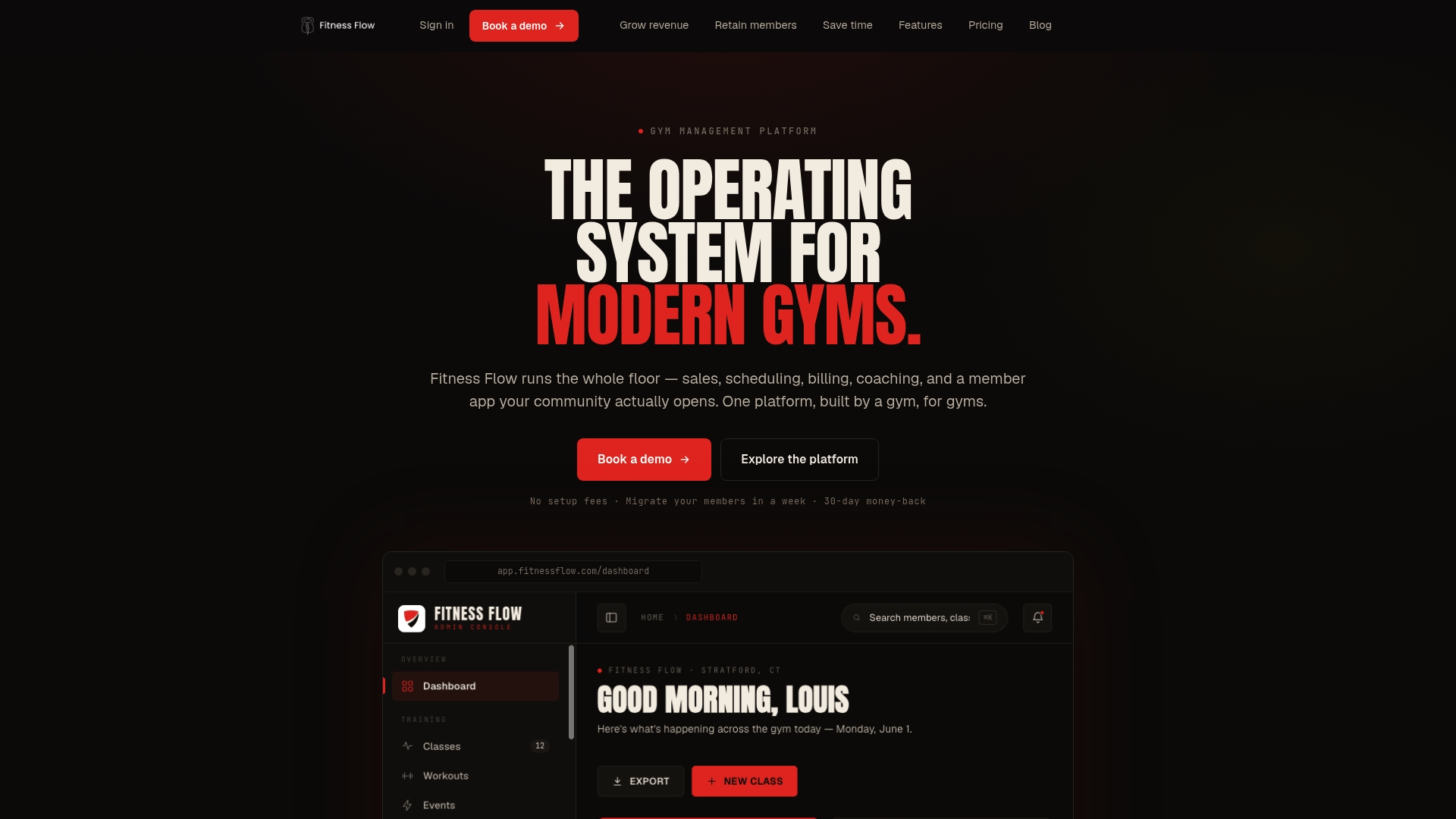
Segmentation works best when your member data lives in one place. Fitness Flow combines lead tracking, CRM, scheduling, recurring billing, a fully branded member app and automated retention workflows, so segments update as members book, visit and pay. Plans start at $149 per month for Solo and $349 per month for Studio, and Multi-site is available for multi-location operators. You can see the plans on our pricing page or read how the platform works for modern gyms.
If you are earlier in the journey and still building your funnel, our guide to gym lead generation pairs well with the segments above, and our piece on habit tracking features shows how in-app routines support the new-member group.
FAQ
How many segments should a gym start with?
Start with three: new members in their first 90 days, active regulars, and members whose visits are falling. Add lapsed members as a fourth once your win-back emails are ready. Each segment should have one action and one owner before you add another.
What is the best data for segmenting gym members?
Visit frequency and its trend over the last 30 days, join date and membership type give you the most useful segments with the least effort. Stated goals are a strong addition because you only need to ask once. Demographics like age and ZIP code are useful as a second layer for scheduling and local marketing.
Do I need special software to segment members?
Not to begin. A spreadsheet export with join date, last visit and visits per month supports simple rule-based groups. Software becomes worth it when you want segments to update automatically and trigger messages without manual exports, especially across several locations.
How big should a segment be?
Big enough that results are meaningful and the effort is worth it. We use a rough floor of 50 to 100 members for anything you plan to market to. In a smaller studio, merge groups or handle the small ones with personal calls.
How often should I review my segments?
Check results at 30 and 90 days after launching, then quarterly. Behavior-based segments should update continuously, but the rules behind them, such as what counts as slipping, deserve a review as your schedule and member mix change.
Sources
- 2026 US Health & Fitness Consumer Report: Headline Trends, Health & Fitness Association
- Market Segmentation Improves Competitiveness, American Spa
- The Fitness Membership Divide, Fitness Industry Technology Council
- How 77 Million Fitness Members Work Out, Health & Fitness Association
- Landmark Les Mills report on MVPs and club profitability
- Identifying groups at risk for 1-year membership termination, Preventive Medicine Reports
- Operating Intelligence for Sports and Fitness Brands, Fairview
- How Gyms Are Using Member Data to Increase Retention, Health & Fitness Association
- Roster management for clubs, Sidekick