

FTC Compliant Recurring Gym Billing for Gym Owners, Live in 4–8 Weeks

Recurring gym billing automatically charges members on a set schedule instead of requiring manual invoicing each month. The right move is to enable tokenized recurring payments with clear upfront consent and a cancellation process that takes seconds, not phone calls. Following FTC guidance and PCI tokenization standards protects your gym from disputes while platforms like Fitness Flow handle the mechanics.
TL;DR:
- Most gyms should enable tokenized recurring payments with clear consent and quick cancellation options to avoid disputes and ensure compliance.
- Effective billing systems must handle proration, retries, failed payments, and integrate seamlessly with POS, CRM, and accounting tools to prevent errors.
- Testing the entire billing flow, especially cancellations, before launch is crucial to avoid member dissatisfaction and regulatory issues.
- Self-service portals that allow members to update payment details and cancel easily are vital for reducing staff workload and meeting consumer protection regulations.
- Implementing recurring billing typically takes four to eight weeks and offers quick ROI through increased revenue recovery and reduced manual admin hours.
Getfitnessflow
getfitnessflow.com
Simplify Your Gym’s Recurring Billing
Fitness Flow brings billing, scheduling, member engagement, and analytics together in one platform built for modern gyms.
Table of Contents
- How automated recurring billing works for gym memberships
- Key features to require in gym billing software
- Step-by-step setup: implementing recurring billing
- Handling failed payments, disputes, double charges, and reconciliation
- Compliance and cancellation best practices
- Security and PCI considerations, tokenization, and ACH basics
- Costs, timeline, and expected ROI for implementing recurring billing
- What running billing inside a gym operating system taught us
- How Fitness Flow handles recurring billing for gyms
- FAQ
- Sources
How automated recurring billing works for gym memberships
Recurring billing runs on triggers: a monthly renewal date, an annual contract anniversary, or a prepaid block that expires and needs renewal. Some gyms layer usage-based add-ons on top, charging separately for guest passes or personal training sessions consumed during the cycle, a strategy discussed in detail in vending machine gym membership perks.
The authorization flow starts when a member enters card or bank details at signup. Rather than storing that raw card number, the processor converts it into a token, a randomized string that represents the payment method without exposing the actual account number. Every future charge references the token, so the gym’s systems never touch sensitive card data directly. This single design choice is what keeps most gyms out of the heaviest PCI compliance burden.
Billing has to adjust as members move through their lifecycle. A free trial converts to a paid plan and needs a first charge event. A member upgrades to an unlimited tier mid-month and the system needs to prorate the difference. Someone freezes their membership for a few months, or cancels outright, and billing needs to stop immediately rather than catching up later with an awkward final charge.
None of this works in isolation. Billing has to talk to your point-of-sale system for in-person add-on purchases, your CRM for lifecycle triggers, a member portal where people update their own payment details, and your accounting software for reconciliation. When these pieces are disconnected, staff end up re-entering the same information three times, and that’s where billing errors creep in.

Key features to require in gym billing software
Not all billing tools are built the same, and the gaps show up fast once you’re running hundreds of accounts. Before signing a contract, confirm the platform handles:
- Flexible plan catalog: supports multiple tiers, add-ons, and trial periods without custom development.
- Proration logic: automatically adjusts charges when a member upgrades, downgrades, or switches billing dates mid-cycle.
- Smart retry and dunning: reattempts failed charges on a sensible schedule and emails the member before a lapse.
- Self-service portal: lets members update cards, view invoices, and cancel without calling the front desk.
- Reporting and reconciliation: tracks monthly recurring revenue, churn, and failed-payment rates in one view.
The self-service portal deserves particular attention because it does double duty. It reduces staff workload and it is also the mechanism that satisfies cancellation-simplicity requirements under consumer protection rules. A portal that buries the cancel button three menus deep defeats the purpose.
Pro Tip: Test the cancellation flow yourself, as a mystery-shopper would, before launch. If it takes you more than two clicks, it will frustrate real members too.
Reconciliation tools matter more than most owners expect going in. A failed-payment rate hovering near zero sounds good until you realize your retry logic is quietly suppressing legitimate declines instead of resolving them, which shows up later as a churn spike nobody can explain.
Step-by-step setup: implementing recurring billing
Rolling out recurring billing is a sequence, not a single toggle. Skipping steps is the most common reason gyms end up fixing problems after launch instead of before it.
- Decide your billing model. Map out monthly versus annual plans, trial length, and how upgrades or freezes will be handled.
- Select payment rails. Choose whether you’ll accept cards, ACH bank debits, or both, and open the relevant processor accounts.
- Enable tokenization. Confirm your processor or gateway tokenizes card data on entry so raw numbers never touch your own servers.
- Configure the plan catalog. Build your pricing tiers, proration rules, and retry or dunning cadence inside the billing system.
- Run end-to-end tests. Simulate a failed payment, a mid-cycle upgrade, and a cancellation to confirm each path behaves correctly.
- Train staff and publish policies. Make sure front-desk and sales staff can explain consent terms and cancellation steps accurately, and post those policies where members sign up.
The testing step is the one most often rushed. A cancellation that works in a demo environment but fails to stop the next billing cycle in production is exactly the kind of gap that leads to member disputes and, at scale, regulatory attention.
Handling failed payments, disputes, double charges, and reconciliation
Payments fail for predictable reasons: an expired card, insufficient funds, or a transient network error at the processor. Good billing software flags each failure type separately because the fix is different for each one.
- Expired cards need a pre-expiration email asking the member to update details before the charge even runs.
- Insufficient funds usually resolve with a short retry delay, often three to five days, rather than an immediate second attempt.
- Network errors can often be retried within hours since they reflect a processor hiccup rather than a member problem.
Duplicate charges typically stem from a retry firing before the first attempt’s status was confirmed. When this happens, refund the duplicate immediately and flag the account for manual review rather than waiting for the member to notice and dispute it, since a dispute hurts your processor relationship more than a quiet refund does.
Automated dunning should escalate to a human only after two or three failed attempts. At that point, a personal email or call tends to recover accounts that pure automation cannot, and it signals to the member that the gym noticed, which matters for retention even when the payment issue itself gets resolved quickly.
Compliance and cancellation best practices
U.S. consumer protection rules are specific about what recurring billing requires. The FTC’s Negative Option Rule requires clear disclosure of material terms before collecting billing information, unambiguous affirmative consent before the first charge, and a cancellation mechanism simple enough to immediately halt future charges.
The FTC has made cancellation friction an enforcement priority: a 2025 FTC business guidance post flagged gyms requiring in-person visits, mailed forms, or staff-only processing to cancel, citing these as factors in enforcement actions, and recommended online or in-app cancellation as the standard.
In practice, that means your cancellation flow should match the ease of your signup flow. If someone can join with three taps on a phone, they should be able to leave the same way. Keep a timestamped log of consent at signup and of any cancellation request. That record is what protects you if a member later disputes a charge, and it is far cheaper to maintain than to reconstruct after the fact.
Security and PCI considerations, tokenization, and ACH basics
Tokenization is the main tool gyms use to limit their PCI exposure. A PCI SSC information supplement notes that tokenization can reduce a merchant’s PCI DSS scope, though merchants remain responsible for validating that their tokenization solution is implemented correctly.
A few practical points worth knowing before you pick a processor:
- Choose a token that cannot be reversed into the original card number by your own systems, which keeps more of your environment out of PCI scope.
- ACH bank debits are a lower-cost alternative to cards for recurring charges, but Nacha’s guidance notes they carry their own return reasons and timing that differ from card declines.
- If you’re unsure whether a given tokenization vendor keeps you in or out of PCI scope, ask your acquirer directly rather than assuming.
Costs, timeline, and expected ROI for implementing recurring billing
A typical rollout runs discovery and planning for one to two weeks, integration and configuration for two to four weeks, and testing before launch for another one to two weeks, putting most gyms live within four to eight weeks depending on how much legacy data needs migrating.

Budget for three buckets: processor fees per transaction, the billing or gym management software subscription itself, and staff time during setup and testing. The payoff shows up fastest in recovered revenue from automated retries catching payments that would otherwise have been written off, followed by admin hours freed up from manual invoicing and chargeback chasing. Retention gains from a smoother member experience tend to compound over months rather than appearing immediately. Starting with a smaller pilot group before a full-member cutover is the fastest way to catch configuration mistakes without exposing your entire membership base to them.
What running billing inside a gym operating system taught us
Billing works best when it isn’t a bolt-on. When scheduling, member engagement, and billing live in the same system, a canceled class pass or a frozen membership updates billing automatically instead of requiring someone to manually sync two tools, and that single change removes a steady source of billing errors.
Migration goes smoothest when staff training focuses first on the cancellation and refund flows, since those are the moments members remember most.
— Louis
How Fitness Flow handles recurring billing for gyms
We built recurring billing into Fitness Flow alongside scheduling and member engagement rather than as a separate add-on, so a plan change or a freeze updates billing without a manual step. Our branded member app keeps that same consistency between the gym floor and the payment page, and our analytics dashboard shows failed-payment rates and churn in one view instead of three spreadsheets.
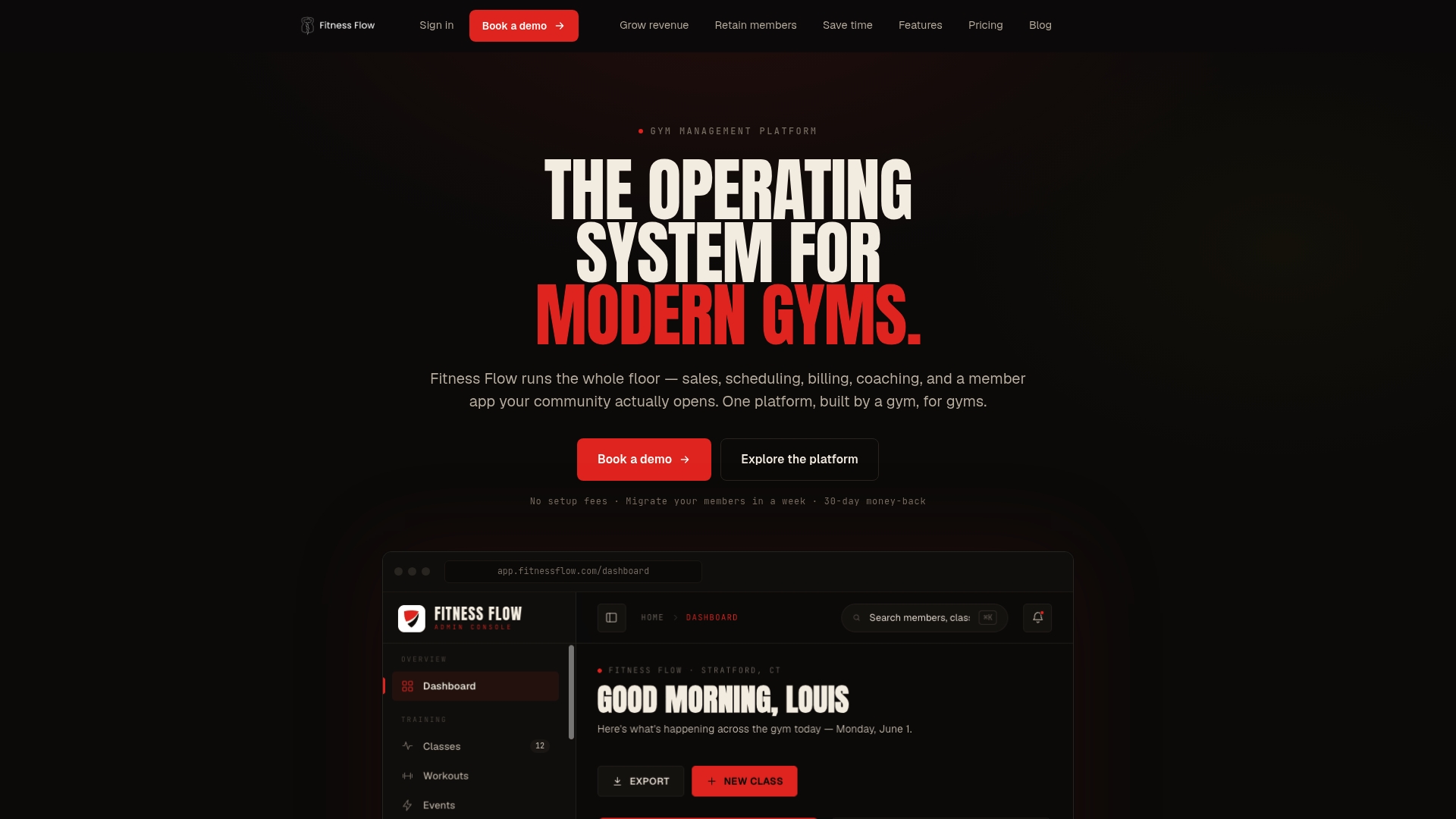
Some gyms report saving significant administrative hours weekly and seeing a notable rise in retention on average. If you’re weighing options, a demo is the fastest way to check how proration, retry schedules, and the member cancellation flow actually behave before you commit. Plans run from the Solo tier at $149 per month up through Studio and Multi-site, listed on our product page.
FAQ
What is the hardest subscription to cancel?
Gym memberships are frequently cited among the hardest subscriptions to cancel because many still require in-person visits or mailed forms. The FTC has specifically targeted these practices, recommending that gyms offer online or in-app cancellation instead.
Can I dispute my gym membership charge?
Yes, members can dispute a gym charge with their card issuer or bank if they believe it was unauthorized or the gym failed to honor a cancellation request. Keeping a timestamped consent and cancellation log is the best way for a gym to resolve these disputes quickly.
Why did I get charged twice for my gym membership?
Double charges usually happen when an automated retry fires before the system confirms whether the first attempt succeeded or failed. The fix is an immediate refund of the duplicate charge and a review of the retry timing settings to prevent it from recurring.
Can I cancel a 12-month gym contract?
Cancellation terms for a fixed-term contract depend on the specific agreement signed, but FTC rules still require that any cancellation mechanism offered be simple and take effect without unnecessary delay. Gyms that make cancellation difficult, even under a term contract, face regulatory scrutiny.