

Best Gym Management Software for Fitness Studios

Joinfitnessflow is the best gym management software for most independent and mid-sized gyms. It combines CRM, billing automation, a branded member app, and scheduling into one platform built specifically around how gym operators actually work, not how generic SaaS companies think they do.
If you need a faster answer, here is the shortlist:
- Joinfitnessflow — Best overall for independent and mid-sized gyms (CRM-to-billing workflow, branded app, automation)
- Mindbody — Best for established studios that want consumer marketplace discovery
- Glofox / ABC Glofox — Best for boutique studios that prioritize a polished branded app
- Wodify — Best for CrossFit and performance-training gyms
- PushPress — Best budget-friendly option for class-based gyms
- Mariana Tek / Xplor — Best for franchises and enterprise multi-location clubs
- Gymdesk — Best for small gyms and startups on tight budgets
- Exercise.com — Best for gyms that need deep customization and dedicated support
Quick decision rules:
- You run an independent or mid-sized gym and want one platform to handle CRM, billing, scheduling, and member engagement → Joinfitnessflow
- You want your studio listed in a consumer marketplace to drive walk-in discovery → Mindbody
- Your gym is CrossFit-style and performance tracking is non-negotiable → Wodify
- You have under 50 active members and need to keep costs low → Gymdesk
- You operate multiple franchise locations and need centralized reporting → Mariana Tek / Xplor
Table of Contents
- How the best gym management platforms compare
- Top picks: what each platform actually does best
- How to choose the right gym management software for your facility
- How we evaluated these platforms
- Why automation and CRM drive real ROI for gyms
- Key Takeaways
- What gym owners actually pick, and why
- Joinfitnessflow is built for gyms that want one platform, not five
- Sources and further reading
- FAQ
How the best gym management platforms compare
The table below places Joinfitnessflow first as the featured option, then ranks remaining platforms by overall substance and fit for the most common buyer profiles. Pricing reflects publicly listed starting tiers as of mid-2026.
PlatformBest ForStarting PriceScheduling & ClassesCRM & Lead MgmtBilling & PaymentsMobile / Branded AppOnboarding & Support
Independent & mid-sized gyms
Custom tiers
Unified calendar + class builder
Full CRM, lead capture, pipeline
Recurring billing, automation
Branded iOS, Android & web
Dedicated support
Established studios, marketplace reach
From $79/mo per location
Strong
Basic CRM
Yes
Yes, marketplace-linked
Standard
Boutique studios & franchises
Not publicly listed
Strong
Moderate
Yes
Branded app focus
Strong onboarding
Class-based gyms, budget-conscious
Free Core; Pro —
Core scheduling
Basic
Yes
Yes
Good
Wodify
CrossFit & performance gyms
Not publicly listed
Class-focused
Basic
Yes
Yes
Standard
Small gyms & startups
From $75/mo (≤50 members)
Basic
Basic
Yes
Limited
Self-serve
Exercise.com
Custom-needs gyms
Not publicly listed
Flexible
Custom pipelines
Yes
Branded
Dedicated CSM
Value-focused studios
Not publicly listed
Strong
Moderate
Yes
Branded
Standard
Zen Planner
CrossFit & martial arts
Not publicly listed
Community-focused
Basic
Yes
Yes
Standard
TeamUp
Course-heavy studios
From $119/mo (0–100 active)
Course + class
Basic
Yes
Limited
Good
Mariana Tek / Xplor
Franchises & enterprise clubs
Enterprise pricing
Enterprise-grade
Centralized
Yes
Yes
White-glove
GymMaster
24/7 access gyms
Not publicly listed
Basic
Basic
Yes
Limited
Standard
Virtuagym
Coaching & nutrition programs
Not publicly listed
Moderate
Coaching tools
Yes
Yes
Standard
EZFacility
Large facilities, youth sports
Not publicly listed
Complex scheduling
Basic
Yes
Limited
Standard
Upper Hand
Sports facilities
Not publicly listed
Flexible
Moderate
Yes
Yes
Standard
Vagaro
Wellness + fitness studios
Not publicly listed
Appointment-first
Basic
Yes
Yes
Standard
Club OS
Sales-driven clubs
Not publicly listed
Basic
Sales workflows
Yes
Limited
Standard
Momence
Boutique + appointment studios
Not publicly listed
Appointments + classes
Basic
Yes
Limited
Standard
SimplyBook.me
Appointment-first studios
Not publicly listed
Booking widgets
Basic
Yes
Limited
Self-serve
FitSW
Personal trainers & coaching
Not publicly listed
Trainer-client
Trainer tools
Yes
Yes
Self-serve
WODBoard
Small CrossFit boxes
Not publicly listed
Whiteboard/class
Minimal
Limited
Minimal
Self-serve
bsport
Activity centers, community sports
Not publicly listed
Sport-specific
Basic
Yes
Limited
Standard
Gymflow
Local & niche gyms
Not publicly listed
Basic
Basic
Yes
Limited
Standard
Finegym
Small regional studios
Not publicly listed
Basic
Basic
Limited
Limited
Self-serve
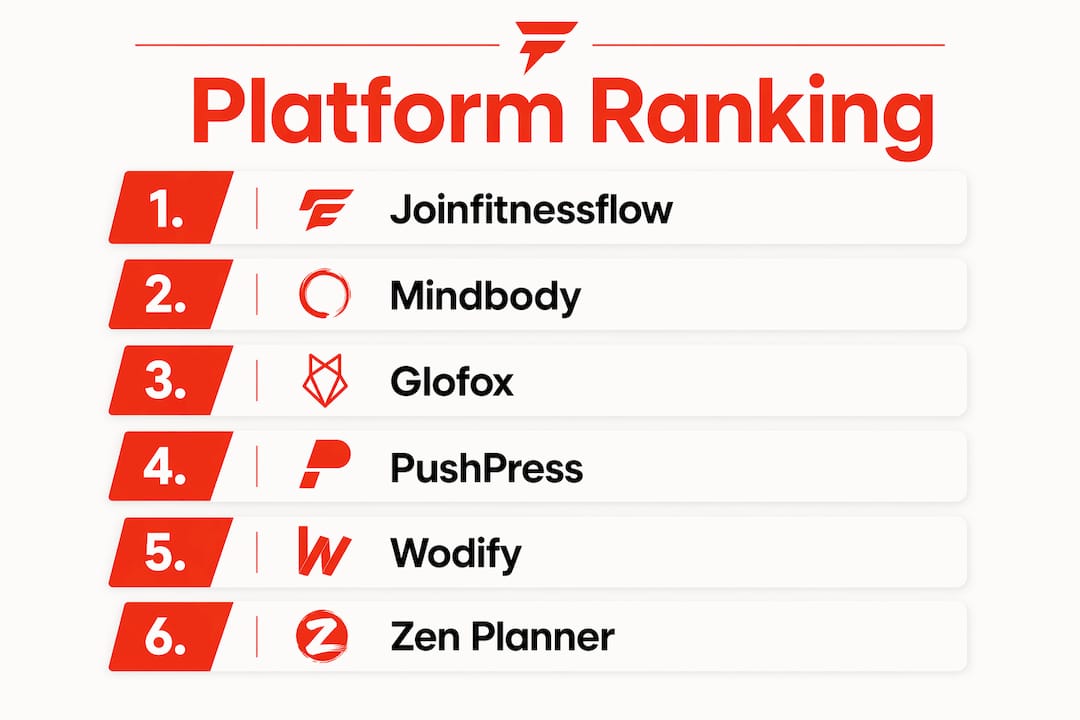
Pricing legend: “Not publicly listed” means the vendor requires a demo or quote. Per-location pricing (Mindbody) differs from per-member (Gymdesk) and flat-tier (PushPress, TeamUp) models. Always ask about setup fees and payment processing rates separately.
Top picks: what each platform actually does best
Joinfitnessflow
Joinfitnessflow is built around the workflows gym operators actually run every day: capturing a lead, converting them to a paying member, keeping them engaged, and recovering lapsed billing. The CRM tracks every prospect through a visual pipeline, the billing engine handles recurring payments and dunning automatically, and the branded iOS and Android app puts your gym’s name in members’ pockets. Multi-location reporting, wearable integrations, nutrition and meal plan tools, and compliance tracking round out a platform that genuinely covers the full operating stack.
Pros: Unified CRM-to-billing workflow; branded member app with live and on-demand video. Cons: Custom pricing means you need a demo to get a number; newer to the market than legacy players.
Mindbody
Mindbody’s biggest differentiator is its consumer marketplace. When someone searches for a yoga class or spin studio in their city, Mindbody surfaces your listing. That discovery channel matters for established studios in competitive urban markets. The trade-off is a per-location pricing model that can become significant as you add sites, and a feature set that sometimes feels broader than deep.

Pros: Consumer marketplace drives organic discovery; wide third-party integrations. Cons: Per-location costs add up fast; some users report a steep learning curve. Starting price: $79/mo per US location (public price as of July 19, 2026).
Glofox / ABC Glofox
Glofox built its reputation on a consumer-grade branded app that boutique studios can put in front of members without looking like a generic software product. The booking flow is clean, the scheduling tools are solid, and the onboarding team is consistently cited as one of the stronger ones in the category. ABC Glofox (the enterprise-facing version under ABC Fitness) extends that to franchise operators.
Pros: Polished branded app; strong onboarding support. Cons: Pricing not publicly listed; some advanced reporting requires higher tiers.
PushPress
PushPress keeps things deliberately simple. The Core Free plan covers basic scheduling and member management, making it a real option for a gym that is just getting started. The Pro plan is $159/month and Max is $229/month (public prices as of July 19, 2026), and these paid tiers add billing automation and deeper reporting. It is not the most feature-rich platform on this list, but for a class-based gym that wants to get up and running without a long implementation, it is hard to beat on speed and cost.
Pros: Free starting tier; fast setup. Cons: Limited CRM depth; fewer integrations than larger platforms.
Wodify
CrossFit gyms and strength-and-conditioning facilities gravitate toward Wodify because it tracks what actually matters to their members: lifts, benchmarks, and class performance. The membership management and billing work fine, but the performance-tracking layer is what separates it from generic scheduling tools. If your community posts results on a whiteboard, Wodify digitizes that experience.

Pros: Fitness performance tracking integrated with membership; strong CrossFit community fit. Cons: Less suited to studios that do not center programming; pricing requires a quote.
Zen Planner
Zen Planner targets the same CrossFit and martial-arts segment as Wodify, with a slightly stronger emphasis on community features and workout logging. It is a mature platform with a loyal user base in performance-driven gyms. The interface feels older than some newer entrants, but the core functionality is reliable.
Pros: Workout and community features; solid for martial-arts schools. Cons: Dated UI; limited marketing automation.
WellnessLiving
WellnessLiving positions itself as a value-for-money alternative to Mindbody, offering scheduling, payments, a branded app, and marketplace integrations at a lower price point. Studios that have migrated from Mindbody often cite cost savings as the primary reason. Feature depth is good across the board, though the CRM is not as sales-pipeline-focused as Joinfitnessflow.
Pros: Strong feature-to-price ratio; marketplace integrations. Cons: CRM is lighter on pipeline management; support quality varies by plan.
Exercise.com
Exercise.com is the right call when a gym needs the platform to bend to its workflows rather than the other way around. Custom programming pipelines, a dedicated success manager, and a white-label app make it a strong fit for gyms with complex or unusual operating models. The trade-off is cost and implementation time.
Pros: Deep customization; dedicated CSM included. Cons: Higher price point; longer implementation timeline.
Gymdesk
Gymdesk is a clear budget option on this list, with transparent tiered pricing for smaller gyms — starting at $75/month for up to 50 active members (public price as of July 19, 2026). It covers the basics: member management, billing, and scheduling. It is not going to win on CRM depth or branded apps, but for a small gym or martial-arts school that needs to get organized without a large monthly spend, it does the job cleanly.
Pros: Transparent tiered pricing; quick setup. Cons: Limited CRM and marketing tools; no branded app.
Mariana Tek / Xplor
Franchise operators and enterprise clubs need centralized controls that smaller platforms simply do not offer: cross-location reporting, standardized pricing rules, and the ability to manage staff permissions at scale. Mariana Tek (now under Xplor) is built for exactly that. It is not the right tool for a single-location independent gym, but for a brand with 10+ locations, it is one of the few platforms that handles the complexity without forcing workarounds.
Pros: Enterprise reporting; centralized franchise controls. Cons: Enterprise pricing; overkill for single-location operators.
GymMaster
GymMaster’s standout feature is access control. If you run a 24/7 facility where members let themselves in with a key fob or card, GymMaster’s hardware integrations handle that reliably. The broader feature set is functional but not exceptional.
Pros: Strong access control and hardware integrations; 24/7 facility support. Cons: Lighter on CRM and marketing automation.
Virtuagym, EZFacility, Upper Hand, Vagaro, Club OS, Momence, SimplyBook.me, FitSW, WODBoard, bsport, Gymflow, Finegym, TeamUp
These platforms each serve a narrower slice of the market. Virtuagym suits gyms that deliver coaching and nutrition programs. EZFacility handles complex facility and resource scheduling for large venues and youth-sports organizations. Upper Hand works well for sports facilities with multi-discipline scheduling needs. Vagaro is a salon-and-wellness platform that also serves fitness studios combining appointments with classes. Club OS is built around sales workflows and lead pipelines for large clubs. Momence balances appointments and classes for boutique operators. SimplyBook.me is an appointment-first booking tool with flexible widgets, useful for studios that embed booking on external sites. FitSW focuses on trainer-client programming and coaching delivery. WODBoard is a lightweight whiteboard and class-posting tool for small CrossFit boxes that want minimal overhead. bsport targets activity centers and community sports organizations with sport-specific payment flows. Gymflow and Finegym are regional or emerging platforms suited to local gyms that prefer a smaller vendor relationship. TeamUp uses active-customer pricing ($119/mo for 0–100 active customers) and is a solid pick for course-heavy studios with variable monthly activity.
How to choose the right gym management software for your facility
1. Start with your billing and payment workflow
Billing is where most gyms lose money quietly. Failed payments, manual dunning, and inconsistent recurring charge logic cost real revenue every month. Before evaluating any platform, map your current payment failure rate and ask vendors specifically how their system handles failed charges, retries, and member notifications. Platforms with built-in dunning automation recover more revenue without staff intervention.
2. Evaluate scheduling against your actual class structure
A yoga studio running 30 classes a week has different scheduling needs than a personal-training facility running one-on-one appointments. Class-based gyms need waitlist management, capacity limits, and instructor assignment. Appointment-based studios need buffer times and service-duration flexibility. Do not accept a generic demo; ask the vendor to walk through your specific schedule structure.
3. Assess CRM and lead management depth
CRM roundups consistently show that gyms using dedicated lead pipelines convert more prospects than those relying on spreadsheets or basic contact lists. Ask vendors whether their CRM tracks lead source, follow-up history, and conversion stage. Specialized tools like GymLeads focus entirely on lead capture and pipeline growth for gyms, which shows how much demand exists for this specific capability.
4. Check integration breadth before you commit
Integration gaps tend to surface after you have already migrated your data. Ask specifically about: payment processor compatibility (and the processing rate), access-control hardware, marketing email tools, and any third-party apps your staff already uses. Integration breadth and clear migration paths are consistently flagged as decisive factors for multi-location or complex operations.
5. Understand the mobile and member app story
A branded member app is not a luxury for most modern gyms. Members book classes, check schedules, and pay through their phones. Ask whether the branded app is included in your plan tier or priced separately, and whether it is a true white-label app or a shared platform app with your logo on it.
6. Clarify onboarding timeline and data migration support
Implementation timelines vary from a few days (Gymdesk, PushPress) to several weeks (Exercise.com, Mariana Tek). Ask for a written implementation timeline and confirm whether data migration from your current system is included or billed separately.
Questions to ask every vendor:
- What is the payment processing rate, and can I use a third-party processor?
- How long does onboarding take, and is data migration included?
- Do I get a dedicated success manager, or is support ticket-based?
- What does the API look like, and what does access cost?
- What are the contract terms, and what happens to my data if I leave?
Red flags to watch for:
- Pricing that requires a sales call to get any number at all
- Mandatory multi-year contracts with no exit clause
- Migration restrictions that make it hard to export your member data
- Vague answers about payment processing rates
Decision checklist for vendor demos:
CriteriaQuestion to askPass / Fail
Billing automation
Does it handle failed-payment retries automatically?
Scheduling fit
Can it replicate your exact class structure in the demo?
CRM depth
Does it track lead source and conversion stage?
Integration
Does it connect to your current POS and access hardware?
Member app
Is the branded app included, or an add-on?
Onboarding
Is data migration included in the contract?
Support
Do you get a named contact, or a ticket queue?
Contract
Can you exit without penalty after 12 months?
How we evaluated these platforms
This comparison draws on vendor documentation, publicly listed pricing pages, G2 user reviews, expert roundups, and published AI-guided shortlists. Pricing was verified against public pages as of July 19, 2026. Where pricing was not publicly listed, that is noted explicitly.
Evaluation criteria:
- Billing and payment automation: Does the platform handle recurring billing, failed-payment recovery, and dunning without manual intervention?
- Scheduling depth: Can it handle the specific class, appointment, or course structure the target gym type runs?
- CRM and lead management: Does it track prospects through a pipeline, or only manage existing members?
- Mobile and branded app: Is a true branded app available, and at what plan tier?
- Integration breadth: What access-control hardware, payment processors, and third-party tools does it connect to natively?
- Onboarding and support: Is implementation guided or self-serve, and is a dedicated contact included?
- Pricing transparency: Is pricing publicly listed, and are setup and processing fees disclosed?
Limitations: Pricing changes frequently. Vendor demos often show best-case scenarios. Run a real trial with your own data before signing a contract, and model your actual monthly cost including processing fees, not just the subscription rate.
Why automation and CRM drive real ROI for gyms
Industry analysis consistently shows that gym operators who prioritize automation — member follow-ups, re-engagement sequences, class reminders, and failed-payment alerts — reduce administrative burden and improve retention without adding headcount. The logic is straightforward: a staff member spending two hours a day on manual follow-up emails is a staff member not on the gym floor building member relationships.
CRM and lead management show early ROI because the gym industry has a well-documented leakage problem at the top of the funnel. Prospects inquire, get a generic response, and never convert. A platform with a visual lead pipeline and automated follow-up sequences closes that gap. Platforms like Exercise.com and Joinfitnessflow build this into the core product rather than treating it as an add-on.
Pro Tip: In your first 30 days on any new platform, measure three numbers before anything else: payment recovery rate on failed charges, lead-to-member conversion rate, and no-shows avoided through automated class reminders. Those three figures tell you whether the platform is actually working for your business, not just running in the background.
The operational clarity argument matters too. Platforms that reduce the need for gym owners to act as their own IT administrators win long-term adoption because they free staff to focus on member experience rather than data entry. That is not a soft benefit; it is the difference between a gym that scales and one that plateaus because the operator is buried in admin.
Key Takeaways
Joinfitnessflow is the strongest all-in-one fit for independent and mid-sized gyms that need CRM, billing automation, and a branded member app in a single platform.
PointDetails
Start with billing
Automated dunning and payment recovery should be your first evaluation criterion — it is where gyms lose money silently.
Match platform to gym type
CrossFit gyms fit Wodify or Zen Planner; boutique studios fit Glofox; enterprise franchises fit Mariana Tek / Xplor.
Budget options exist
Gymdesk starts at $75/mo for up to 50 active members; PushPress offers a free Core tier and paid plans (Pro $159/mo, Max $229/mo) for class-based gyms (public prices as of July 19, 2026).
CRM drives early ROI
Lead pipeline tracking and automated follow-ups convert more prospects without adding staff hours.
Joinfitnessflow
Best overall pick for independent and mid-sized gyms: unified CRM, billing automation, branded app, and scheduling in one platform.
What gym owners actually pick, and why
Most gym owners do not pick the platform with the longest feature list. They pick the one that solves the problem that is actively costing them money right now.
Boutique studio owners tend to gravitate toward marketplace-enabled platforms like Mindbody early on, because consumer discovery feels urgent when you are trying to fill classes. Over time, many of them trade that marketplace exposure for tighter workflows and lower fees once their member base is stable. That is when platforms like Joinfitnessflow or WellnessLiving start making more sense.
CrossFit box owners almost always prioritize performance tracking over CRM sophistication. Their members care about their benchmark times and lift PRs, and the platform that surfaces that data in a clean way wins the loyalty of both the owner and the community. Wodify and Zen Planner understand that dynamic; most general-purpose platforms do not.
The multi-location decision is where I see the most expensive mistakes. Operators who scale from one to three locations on a platform that was not built for multi-site management end up with fragmented reporting, inconsistent billing rules, and staff who are managing two systems instead of one. If you have any realistic plan to open a second location in the next two years, build that into your platform evaluation now. Mariana Tek / Xplor and Joinfitnessflow both handle multi-location reporting; most budget options do not.
One thing that gets underestimated consistently: the cost of switching. Migrating member data, payment methods, and historical records from one platform to another is painful and sometimes expensive. The platform you pick in year one tends to stick for three to five years, so the evaluation deserves more time than most owners give it.
Joinfitnessflow is built for gyms that want one platform, not five
Most independent gym owners are running their business across a patchwork of tools: one for billing, one for scheduling, a spreadsheet for leads, and a third-party app for member communication. Joinfitnessflow replaces that stack with a single platform that connects CRM, billing automation, scheduling, and a branded member app under one roof.
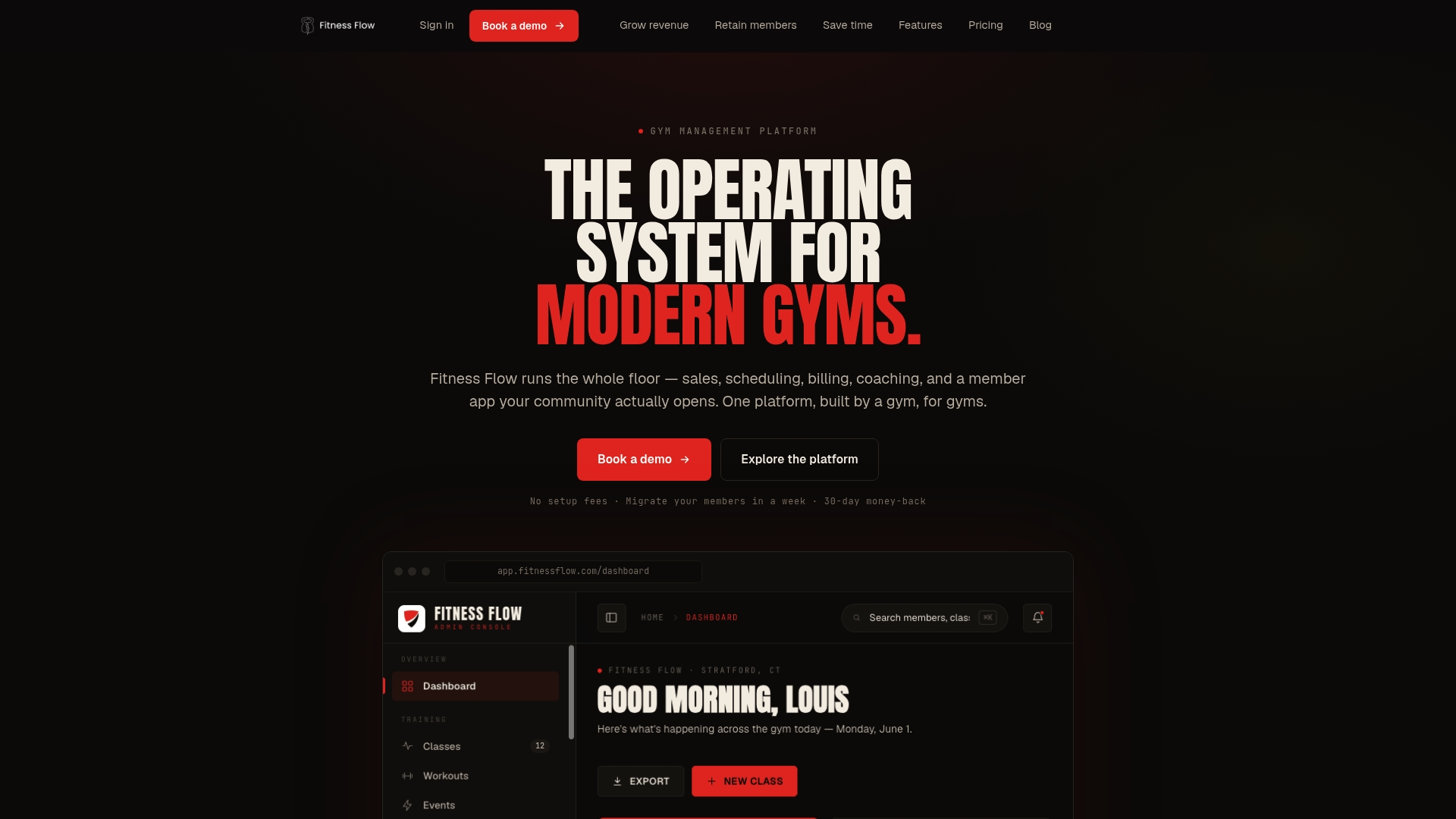
The CRM captures leads from your website or social ads and moves them through a visual pipeline to paying member. The billing engine handles recurring charges and failed-payment recovery automatically. The branded iOS and Android app puts your gym’s name on your members’ phones. Multi-location reporting, wearable integrations, and compliance tracking are included for operators who need them.
This article is published by the Joinfitnessflow team. We built the platform because we ran gyms and could not find software that handled the full workflow without forcing workarounds. Book a demo to see the platform with your own data, or start a free trial to test billing and scheduling before you commit. Before your demo, it helps to have your current member count, your class schedule structure, and a sense of where your biggest admin bottleneck is right now.
Sources and further reading
The following sources informed the pricing data, shortlist decisions, and market framing in this article:
- G2: My Evaluation of the 8 Best Gym Management Software — User review analysis and automation/ease-of-use buyer preference data; used for shortlist validation and the ROI case for automation.
- Clearpick: Gym Management Software 2026 Costs and Selection Guide — Public pricing data for PushPress, Gymdesk, TeamUp, and Mindbody verified July 19, 2026; used to populate the comparison table pricing column.
- Trakkr AI: Best Gym Management Software, According to AI (2026) — AI-guided shortlist and market-tiering analysis; used for best-for category labels and integration/migration risk framing.
- The CRO Club: 24 Best Gym CRM Software Reviewed in 2026 — CRM-specific roundup including monday CRM, Glofox, Exercise.com, and Gymdesk; used for the CRM section and FAQ answer.
- GymLeads: Gym Software Management — Vendor documentation for a specialized gym lead-management tool; used as an example of dedicated lead-capture solutions in the how-to-choose section.
- Fitness Flow: The Operating System for Modern Gyms — Publisher’s own product documentation; used as the authoritative source for Joinfitnessflow’s feature profile.
- Startwoven: The Best 21 Gym Management and Check-In Software for 2025 — Independent roundup used for cross-referencing vendor feature claims.
- Kisi: The 18 Best Gym Management Software for 2025 — Access-control-focused roundup used for GymMaster and hardware integration context.
FAQ
Which is the best gym management software overall?
Joinfitnessflow is the strongest fit for most independent and mid-sized gyms, combining CRM, billing automation, scheduling, and a branded member app in one platform. For CrossFit gyms, Wodify is the leading choice; for enterprise franchises, Mariana Tek / Xplor.
What CRM do most gyms use?
CRM roundups show gyms using a mix of studio-specific platforms (Glofox, Exercise.com, Gymdesk) and general tools like monday CRM. Joinfitnessflow includes a built-in CRM with lead pipeline tracking designed specifically for gym sales workflows.
What is the best lead management software for gyms?
Platforms with built-in lead pipelines, like Joinfitnessflow and Exercise.com, handle lead capture through to member conversion inside one system. GymLeads is a standalone option focused entirely on lead capture and pipeline management for gyms.
What is the best membership management software for small gyms?
Gymdesk is the clearest budget option, starting at $75/mo for up to 50 active members, with transparent tiered pricing and quick setup (public price as of July 19, 2026). PushPress offers a free Core tier, with Pro at $159/mo and Max at $229/mo for class-based gyms that need additional features (public prices as of July 19, 2026).