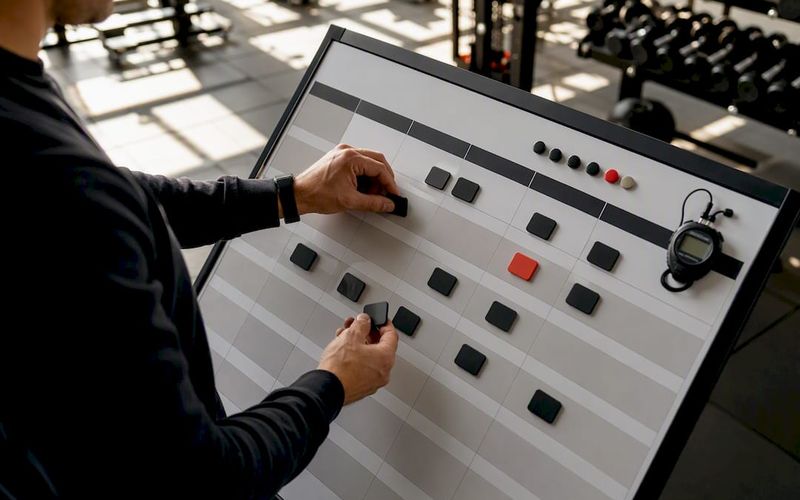

Run a 12 Visit Month: Gym Leaderboard Ideas for Gym Owners

For most gyms, a 12-visit month or a streak board, scored by check-ins and displayed on a wall TV, delivers the fastest lift in attendance. Both use one metric everyone understands, run on a short timeline, and require almost no manual scoring. Start there, then layer in performance and team formats once the habit sticks.
TL;DR:
- Using a single, clear metric with a fixed end date and posted scoring direction ensures the leaderboard stays fair and engaging for the entire duration.
- Threshold-based attendance challenges, like a 12-visit month or streaks, yield higher participation because members compete against a target rather than each other.
- Improvement-focused formats, such as percentage gains or retests, better motivate beginners and reduce pressure on top performers while maintaining accuracy.
- Whole-gym accumulators, like distance or minutes moved, encourage collective effort and inclusivity, especially for members hesitant about head-to-head competitions.
- Automating data collection and communication with tools like Fitness Flow simplifies maintenance, increases retention, and frees staff from manual admin tasks.
Getfitnessflow
Keep Members Engaged Between Visits
Fitness Flow combines live classes, gamified features, and a branded member app to support engagement and retention for modern gyms.
Table of Contents
- Why Gym Leaderboard Ideas Change Member Behavior
- Consistency Challenges: Attendance, Streaks, and Threshold Finishers
- Performance Challenges: Benchmarks, Percentage Gains, and Rep Accumulators
- Whole-Gym Accumulator Ideas That Get Everyone Involved
- Head-to-Head Formats: Brackets, Leagues, and Team Competitions
- Quick Setup Checklist for Any Gym Leaderboard
- Operational Tips for Keeping a Challenge Alive Past Week Two
- Running a 12-Visit Month With Fitness Flow
- What I’d Prioritize If I Were Running This
- Launch Your Next Challenge With Fitness Flow
- Sources
- FAQ
Why Gym Leaderboard Ideas Change Member Behavior
A leaderboard works because people change their behavior when they know someone else can see it. Put a name on a screen next to a number, and that member checks in on a Tuesday they would have skipped. This isn’t a theory gyms invented. It’s the same mechanism behind step-count competitions at offices and mileage boards at running clubs: visibility plus repetition plus a simple number people can compare against their own history.
The formats that fail almost always share the same flaw: too many metrics, no visible end date, or scoring that only the gym owner can decode. A workout challenge leaderboard built around “overall fitness improvement” invites arguments. One built around “check-ins this month” does not. Leaderboard design guidance consistently points to the same three requirements: a single indisputable metric, a fixed end date, and divisions that keep the competition fair for members who aren’t already the strongest in the room.
Divisions matter more than most gym owners expect. Splitting a board into Rx versus scaled, or by age and experience bracket, keeps your best athletes from locking out everyone else, and it measurably broadens participation because newer members see a lane where they can actually place.
Three things separate a leaderboard that runs for two months from one that dies in week two:
- One metric, stated in plain language, with no room for interpretation
- A published end date visible on the board itself
- A scoring direction (higher wins or lower wins) printed at the top, before a single score goes live
Gyms that follow this pattern see stronger completion rates than those running open-ended, vague “fitness challenges,” according to practical challenge tracking guidance built from hundreds of real gym launches.
Consistency Challenges: Attendance, Streaks, and Threshold Finishers
Attendance-based leaderboards are the easiest win because the metric already exists in your check-in system. You’re not asking members to test anything new. You’re just making their existing behavior visible.
- The 12-visit month. Metric: total check-ins. Length: 4 weeks. Format: threshold finisher, meaning anyone who hits 12 visits earns recognition, not just the single top scorer. This format consistently produces higher completion rates than winner-take-all races because members aren’t competing against a superstar, they’re competing against a number.
- The streak board. Metric: consecutive weeks with a minimum number of visits (say, three per week). Keep it open-ended, then reset it quarterly so nobody carries an unbreakable lead into a new season.
- Bring-a-friend mini-race. Metric: guests who complete a full workout, not just guests who walk through the door. Run this one short, two to three weeks, so it stays a burst of energy rather than a slow grind.
None of this requires a spreadsheet if your check-in system already logs visits. Pull counts directly from your gym management platform, or set up a QR code at the front desk that lets members self-check into the challenge the moment they scan in for class.
Pro Tip: Print the scoring rule directly on the leaderboard header, not just in an email. “12 visits by September 30, ties broken by earliest 12th visit” ends more arguments than any announcement ever will.
Performance Challenges: Benchmarks, Percentage Gains, and Rep Accumulators
Raw-strength leaderboards reward the members who were already strong on day one. Improvement-based formats reward effort instead, and they keep a beginner competing against their own baseline rather than your gym’s best lifter.
- Benchmark retest. Record a baseline number (max squat, mile time, whatever fits your program), then retest at the end. Sort by delta, not by final number, so a member who added 30 pounds outranks one who added 5, regardless of where either started. Run this over 6 to 8 weeks, long enough for real physiological change, a timeframe consistent with published exercise frequency research on how long moderate, repeated training takes to produce measurable results.
- Percentage-gain strength challenge. Instead of ranking by pounds added, rank by percent added to a starting total. This levels the field between someone starting at 100 pounds and someone starting at 300.
- Rep accumulator or time-cap events. Define the unit with zero ambiguity, total reps completed, or total seconds under a cap, and state the sort direction before the event starts. Fitness competition ideas built on ambiguous units are the number one source of post-challenge complaints.
Verification matters here more than in attendance challenges, because the incentive to fudge a personal record is higher. Require trainer-verified retests for anything going on a public leaderboard for personal records, or ask for a short video clip on PR claims. Ranking by improvement rather than raw ability is also the single best lever for keeping newer members engaged instead of watching from the sidelines.
Whole-Gym Accumulator Ideas That Get Everyone Involved
Some of the best monthly gym challenges aren’t competitions between individuals at all. They’re shared totals the whole membership builds together, and they work especially well for members who feel intimidated by head-to-head formats.
- Distance total. Aggregate miles or meters logged across classes, cardio machines, and home workouts members self-report. Two to four weeks keeps momentum without becoming a grind.
- Minutes moved. This is the most inclusive metric on this list because it doesn’t care about pace, weight, or skill level. A 20-minute walk counts the same as a 20-minute HIIT class.
- Format bingo. Build a card of class types (yoga, strength, cycle, mobility) and reward members who cross off a full row. This nudges people out of their usual routine and into formats they’d never try on their own.
- Fundraising tie-ins. Pledge a set donation per mile, per minute, or per completed bingo card, and post the running total publicly. A visible fundraising goal turns a fitness contest into a cause, which tends to pull in members who skip competitive formats entirely.
Head-to-Head Formats: Brackets, Leagues, and Team Competitions
Structured competition formats create a recurring reason for members to show up, but only if you keep the admin light enough to sustain past the first event.
- Weekend throwdown bracket. Eight or sixteen-person brackets work best for a single-day event. Single elimination keeps the schedule tight, and you can run three or four matches per hour without falling behind.
- Gym league. Assign points per week (attendance, class completion, or a weekly benchmark) and run the season 6 to 10 weeks. Seed teams by mixing experience levels so no single team stacks all your strongest athletes.
- Class-vs-class aggregation. Rather than tracking every individual, aggregate scores by class time slot; the 6 a.m. crew versus the 6 p.m. crew. This keeps the board readable even with a hundred-plus members participating.
- Archive and celebrate winners. Post a “Hall of Fame” wall or digital archive of past winners. Nothing motivates a returning champion, or a challenger, faster than seeing last season’s name still up.
Quick Setup Checklist for Any Gym Leaderboard
You can build a working gym ranking system in under ten minutes if you nail down five decisions before you open registration.
- Name the board with the challenge and the metric together. “September 12-Visit Club” tells a member exactly what they’re looking at, instantly, no explanation needed.
- Set the metric and unit before anyone scores. Decide whether higher wins or lower wins, and don’t leave this ambiguous. The simplest disputes come from unclear sort direction, and printing “higher is better” on the header solves it permanently.
- Choose your display setup. A wall-mounted TV covers the gym floor, a public join link with a QR code lets members register from their phones, and a reception tablet covers walk-ins who haven’t downloaded anything yet.
- Decide verification rules upfront. Self-submit with random trainer spot-checks works for attendance and endurance challenges. Trainer-verified-only makes more sense for personal record claims where the incentive to inflate a number is real.
- Set a privacy guardrail. Never display bodyweight or body-fat percentage on a public board. Track behavior and percentage improvement instead, which protects members and keeps the board focused on what actually matters for their long-term training.
Setup elementWhat to decideWhy it matters
Board name
Challenge + metric in one phrase
Removes confusion at a glance
Metric and unit
Exact measurement, no ambiguity
Prevents scoring disputes
Sort direction
Higher wins or lower wins, stated upfront
Eliminates the most common complaint
Display
TV, QR join link, reception tablet
Covers members on-site and remote
Verification
Self-submit, spot-check, or trainer-only
Matches rigor to the incentive to inflate scores
Self-registration through a public link removes your front desk as a bottleneck entirely. Letting members self-score through a QR code keeps the board current in real time instead of waiting on staff to manually input numbers between classes.
Operational Tips for Keeping a Challenge Alive Past Week Two
Most exercise achievement awards programs don’t fail because the idea was bad. They fail because nobody communicated, or the reward didn’t match the effort.
- Set a three-touch communication cadence. Announce at launch, send a midpoint reminder around the halfway mark, and close with a public celebration naming every finisher, not just the winner.
- Favor recognition over cash. Branded merchandise, a reserved parking spot, or a spotlight post on your gym’s social feed often drives more repeat participation than a cash prize, because it’s visible and it’s something a member can point to.
- Never build a leaderboard around weight loss. Behavior and performance metrics keep the competition healthy; a public bodyweight number does the opposite, and it can quietly push out the members who need encouragement most.
- Keep scoring rules simple enough to explain in one sentence. If you can’t summarize the rule out loud in under ten seconds, it’s too complicated for a public board.
Gyms that build inclusive formats also tend to think about who isn’t walking through the door at all. If part of your challenge design includes onboarding hesitant newcomers, addressing gym anxiety directly before launch day can widen your participant pool more than any prize ever will.
Running a 12-Visit Month With Fitness Flow
Here’s what that workflow actually looks like end to end: you create the challenge inside your gym management system, check-ins are collected automatically as members badge in or scan a QR code, the leaderboard publishes to a branded TV display in real time, and finishers get an automatic notification the moment they hit visit number 12.
- Challenge setup takes minutes, not a spreadsheet afternoon
- Check-in data pulls automatically, no manual entry required
- The member app keeps the challenge visible between visits through classes and progress tracking
- Analytics flag which cohorts are falling behind on participation, so you know exactly who to target with a reminder push
Gyms running this kind of automated engagement loop report an average increase in member retention(https://getfitnessflow.com) and save several hours a week that used to go into manual admin. That’s the gap between an exercise achievement award that looks good on paper and one that actually runs itself month after month.
What I’d Prioritize If I Were Running This
Start small. One metric, one visible board, and celebrate every single finisher, not just the person at the top. A gym that launches five leaderboards at once usually loses the thread on all five within a month, because nobody, staff included, can keep the rules straight.
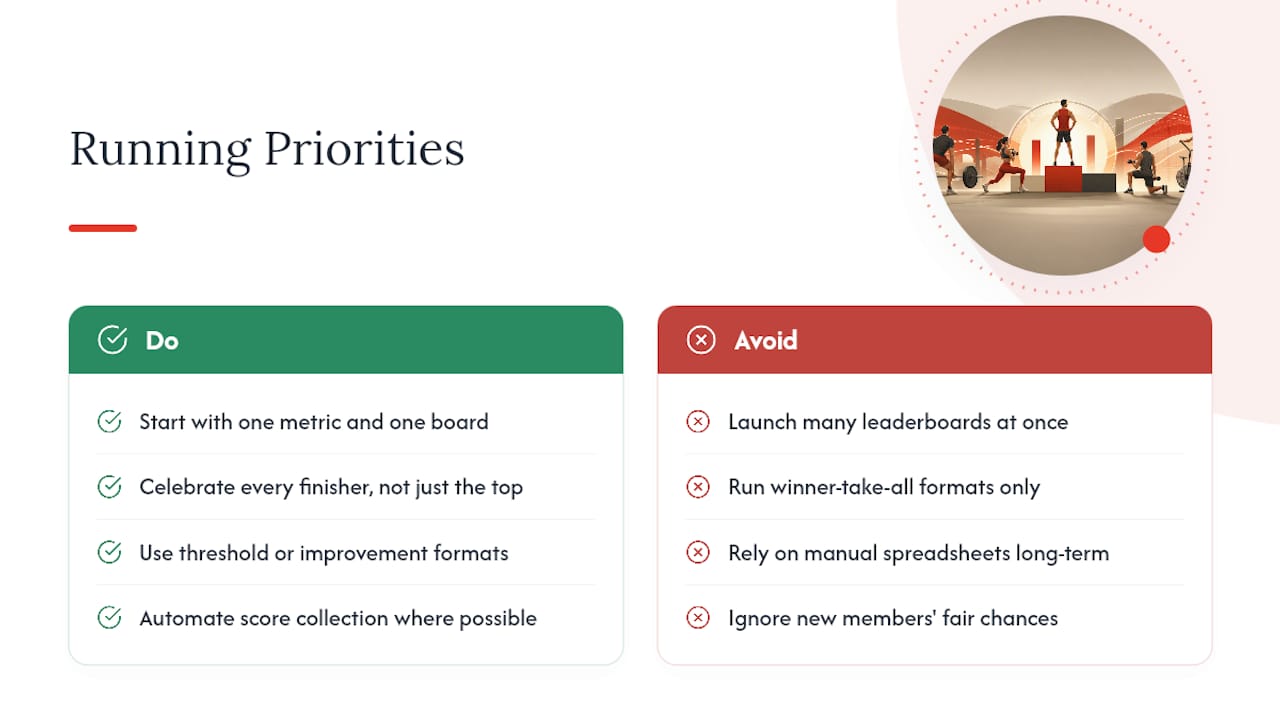
Threshold and improvement formats deserve more attention than they get. Winner-take-all boards are exciting for the three people who might actually win, and demoralizing for everyone else. A 12-visit month or a percentage-gain challenge lets a brand-new member and a three-year regular compete on genuinely fair terms, which is the entire point of running a gym-wide challenge instead of just a leaderboard for your best athletes.
Automate the score collection wherever you can. The gyms that burn out on leaderboard ideas almost always burned out on the spreadsheet behind them, not the concept itself.
— Louis
Launch Your Next Challenge With Fitness Flow
Fitness Flow turns the manual side of a gym ranking system, chasing check-in counts, updating a whiteboard, texting finishers individually, into something that runs itself.
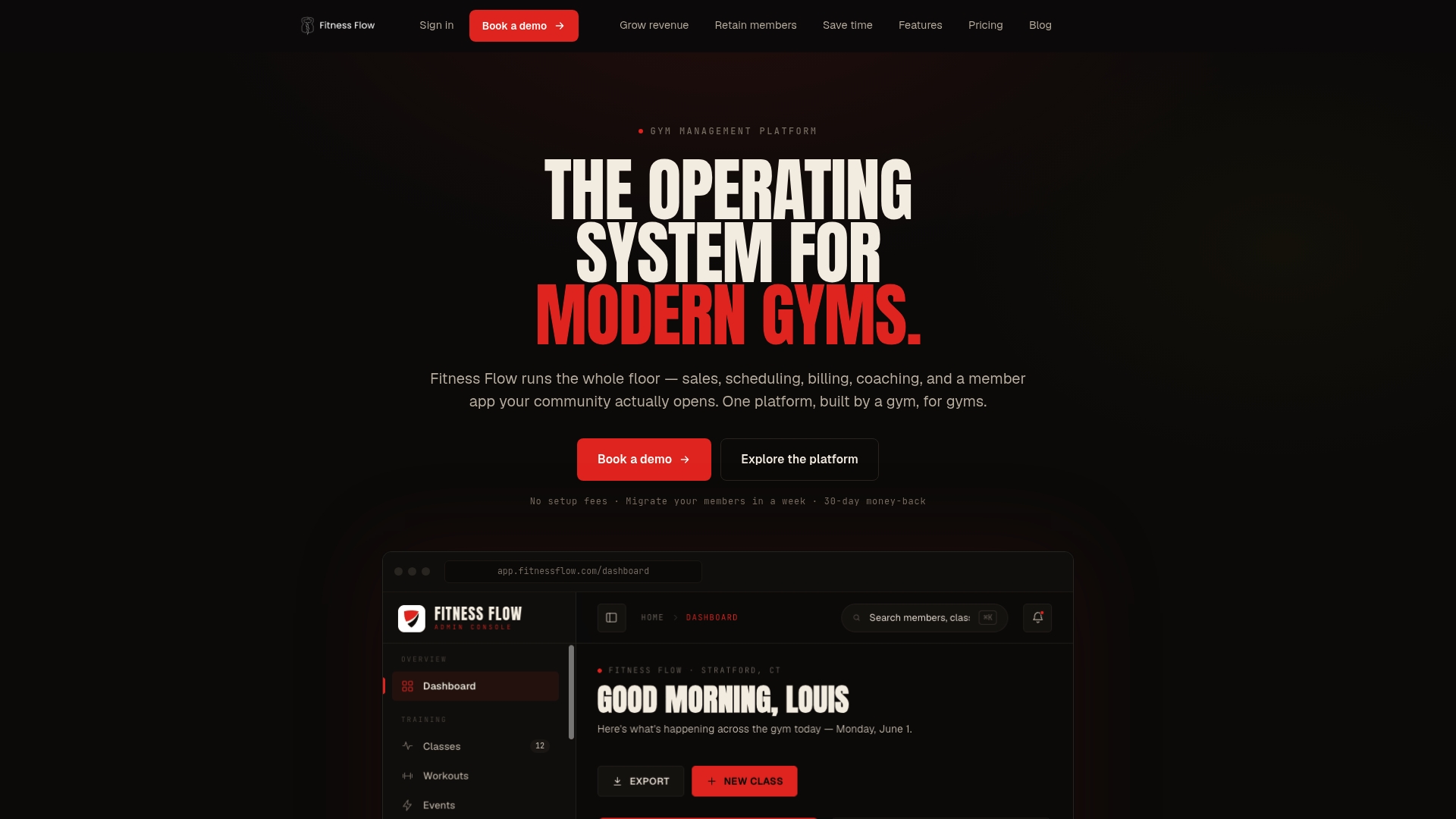
The member app keeps a challenge alive between visits through classes and progress tracking, while automated check-in collection means your leaderboard updates the moment a member walks in the door. Run a 12-visit month as your pilot: set the challenge once, let attendance data populate the board automatically, and publish it to a TV display without touching a spreadsheet. Gyms using this kind of automation report an average increase in member retention, and save hours a week that used to go into manual admin work. If you’re ready to see what a fully automated leaderboard workflow looks like for your gym, explore Fitness Flow and start your first challenge this month.
Sources
- Leaderboard ideas: How to design, display and use one | Leaderboarded
- 12 Gym Challenge Ideas That Keep Members Coming Back (and How to Track Each One) | MakeTheBoard
- NCBI review article on exercise frequency and health outcomes
FAQ
What is the 3-3-3 rule in gyms?
It generally refers to structuring a workout around three exercises, three sets, and three key movement patterns, though gyms sometimes adapt the exact numbers for their own challenge formats.
What is the 2-2-2 rule in gyms?
It’s commonly used to describe a habit-building approach: exercising at least two times a week for two months while tracking two key metrics, though definitions vary by gym.
What are some creative ideas for a gym fitness competition?
Threshold-based formats like a 12-visit month, percentage-gain strength challenges, and whole-gym distance totals tend to outperform winner-take-all races because they let members of different abilities compete fairly, and platforms like Fitness Flow can automate the scoring so staff aren’t tracking it by hand.
What are some good examples of fitness goals for a challenge?
Strong goals are specific and measurable, hitting 12 visits in a month, adding a set percentage to a lift total, or logging a set number of minutes moved, rather than vague targets like “get fitter.”
How long should a gym leaderboard challenge run?
Attendance and habit challenges work best over 2 to 4 weeks, while strength or transformation-based challenges need 6 to 8 weeks to show a meaningful, measurable change.