

Gym Retention Automation: What to Automate and How

Gym retention automation means letting software watch member behavior and send the right message at the right moment: a welcome series for new joins, a nudge when visits drop, a retry when a card fails, a congratulation at a milestone. The goal is not more messages. It is catching the quiet signals, such as a member who stopped showing up three weeks ago, before they turn into a cancellation. This guide covers what to automate, which triggers matter most, what US texting and email rules require, and which numbers show whether it is working.
Getfitnessflow
getfitnessflow.com
Keep Members Engaged Between Visits
Fitness Flow combines a branded member app, live classes, and gamified features to help gyms keep clients connected and motivated.
TL;DR
- Automate the routine, time-sensitive touches: onboarding, attendance-drop alerts, class reminders, failed-payment recovery, renewals and milestones. Keep personal outreach for members who are already slipping.
- The first weeks decide a lot. Members who visit four or more times a month stay about seven months longer, according to one researcher cited in industry media.
- Texting needs documented consent, and sending hours matter. Email needs a clear sender, a postal address and a working unsubscribe.
- Judge the system by visit frequency, 90-day retention, churn and recovered payments, not by messages sent.
- Multi-location gyms should look for one member record, location-level reporting and shared automation rules.
Table of Contents
- Why members leave, and why automation fits the problem
- What you can automate effectively
- The rules you have to follow: texting and email
- How to set up retention automation step by step
- Metrics that show whether it is working
- What to look for in software, especially across locations
- Our perspective
- Where Fitness Flow fits
- FAQ
- Sources
Why members leave, and why automation fits the problem
The retention picture in the US is better than it was. Health & Fitness Association research reported in 2026 found that industry-wide churn for US fitness facilities fell to 7.1% in 2025, its lowest level in a decade, and average member tenure rose to five years. The same research found that the share of members who held a membership but never visited fell to 4.6%, about half the pre-pandemic norm of 10%.
That shifts the job. The HFA describes the principal challenge as moving from general disengagement to raising visit frequency among members who are already active. In practice, you are less often chasing ghosts and more often nudging a member from two visits a month to four.
That is where the money is. Dr. Paul Bedford found that members who visit four or more times each month stay an average of seven months longer than those who don’t build that routine early. And the market is not forgiving: mid-year 2026 data show traditional gym joins down 9% and cancellations up 8%, while studios saw check-ins up 27% and cancellations down 6%.
Why do members actually stop? Usually it is not a single dramatic event. Visits thin out, the habit breaks, a card expires, a schedule changes, and nobody on staff notices until the cancellation request arrives. A front desk cannot watch 800 members. Software can.
Contract structure matters too. IHRSA’s “One Million Strong” study, a 36-month analysis of 1.5 million North American members, found that month-to-month members were four times more likely to cancel than those on a 12-month minimum. That study is from 2015, so treat the ratio as direction rather than a current benchmark. The lesson holds: if members can leave any month, engagement has to do more of the work.

What you can automate effectively
Not everything should be automated. A useful rule: automate anything that is triggered by a date or a data point and does not need judgment. Hand off to a human when the member needs to feel noticed.
MomentTriggerAutomate?Best channel
New member welcome
Sign-up completed
Yes, a short series over the first two weeks
Email plus app notification
First-visit follow-up
No check-in within 7 days of joining
Yes, then staff call if still no visit
Text
Class reminder
Booking made
Yes
App push or text
Missed class
No-show recorded
Yes, with an easy rebooking link
Text or push
Attendance drop
Visits fall below the member’s own pattern
Yes for the first message, human follow-up for the second
Text, then a call
Failed payment
Card declined
Yes, with retry schedule
Email and text
Renewal or upgrade
Term ending
Yes
Milestone
10th, 25th, 50th visit or anniversary
Yes, but write it warmly
App and email
Cancellation request
Member asks to leave
No, a person responds
Phone or in person
Onboarding
The first 90 days are where habits form. A good onboarding flow books an orientation, suggests three classes, checks in after the first visit and flags anyone who has not come back by the end of week one. We walk through the full sequence in our 90-day member retention playbook.

Attendance drops
This is the highest-value automation. Do not use a flat rule like “no visit in 30 days.” By then many members have mentally quit. Compare each member with their own baseline: someone who normally comes three times a week and has now gone ten days without a visit deserves a message sooner than someone who always comes twice a month. Our guides on gym attendance tracking and on saving members within 30 days using attendance data show how to set those thresholds.
The message itself should be short and human: a question, not a sales pitch. “Haven’t seen you since the 3rd. Want us to hold a spot in Thursday’s class?” works better than a discount.
Class reminders and follow-ups
Reminders reduce no-shows, and the follow-up after a missed class is a second chance to keep the habit alive. Send the reminder inside the member app or by text a few hours before class, and include a one-tap cancel or reschedule option. A member who cancels in time frees a spot for the waitlist. A member who silently skips drifts away.
Failed payments
Involuntary churn is the most fixable kind. Cards expire, banks decline, and members who never meant to leave get removed from the roster. Automate retries, send a clear update-your-card link and escalate only when the soft declines run out. We cover the mechanics in failed gym payments: stopping hard declines and recovering soft ones. If you are also reviewing how you accept payments, this overview of payment processing types for gyms helps you understand what sits behind those declines.
Milestones and community
Milestones make progress visible. Life Fitness, writing in 2025, argues that community workouts, challenge weeks, virtual check-ins and habit tracking extend engagement beyond the facility. Streaks, badges and challenges inside a branded app do this without extra staff time. Keep competition opt-in so less competitive members do not feel pushed out.
The risk is tone. Automated posts that read like marketing emails get ignored. Use automation to seed interaction: announce the challenge, celebrate the 50th visit by name, then have a coach reply in person.
The rules you have to follow: texting and email
Automation does not exempt you from the law. Two rules cover most gym messaging in the US.
Text messages
Texting is the most effective channel for attendance nudges and the easiest to get wrong. The Telephone Consumer Protection Act (TCPA) governs it. In practice:
- Get consent first and keep the record. Store the date, time, how consent was captured and the exact wording the member saw. One platform’s support documentation describes requiring consent on record before the first SMS, which is the right model for any gym system.
- Respect sending hours. The same documentation notes that TCPA sending hours run 8:00 AM to 9:00 PM in the recipient’s local time. If you have members in another time zone, your automation must account for it.
- Honor STOP immediately. The opt-out should be processed in real time, not at the next weekly export.
We list exactly what to capture in 9 SMS consent items US gyms must collect and keep, and explain how to set up replies in two-way texting for US gyms. If you are weighing whether texting is worth it at all, read our verdict on gym SMS marketing.
This is general information, not legal advice. Have a lawyer familiar with TCPA review your consent language before you launch a campaign.
The FTC enforces the CAN-SPAM Act, which applies to all commercial email, including messages to existing customers. Its compliance guide says headers must not be misleading, and the sender must be identifiable. Every promotional email needs a valid physical postal address and a clear way to opt out. Opt-outs must be honored within 10 business days, though a system that does it instantly is better. Transactional notes, like a payment receipt, are treated differently from promotions, so keep the two types separate.
How to set up retention automation step by step
- Clean your data. Retention automation is only as good as the check-in, booking and billing records behind it. Make sure every visit is captured, whether by door scan, app or class check-in.
- Define your risk signals. Start with three: no visit within 7 days of joining, visits falling below a member’s usual pace, and a failed payment. Add more later.
- Write the messages. Keep each under 40 words in a text. Use the member’s first name and one clear action. Write them in the voice of your gym, not a template.
- Set consent and quiet hours. Confirm consent capture is built into sign-up, and set sending windows by recipient time zone.
- Add a human step. If the first automated message gets no reply or visit in a week, create a task for a coach or manager to call.
- Launch to a segment. Run it on new members or one membership type first, and compare with a similar group.
- Review every month. Read replies, check opt-out rates and retire messages that do not work.
Metrics that show whether it is working
Messages sent, open rates and click rates are activity measures. They tell you the system runs, not that it helps. Track these instead:
- Visits per member per month. The most direct signal. The share of members reaching four visits a month is a meaningful target given the tenure data above.
- 90-day retention of new members. Compare cohorts before and after automation. Our guide to gym cohort analysis uses a simple milestone of nine visits in six weeks.
- Monthly churn. Benchmark it against the HFA’s 7.1% industry figure for 2025, but remember your mix of contracts, pricing and location changes what is normal for you.
- Reactivation rate. Of members flagged as at risk, how many returned to their usual visit pattern within 30 days?
- Recovered payments. The dollar value of declined charges collected on retry.
- Opt-out and complaint rate. A rising rate means your messages are too frequent or too salesy.
For the full set of definitions, see the retention metrics every membership manager should track and our walkthrough of three gym analytics KPIs you can start with.
What to look for in software, especially across locations
Many gyms try to stitch retention together from a booking tool, a billing tool, a texting tool and a spreadsheet. The weakness is that none of them sees the whole member. The attendance system does not know about the declined card, and the texting tool does not know that the member just booked a class. Questions to ask any vendor:
- Is attendance, billing and messaging in one member record? Triggers are only as smart as the data they can see.
- Can you set rules per member, not just per list? Baseline-based drop alerts need individual history.
- Does it capture and store TCPA consent and honor STOP automatically?
- Can staff see a task list? Automation should hand off to people, with a clear reason for the flag.
- Is there a branded member app? Push notifications, bookings and challenges in one place reduce reliance on text.
- For multiple locations: one member profile that works at every site, shared automation templates with local overrides, reporting by location, and role-based permissions so a front-desk employee at one site cannot see another site’s finances.
- Migration support. Moving billing data is the part owners dread. Ask what the vendor does for you.
Our perspective
We built Fitness Flow because we kept seeing the same pattern in gyms: a capable owner paying for four or five tools, copying data between them and finding out about a lost member after the fact. Retention is mostly a timing problem. The information that a member is slipping exists in the system days or weeks before they cancel. What is missing is a way to act on it without adding another job to your week.
That is why we put scheduling, billing, CRM, the branded member app, live classes and retention workflows in one platform. When a member’s visits taper, the same system that knows their booking history and payment status can send the right nudge and create a task for your coach. Fitness Flow reports an average 27% increase in member retention and about 12 hours a week saved on admin for gyms on the platform.
Our advice, whatever software you use: start small. Automate onboarding, attendance drops and failed payments first. Keep your voice human. And let automation seed relationships, not replace them.
— Louis
Where Fitness Flow fits
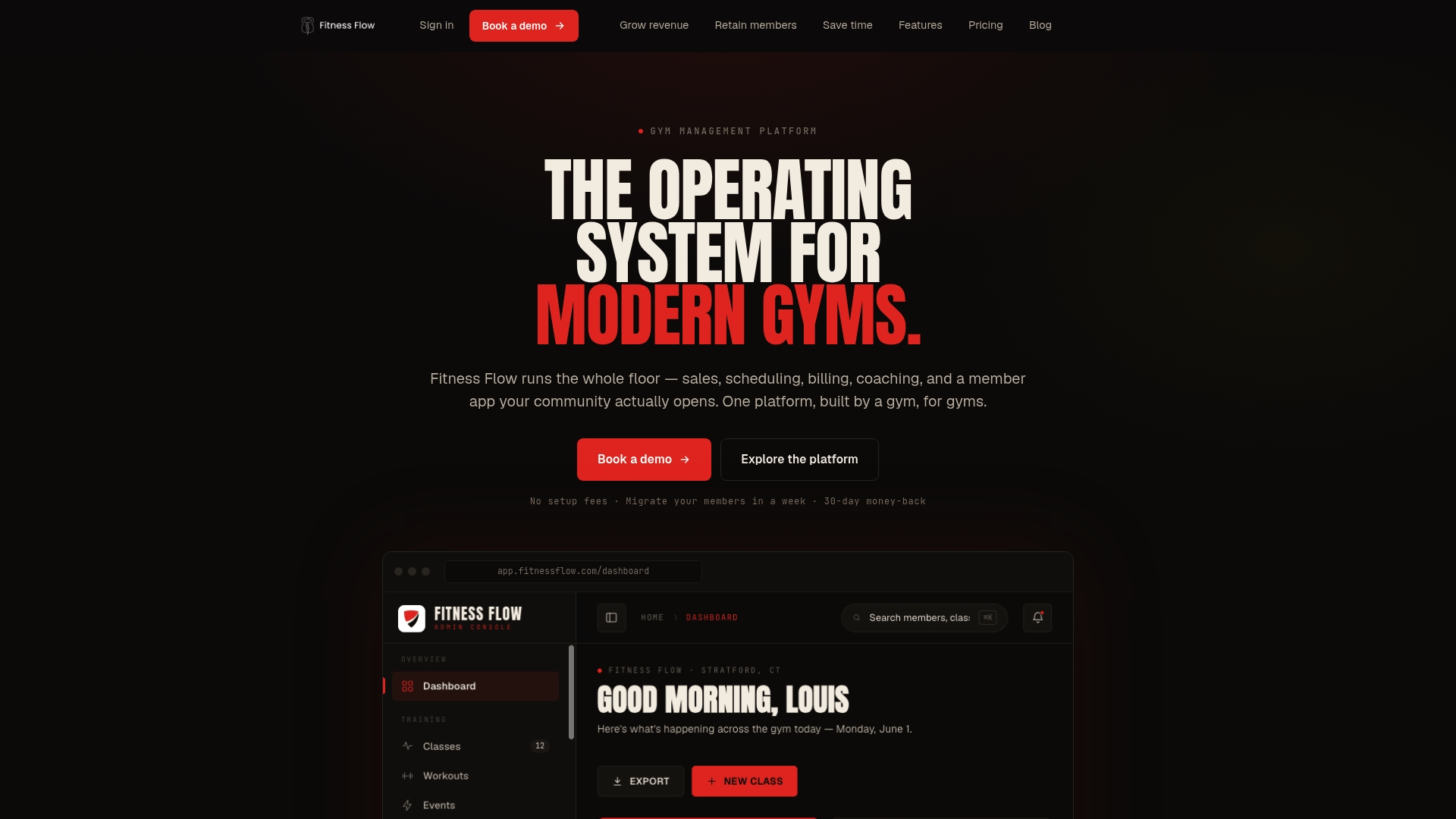
Fitness Flow gives gym owners one place for sales and lead tracking, class scheduling, recurring billing, a fully branded member app and automated retention workflows. Plans are Solo at $149 per month and Studio at $349 per month, and Multi-site is priced by conversation, with no published price. You can see the plans on our pricing and plans page, or look at how Fitness Flow works for gyms.
FAQ
What is gym retention automation?
It is software that watches member data, such as visits, bookings and payments, and triggers messages or staff tasks when something changes. Examples include a welcome series, an alert when visits drop and a retry after a declined card. It handles timing and routine, while your team handles real conversations.
Which retention messages should a gym automate first?
Start with three: a new-member follow-up if there is no visit in the first week, an attendance-drop message based on each member’s own pattern, and failed-payment recovery. They tie directly to cancellations and need little writing. Add renewals and milestones afterward.
Is it legal to text gym members automatically?
Yes, if you have documented consent and follow TCPA rules, including sending between 8:00 AM and 9:00 PM in the recipient’s local time and honoring STOP requests. Keep records of when and how each member agreed. Ask an attorney to review your consent wording.
How do I know if retention automation is working?
Compare cohorts before and after launch on visits per member, 90-day retention, monthly churn and recovered payments. Open rates alone do not prove anything. Look at whether flagged members return to their normal visit pattern within 30 days.
Will automated messages feel impersonal?
They can if they read like ads. Keep them short, use the member’s name and a specific action, and let a coach follow up personally when the first message does not work. Automation should start the conversation, not stand in for it.
Sources
- Research: HFA Survey, Health & Fitness Business, May 2026
- Why Consistency is Becoming Fitness’s New Currency, Athletech News
- IHRSA update: One million strong, FitTech Global
- The New Loyalty Loop: Why Emotion Is the Future of Gym Loyalty, Life Fitness
- SMS Messaging, Avidon Platform Support
- CAN-SPAM Act: A Compliance Guide for Business, FTC