
Group Class Programming for Instructors: Ready-to-Run Templates

A reliable group class program runs on five repeatable components: Intro, Movement Prep, Body of Workout, Transition, and Outro. Pair those with deliberate sequencing, progressions and regressions for mixed-ability groups, and music mapped to intensity, and you can teach a safe, measurable class tonight and build on it for the next four weeks.
Quick-start checklist — copy this before your next class:
- [ ] Confirm class format and total time (30/45/60 min)
- [ ] Map each component to a time block (see timing table below)
- [ ] Choose 2–3 rehearsal moves that preview the hardest exercises
- [ ] Set equipment stations before participants arrive; plan for a full room
- [ ] Prepare a beginner regression and an advanced progression for every main movement
- [ ] Build your playlist in an order that gradually rises and then falls in tempo
- [ ] Write a two-sentence outro script before class starts
Three things to change in your next class:
- Replace any cold transition from peak cardio to floor work with a standing bridge movement
- Add one verbal cue per main exercise that names the modification (“step instead of jump”)
- End with a scripted outro, not an improvised “good job, see you next week”
Pro Tip: Write your rehearsal moves and outro script on an index card and tape it to your water bottle. You will never skip either one mid-class again.
Key Takeaways
Effective group class programming runs on five repeatable components, deliberate sequencing, BPM-mapped music, and a 4-week periodization cycle that builds measurable progression across sessions.
PointDetails
Five-part class blueprint
Every class needs Intro, Movement Prep, Body, Transition, and Outro — skipping any one costs safety or retention.
Sequencing protects adaptations
Insert transitional movements between intensity extremes to reduce orthostatic risk and preserve training responses.
Music mapped to BPM
Match warm-up tracks to 100–120 BPM, peak intervals to 135–160 BPM, and cool-down to 90–110 BPM.
4-week periodization cycle
Use Week 1 for foundation, Week 2 for volume, Week 3 for intensity, and Week 4 for deload and assessment.
Joinfitnessflow for execution
Joinfitnessflow’s class builder, scheduling, and attendance reporting help instructors deploy and measure 4-week program cycles from one platform.
Table of Contents
- What does good group class programming actually look like?
- How to sequence, progress, and periodize group fitness programming
- How does music tempo regulate intensity in group exercise?
- Which class formats work best, and how do you program for each?
- Ready-to-use class templates and a 4-week program cycle
- How do you keep classes safe and inclusive for mixed-ability groups?
- How do you measure class success and build retention through the outro?
- How should you assess participants before programming group classes?
- What most instructors get wrong about group class design
- Joinfitnessflow makes it easier to run your group class programming at scale
- Sources
- FAQ
What does good group class programming actually look like?
AFAA recommends five components for every class: Introduction, Movement Prep, Body of Workout, Transition, and Outro. Each one has a specific physiological or behavioral job, and skipping any of them costs you either safety or retention.
Introduction (2–5 minutes)
This is not small talk. Use it to state the class goal, preview the format, screen for injuries with a quick verbal check-in (“Any new injuries or limitations today?”), and set equipment. Participants who know what is coming work harder and panic less.
Movement prep (5–10 minutes)
The warm-up’s real job is rehearsal. ACE’s class blueprint guidance recommends teaching skills progressively within a session, which means your warm-up movements should directly preview the hardest exercises in the body. If the body includes a squat-to-press, rehearse the squat pattern here at low load. Tell participants when that move will reappear: “We’ll come back to this at full speed in about 12 minutes.”
Body of workout (15–35 minutes, depending on class length)
This is where training adaptations happen. Organize it in blocks or quarters rather than one long undifferentiated stretch. Each block has a clear intensity target, a movement theme, and an exit cue so participants know when to rest.

Transition (2–5 minutes)
Often skipped, always needed. A transition bridges the body and the cool-down, bringing heart rate and core temperature down gradually. ACE’s sequencing research is direct: abrupt shifts from high-intensity cardio to supine floor work raise the risk of orthostatic hypotension. Standing stretches, slow marching, or a light mobility circuit fill this slot well.
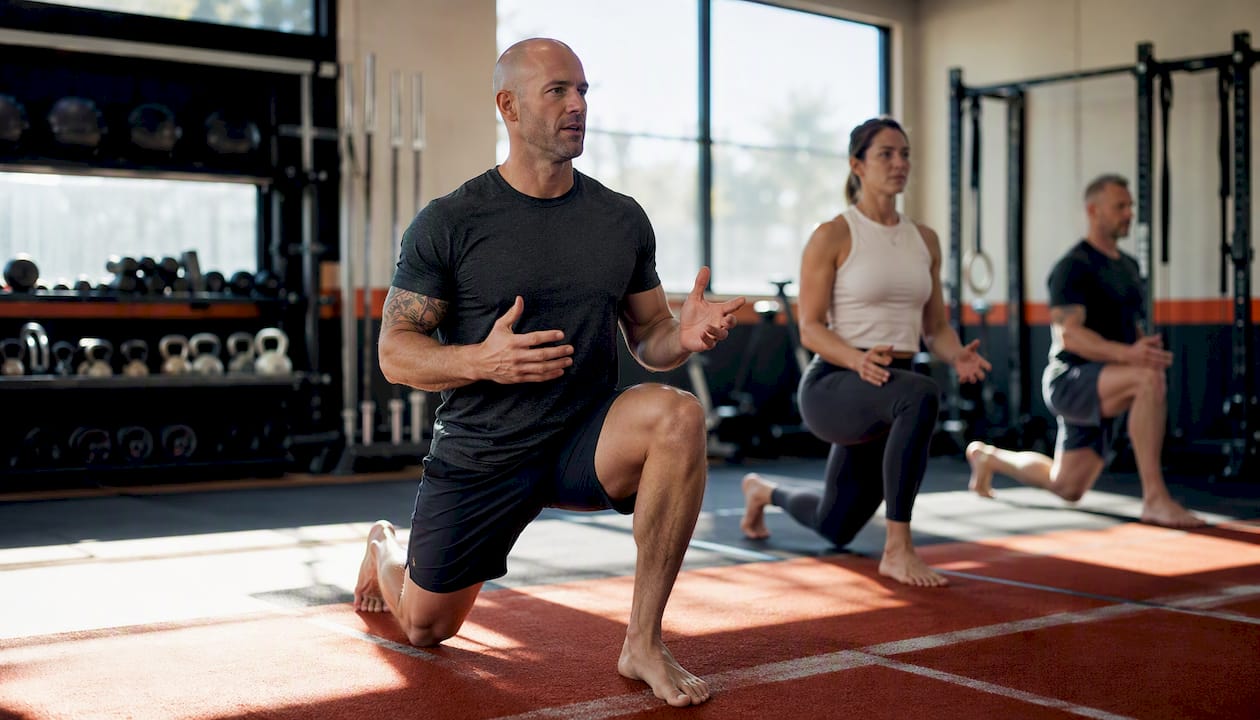
Outro (3–5 minutes)
A scripted outro converts the end of class into a community moment. AFAA’s guidance specifically calls out scripted outros as a retention tool, not just a courtesy. Use it to preview next week, ask one feedback question, or prompt a referral.
Timing by class length:
ComponentShort classMedium classLonger class
Introduction
Brief warm-up and overview
Moderate warm-up and overview
Full warm-up and detailed overview
Movement prep
Short rehearsal of movements
Moderate duration rehearsal
Longer mobility and rehearsal drills
Body of workout
Focused workout segment
Moderate duration workout
Extended workout session
Transition
Brief active recovery
Moderate active recovery
Moderate active recovery
Outro
Cool down and closing remarks
Cool down and closing remarks
Cool down and closing remarks
Component checklist before every session:
- Rehearsal moves selected and cued
- Equipment plan confirmed (stations set, no bottlenecks)
- Verbal screening question ready
- Outro script written
Pro Tip: Signpost every transition out loud: “We’re moving into the body now — grab your weights.” Participants who know where they are in the class stay calmer and move faster between stations.
How to sequence, progress, and periodize group fitness programming
Sequencing is not just about what comes first. It is about protecting physiological adaptations and keeping participants safe across the full hour.
Sequencing rules
ACE’s movement sequencing guidance makes the core principle clear: random jumps between cardio and muscular training compromise both adaptations and adherence. In hybrid classes, cardio typically comes before heavy strength work because elevated heart rate and warm muscles support power output. Between intensity extremes, always insert a transitional movement — a standing stretch, a slow bodyweight squat, or a controlled breath pattern — rather than jumping straight from sprints to deadlifts.
Three-level progressions and regressions
SCW’s Group Exercise Certification curriculum lists multi-level instruction as a foundational competency. Every main movement in your class needs three versions:
- Beginner: Reduce range of motion, remove load, or swap to a supported variation. Example: wall push-up instead of floor push-up.
- Intermediate: Standard form at moderate load or speed. Example: floor push-up at controlled tempo.
- Advanced: Add load, speed, instability, or unilateral work. Example: push-up with a shoulder tap or weighted vest.
Cue all three versions before the set starts. Participants self-select, and you spend less time correcting mid-exercise.
Simple periodization for a 4-week cycle
Practical programming guides recommend a macro/meso/micro structure: a 12-week macro goal, broken into 4-week mesocycles, with weekly microcycles that adjust volume and intensity. For a single studio block, that looks like this:
- Week 1: Introduce the movement theme at moderate intensity; prioritize form.
- Week 2: Increase volume (more sets or reps) at the same intensity.
- Week 3: Increase intensity (heavier load or faster tempo) at moderate volume.
- Week 4: Deload or test — reduce volume, reinforce technique, assess progress.
Recurring themed blocks beat novelty every week. Participants who recognize a movement pattern can push harder on it; constant novelty keeps them learning but limits measurable improvement.
Logistics: equipment and room flow
Plan every class as if it is at capacity. If 15 participants share one dumbbell rack, you have a bottleneck that kills pacing. Assign stations before class, stagger equipment needs across blocks, and use bodyweight or resistance band alternatives when gear is limited.
Sequencing principleWhy it mattersPractical fix
Cardio before heavy strength
Preserves power output and reduces injury risk
Schedule HIIT blocks in the first half
Transitional movements between extremes
Reduces orthostatic hypotension risk
Add 60–90 seconds of standing mobility
Themed blocks, not random exercises
Supports progressive overload
Reuse 3–4 core movements across the week
Plan at capacity
Avoids equipment bottlenecks
Pre-assign stations; use bodyweight swaps
Pro Tip: When you introduce a new movement theme for a 4-week block, tell participants on day one: “We’ll build on this every week.” That single sentence increases buy-in and repeat attendance.
How does music tempo regulate intensity in group exercise?
Music is not background noise. ISSA’s group fitness guidance identifies music as a primary intensity regulator: upbeat, higher-tempo tracks drive effort during peak intervals, while slower tempos signal recovery and cool-down. Instructors who treat the playlist as a second coaching tool consistently get better pacing from their groups.
BPM guidelines by class segment
- Warm-up music should be energizing but not frantic, matching light cardio and rehearsal moves
- Moderate intensity work music should sustain effort without spiking perceived exertion
- High-intensity interval music should drive urgency and match fast movement patterns
- Transition and cool-down music should signal the body to downshift and avoid abrupt tempo drops
Repbeats’ adaptive playlist guide documents BPM mapping as a practical method for improving pacing and participant engagement. The approach is straightforward: write your class timeline first, mark the intensity peaks and valleys, then assign a BPM target to each segment before you search for tracks. See also Repbeats’ adaptive music workout practices for sport-specific BPM strategies.
Building a mapped playlist
- Write the class timeline with intensity labels (low/moderate/high/recovery).
- Assign a BPM target to each segment.
- Search for tracks in that BPM range using a DJ tool or a BPM-tagged streaming playlist.
- Order tracks so tempo rises gradually to the peak interval and falls gradually into the cool-down.
- Test the playlist in an empty room before class — listen for jarring tempo jumps between tracks.
Music strongly influences class energy and adherence. Matching playlist tempo to intensity phases is one of the highest-leverage adjustments an instructor can make without changing a single exercise.
Pro Tip: Never let two consecutive tracks drop more than 20 BPM between them outside of a planned cool-down. An abrupt tempo drop mid-interval breaks the physiological rhythm participants have built — and they feel it immediately.
Which class formats work best, and how do you program for each?
Format choice determines your movement menu, equipment needs, and intensity ceiling. Here is how to build each type and adapt it when gear is limited.
Cardio class: Lead with a progressive warm-up, build through two or three interval blocks (work-to-rest ratios of 2:1 or 1:1), and close with a standing cool-down. Minimal-equipment swaps: replace treadmills or bikes with jump rope, lateral shuffles, or step patterns. NASM’s minimal-equipment guidance recommends unilateral work and circuits to maintain intensity without additional kit.
Strength class: Organize around compound movements (squat, hinge, push, pull). Three to four blocks of 3–4 sets each, with clear rest periods. Bodyweight progressions (single-leg squat, push-up variations) keep intensity high when weights are unavailable.
Mobility/flexibility session: Lower intensity ceiling means sequencing matters more, not less. Move from dynamic mobility in the warm-up to static holds in the cool-down. Never open with deep static stretching on cold tissue.
Fusion/hybrid formats: Sequence cardio first, then strength, then mobility. This order protects training responses: aerobic work primes the cardiovascular system, strength work capitalizes on elevated core temperature, and mobility work is most effective when muscles are warm. Keep transitions between modalities explicit and verbal.
Minimal-equipment swaps:
- Dumbbells → resistance bands or bodyweight unilateral variations
- Cardio machines → jump rope, agility ladder, or floor patterns
- Cable machines → banded rows, pull-aparts, or partner resistance
- Bench → floor, step platform, or stability ball
Ready-to-use class templates and a 4-week program cycle
Minute-by-minute templates
30-minute class
TimeComponentContent
2–5 min
Introduction
Goal, format overview, verbal screening
5–10 min
Movement prep
3 rehearsal moves at low intensity
15–35 min
Body of workout
Blocks with clear intensity and movement themes
2–5 min
Transition
Standing mobility, slow march
3–5 min
Outro
Cool-down stretch, feedback prompt, preview next class
45-minute class
TimeComponentContent
2–5 min
Introduction
Goal, format, screening, equipment check
3–10 min
Movement prep
4 rehearsal moves, progressive tempo
10–35 min
Body of workout
Multiple blocks totalling 15–35 min
35–40 min
Transition
Standing stretch, breath work
40–45 min
Outro
Cool-down, community prompt, next-week preview
60-minute class
4-week sample program cycle
- Week 1 (Foundation): Introduce movement theme; moderate intensity; prioritize form cues
- Week 2 (Volume): Same movements, add one set or 2–3 reps per block
- Week 3 (Intensity): Increase load or speed; maintain volume from Week 2
- Week 4 (Deload/Assess): Reduce volume by 30–40%; reinforce technique; collect participant feedback
Equipment-swap table:
Primary equipmentSwap optionIntensity maintained?
Barbell
Dumbbells or resistance bands
Yes, with unilateral work
Cardio machine
Jump rope or floor patterns
Yes
Bench
Floor or step platform
Yes
Cable machine
Resistance band anchored to door
Yes
Instructor session checklist:
- [ ] Equipment set before participants arrive
- [ ] Playlist loaded and BPM-mapped
- [ ] Three-level progressions ready for each main movement
- [ ] Verbal screening question prepared
- [ ] Outro script written
How do you keep classes safe and inclusive for mixed-ability groups?
Safety in group exercise is a design problem, not just a cueing problem. Build it into the structure before anyone walks in the door.
Essential safety checklist:
- Verbal screening at the start of every class: “Any new injuries, surgeries, or health changes since we last met?”
- Equipment stations set with clear walking paths; no cables or bands crossing traffic lanes
- Demonstrated regression for every main movement before the set begins
- Explicit rest permission: “If you need to stop, step to the side — that is always the right call”
- Emergency protocol posted and reviewed with any new instructor covering your class
Cueing for alignment, breathing, and modifications
Effective group cues are short and visual. “Soft knees, ribs down” lands faster than “maintain a slight flexion at the knee joint while keeping your ribcage from flaring.” Breathing cues follow the same rule: “exhale on the effort” is enough. For modifications, name the regression before the set, not during it — mid-exercise corrections slow the class and embarrass participants.
Accessibility and scaling
SCW’s certification curriculum positions multi-level instruction as a core competency, not an add-on. Practical scaling for common limitations:
- Balance issues: Add a chair or wall for support; reduce unilateral work
- Joint pain (knees/hips): Swap impact moves for step patterns; reduce depth of squats and lunges
- Medication effects on heart rate: Participants on beta-blockers cannot use heart rate as an intensity guide; cue to perceived exertion (RPE 1–10) instead
One regulatory note: instructors should hold a current certification from a recognized body (AFAA, NASM, ACE, or SCW) and carry professional liability insurance. Certification requirements vary by employer and state, so confirm what your facility requires before teaching independently.
Pro Tip: Offer a “modification of the day” at the start of class — one specific swap for one specific movement. Participants who need it feel seen; participants who don’t need it learn something about the movement pattern.
How do you measure class success and build retention through the outro?
Attendance trends are the first metric to watch. A class that fills consistently is working; one that empties after week two has a programming or experience problem. Track week-over-week attendance, repeat attendance rate (how many participants return the following week), and self-reported progression (participants who report moving up a level or adding load).
Key metrics and review cadence:
- Attendance per class: review weekly
- Repeat attendance rate: review every two weeks
- Participant-reported progression: survey monthly or at the end of each 4-week cycle
- Instructor-observed progression: note in a session log after each class
ISSA’s group fitness research links structured programming and consistent instructor cues directly to repeat attendance. Community and social accountability are the mechanisms: participants return for the people and the predictable experience, not just the workout.
Two outro scripts you can use verbatim
Retention-focused outro: “Great work today. We’re building on this exact format next week — same movements, more intensity. If you want to track your progress, write down what weight you used today. See you [day].”
Feedback-focused outro: “Before you head out — one question: what was the hardest part of today’s class? Tell me on your way out. That helps me make next week better for you.”
Retention tactics tied to business outcomes
- Run a 4-week challenge tied to your program cycle; participants who complete all four sessions get a visible recognition moment in the outro. For specific challenge formats, the gym challenge ideas guide has 12 retention-tested options.
- Use the outro to prompt referrals: “If you have a friend who would love this class, bring them next week — first class is free.”
- Log attendance and progression data after every session. Patterns in that data tell you which blocks drive retention and which ones lose people.
How should you assess participants before programming group classes?
Participant assessment does not require a full fitness test for every class member. A practical screening approach uses three layers:
- Pre-participation health screening: A brief PAR-Q (Physical Activity Readiness Questionnaire) or equivalent form for new participants. This identifies contraindications and flags anyone who needs medical clearance before starting.
- Verbal check-in at class start: One question, every session: “Any new injuries or health changes?” This catches acute issues that a one-time form misses.
- Observational assessment during movement prep: Watch how participants perform rehearsal moves. Poor hip hinge mechanics, asymmetrical loading, or visible pain during a bodyweight squat tells you who needs a regression before the body of workout begins.
For ongoing fitness level evaluation, use a simple self-report scale at the end of each 4-week cycle: “On a scale of 1–5, how challenging was this block compared to week one?” Participants who consistently rate it a 1 or 2 are ready for the next progression level. Those rating it a 5 every week may need a regression or a different class format.
Fitness level groupings within a class are more useful than formal testing for most group settings. Label them internally (not out loud) as Foundation, Build, and Peak, and design your three-level progressions around those tiers. This keeps the class unified while giving every participant a path that matches their current capacity.
What most instructors get wrong about group class design
The most common mistake is treating novelty as the primary retention driver. New movements every week feel engaging in the short term, but they prevent the progressive overload that actually produces results. Participants who never repeat a movement pattern cannot measure their own improvement, and unmeasured improvement is invisible improvement. That is a retention killer.
The second mistake is under-planning the outro. Those five minutes are the ones participants remember when deciding whether to come back. A scripted outro, as AFAA’s guidance makes clear, converts a workout ending into a community touchpoint. Two sentences, written in advance, do more for retention than an extra exercise block.
The third lesson is operational: equipment planning at capacity is not optional. A class that runs smoothly with eight participants can collapse with fourteen if the equipment layout was not designed for the full room. Plan the room at capacity on day one, and you will never have to redesign it mid-cycle.
Where programming intersects with operations most visibly is in scheduling. A 4-week cycle only works if participants can attend consistently, which means class times need to match your audience’s availability. Scheduling software that shows attendance trends by time slot gives you the data to make that call rather than guessing.
Joinfitnessflow makes it easier to run your group class programming at scale
Running a 4-week program cycle across multiple class formats is straightforward on paper. Executing it consistently, tracking who showed up, and knowing which blocks drove repeat attendance is where most studios lose the thread.
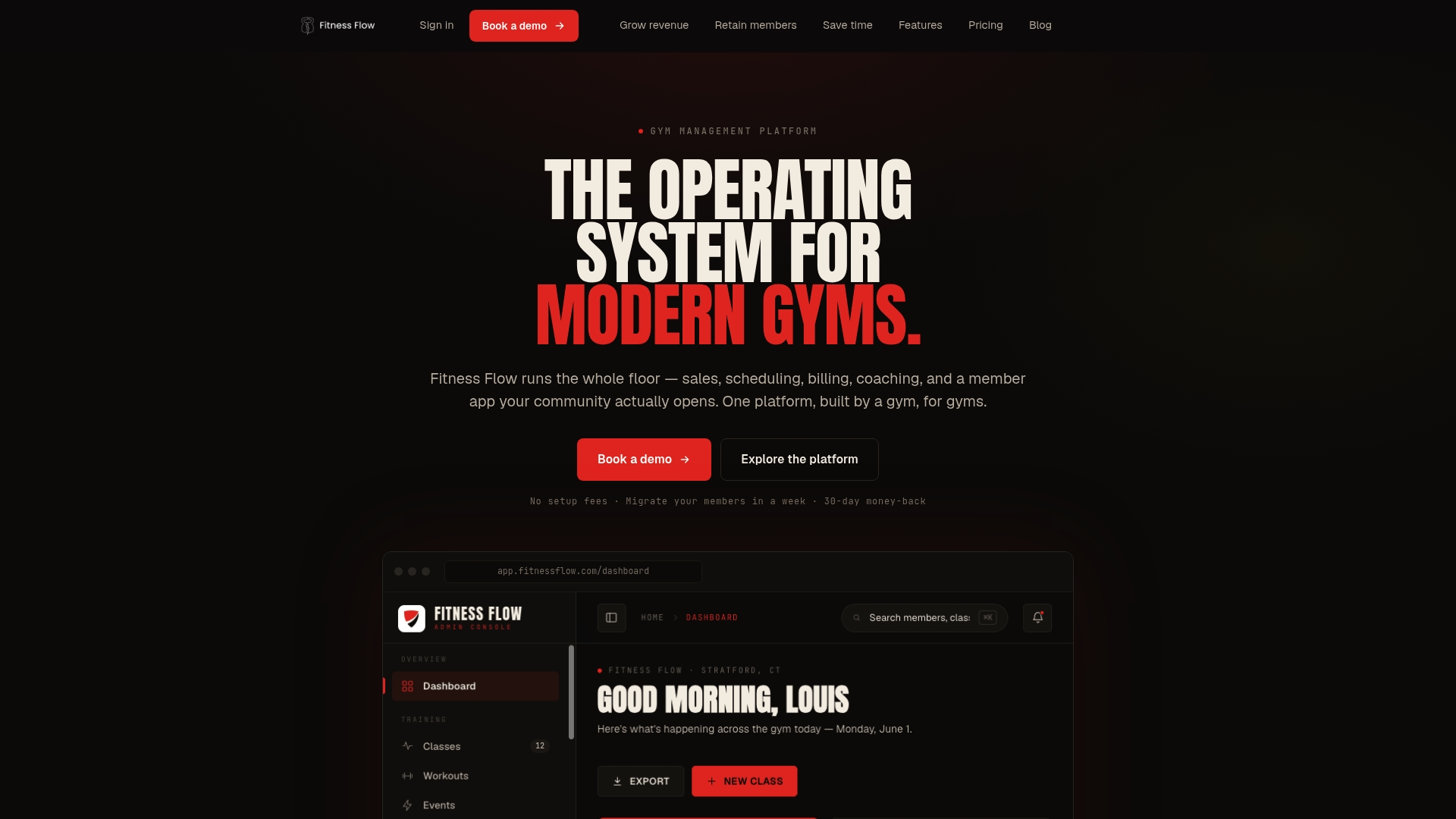
Joinfitnessflow’s class and workout builder lets you build your 30/45/60-minute templates once and deploy them across your schedule with a few clicks. The branded member app keeps participants informed about next week’s format and lets them track their own progression. Scheduling, billing, CRM, and attendance reporting all live in one place, so you can see which classes are filling and which ones need a programming adjustment, without pulling data from three different tools. When you’re ready to run your group programming with the infrastructure to back it up, Joinfitnessflow gives you the scheduling, reporting, and member communication to do it right. Start a free trial and have your first 4-week cycle live this week.
Sources
- How To Design Group Fitness Programs
- SCW Group Exercise Certification | Course Introduction | Page 4
- Keys to Effective Group Fitness | ISSA
- The Ultimate Guide to Running a Group Exercise Program
- Sync Music to Workout Intensity: A Practical Guide | Repbeats
FAQ
What are the five components of a group fitness class?
AFAA identifies Introduction, Movement Prep, Body of Workout, Transition, and Outro as the five required components. Each serves a distinct physiological or behavioral purpose, and skipping any one increases injury risk or reduces retention.
What is the most popular group exercise class format?
High-intensity interval training (HIIT) and hybrid strength-cardio formats consistently draw the largest group class attendance in U.S. studios, though yoga and cycling remain top formats by total participation across the country.
How do you use the 3-3-3 rule in fitness programming?
The 3-3-3 rule is not a standardized industry framework with a single canonical definition. A common interpretation in group settings is three exercises, three sets, three minutes of work per block, used as a simple structure for organizing strength intervals within a class.
What BPM should a group fitness playlist use?
Warm-up segments work well at 100–120 BPM, steady-state or moderate-intensity work at 120–135 BPM, peak intervals at 135–160 BPM, and cool-down at 90–110 BPM. Repbeats’ BPM mapping approach recommends building the playlist from the class timeline, not the other way around.
How does Joinfitnessflow support group class programming?
Joinfitnessflow’s class and workout builder lets instructors create and save 30/45/60-minute templates, deploy them across a scheduled calendar, and track attendance and progression data, giving studios the infrastructure to run and measure 4-week program cycles consistently.