
Gym Review Automation: A Practical Setup Guide for Owners

Gym review automation means using software to ask members for a Google review at the right moment, every time, without anyone on your team remembering to do it. The set-up has four parts: a trigger (a milestone, a renewal, a great class), a short message with a direct review link, a reply routine for what comes back, and rules that keep you inside Google’s policies and federal law. This guide walks through each one.
Getfitnessflow
Keep Members Engaged Between Visits
Fitness Flow brings scheduling, billing, sales, and a branded member app together to help gyms stay connected with members.
TL;DR
- Most members will leave a review if you ask directly: 96% of consumers say they would. The bottleneck is usually that nobody asks.
- Trigger requests from positive moments (a personal best, a renewal, a milestone visit), and send the Google link by text or email soon after.
- Never offer discounts, free sessions or perks for reviews, and never gate the request by sentiment. The FTC rule carries civil penalties of up to $53,088 per violation as of 2026.
- Automate the asking, not the answering. Reply to every review, including the bad ones, in a human voice.
- Ask members to describe specifics (coaches, atmosphere, classes) so the reviews help the next prospect decide.
Table of Contents
- Why reviews matter more for gyms than ever
- What review automation actually does
- Step 1: Get your review link and QR code
- Step 2: Pick triggers that catch members at a high
- Step 3: Write a request people answer
- Step 4: Stay inside the rules
- Step 5: Reply to everything, by hand
- Our perspective: reviews are a retention signal first
- A simple workflow you can set up this week
- Where Fitness Flow fits
- FAQ
- Sources
Why reviews matter more for gyms than ever
A gym is a trust purchase. A prospect is deciding whether they will show up three times a week for a year, and they want to know who else walks through your door. Reviews are the closest thing to a free trial they can get before they visit.
The numbers back that up. An analysis of 4.9 million reviews by SOCi, as summarized by Made For Builders, found that lifting a business’s average rating by one full star correlates with up to a 44% increase in conversion actions on Google Business Profiles: calls, website clicks and direction requests. That figure comes from local businesses in general, not gyms alone, so treat it as a direction rather than a promise.

There is a second reason that has grown in the last two years. Discovery is shifting toward AI-generated summaries and recommendations. Made For Builders argues that a business without a steady stream of fresh, authentic reviews risks being left out of those recommendations. Their analysis is about home services, but the mechanism applies to any local business whose reputation lives on Google: recent reviews are the raw material those summaries draw on. BrightLocal’s 2025 survey also notes consumers moving toward alternative platforms for local reviews, including Instagram, TikTok and AI tools such as ChatGPT.
Put those together and the reasoning is simple. A review profile that stopped growing eighteen months ago says your gym stopped caring, or stopped having happy members. Neither is true of most gyms. The profile is just stale.
What review automation actually does
Strip away the marketing and a review automation setup has three jobs.
- Decide when to ask. A rule fires on a member event: a visit count, a renewal, a class attended, a goal logged.
- Deliver the ask. A text or email goes out with a one-tap link to your Google review form.
- Keep the loop tidy. You see who was asked, who responded, and which reviews need a reply.
What it should not do is decide who gets asked based on how they feel, or write fake praise, or reply to a frustrated member with a canned line. Those are the three ways automation turns from an asset into a liability, and we cover each below.
Note that automation here is not exotic. It is the same logic a gym already uses for billing reminders and class waitlists: an event happens, a message goes out. If you want the wider picture of what a gym can hand to software, our guide to the best gym management software covers it.
Step 1: Get your review link and QR code
Before any automation, you need the destination. Google lets you create a shareable link or QR code that opens the review form for your Business Profile directly. The feature launched in 2025, and Google published formal help documentation on December 31, 2025, so the process is now officially supported rather than a workaround.
Get two versions ready:
- The link, for text messages, emails and app notifications.
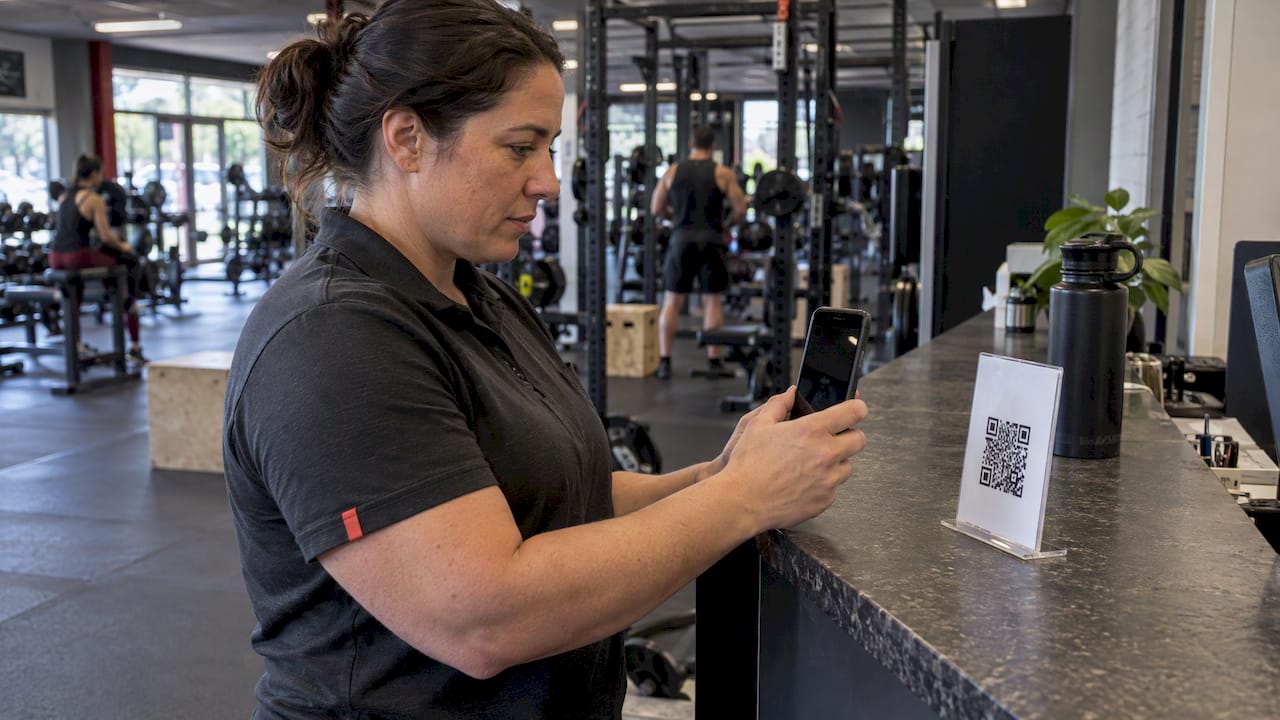
- The QR code, for the front desk, the exit door, the mirror in the locker room and the post-class screen.
If you run several locations, each one needs its own Business Profile and its own link. Sending members of your downtown studio to your suburban location’s profile helps nobody and confuses the reader who later sees the review.
Google’s own tips for getting more reviews stress that reviews must reflect a genuine experience. Keep that sentence in mind through the rest of the setup. Everything below is designed to make genuine feedback easier to give, not to manufacture it.
Step 2: Pick triggers that catch members at a high
Timing decides your response rate more than wording does. Made For Builders, writing about service businesses, reports that the best time to request a review is within one hour of job completion, when satisfaction is at its peak, and that waiting a day or more cuts response rates. A gym has no “job completion,” so you create equivalents.
Good gym triggers:
TriggerWhy it worksSuggested timing
Member logs a personal best or hits a streak
Pride is at its peak
Same day, within a few hours
Renewal or upgrade
They just chose you again
Right after payment confirms
10th, 25th or 50th visit
A habit has formed
Evening of that visit
Finishing a challenge or program
A clear achievement
Day the challenge ends
Positive reply to a check-in or survey
They have already told you they’re happy
Within a day of the reply
Bad triggers: a failed payment, a cancelled class, a freeze request, a complaint ticket, or a member who has not visited in a month. Exclude anyone with an open issue, and pause requests for new members in their first week, before they have had a real experience to describe.
That last point connects to retention. Members in their first 90 days are the ones most at risk of quitting, and our 90-day retention playbook explains what to do in that window. Review requests belong after the member is settled, not as part of the welcome sequence.
Step 3: Write a request people answer
Short, specific, personal. A request that reads like a form letter gets treated like one.
A text that works:
Hi Maria, congrats on your 50th visit! If you have a minute, would you share what the gym has been like for you? It helps other people find a place like this. [link]
A few rules for the copy:
- Use the first name and the milestone. It proves a person is behind the message.
- Ask about the experience, not the score. Never write “leave us 5 stars.”
- Invite detail. Chatmeter’s 2025 Gym Reputation Report highlights the “vibe” of a gym, the atmosphere and the welcome, as a top driver of loyalty. A line such as “what’s the community like for you?” or “what’s your favorite class and why?” nudges members toward the specifics prospects actually read.
- Keep it to one link and one ask. No survey, no referral pitch in the same message.
- Use text for speed, email as a backup. A reminder after a few days to people who did not open the first message is fine. A third nudge is pushing it.
As for volume, cap how often any member can be asked. Once per member per year is a sensible default, and never re-ask someone who already reviewed.
Step 4: Stay inside the rules
This is where well-meaning gym owners get hurt, so be exact.
Do not pay for reviews
It is common to hear an owner say “we’ll give a free week of training for a 5-star review.” Don’t. The FTC’s Consumer Reviews and Testimonials Rule, which took effect on October 21, 2024, prohibits buying or incentivizing reviews conditioned on positive sentiment, with civil penalties of up to $53,088 per violation under the 2026 inflation adjustment. The FTC also publishes a plain-language guide for marketers on soliciting and paying for online reviews worth reading once.
Google’s side is just as firm: contributions must reflect a genuine experience, and a profile caught with fake engagement can be penalized. If you want to reward members for being active, use a loyalty program tied to attendance, not to reviews. We describe one in the simplest gym loyalty program that actually works.
Do not gate by sentiment
Some tools ask “how was your visit?” and only show the Google link to people who answer happily. That is review gating. It hides honest criticism and skews your rating, and it sits uneasily with the FTC’s stance on reviews that do not reflect real customer opinion. Send the same request to every eligible member. If you want private feedback, collect it separately through a survey, and keep that channel independent.
Do not write or edit reviews for members
You can suggest topics. You cannot draft the review or pre-fill the text.
Step 5: Reply to everything, by hand
Automation gets reviews in. What you do next decides whether they help.
BrightLocal’s 2025 research indicates consumers read both positive and negative reviews to form their own opinions, and an owner who responds professionally to all of them, including the critical ones, signals transparency. A flawless 5.0 profile can look less believable than a 4.7 with thoughtful replies.
A simple reply routine:
- Positive reviews: Reply within two days. Use the member’s name, mention one detail from their review, and do not paste the same sentence into every response.
- Mixed or negative reviews: Reply within 24 hours, calmly. Acknowledge the specific issue, say what you are looking at, and move the details offline with a name and a way to reach you.
- Alerts: Set a notification so a one-star review reaches a manager immediately, not at the end of the week.
People sometimes ask whether they can simply get a bad review removed. Rarely. Google removes reviews that violate its policies, such as spam, profanity or an experience that wasn’t genuine. A review that is merely unfair or unpleasant generally stays. Your public reply is the tool you have, and prospective members often judge you more on how you answered than on what was said.
We would also caution against fully automated AI replies. They are fast, but members spot them, and a templated answer to a real complaint looks worse than a late human one.
Our perspective: reviews are a retention signal first
Most advice on gym review automation treats it as a marketing tactic. We see it differently, and the reason comes from how we build software for gyms.
A review request is only as good as the relationship behind it. The members who write the best reviews are the ones who are engaged: they book classes, they hit goals, they know a coach by name. The same signals that tell you someone is likely to stay for years tell you they are likely to say something good about you. So the highest-quality review pipeline is a by-product of a gym that keeps members active, not a separate system bolted on.

That is why we built Fitness Flow as one platform rather than a pile of tools: scheduling, billing, the branded member app, community features and retention workflows share the same member data. When bookings, attendance and billing live in one place, a gym owner can see who is thriving and who is drifting, and the follow-up to each group is different. Engaged members get an invitation to share their experience. Drifting members get a personal check-in, and we cover how to do that well in our guide to gym member surveys, where recovering at-risk members is the point.
Our advice, in practice:
- Fix the experience first. No workflow rescues a gym with a cold front desk.
- Ask only people you know are doing well.
- Treat every review, good or bad, as free market research and read them monthly with your coaches.
- Never let a tool speak for you in public.
— Louis
A simple workflow you can set up this week
Here is the minimum version that works for a single-location gym.
- Create your Google review link and QR code and print the QR code for the front desk and exit.
- Define one trigger. Start with the 25th visit or a renewal. One trigger is enough to learn from.
- Write one text using the template above and test it on yourself and a coach.
- Add exclusions: open complaints, failed payments, freezes, members under two weeks old, and anyone asked in the last 12 months.
- Assign reply ownership. One named person checks new reviews every weekday.
- Review monthly: how many requests went out, how many reviews came in, average rating, and which topics members mention.
After a month or two, add a second trigger such as a personal best, and a third for challenge completions. Resist the urge to blast your whole member list at once: a sudden spike of reviews then silence looks less natural, and the steady cadence is what keeps your profile fresh.
Where Fitness Flow fits
If your member data is spread across a booking tool, a billing tool and a spreadsheet, triggers like “50th visit” or “just renewed” are hard to build. Fitness Flow puts scheduling, recurring billing, the fully branded member app, CRM and automated retention workflows in one system, with integrations to payment and communications tools. That gives you the member events that make good review timing possible, and one place to see how engaged each member is.
Plans start with Solo at $149 per month and Studio at $349 per month, and Multi-site is available for groups of locations. You can see them on our plans page, or look at how Fitness Flow works for gyms. If you are weighing a switch, our software implementation playbook explains what a migration involves.
FAQ
How many reviews should my gym aim for?
There is no magic number, and we would not trust anyone who gives one. Aim for steady growth that matches your member base: a handful per month is realistic for a small studio. Recency and detail matter as much as the total, so a profile with fresh, specific reviews beats a larger one that has been quiet for a year.
Can I offer a discount or free session for leaving a review?
No. The FTC’s rule prohibits buying or incentivizing reviews that depend on positive sentiment, and Google requires reviews to reflect genuine experience. Penalties can reach $53,088 per violation as of 2026. Reward attendance and milestones through a loyalty program instead, and keep it separate from any review request.
When is the best time to ask a member for a review?
Right after a positive moment: a personal best, a renewal, a milestone visit or a completed challenge. Research on service businesses suggests the response rate is highest within about an hour of a good experience and drops quickly after a day. Skip members with open complaints, failed payments or freezes.
Should I use AI to reply to my gym’s Google reviews?
Use it, if at all, to draft a first pass that a person edits. Automated replies to critical reviews tend to read as dismissive, and prospective members read your responses closely. A short, specific human reply that moves the conversation offline works better.
Can I get an unfair negative review removed?
Only if it breaks Google’s policies, for example spam, profanity or a reviewer who never had the experience described. Disagreeing with the review is not grounds for removal. Reply politely and factually, and let the reply speak for you.
Sources
- BrightLocal: Local Consumer Review Survey 2025
- Made For Builders: Google Reviews for Trades (SOCi data)
- Made For Builders: Google Reviews for Home Service Businesses
- FTC: Consumer Reviews and Testimonials Rule, Questions and Answers
- FTC: Soliciting and Paying for Online Reviews, A Guide for Marketers
- Google Business Profile Help: Create a link or QR code to request reviews
- Google Business Profile Help: Tips to get more reviews
- Google Business Profile Help: Report inappropriate reviews
- PPC Land: Google formalizes review requests
- Chatmeter: 2025 Gym Reputation Ranking