

Check 8 Features Before Rolling Out Gym Software Across Locations

For multi-location gym management, we recommend a branch-aware, centralized platform that unifies membership, billing, scheduling, and reporting while leaving each site its own controls. We recommend Fitness Flow first, with the caveat that we compete here. The payoff of this approach is connected member records, billing, and reporting across locations.
TL;DR:
- Clean duplicate records and standardize membership statuses before importing, then pilot one site with real billing and booking before expanding in waves.
- Compare retention with the 66.4% 2025 median, and include migration, training, and integration costs when estimating payback from retained members or saved admin hours.
- Give location managers access to local schedules and revenue while restricting corporate pricing and other branches’ financial records; require unique employee logins and offboard staff.
- Review site revenue, retention, membership changes, and class use alongside total revenue, churn, net growth, and payroll as a share of revenue to spot subsidized locations.
- Set corporate limits for brand and billing rules, while letting locations adapt schedules and pricing to local demand; clarify which memberships allow access across sites.
Getfitnessflow
Bring Gym Operations Together
Fitness Flow brings sales, scheduling, billing, and analytics into one platform for gym owners managing multiple locations.
Table of Contents
- What multi-location-ready software actually means
- The multi-location feature checklist owners must require
- How to roll out centralized management across multiple locations
- Pricing models and how to calculate ROI for multi-site platforms
- How to reorganize staff roles and permissions when you centralize operations
- The reports and KPIs you must track across locations
- Integrations, branded apps and member-facing features to prioritize
- Compliance and local regulation management per location
- Security and data privacy across multiple locations
- Scalability and performance considerations with growing number of locations
- Support and service level agreements tailored for multi-site customers
- Multi-location marketing and member engagement strategies
- Handling location-specific customizations (pricing, class offerings)
- Lessons from deploying centralized systems at scale
- How we help multi-location gym owners centralize with Fitness Flow
- FAQ
- Sources
What multi-location-ready software actually means
A single-location tool stretched across several sites usually breaks in the same places: member records get duplicated, pricing can’t differ by branch, and reports require spreadsheet gymnastics. Genuine multi-site software treats the whole business and each location as separate layers that stay connected. SoftwareAdvice’s multi-site guidance describes the baseline as branch-aware settings, granular role-based permissions, cross-location access without data leakage, and site-level P&L reporting.
Here is what those terms mean in practice:
- Branch-aware settings: each location can carry its own prices, class offerings, opening hours, and policies without touching the others.
- Unified member profiles with branch tags: one person, one record, tagged to a home club. A member who trains at two sites is never entered twice.
- Cross-location access without data leakage: a member can book or check in at any permitted site, while a front desk employee sees only what their role allows.
- Centralized billing: one payment history per member, whichever site collected the fee.
These pieces work as a system. Unified scheduling feeds attendance data into one place, billing ties that data to revenue, and consolidated reporting shows you which sites earn their keep. Pull one piece out and you rebuild it by hand every month.
The scale argument is backed by industry benchmarks too. The 2019 IHRSA Profiles of Success data showed chain-affiliated clubs reporting revenue growth of 7.1%, against 3% for independents. The lesson is not that chains simply win. It is that growth comes easier with shared systems, while retention takes deliberate local attention. Good multi-site software gives you both.
The multi-location feature checklist owners must require
Use this list as a scoring rubric during demos. Ask the vendor to show each item live, in a multi-branch account, not on a slide.
- Centralized member database. Single customer records with branch tags, so you can see a member’s full history and home club at a glance.
- Branch-aware settings. Pricing, offerings, and opening hours set per location, with corporate defaults that sites can inherit or override.
- Role-based permissions and admin scopes. Separate corporate admins from location managers and front desk staff, with access limited to what each role needs.
- Centralized billing. Autopay, invoicing, and failed-payment recovery handled in one place, with location-level revenue attribution.
- Unified class scheduling. Cross-location booking, waitlists, and cancellations that behave consistently at every site.
- Location-level P&L reporting plus consolidated rollups. You should view a single site or the entire business without exporting anything.
- A fully branded member app. It should offer cross-location access and live or on-demand content, so members stay engaged between visits.
- Migration, integrations, and onboarding support. Data import tools, API or integration options, and real people helping you through the first weeks.
Billing deserves extra scrutiny because leaks hide there. This partner article on billing automation requirements lays out what to demand from a system so failed payments don’t quietly erode revenue.
Pro Tip: Bring a messy real-world scenario to the demo, such as a member who joined at Site A, freezes at Site B, and owes a failed payment, and ask the vendor to walk through it end to end.
How to roll out centralized management across multiple locations
Moving every site at once is the fastest way to create chaos. A phased plan limits disruption and gives you proof before you commit fully.
- Audit your systems and data. List every membership roster, payment processor, class schedule, staff role, and existing contract. Note which contracts have exit dates that affect timing.
- Standardize and clean data before import. Agree on common fields, resolve duplicate members, and settle on one set of membership statuses. Dirty data imported into a new system is still dirty data.
- Pilot one site or cohort. Migrate it, then test billing and class flows with real transactions. Collect staff feedback while the stakes are low.
- Train staff and lock down permissions. Set roles before go-live, not after. Run a dual-run or shadow period for billing, so you can compare old and new totals.
- Roll out remaining sites in waves. Track retention, revenue, and admin hours as you go, and adjust rules per location where local differences justify it.
While you work, keep a short list of what to watch:
- Billing totals matching between old and new systems
- Failed-payment rates in the first two billing cycles
- Front desk questions that signal confusing workflows
- Class booking errors across locations
Attendance data becomes useful as soon as sites are connected. Our guide on class attendance tracking for gym owners shows how to turn that data into retention actions once the migration settles.
Pricing models and how to calculate ROI for multi-site platforms
Vendors price multi-site software in a few common shapes. Some charge a fee per location, some price per member, some offer tiered multi-site plans, and some quote custom enterprise terms. Each shifts risk differently: per-member pricing grows with you, while per-location pricing rewards dense sites. For our own plans, we list Solo at $149 per month and Studio at $349 per month on our plans page, and Multi-site pricing is available on request.
The return on a platform comes from a handful of levers:
- Admin hours saved by removing duplicate data entry and manual reporting
- Higher member retention from better engagement and fewer billing errors
- Billing recovery from automated failed-payment follow-up
- Savings from replacing several separate vendors with one
To size retention, you need a baseline. The 2025 Fitness Industry Benchmarking Report puts median member retention at 66.4%.
Statistic callout: The median member retention rate in the 2025 benchmarking report was 66.4%. Compare your own number against it before you model any lift.
Here is a worked example with purely illustrative inputs. As an illustrative example, estimate revenue from any additional retained members using your own membership count and monthly fee. Compare that estimate with the platform and migration costs to assess payback, before counting any admin savings.
Always include migration costs, training hours, and integration effort in your payback math. Leaving them out flatters every vendor equally and tells you nothing.
How to reorganize staff roles and permissions when you centralize operations
Centralizing software works only if people know who owns what. Start by mapping responsibilities across four layers:
- Corporate admin: pricing rules, billing settings, integrations, and consolidated reporting.
- Regional operations: performance review across a cluster of sites and cross-site promotions.
- Location managers: local schedules, staffing, class changes, and member issues at their site.
- Front desk: check-in, sign-ups, and basic account questions.
Then build permission sets around those layers. A location manager might edit class schedules and view site revenue, but not change corporate pricing or see other branches’ financial data. A front desk employee can check members in and take payments, but cannot issue refunds without approval. Approval flows for refunds, freezes, and discounts prevent accidental double-billing and keep a paper trail.
Consolidated staff management also simplifies scheduling and payroll coordination. When instructors who teach at several sites live in one system, you see their total hours, avoid double-booking, and send cleaner data to payroll. That matters because turnover is real: the 2026 Employee Compensation and Benefits Report puts frontline hourly turnover at 26.9%, so clear roles and fast onboarding pay off.
Pro Tip: Write each role’s permissions in a one-page table before you configure anything, then have a location manager review it for gaps.
The reports and KPIs you must track across locations
Track two sets of numbers: what each site is doing, and what the business is doing as a whole.
Location-level KPIs:
- Monthly revenue
- Memberships added and dropped
- Retention rate
- Occupancy and class utilization
Consolidated KPIs:
- Total revenue across all sites
- Churn
- Net membership growth
- Payroll as a percentage of revenue
The value comes from comparing the two. P&L rollups reveal subsidized locations, the sites that look busy but lose money once rent and payroll are counted. They also show where a strong site’s practices could be copied elsewhere. Use the consolidated view to decide where to invest, where to renegotiate, and where to fix operations before spending on marketing.
Statistic callout: The 2025 benchmarking report found median net membership growth of 5.5% in 2024. Use it as a yardstick when you review each site’s net growth.
If you are still deciding which numbers matter most, our primers on member retention metrics and gym analytics for owners cover the essentials without requiring new software.
Integrations, branded apps and member-facing features to prioritize
Integrations decide whether a platform fits your existing stack or fights it. Rank them by how much work they remove.
- Payment processor integrations: prioritize those that support centralized reconciliation across sites and meet PCI compliance requirements.
- Marketing and CRM tools: connect lead tracking and email or SMS campaigns so promotions can target members by location and behavior.
- Calendar sync: let members add bookings to their own calendars, which reduces no-shows.
- A fully branded member app: with single sign-on and cross-location class access, so one login works at every site and the app looks like your gym, not a vendor.
The app matters more than owners expect. Members interact with it far more often than with your front desk, and it is where live classes, on-demand content, and gamified features keep people connected between visits. Judge any app by whether a member who trains at two locations can book at both without a second account.
Compliance and local regulation management per location
Every site answers to its own local rules, and those rules differ more than owners assume. Health department requirements, business licensing, signage, minors’ policies, and waiver language can all vary by city or state. A multi-site platform should help you keep track of these requirements rather than leave them in someone’s inbox.
Start with what the software can systematize. Digital waivers can be versioned per location, so a site in one state signs the right text while another uses different wording. Membership terms, cancellation rules, and auto-renewal disclosures often follow state-specific consumer protection law, so contract templates should be configurable by branch. Keep a record of which version each member signed and when.
Then assign ownership. Corporate should hold the master compliance calendar, covering license renewals, inspection dates, and certification expirations for staff such as CPR-trained employees. Location managers should confirm completion at their sites. Facility management tools that log maintenance and equipment checks create the audit trail you want if an inspector or insurer asks questions.

Finally, treat any legal question as one for a qualified attorney familiar with your state. Software can enforce the rules you choose, but it cannot tell you what each jurisdiction requires.
Security and data privacy across multiple locations
More sites mean more people with access to member data, and that raises the stakes. Your member database holds names, contact details, and payment information, so protection has to be designed in, not added later.
Begin with access control. Role-based permissions should follow the principle of least privilege: each person sees only the records their job requires. Branch-aware scoping means a manager at one site cannot browse another site’s financial reports or member notes. Review these scopes whenever someone changes roles or leaves, since stale accounts are a common weak point.
Payment data deserves separate attention. Choose processors that handle card details so your own systems never store them, which keeps your exposure to PCI requirements smaller. Centralized reconciliation also makes unusual transactions easier to spot, because refunds and adjustments appear in one ledger instead of several.
Add a few operational habits:
- Require unique logins for every employee, never a shared front desk account
- Use strong passwords and, where available, multi-factor authentication
- Keep an activity log so you can see who changed what and when
- Set a clear process for offboarding staff on their last day
When you evaluate vendors, ask where data is hosted, how backups work, and what happens after a suspected breach. Good answers are specific. Vague ones are a warning.
Scalability and performance considerations with growing number of locations
A system that feels fine at two sites can strain at ten. Before you sign, think about how your business may grow, not just how it operates today.
Test how the platform behaves under load that resembles your future. Ask how it handles peak check-in times when several clubs are open, and how fast consolidated reports load when they pull from every branch. A dashboard that takes minutes to refresh will go unused, and unused reporting defeats the point of centralizing.
Look at how adding a location actually works. The best systems let you clone settings from an existing site, then adjust pricing and hours, making a new opening easier to configure. Ask whether new branches require a new contract, a vendor ticket, or just a few clicks, and whether pricing scales predictably as you add sites.
Consider your own organization too. Growth tends to expose weak processes before it exposes weak software. Standard operating procedures, a consistent naming scheme for memberships, and clear role definitions let you add sites without reinventing everything. Pilot each new opening the way you piloted the first migration, and watch the same KPIs so problems show up early.
Support and service level agreements tailored for multi-site customers
When one site has a billing glitch on a Monday morning, you lose revenue at every location that shares the same configuration. That is why support terms matter more for multi-site operators than for single clubs.
Ask what response times the vendor commits to, and whether those commitments differ by severity. A payment processing failure should not wait in the same queue as a question about a report layout. Find out which hours support covers, since gyms operate early mornings, evenings, and weekends, exactly when many help desks are closed.
Onboarding support deserves equal weight. A migration plan, named contacts, and help with data import reduce the risk of the rollout phase far more than any feature list. Ask what training the vendor provides for staff, and whether it covers each role, from front desk to regional operations.
Write down what you need before the demo:
- Response and resolution targets by severity
- Coverage hours that match your opening hours
- A named contact or team for escalations
- Migration and training included, with timelines
- A clear process for handling outages and communicating them
Reviews on sites like G2 and Capterra can show how real customers describe support over time, which tells you more than a sales promise.
Multi-location marketing and member engagement strategies
Multiple sites give you marketing options a single club lacks, if your data is connected. Because every member lives in one system, you can run campaigns that cross locations and still measure results per site.
Cross-location promotions are the simplest starting point. A new site can invite members from nearby branches to try classes, while a quiet location can feature a class series to draw in people who usually train elsewhere. Referral offers work well when a member can bring a friend to whichever site is closest to that friend.
Loyalty programs also gain strength across branches. Points, streaks, or milestones that follow a member from site to site reward consistency rather than tying recognition to one building. Gamified features in a branded app make this visible, which supports habit formation. Our retention playbook covers ways to help members stay engaged.
Keep segmentation in mind. Message members based on home club, attendance patterns, and class preferences, not one blast to everyone. Someone who hasn’t visited in three weeks needs a different note than someone about to hit a milestone. Track which campaigns lead to bookings at each site, and move budget toward what works. Consistent branding across locations helps too, so a member moving between clubs feels the same experience.
Handling location-specific customizations (pricing, class offerings)
Not every site should look identical. A downtown studio, a suburban family club, and a university-adjacent location serve different people, and forcing one price list on all three leaves money or members behind.
Good multi-site software lets corporate set the framework while locations adapt within limits. Define which settings are locked, such as brand standards, billing rules, and core membership tiers, and which are flexible, such as class schedules, local promotions, and sometimes pricing within an approved band. Document those boundaries so managers know what they can change without asking.
Pricing needs the most care. If members can use multiple sites, decide how rates reflect that: a single-site membership, an all-access tier priced higher, or a home-club model with a guest allowance. Keep rules simple enough for front desk staff to explain in one breath. Confusing structures generate disputes and cancellations.
Class offerings can differ more freely. Let each site build a schedule around local demand, using attendance data to retire weak slots and expand popular ones. Where a class runs at several sites, keep names and descriptions consistent so members know what to expect.
Review customizations regularly. Exceptions tend to multiply, and a quarterly check keeps the number of one-off rules from growing until the system is hard to manage.
Lessons from deploying centralized systems at scale
Three problems show up again and again when gyms centralize, and none of them are about features. The first is data quality: duplicate members, inconsistent statuses, and half-filled fields turn a migration into a cleanup project. The second is staff buy-in, because people who feel the change was imposed will quietly keep their old spreadsheets. The third is migration time, which owners almost always underestimate.
My view is that the pilot is the most valuable step in the whole process, and the one owners most want to skip. A single-site trial exposes billing quirks, permission mistakes, and confusing workflows before they affect every member. Pair that with a vendor who provides real migration help, and the risk drops sharply.
In demos, ask for specifics. Request a migration plan with dates, a walk-through of branch-aware permissions, and a consolidated report built from sample multi-site data. Vendors who answer with live examples tend to deliver; those who answer with slogans usually don’t.
Rollout speed is a trade-off. Faster means savings sooner but thinner support per site. Slower costs more months of dual systems. I lean toward rolling out in waves, because each wave teaches you something the next one benefits from.
— Louis
How we help multi-location gym owners centralize with Fitness Flow
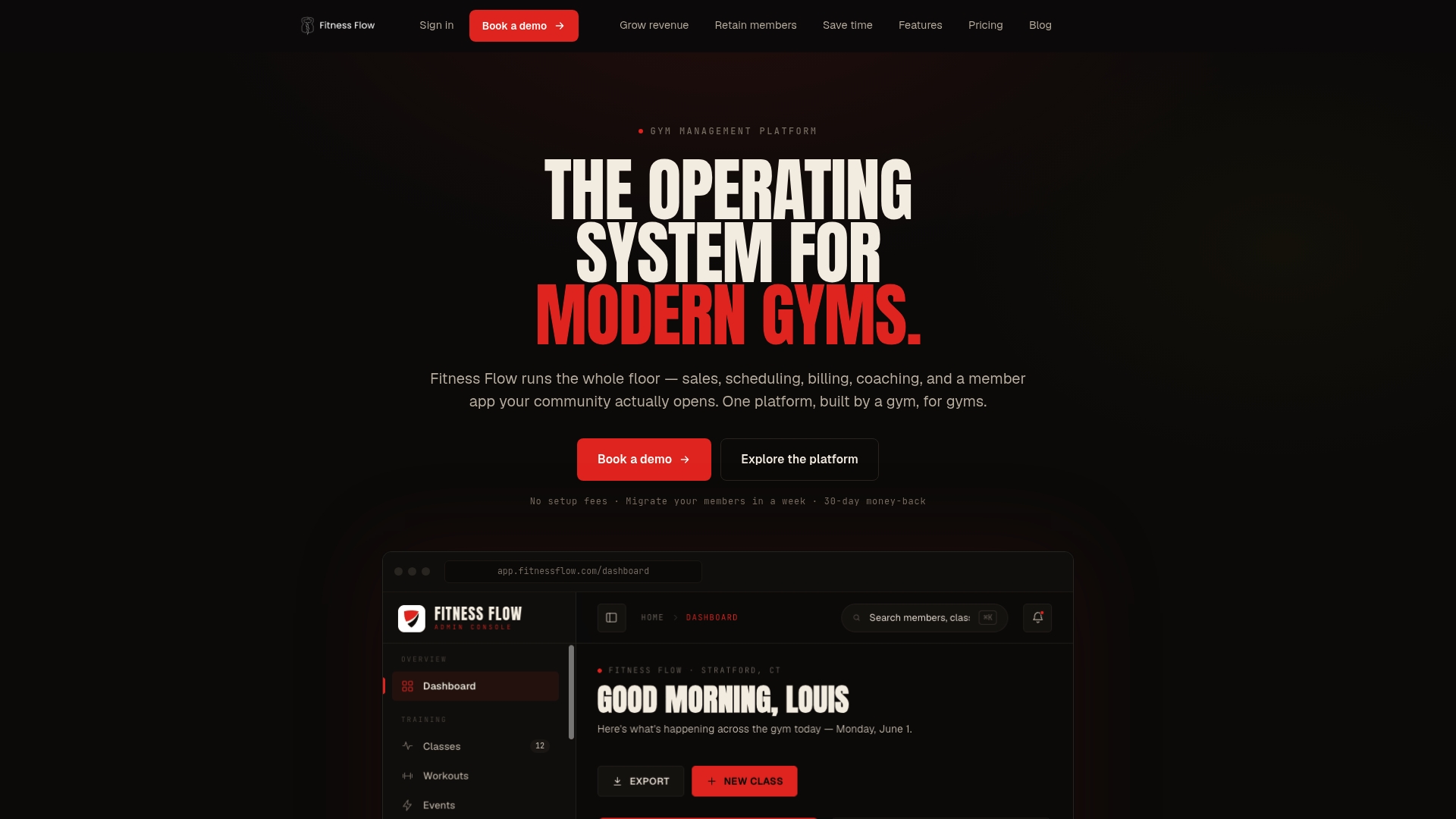
If you run several gyms and are tired of stitching together separate tools, we built Fitness Flow to replace that patchwork. It is an all-in-one platform that brings sales, scheduling, billing, and member engagement into one place, so your sites run from a single record instead of several. Here is what we offer:
- Multi-site management with reporting and analytics across locations
- A fully branded member app with live classes and gamified features
- Class scheduling, recurring billing, and role and employee management
- Migration support and integrations with payment and communications tools
In a demo, ask us to show a migration plan, branch-aware permissions, and a consolidated report from sample multi-location data. Bring a data export from your current system, a list of your locations, and the KPIs you care about most. Our Solo, Studio, and Multi-site plans are listed on our site, and our team can walk you through the right fit. Request a demo today and we will build your rollout plan together.
FAQ
What is multi-location gym management?
It is running several gym sites from one connected system, so membership, billing, scheduling, and reporting live in a single place. Each location keeps its own settings, while owners see the whole business at once.
What features should multi-location gym software have?
Look for a centralized member database, branch-aware settings, role-based permissions, centralized billing, and unified scheduling. You also want location-level P&L reporting with consolidated rollups, and migration support. SoftwareAdvice’s multi-site guidance lists branch-aware settings and cross-location access without data leakage as core requirements.
How long does it take to migrate multiple gyms to one platform?
It depends on data quality and the number of sites, but plan for a pilot first, then a dual-run billing period so you can compare old and new totals. Remaining sites usually follow in waves. Cleaning your member data beforehand is the best way to shorten the process.
How do I measure whether centralizing is paying off?
Track retention, revenue, and admin hours before and after, site by site. Compare your retention against the 2025 benchmarking report, which puts the median at 66.4%, then estimate payback including migration and training costs.
Can each location keep its own pricing and classes?
Yes. Branch-aware settings let each site set its own prices, hours, and class schedules within limits corporate defines. Lock the settings that protect your brand and billing, and leave local demand to shape the rest.
Sources
- IHRSA 2019 Profiles of Success - Health & Fitness Association
- Best Gym Management Software - 2026 Reviews & Pricing
- Research - HFB APRIL 2026