

12 Gym Challenge Ideas That Actually Boost Retention

Run these 12 gym challenge ideas this month and watch attendance climb, churn drop, and members start talking about your gym to their friends. The fastest two to launch right now:
Run this month #1 — 28-Day Attendance Streak Score: 1 point per visit, bonus point for any class tried outside your usual routine. Winner: most points. Entry: free or $20 optional stake.
Run this month #2 — Team Distance Challenge Score: total miles (run, rowed, or cycled) pooled across a team of 4–6. Winning team splits a prize or earns a free month. Entry: free.
Both work for beginner-heavy gyms and experienced athletes alike. For duration, the sweet spot is 21–28 days for attendance and habit challenges; transformation challenges need 42–60 days but require a mid-point event to prevent dropout. A $20–$40 optional entry fee is worth testing: completion rates jump from 35–45% (free) to 70–85% (stakes-based), per facility reporting.

Here’s the full bank of ideas, plus the planning checklist, scoring rules, and KPIs to measure every one of them.
Quick-hit challenge list:
- 28-Day Attendance Streak
- Team Distance Race
- 30-Day Habit Builder
- 1-Minute Power Challenge
- 6-Week Transformation
- Fitness Bingo
- Charity-a-Thon
- Skill Benchmark Series
- 21-Day Morning Warrior
- 2-Week Class Sampler (“Try 5”)
- Seasonal Points Blitz
- Nutrition Reset Challenge
Pro Tip: Set your scoring rule before you name the challenge. If you can’t explain it in one sentence, members won’t track it — and you’ll spend the whole month answering questions.
Table of Contents
- What is a gym fitness challenge?
- Why run challenges? The business case for gym owners
- How to pick the right challenge type for your goal
- What makes a gym challenge actually work?
- Designing and running a challenge: your step-by-step playbook
- 12 ready-to-copy challenge ideas by category
- How to track and score progress without losing your mind
- How Joinfitnessflow makes challenge management faster
- Safety, inclusivity, and scaling for all fitness levels
- KPIs and formulas to measure challenge success
- Key Takeaways
- The part most gym owners get wrong about challenges
- Joinfitnessflow handles the operational work so you can focus on coaching
- Useful sources and further reading
- FAQ
What is a gym fitness challenge?
A gym fitness challenge is a time-bound, measurable program where members compete or progress toward a defined goal, tracked against a scoring system, with rewards tied to completion or ranking. Common formats include attendance streaks, points-based variety programs, body transformation contests, and habit-building tracks. Most run 14–60 days, with the primary objectives being member engagement, long-term retention, and lead generation.
Why run challenges? The business case for gym owners
The numbers suggest that challenge participants visit more frequently and have higher retention rates than non-participants. Members who regularly join challenges appear less likely to cancel.
Member benefits:
- Clearer short-term goals that make each visit feel purposeful
- Habit formation through structured repetition over 3–6 weeks
- Social accountability from teammates or a public leaderboard
- Visible, measurable progress that builds confidence
Business benefits:
- Higher average visit frequency during the challenge window
- Lower churn among participants versus the general member base
- Lead generation when non-members can enter transformation or charity challenges
- Short-term revenue from entry fees and upsells (personal training, nutrition add-ons)
- Social proof: photos, leaderboard screenshots, and finish-line moments members post organically
Stat to know: A well-run challenge can generate $5,000–$15,000 in additional revenue over a 4–6 week period and drive 20–50 leads per round when structured for conversion.
Team-based formats drive stronger social accountability and better long-term adherence than purely individual competition, which is why the Team Distance Race appears at the top of this list.
How to pick the right challenge type for your goal
Not every format fits every facility or objective. Match the challenge to what you actually need right now.

Retention → Attendance Streak or Habit Builder These reward consistency, not performance, so every member can win. Best for beginner-heavy gyms or any facility seeing mid-week drop-off. Run 21–28 days; low operational complexity.
Lead generation → Transformation Challenge (paid entry) A 6-week transformation with a $50–$100 entry fee and a public results event attracts non-members and creates a natural conversion moment at the close. Higher complexity: you need before/after photo consent, clear judging criteria, and a post-challenge follow-up sequence.
Community building → Team Competition Team Distance, Team Points Blitz, or a Charity-a-Thon. Members recruit each other, which reduces your marketing load. Works well for experienced-athlete gyms and CrossFit-style communities.
Trial-to-membership conversion → Class Sampler (“Try 5”) A 2-week challenge where participants must try five different class formats. Low barrier, high exposure to your full schedule. Ideal for studios with diverse programming.
Skill development → Benchmark Series Track a specific lift, row time, or movement standard over 6 weeks. Appeals to performance-oriented members; less accessible for beginners unless you offer scaled versions.
Attendance and points-based challenges perform best at 21–28 days for engagement; transformation challenges require 42–60 days but need mid-point interventions to reduce dropout. Seasonal scheduling helps too: plan 3–4 major challenges per year (New Year, Spring, Summer, Fall) with shorter mini-challenges between to avoid fatigue.
What makes a gym challenge actually work?
Most challenges fail not because the idea was bad but because the execution was sloppy. Before you launch anything, run through this checklist.
Pre-launch checklist:
- Clear, single-sentence goal (“Complete 20 visits in 28 days”)
- Measurable scoring rule that any staff member can explain
- Tiered difficulty or scalable metric so beginners and advanced members compete fairly
- Registration process with a firm enrollment deadline
- Tracking system confirmed and tested before Day 1
- Communication schedule written out (not improvised)
- Prizes sourced and fulfillment timeline confirmed
- Safety screening or waiver reminder included in enrollment
Operational rules to set in writing:
- Enrollment closes 48 hours before start
- Minimum completion threshold to qualify for prizes (e.g., 80% of target visits)
- Dispute resolution: who adjudicates scoring questions and how fast
- Data privacy: how member progress data is stored and who can see it
The biggest operational trap is prescribing identical absolute goals. A 200-pound beginner and a competitive athlete cannot fairly compete on the same squat total. Use scalable metrics: percentage improvement, total visits, or habit-completion counts so the playing field stays level.
Pro Tip: A failed challenge creates “operations debt” — accumulated frustration that reduces future participation by 25–35%. Run a small, tight challenge before you run a big one.
Designing and running a challenge: your step-by-step playbook
Step 1: Define the concept (Week minus 4)
Pick your format, duration, scoring rule, and prize structure. Set the entry fee (free, optional stake, or required). Confirm your tracking method. Write the one-sentence goal.
Step 2: Build the infrastructure (Week minus 2)
Create the registration form or enrollment flow. Draft all communications (welcome, check-in reminders, mid-challenge push, final week countdown, results announcement). Source prizes and confirm delivery timeline. Brief staff.
Step 3: Pre-launch marketing (Days minus 7 to 0)
Post signage in the gym. Send an email announcement. Push a social post with the scoring rule and prize. Use your member app or SMS for a direct invite. A short sample blurb that works:
Step 4: Launch and early engagement (Days 1–7)
Send a welcome message on Day 1 with the leaderboard link or tracking sheet. Follow up on Day 3 with early standings and an encouragement note. The optimal communication cadence for a 28-day challenge is 8–10 touchpoints, with heavier frequency in the first 3 days and the last 5 days.
Step 5: Mid-challenge momentum (Days 14–21)
Post a mid-point leaderboard. Run a bonus event (a special class, a guest trainer session, or a “double points” day). Recognize the top performers publicly. This is where the goal-gradient effect kicks in: members who can see the finish line accelerate their effort.
Sample 4-week communication timeline:
DayTouchpointChannel
0
Welcome + leaderboard link
Email + app push
3
Early standings + encouragement
SMS or app
14
Mid-point leaderboard + bonus event announcement
Email + in-gym
18
“10 days left” countdown
App push
21
Top 5 shoutout + final push
Social + email
25
“Final stretch” reminder
SMS
28
Results + prize announcement
Email + in-gym event
30–38
Conversion follow-up for non-members
Email sequence
Step 6: Close and convert (Days 28–38)
Announce results publicly. Fulfill prizes within 72 hours of close. Then start your conversion sequence. You have a 7–10 day window after the challenge ends to convert non-member participants into paying members. Build that offer into the challenge structure before it ends, not after.
Pro Tip: Write your post-challenge conversion email before the challenge starts. When you’re exhausted at the finish line, you won’t write a good one.
12 ready-to-copy challenge ideas by category
Attendance and visits
28-Day Attendance Streak Duration: 28 days | Score: 1 point per visit, 2 points for a new class format | Prize: Free month or branded gear for top 3 | Entry: Free or $20 optional stake
21-Day Morning Warrior Duration: 21 days | Score: 1 point per visit before 9 AM | Prize: Branded water bottle + recognition wall | Entry: Free
2-Week Class Sampler (“Try 5”) Duration: 14 days | Score: Complete 5 different class formats | Prize: Free class pack or guest pass | Entry: Free — ideal for trial-to-membership conversion
Points and variety
Seasonal Points Blitz Duration: 28 days | Score: Points for visits, classes, referrals, and social shares | Prize: Tiered (top 10%, top 3, grand prize) | Entry: Free or $15 stake
Fitness Bingo Duration: 21 days | Score: Complete a 5x5 bingo card of activities (yoga class, outdoor run, strength session, etc.) | Prize: Completion prize for every finisher | Entry: Free — great for beginners
Team competitions
Team Distance Race Duration: 28 days | Score: Total miles pooled across a team of 4–6 (run, row, cycle) | Prize: Winning team splits a prize fund or earns a free month | Entry: $10–$20 per person
Charity-a-Thon Duration: 14–28 days | Score: Miles or reps converted to a dollar donation amount | Prize: Community recognition; gym matches donations up to a cap | Entry: Free — excellent for team-based fitness events and social media reach
Transformation and habit
6-Week Transformation Challenge Duration: 42 days | Score: Judged on before/after photos, body composition change, and coach assessment | Prize: $200–$500 cash or prize package | Entry: $50–$100 required — drives lead gen and revenue
21-Day Habit Builder Duration: 21 days | Score: Daily habit checklist (sleep, hydration, movement, nutrition) tracked via app | Prize: Completion badge + recognition; optional prize draw | Entry: Free
Nutrition Reset Challenge Duration: 28 days | Score: Points for logging meals, hitting protein targets, and attending nutrition workshops | Prize: Free nutrition coaching session | Entry: Free or $25 stake
Skills and benchmarks
Skill Benchmark Series Duration: 42 days | Score: Percentage improvement on a chosen lift or movement (squat, row 500m, push-up max) | Prize: Tiered by improvement percentage, not absolute number | Entry: Free
1-Minute Power Challenge Duration: Single event or 4-week series | Score: Max reps in 60 seconds (burpees, kettlebell swings, box jumps) | Prize: Leaderboard bragging rights + small prize | Entry: Free — fast to run, high energy, great for social content
How to track and score progress without losing your mind
Manual tracking
Whiteboards and paper sign-in sheets work for small gyms running short challenges. Staff verify check-ins at the door, update a shared spreadsheet daily, and post standings on a physical leaderboard. The upside: zero tech cost. The downside: it takes time, introduces human error, and creates the exact operations debt that tanks future participation.
Manual tracking works when:
- Fewer than 30 participants
- Challenge duration is 14 days or less
- You have a dedicated staff member to own it daily
App-based and automated tracking
Branded member apps with check-in integration, wearable device sync (Apple Watch, Garmin, Fitbit), and automated leaderboard updates eliminate most of the manual load. Automating challenge management cuts per-challenge staff time from 25–40 hours to 3–5 hours for facilities with 200–2,000 active members.
App-based tracking works when:
- More than 30 participants or challenge runs longer than 21 days
- You want real-time leaderboards without daily staff updates
- You’re running a team challenge with pooled scores
Privacy note: Tell members in the enrollment form exactly what data you collect, how long you keep it, and who can see their scores. A one-line consent checkbox at signup covers most facilities, but confirm specifics with your legal counsel.
Pro Tip: Show both a competitive leaderboard AND a personal-progress dashboard. Leaderboards improve overall engagement but can demotivate the bottom cohort. A member who sees they’re 40th out of 50 will quit; a member who sees they’ve hit 18 of their 20 personal visit goal will push through.
How Joinfitnessflow makes challenge management faster
Running a challenge manually at scale is where good ideas go to die. Enrollment spreadsheets get messy, leaderboards go stale, and the post-challenge conversion email never gets sent because everyone’s exhausted. Joinfitnessflow’s gym management platform handles the operational layer so your team focuses on coaching, not administration.
Specific features that matter for challenges:
- Automated enrollment: Members register through the branded app; the system captures consent, entry fee payment, and baseline data in one flow.
- Progress dashboards and leaderboards: Real-time standings update automatically from check-in data and wearable integrations.
- Scheduled communications: Pre-write the entire 8–10 touchpoint sequence before Day 1; the platform sends it on schedule.
- Prize fulfillment tracking: Log prize commitments and mark them fulfilled so nothing falls through after close.
- Conversion automation: Trigger a non-member follow-up sequence automatically at Day 28 so you never miss the 7–10 day conversion window.
Challenge lifecycle workflow with a management platform:
PhaseTaskPlatform handles
Setup
Enrollment form, payment, consent
Automated
Live
Check-in tracking, leaderboard updates
Automated
Mid-challenge
Scheduled push notifications, bonus event reminders
Automated
Close
Results calculation, prize log
Semi-automated
Post-challenge
Conversion email sequence for non-members
Automated
Pro Tip: Build your conversion offer into the platform before the challenge starts. A triggered email at Day 29 offering a discounted membership to non-member finishers takes 10 minutes to set up and captures revenue you’d otherwise leave on the table.
Safety, inclusivity, and scaling for all fitness levels
A challenge that injures a member or excludes beginners is worse than no challenge at all. Build these checks into every program you run.
Safety checklist:
- Remind members to complete or update their health screening waiver at enrollment
- Include a modification note in the rules: every exercise has a scaled version
- Build in at least one mandatory rest day per week for workout-based challenges
- Flag high-risk exercises (heavy Olympic lifts, max-effort sprints) for staff supervision
- Encourage members with medical conditions to consult their physician before participating
Scaling for different fitness levels:
- Use percentage-improvement scoring instead of absolute totals
- Offer a beginner track with lower visit targets (12 visits in 28 days vs. 20)
- Create tiered divisions (beginner, intermediate, advanced) for transformation and benchmark challenges
- For team challenges, mix fitness levels across teams intentionally to balance competition
Liability note: Include a waiver acknowledgment in the enrollment flow and a medical screening reminder. For specifics on liability exposure, consult your facility’s legal counsel before launching any challenge that involves physical performance testing or financial stakes.
Pro Tip: The most inclusive scoring metric is total visits. It doesn’t matter if someone does a 20-minute walk or a 90-minute strength session — showing up counts. That single rule opens your challenge to every fitness level without any extra administration.
KPIs and formulas to measure challenge success
Track these metrics after every challenge. They tell you whether to run it again, modify it, or retire it.
Primary KPIs:
- Participation rate: Participants ÷ total invited members
- Completion rate: Members who hit the minimum threshold ÷ total enrolled
- Attendance lift: (Post-challenge visits per participant) minus (pre-challenge visits per participant) ÷ pre-challenge visits
- Conversion rate: Non-member participants who became paying members ÷ total non-member participants
- Churn delta: 90-day cancellation rate for participants vs. non-participants
- Revenue per challenge: Entry fees + upsells + new member revenue generated in the 30-day window
Benchmark to beat: Challenge participants show a 78% 12-month retention rate versus 54% for non-participants. If your participant retention is below 65%, the challenge design or follow-up sequence needs work.
Measurement tips:
- Pull your KPIs at Day 30 and Day 90 post-challenge, not just at close
- Report participation rate and completion rate to leadership immediately after close
- Track the churn delta at 90 days to see the real retention impact
- Compare revenue per challenge across formats to find your highest-ROI program
The 7–10 day post-challenge conversion window is the metric most gym operators ignore. If you’re not tracking how many non-members converted in the 10 days after close, you’re missing the clearest signal of whether your challenge structure is working.
Key Takeaways
The most effective gym challenges combine a scalable scoring rule, 8–10 timed communications, and a built-in 7–10 day conversion window to turn participants into long-term members.
PointDetails
Start with 28 days
Attendance-based challenges at 21–28 days are the simplest to run and give the clearest engagement metrics.
Use financial stakes
Optional entry fees lift completion rates from 35–45% (free) to 70–85%, per facility reporting.
Communicate 8–10 times
Front-load messages in the first 3 days and last 5 days of a 28-day challenge to reduce dropout.
Track the conversion window
You have 7–10 days after close to convert non-member participants; build the offer before the challenge starts.
Use Joinfitnessflow
Joinfitnessflow automates enrollment, leaderboards, scheduled messaging, and post-challenge conversion sequences in one platform.
The part most gym owners get wrong about challenges
Gym owners spend most of their planning time on the idea and almost none on the close. The challenge concept matters far less than what happens in the 10 days after it ends.
The conventional wisdom is that a great challenge sells itself: members finish, they’re motivated, they stick around. That’s true for the members who were already committed. The real opportunity is the non-member who paid $50 to enter your transformation challenge, showed up 18 times in 6 weeks, and then received no follow-up because your team was too tired to write the email. That person was ready to buy. You just didn’t ask.
The same logic applies to mid-challenge dropout. Most facilities send a welcome message and then go quiet until the results announcement. The research on goal-gradient behavior is clear: people accelerate toward a visible finish line and stall when they can’t see progress. A mid-challenge bonus event, a personal progress dashboard, or even a simple “you’re 60% of the way there” push notification can recover a member who’s about to quit.
The other underrated move: assign team captains for group challenges. Captains recruit, they check in on teammates, and they create the social accountability that no leaderboard can replicate. It costs you nothing and dramatically reduces the dropout rate in the second and third week, which is where most challenges fall apart.
Run the challenge. But plan the close first.
Joinfitnessflow handles the operational work so you can focus on coaching
The biggest reason gym challenges underdeliver isn’t the idea. It’s the 25–40 hours of manual work per challenge that burns out your staff and leaves the post-challenge conversion sequence unwritten. Joinfitnessflow cuts that to 3–5 hours by automating the entire challenge lifecycle: enrollment and payment collection, real-time leaderboards, the full 8–10 message communication sequence, and the triggered conversion follow-up that fires automatically when the challenge closes.
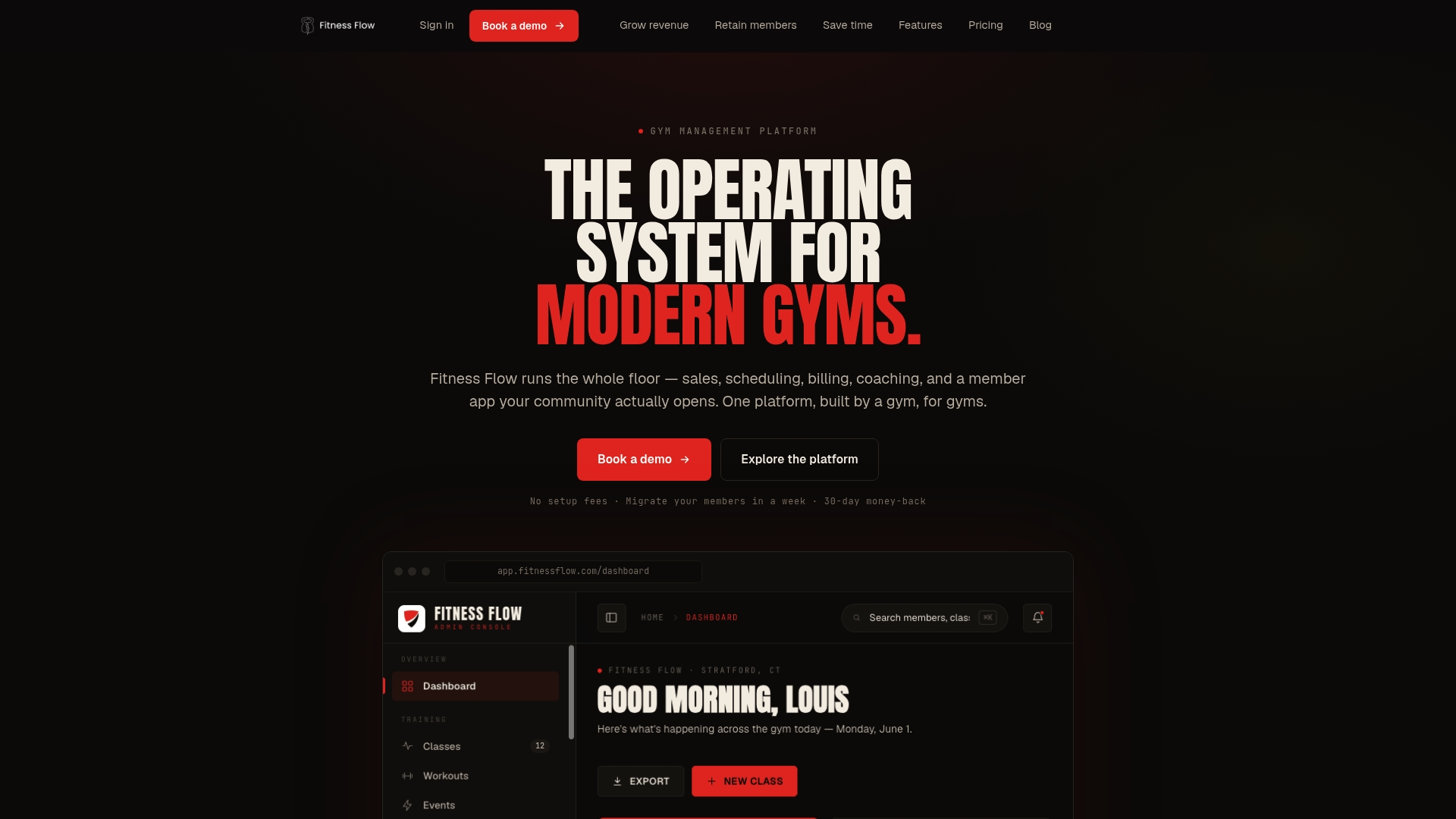
For a facility running 3–4 challenges per year, that’s the difference between a program that compounds (each challenge builds on the last, conversion data improves, member retention climbs) and one that resets to zero every time because the team is too exhausted to debrief. Joinfitnessflow’s branded member app, wearable integrations, and multi-location reporting mean you can run the same challenge across every location with one setup.
Start a free trial or book a demo to see how the platform runs a full challenge from enrollment to conversion without adding to your team’s workload.
Useful sources and further reading
These are the primary sources used in this article. Operators who want to go deeper on behavioral design, automation, and ROI measurement will find the most value here.
Operations and automation (highest priority for coordinators):
- How Fitness Challenges Cut Gym Member Churn by Up to 30% — Cadoo. Retention data, completion rate comparisons, and the case for financial stakes.
- Automate Fitness Challenges for 2x Engagement — US Tech Automations. Staff time benchmarks, communication cadence guidance, and automation workflow.
- Why 60% of Gym Challenges Fail — US Tech Automations. Operations debt analysis and recovery strategies.
- How to Run Fitness Challenge Programs That Boost Revenue and Retention — StudioStack. Revenue benchmarks and conversion window guidance.
Behavioral design and engagement:
- Gamification in Gym Membership — Basso Entertainment. Leaderboard effects, goal-gradient behavior, and personal progress dashboards.
- Motivation Crowding Effects on Gamified Fitness Apps — Frontiers in Psychology. Academic research on intrinsic vs. extrinsic motivation in gamified fitness programs.
- Psychological Drivers of Retention — Retention Guru. Autonomy, competence, and relatedness as the foundation for sustainable challenge design.
Program ideas and scheduling:
- Fitness Challenge Ideas for Gyms — Member Solutions. Seasonal scheduling and annual calendar guidance.
- Fitness Challenge Ideas for Team Building — Charity Miles. Team and charity challenge formats with social impact angles.
FAQ
What makes a good gym challenge?
A good gym challenge has a single measurable goal, a scoring rule anyone can explain in one sentence, and a duration matched to the format: 21–28 days for attendance or habit challenges, 42–60 days for transformation programs. Scalable metrics (percentage improvement or total visits) keep it fair for all fitness levels.
What are some fun workout challenge ideas for a gym?
Fitness Bingo, the 1-Minute Power Challenge, Team Distance Race, and the Class Sampler (“Try 5 classes in 2 weeks”) are consistently high-engagement formats because they reward variety and effort rather than raw performance. Charity-a-Thons add a community angle that drives social sharing.
What is the 3-3-3 rule in the gym?
The 3-3-3 rule isn’t a standardized industry framework with a single definition; different coaches use it differently. A common version refers to training 3 days per week, 3 exercises per session, and 3 sets per exercise, but definitions vary widely. For challenge design, the clearer approach is to define your own specific rule and state it explicitly in your challenge materials.
How long should a gym challenge run?
Attendance and points-based challenges perform best at 21–28 days. Transformation challenges need 42–60 days but require a mid-point event to reduce dropout. A 2-week mini-challenge works well as a low-commitment entry point for new or returning members.
How do I convert challenge participants into paying members?
You have a 7–10 day window after the challenge closes to convert non-member participants. Build a specific membership offer into the challenge structure before it starts, then trigger an automated follow-up email sequence at Day 28 or 29. Platforms like Joinfitnessflow can automate this sequence so the offer goes out even when your team is focused on prize fulfillment.