Gym Emergency Plan: How to Build One That Works

A gym emergency plan is a written set of procedures that tells every staff member exactly what to do in a medical emergency, a fire, severe weather or a security threat. It names who takes charge, who calls 911, where the AED is, how people get out, and how often you practice. This guide walks you through each piece in the order you would build it.
Getfitnessflow
Keep Gym Operations Connected
Fitness Flow brings scheduling, billing, member engagement, and analytics together in one platform for gym owners managing daily operations.
TL;DR
- Write one plan that covers medical emergencies first (cardiac arrest, injuries, heat illness), then fire, weather, equipment failure and security threats.
- OSHA’s emergency action plan standard sets minimum content: reporting, evacuation routes, accounting for people, rescue duties and a named contact.
- Assign five roles per incident: leader, responder, communicator, runner and crowd manager.
- Aim for defibrillation within 3 minutes of collapse (5 at most), review the plan quarterly and rehearse it at least twice a year.
- Keep the plan, the floor map, training records and incident reports in one place your whole team can reach.
Table of Contents
- What a gym emergency plan is, and what it covers
- What the plan must include
- Assign roles before anything happens
- Responding to a medical emergency and cardiac arrest
- Fire, weather and evacuation
- Security threats: evacuate, lock down or shelter
- Equipment, contacts and maintenance
- Training, drills and review
- Perspective: why we keep emergency paperwork in the same place as operations
- Fitness Flow for gyms that want one system
- FAQ
- Sources
What a gym emergency plan is, and what it covers
A gym emergency action plan (EAP) is a written document that outlines what to do when something goes wrong, from a medical emergency to a facility issue or an unexpected threat. Its job is to cut confusion and speed up care.
The American College of Sports Medicine (ACSM) says the response system must address medical emergencies that are reasonably foreseeable in an exercise setting: common orthopedic injuries, sudden cardiac arrest, acute myocardial infarction, stroke, hypoglycemia and heat illness. For a typical gym, that translates into a list like this:
- Sudden cardiac arrest and heart attack
- Falls, dropped weights, and other orthopedic injuries
- Stroke, diabetic episodes, fainting and heat illness
- Fire, smoke and chemical spills (cleaning products, pool chemicals)
- Equipment malfunction
- Severe weather
- Active assailant or other security threats
One distinction matters. An EAP is not the same as an evacuation plan. One insurer’s guidance says an EAP speeds response and reduces injury severity, and that evacuation planning should be done with your local fire and police departments. Treat them as two chapters of one binder, each built with the right people.
The plan will not predict everything. Guidance from the Michigan High School Athletic Association notes that an EAP cannot realistically cover every scenario but gives your team a shared framework they can adapt. That is the goal: a staff that has already thought it through.
What the plan must include
The OSHA minimum
If you have employees, start with federal rules. OSHA’s standard 1910.38 says an emergency action plan must include at a minimum:
- Procedures for reporting a fire or other emergency.
- Procedures for emergency evacuation, including the type of evacuation and exit route assignments.
- Procedures for employees who remain to operate critical operations before they evacuate.
- Procedures to account for all employees after evacuation.
- Procedures for employees performing rescue or medical duties.
- The name or job title of every employee who can be contacted for more information about the plan.
The standard applies whenever another OSHA standard requires an EAP, so check which of those apply to your operation. Our guide to OSHA requirements for gyms covers how to keep inspection-ready records.
What fitness-specific guidance adds
OSHA’s list is a floor. Fitness and sports guidance adds the details a responding team actually needs:
- A method to alert employees, which could be an automated alarm system.
- Contact information for emergency medical services, the venue’s address and access points, and the location of phones, fire extinguishers, first aid kits and AEDs.
- A facility map showing AED, first aid kit, phone and exit locations, plus EMS access routes and gate codes, posted near entrances and phones.
- Incident documentation steps and training and drill records.
- Written instructions for how staff handle each emergency, and entry and exit locations for EMS crews, as ACSM requires.
Cover every area where members go, not just the workout floor. Guidance for athletic programs specifically says planning should include locker rooms, weight rooms and private facilities. For a gym, add the childcare room, the sauna, the studio with the door that sticks, and the parking lot.
A simple outline you can copy
SectionWhat goes in it
Purpose and scope
Which locations, shifts and emergencies the plan covers
Roles
Named job titles for each of the five response roles, with backups
Contacts
911, nearest hospital, utility shutoffs, owner, insurer, building manager
Facility information
Street address, entrances, gate codes, floor map, equipment locations
Evacuation and shelter
Exit routes, assembly points, lockdown and shelter-in-place steps
Procedures by scenario
One page each: cardiac arrest, injury, fire, weather, threat
Documentation
Incident report, follow-up communication, drill log
This mirrors the seven components outlined in a widely read gym EAP guide: purpose and scope, roles, contacts, facility information, evacuation, equipment and resources, and scenario procedures.
Assign roles before anything happens
In a real emergency, the most common failure is that everyone helps and nobody leads. One youth sports and fitness guide assigns five roles:
- Emergency Leader: coordinates the response and makes decisions.
- Responder: provides CPR, AED use or first aid if trained.
- Communicator: calls 911 and relays information.
- Runner: retrieves emergency equipment and meets EMS at the entrance.
- Crowd Manager: keeps a safe perimeter around the incident.
Assign these by job title and shift, not by person. A front desk associate on a Sunday evening should know their role is Communicator or Runner without checking who else is in the building. Keep the list short enough to fit on a card behind the desk, and name a backup for each role so the plan still works when the manager is off.
A small studio with two staff on shift will double up: one person becomes Leader and Responder, the other Communicator and Runner. Write that down so nobody improvises it under stress.
Responding to a medical emergency and cardiac arrest
Write the response as short steps staff can follow without reading. Activating the plan does not always mean an ambulance is needed, but when in doubt call: 911 can help troubleshoot and get care to you faster. The AGuard guide sorts incidents into four severity levels, from scrapes and bruises up to unconsciousness, suspected concussion or broken bones, where an immediate 911 call is the rule. Put that ladder in the plan so staff do not debate whether something is serious enough.
The cardiac arrest clock
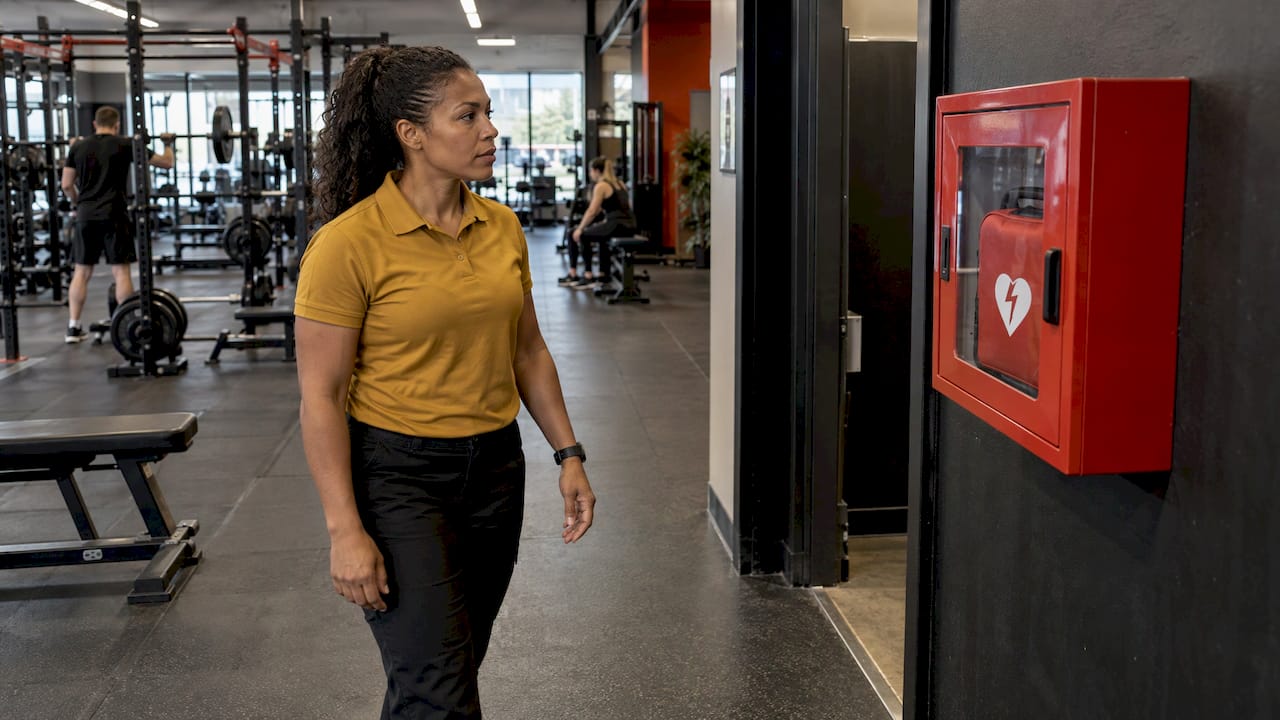
Speed is the whole story. ACSM says every site with an AED should aim for defibrillation within 3 minutes of collapse (optimal) and 5 minutes (acceptable). The best way to get there is to place AEDs in visible, accessible locations that staff or the public can reach within a 1.5-minute walk. Walk your own floor with a timer: from the farthest corner, the pool deck or the back studio, how long does it take to reach the AED and return?
ACSM’s public guidance adds that people are most likely to survive a cardiac incident with CPR and AED help within five minutes, and better still under three. Your cardiac arrest page should read, in order: confirm collapse, call 911, start CPR, send the Runner for the AED, attach it and follow its prompts, keep going until EMS takes over. Have your local EMS provider review it. ACSM says the emergency plan and AED plan should be coordinated with local EMS, a prerequisite in some states.
Check your state’s AED rules
Federal, state and local AED requirements differ. ACSM says facilities must comply with them and include a public access defibrillation program in the written plan. Some states require AEDs in fitness centers, so confirm with your state health department before you finalize the equipment list.
Fire, weather and evacuation
Your alert method comes first: an alarm, a spoken code word or both. For fire, chemical spills or severe weather, cheer-industry safety guidance advises that a code word or signal should be rehearsed and that assembly areas be pre-designated as rally points. Pick spots away from the building and away from the street where fire trucks pull in.
The same program splits planning into three plans: an EAP for medical concerns, an Emergency Evacuation Plan for hazardous internal conditions and an Emergency Shelter Plan for hazardous external conditions, plus a communication plan for follow-up. That is a useful way to organize a gym binder.
Exit routes need real attention. A workplace safety primer for CrossFit trainers explains that exit routes must be a permanent part of the workplace, that discharges lead directly to a street, walkway, area of refuge or open space, and that buildings with 60 or fewer occupants need at least one exit route while 61 to 600 need at least two. Do not stack plates, mats or rigs in front of exit doors, and do not lock them during open hours. Your local fire marshal has the final word on your building, so ask for a walkthrough.

Accounting for everyone
After evacuation, you need to know who is out. OSHA’s standard requires procedures to account for all employees, and federal security guidance also advises organizations to develop procedures for accounting for staff, visitors, vendors and customers. In a gym that means members. A check-in or booking record that lists who is in the building and who is in each class gives the Leader a head start with a roll call. Make sure your team can pull that list on a phone, not only from the front desk computer.
Security threats: evacuate, lock down or shelter
Security planning is uncomfortable but belongs in the document. The Cybersecurity and Infrastructure Security Agency (CISA) says that in an active assailant incident, personnel may need to evacuate, lock down or shelter in place, and that mass evacuation may not be appropriate. It defines lockdown as getting everyone secured quickly in areas away from immediate danger, and shelter-in-place as taking refuge in the nearest designated safe area until notified the situation is resolved. Its template asks you to cover all areas, including public spaces, staff-only areas, storage and spaces next to the facility.

For a gym, identify which rooms lock from the inside, where staff can take members (offices, studios with solid doors) and who communicates with police. Staff training on this topic should come from your local law enforcement or a qualified trainer.
A written workplace violence policy supports this section. This explainer on the OSHA workplace violence policy covers what employers are expected to have in writing.
Equipment, contacts and maintenance
A plan is only as good as what is on the wall. Keep these ready and checked:
- AED(s) in visible, unlocked, signed locations, with pads and batteries in date.
- First aid kits stocked and located on your map. ACSM says first-aid kits and AEDs should be regularly inspected and maintained.
- A working phone with a direct line to 911, and, as United Educators advises, phones or other communication devices throughout the facility.
- Fire extinguishers and clear exit signs.
- Maps posted near entrances and phones, with EMS routes and gate codes marked.
Put inspections on the same schedule as the rest of your upkeep. Our gym maintenance checklist shows how to split daily, weekly and annual tasks, and AED and first aid checks fit neatly into it.
Training, drills and review
ACSM says all staff members should have the opportunity to receive training and certification in first aid, CPR and AED use. It also says the written plan should be reviewed quarterly and physically rehearsed at least twice a year. The ACSM standards excerpt adds that an AED skills review and practice drill should happen at least every six months.
A practical rhythm:
- At hire: give every new employee the plan, show them the AED and the exits, and record the date.
- Quarterly: reread the plan, update contacts, check equipment dates and confirm role assignments for the new schedule.
- Twice a year: run a full scenario, such as a collapse on the floor during a busy class. Time the AED retrieval and the 911 call.
- After each drill: write down what slowed you down and fix it. The recommended pattern is to practice realistic scenarios, review response times and communication flow, and document lessons learned.
Keep communication after an incident consistent, brief and non-blaming. Decide in advance who talks to the member’s family, to other members and to the press, and write the incident up the same day. Our gym incident reporting guide offers templates and a workflow for that. If members sign liability paperwork, see how digital waivers for gyms fit into your records.
Perspective: why we keep emergency paperwork in the same place as operations
Most gym owners we talk to have an emergency plan somewhere: a binder in the back office, a PDF nobody has opened since the day it was written. The plan fails not because the content is wrong, but because it is disconnected from how the gym runs every day.
We built Fitness Flow as one platform for scheduling, billing, member communication, employee roles, waivers, compliance tools and facility management, so the information a response depends on lives with everything else you manage. Staff roles are defined once. Class schedules show who is in the building. Waivers and incident records sit with the member file. Multi-location owners can see each site in one view instead of chasing five binders.
Our advice: treat the emergency plan like a class schedule. It has owners, a calendar, and a review date. When it is part of your weekly routine, it is ready on the day you need it.
Louis
Fitness Flow for gyms that want one system
An emergency plan works best when your roles, schedules, member records and compliance tasks are not scattered across five tools. Fitness Flow combines class scheduling and booking, employee and role management, waivers, compliance tools, facility management and reporting in one platform, with a branded member app for communication. Plans are listed at $149 per month for Solo and $349 per month for Studio, and Multi-site pricing is available on request. See the details on the Fitness Flow plans page.
If you run several locations, our guide to centralized gym reporting shows how to keep each site’s records audit-ready.
FAQ
How often should a gym review its emergency plan?
ACSM recommends reviewing the written plan every quarter and physically rehearsing it at least twice a year. Update it sooner after a layout change, a new AED, a staffing change or any real incident.
Does my gym legally need an AED?
It depends on your state and locality. ACSM says facilities must comply with federal, state and local AED requirements, and United Educators notes that some states require AEDs in fitness centers. Check with your state health department and your insurer.
Who should be in charge during an emergency?
Name an Emergency Leader by job title for every shift, with a backup. The leader coordinates the response while others call 911, give CPR or first aid, fetch the AED and manage the crowd.
Is an emergency action plan the same as an evacuation plan?
No. The EAP covers how staff respond to emergencies, especially medical ones. Evacuation is a related chapter that should be developed with your local fire and police departments.
Sources
- OSHA 29 CFR 1910.38, Emergency action plans
- ACSM Expert Consensus Statement on emergency preparedness in health/fitness facilities
- ACSM Expert Consensus Statement (Ovid)
- ACSM: Are You Prepared for a Cardiac Emergency?
- CISA Instructional Guide to the Active Assailant EAP Template
- MHSAA Emergency Action Planning FAQ
- SafeAthlete Emergency Action Plan Guide
- Health & Safety: A Primer for CrossFit Trainers
- USACHEE Emergency Preparedness Program
- Markel: Does Your Fitness Club Have an Emergency Action Plan?
- AGuard: Emergency Action Procedures at Your Gym