Gym Incident Reporting: Templates & Workflow for Owners
The moment someone gets hurt on your gym floor, complete an incident report before the shift ends, preserve every piece of physical evidence, and send a copy to your insurer if there’s any real chance of a claim. Waiting even a day means fading memories and missing details.
Grab our free incident report template and use it for every injury, near-miss, or property issue going forward. Right now, do three things:
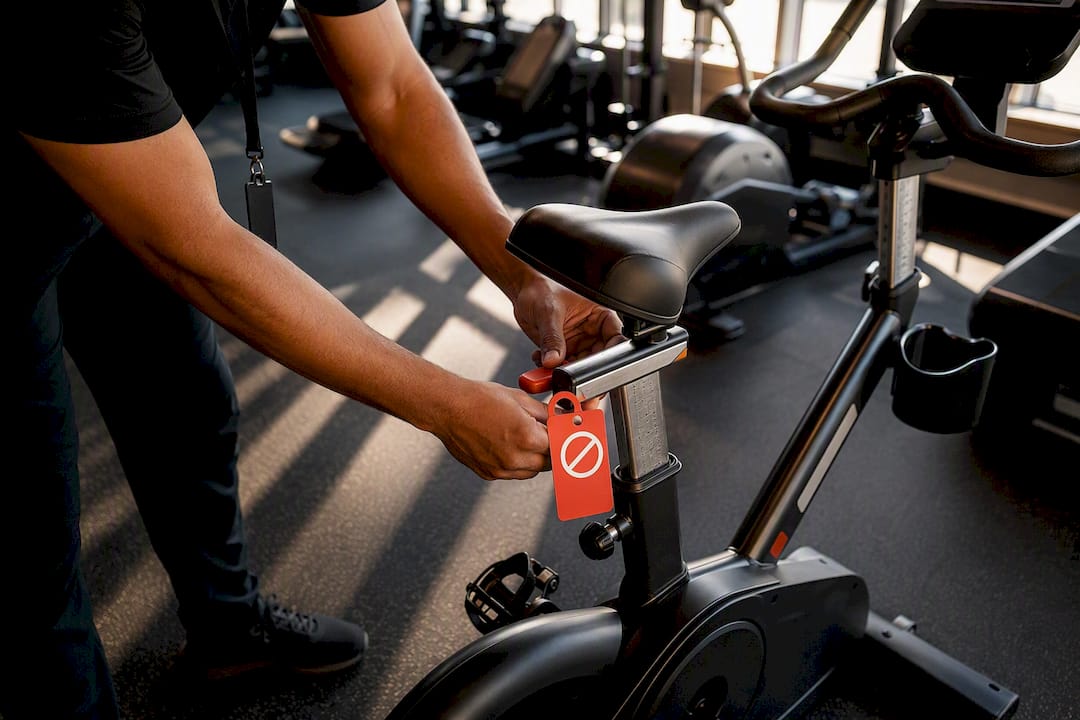
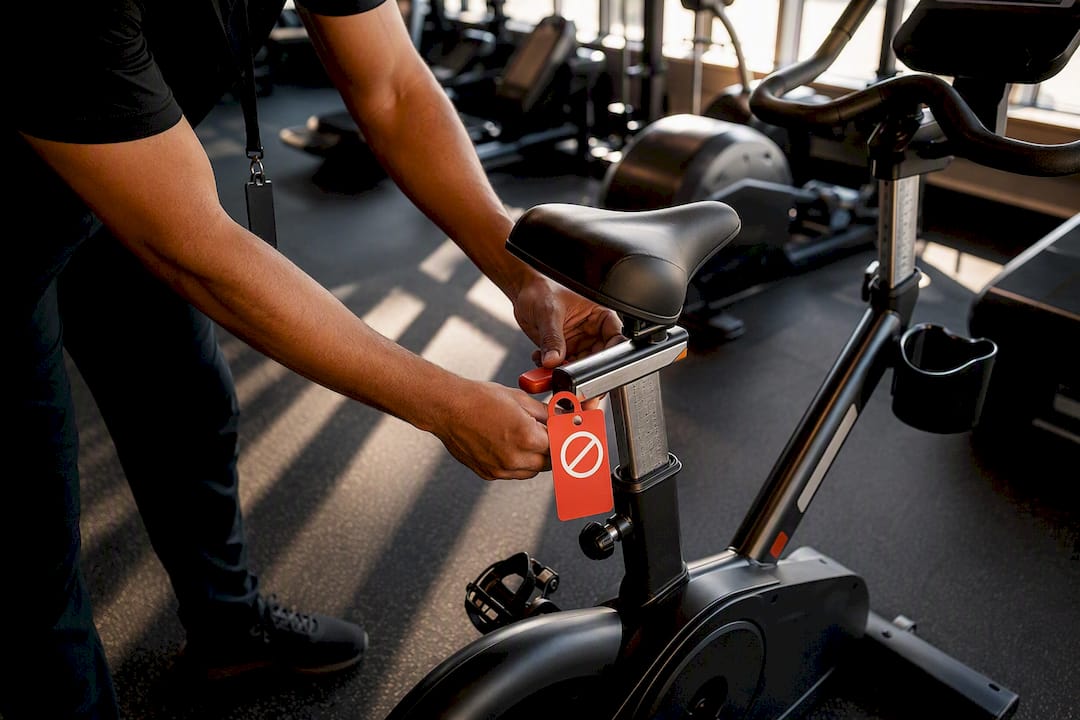
- Secure the scene and remove or tag any equipment involved
- Get the injured person help first, then start documenting once they’re stable
- Write down what happened while witnesses are still standing there
Pro Tip: Documentation written the same day protects your gym far better than a report filed a week later. Details you swear you’ll remember rarely survive a busy weekend of classes.
Key Takeaways
Consistent, immediate documentation is what protects a gym legally and operationally, not the severity of the incident itself.
PointDetails
Act within the hour
Secure the scene, assist the injured person, and start documenting while witnesses are present.
Capture all eight core fields
Include date, time, location, contact info, factual description, witnesses, actions taken, and signatures.
Report when unsure
File a “reporting only” notice with your insurer if there’s any chance an incident becomes a claim.
Retain and restrict access
Keep reports for several years and limit viewing to managers, legal counsel, and insurers.
Digitize with Fitness Flow
Store reports, photos, and witness statements in one auditable system tied to member files.
Table of Contents
- What Counts as a Gym Incident Report?
- What Belongs in Every Incident Report?
- What Should Staff Do in the First Hour?
- When Do You Need to Notify Your Insurer or Authorities?
- How Long Should You Keep Incident Reports?
- How Do You Train Staff to Report Consistently?
- How Do You Digitize the Reporting Process?
- Editorial Take: What Gym Owners Get Wrong About Incident Reporting
- Get Your Incident Reports Off Paper and Into One System
- Sources
- FAQ
What Counts as a Gym Incident Report?
A gym incident report is a factual, written record of anything that happens on your premises that could lead to injury, liability, or a member complaint. It’s not a story or an apology. It’s a record of what a staff member observed, in plain language, with names, times, and specifics attached.
Not every hiccup needs one, but more situations qualify than most managers assume:
- Injuries — a torn hamstring during a class, a slip near the pool deck, a dropped plate on a foot
- Equipment failures — a snapped cable on a lat pulldown, a treadmill belt that jams mid-run
- Near-misses — a rack that wobbles but doesn’t fall, a spotter who catches a bar just in time
- Suspected assaults or harassment — an altercation in the locker room, an inappropriate comment reported by a member
- Member complaints — a formal grievance about staff conduct or facility conditions
- Property damage — a shattered mirror, a flooded sauna
- Fire or evacuation events — a triggered alarm, a real evacuation, even a false one worth logging
Fitness-safety guidance from GymBC treats near-misses as early warnings, not noise. A rack that almost tips over today is the injury you prevent next month if you record it and fix the hazard.
What Belongs in Every Incident Report?
A usable report answers eight questions without editorializing. Miss one and you weaken the record.
- Date, time, and exact location — “3:42 PM, free weight area near rack 4,” not “afternoon, gym floor”
- Involved person’s contact info and membership ID — full name, phone, and account number so you can follow up
- A factual description of what happened — what you saw, not what you assume caused it
- Injuries observed — visible marks, complaints of pain, whether the person could walk unassisted
- Witnesses and staff present — full names and roles, not just “a few people nearby”
- Immediate actions taken — first aid given, EMS called, equipment removed
- Equipment involved — model, serial number if available, and its maintenance history
- Photos, diagrams, and signatures — visual evidence plus sign-off from staff and, when possible, the injured party
Write “Member reported sharp pain in left knee after stepping off the box during a jump exercise” rather than “Member hurt himself jumping wrong.” The first is defensible. The second assigns blame you can’t prove and may not even be true.
Guidance from SportsFitness’s incident report walkthrough stresses legibility and immediacy: write it while witnesses are still in the building, not from memory the next morning.
What Should Staff Do in the First Hour?
Every minute matters in the first hour, and what happens in the following days determines whether your paperwork holds up.
- 0 to 10 minutes: Administer first aid, call 911 if warranted, and clear the area so others aren’t at risk.
- 10 to 60 minutes: Collect witness statements while details are fresh, take photos from multiple angles, and tag or remove any equipment involved.
- Before the shift ends: Complete the incident report in full, file it in a secure location, and notify the manager on duty.
- Within 24 to 72 hours: Follow up with the injured member, review the report for gaps, and decide whether it goes to your insurer.
Markel’s guidance for club operators recommends training staff on this exact sequence in advance, so nobody is improvising during a crisis.
Pro Tip: Photograph equipment from at least three angles, include a timestamp, and lock it out of service with a visible tag until it’s inspected. A single blurry photo taken a week later won’t hold up the way four clear ones taken on the spot will.
When you talk to the injured member, stick to concern and facts: “We’ve documented this and I want to make sure you get checked out.” Skip anything that sounds like an admission of fault. That’s a conversation for your insurer, not your front desk.
When Do You Need to Notify Your Insurer or Authorities?
Call 911 immediately for loss of consciousness, severe bleeding, a suspected fracture, or any sign of a cardiac event. There’s no gray area here.
For everything else, the harder question is what to tell your insurer. A useful rule from Markel: if you’re unsure whether an incident will turn into a claim, send it in anyway as a “reporting only” notice. This preserves your coverage without triggering a formal claims process.
- Any injury requiring medical treatment beyond basic first aid
- Any incident where EMS was called
- Any event involving equipment failure or a potential safety hazard
Larger operators should also understand recordkeeping expectations similar to OSHA’s employer reporting thresholds, which flag events like inpatient hospitalization, amputation, or loss of an eye for rapid reporting where those regulations apply. Rules vary by jurisdiction, so confirm your specific obligations with counsel or your local labor authority.
Pro Tip: When you’re genuinely unsure, report it. A reporting-only notice costs you nothing and keeps your coverage intact if the situation escalates later.
How Long Should You Keep Incident Reports?
Retention matters as much as collection. Keep incident reports for at least several years, and link each one to the relevant member file and any equipment maintenance record it touches, since maintenance history and inspection logs can determine whether a dangerous condition was known or reasonably discoverable.
- Limit access to managers, legal counsel, and your insurer. Front desk staff don’t need to see every file.
- Redact personal medical details before sharing reports externally unless a request specifically requires them.
- If a report includes detailed medical information beyond basic first-aid notes, treat it cautiously. Most gyms aren’t HIPAA-covered entities, but sensitive health details still deserve tighter handling. When in doubt, ask a lawyer.
How Do You Train Staff to Report Consistently?
Reporting habits fall apart without structure. Build one policy document that spells out what triggers a report, cover it during onboarding, and refresh it annually so it doesn’t quietly disappear from memory.
- Written policy every employee signs off on
- Onboarding walkthrough of the actual form, not just a verbal summary
- Annual refresher training, ideally with a role-play drill
- A known, accessible location for blank forms, digital or physical
Audit quality periodically: pull five random reports and check for missing fields, vague language, or reports filed days late. The Association of Fitness Studios recommends clear runbooks and accessible forms so staff can complete reports before memories fade, which is exactly what a random audit will reveal if it’s missing.
Pro Tip: Track training completion the same way you track incident reports. When you can show a member never went untrained and every report ties back to a documented process, that consistency becomes your strongest evidence.
How Do You Digitize the Reporting Process?
A downloadable incident report template gets you started immediately. Fill in the critical fields with plain factual language:
Incident description: “Member slipped near the pool deck at 5:15 PM. Floor was wet from a recent mopping; no wet floor sign was visible at the time.”
Injuries observed: “Member reported soreness in right wrist, no visible swelling, declined medical transport.”
Immediate action taken: “Staff placed wet floor sign, offered ice pack, logged incident, and followed up by phone the next morning.”
Paper logs work until they don’t. Pages go missing, handwriting turns illegible, and cross-referencing a report against a maintenance log takes forever. A platform like Fitness Flow lets you store reports digitally, attach photos and witness statements directly to a member’s file, and keep a timestamped audit trail that shows exactly when a report was filed and by whom. If you’re migrating from paper, scan your existing logs as a backup archive and start entering new incidents digitally from day one. Mixing both systems during a transition is fine. Losing the paper trail before the digital one is built out is not.

Editorial Take: What Gym Owners Get Wrong About Incident Reporting
Most gyms treat incident reporting as damage control. That’s backwards. The real value of a solid gym incident report isn’t defending against a lawsuit that hasn’t happened yet. It’s the pattern you can only see once you’ve logged enough near-misses and equipment failures to notice the same rack, the same wet corner, the same class format causing trouble more than once.
The conventional advice tells owners to “document everything” without explaining what makes documentation useful versus just voluminous. A report with vague language like “member seemed to slip” is barely better than no report at all. Specificity is what turns a report into evidence and a de facto safety audit.
What most operators underinvest in is the follow-up loop. Filing the report is step one. Reviewing it with your team, fixing the hazard it revealed, and confirming the fix worked is where the real safety gains happen. If you’re not closing that loop, you’re just building a paper trail for a lawyer instead of a safer gym for your members.
Prioritize training staff to write factually before you worry about legal thresholds. Get the habit right first. The compliance details matter, but they’re useless if nobody fills out the form correctly in the first place.
Get Your Incident Reports Off Paper and Into One System
Paper forms and scattered spreadsheets are how gyms lose evidence right when they need it most. Fitness Flow gives you a place to log incidents digitally, attach photos and witness statements to the exact member file involved, and keep a timestamped audit trail your insurer or legal counsel can actually review without chasing down loose paperwork.

Beyond incident tracking, Fitness Flow runs your CRM, billing, scheduling, and compliance tracking from one dashboard, so incident documentation lives alongside waivers, membership records, and maintenance notes instead of sitting in a separate binder. If you’re managing multiple locations, that cross-referencing becomes the difference between catching a pattern and missing it entirely. See how the platform’s gym management software handles compliance workflows, or start a trial directly at Fitness Flow and get your first incident report digitized today.
Sources
This article is general information, not a substitute for advice from a qualified lawyer. Consult a qualified legal professional about your own circumstances before acting on anything here.
FAQ
Where can I report a gym for safety violations?
Report safety concerns directly to the gym’s management first, then to your local health or building code authority if the issue involves fire, sanitation, or structural hazards. For employee-related safety issues, regulatory agencies like OSHA may apply depending on your jurisdiction.
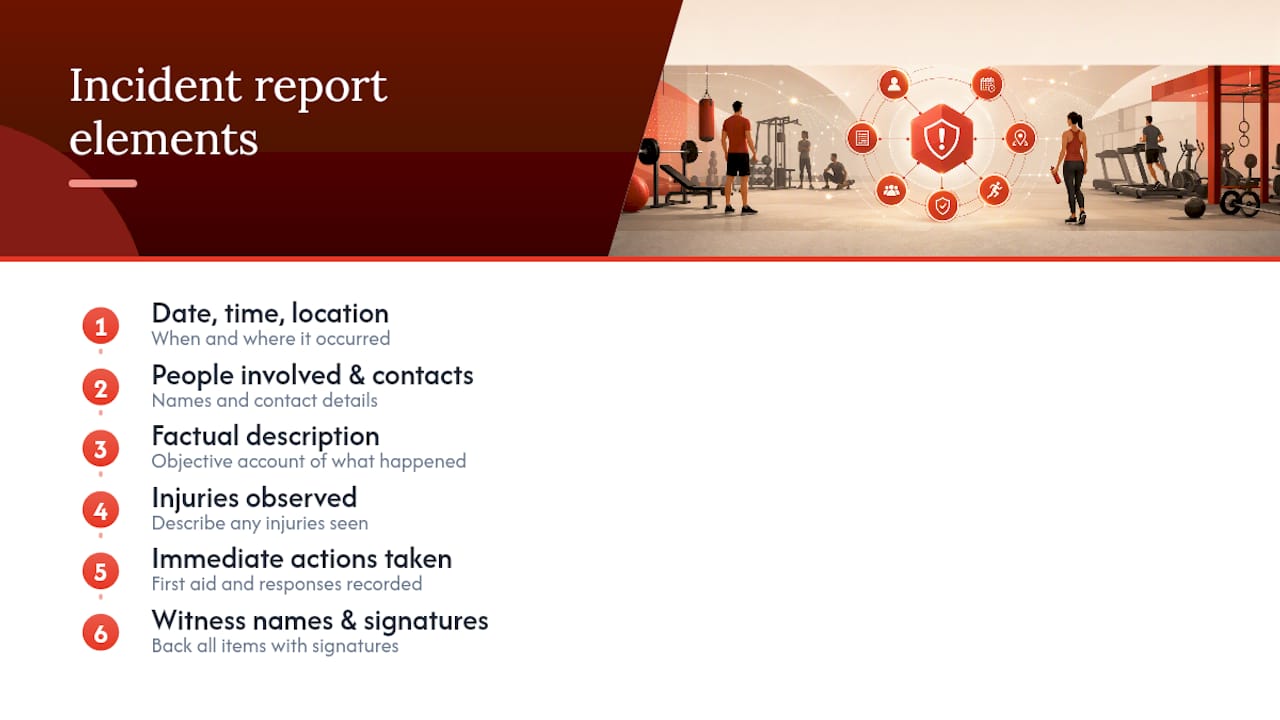
What are the 5 elements of a good incident report?
A strong report includes the date, time, and location; the people involved and their contact details; a factual description of what happened; injuries observed; and the immediate actions taken, all backed by witness names and signatures.
What should I do if I get injured at the gym?
Report the injury to staff immediately, ask for the incident to be documented in writing, and request a copy of the report for your own records before you leave the facility.
Do gyms have a duty of care to their members?
Yes, gyms generally owe members a duty to maintain reasonably safe premises and properly functioning equipment, though the exact legal standard varies by jurisdiction and often depends on waivers signed at enrollment.