

Gym Lead Generation: Essential Strategies for Growth

The most effective gym lead generation system combines fast digital follow-up, referral programs, and automated nurturing. Gyms that respond to a new lead very quickly convert at much higher rates compared to those that respond after a day or more. That single variable, speed to first contact, outweighs almost every other factor in your fitness sales pipeline.
Here are the core tactics that drive membership growth:
- Digital advertising on Meta and Google with tight geo-targeting (1–3 mile radius)
- SEO and content marketing to capture high-intent local search traffic
- Referral programs with simple, compelling rewards for current members
- Free trials and intro offers to lower the barrier for prospects
- Chat-based lead capture via WhatsApp and Messenger for faster engagement
- Local partnerships with complementary businesses for compounding referrals
- Automated CRM workflows to nurture leads without burning staff hours
Pro Tip: Set up an AI-driven first-response sequence that fires within 60 seconds of a new inquiry. Gyms using this approach see lead-to-tour conversions of 30–45% versus 5–15% with no automated follow-up.
Table of Contents
- Why a lead generation strategy drives real gym growth
- Digital marketing channels that attract qualified gym leads
- Offline and in-person tactics that build local momentum
- How technology and automation convert more leads for less effort
- How Joinfitnessflow accelerates lead generation and member retention
- Joinfitnessflow puts your entire lead pipeline in one place
- Key Takeaways
Why a lead generation strategy drives real gym growth
Running ads without a defined strategy is how gyms burn through budget and wonder why membership numbers stay flat. A structured approach connects your marketing spend directly to revenue, so you know exactly what each new member costs to acquire.
Understanding your true cost per acquisition matters because it tells you which channels are actually profitable, not just which ones generate the most clicks. Customer acquisition cost varies widely for gyms, and member churn within the first few months can be high, so profitability depends on attracting the right customers at the outset.
That starts with knowing who you are targeting. A 28-year-old professional looking for early morning HIIT classes responds to completely different messaging than a 45-year-old parent seeking flexible scheduling and personal training. Segment your audience by relevant demographics and preferences before creating targeted advertising. Once you know your ideal member profile, you can tailor every offer, every email subject line, and every landing page headline to speak directly to that person’s specific motivation.
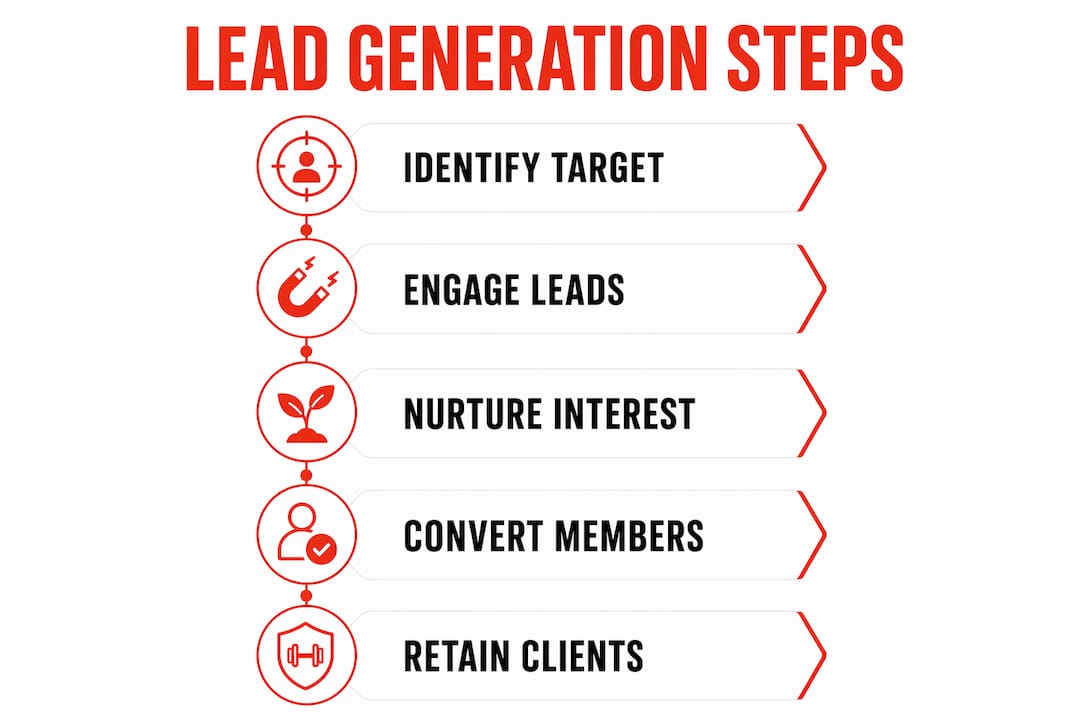
A practical communication framework is to highlight key benefits to defined audience segments across multiple engagement points. It forces focus and keeps your messaging consistent from ad to landing page to follow-up email, which is where most gyms lose prospects.
Digital marketing channels that attract qualified gym leads
A large portion of fitness consumers discover new gyms through search engine results. If your website is not showing up for “[your city] gym” or “[your city] personal training,” you are invisible to the majority of people actively looking for what you offer.

SEO and content
Fitness blogs generate substantially more leads than static websites, and content marketing is generally cheaper and more effective than traditional advertising. Publishing genuinely useful content, workout guides, nutrition tips, member success stories, builds organic traffic that compounds over time. Your Google Business Profile deserves equal attention. Most gyms leave it incomplete or stale, yet an actively managed profile with weekly photos, prompt review responses, and complete service listings drives free, high-converting inbound traffic.
Paid advertising
Meta (Facebook and Instagram) remains the dominant paid channel for most gym operators. Average cost per lead on Meta tends to be lower than on Google Search, reflecting differences in platform and intent., but they capture higher commercial intent. Someone searching “[city] gym membership” is much closer to a buying decision than someone scrolling Instagram. For most gyms in a growth phase, a budget split of roughly 60% Meta and 30% Google Search makes sense, with the remainder on TikTok or retargeting.
Chat-based lead capture
Replacing static lead forms with WhatsApp or Messenger conversations substantially increases lead capture rates and lead-to-tour conversion compared to traditional forms. WhatsApp messages have much higher open and response rates than email. For gyms in markets with strong WhatsApp adoption, including many Hispanic communities and younger demographics across the U.S., this channel is already outperforming email at every stage of the funnel.
Key digital tactics to run in parallel:
- Email sequences triggered by lead behavior, not just a weekly newsletter blast
- Video ads using real member footage rather than stock imagery
- Retargeting campaigns for website visitors who did not convert on the first visit
- Instagram content built around transformation stories, since A majority of fitness consumers research brands on Instagram before visiting a gym.
Offline and in-person tactics that build local momentum
Digital ads get attention. In-person trust closes deals. The gyms growing fastest in competitive local markets combine both, and they do not treat offline tactics as an afterthought.
Referral programs
Member referrals often have the highest ROI among lead sources due to high lead-to-tour conversion rates. Simple referral incentives are effective. Formal referral programs typically boost new member sign-ups and lower customer acquisition costs by reducing the need for paid advertising.
Free trials and intro offers
A well-structured free trial removes the biggest objection prospects have, which is uncertainty about whether the gym is right for them. Gyms with low conversion from trials to paid members usually have process or follow-up issues rather than product quality problems. Simplifying the path from trial to membership, fewer steps, clearer next actions, and a personal check-in call, moves that number.
Local partnerships and community events
Adjacent businesses, physical therapy clinics, juice bars, athletic apparel stores, and corporate wellness programs, are sitting on pools of people who already care about their health. Local partnerships typically build a referral stream over time that reduces dependency on paid advertising. Sponsoring a 5K, hosting a free outdoor workout, or co-running a wellness challenge with a nearby employer puts your brand in front of warm prospects at zero media cost.
Offline tactics worth running consistently:
- Direct mail to households within a 3-mile radius, especially for grand openings or seasonal promotions
- Print ads in local community papers or neighborhood newsletters
- “Bring a friend” workout events that give current members a social reason to recruit
- Partnerships with local employers for corporate wellness discounts
Pro Tip: Timing local outreach to the highest-intent months for gym membership decisions in the U.S. can increase lead generation effectiveness. Running a referral push or community event in the first two weeks of January can generate more leads than two months of paid ads at other times of year.
How technology and automation convert more leads for less effort
Speed and personalization at scale are the two things manual follow-up cannot deliver. Automation solves both.
AI-powered lead response
The data on response time is stark. A lead contacted within one minute converts at 48%. Wait five minutes and that rate drops to 39%. Wait 24 hours and it falls to 4%. AI-driven response agents that fire an SMS or WhatsApp message within 60 seconds of a form submission double to triple lead-to-tour conversion rates compared to manual outreach. The economics shift dramatically: a $25 paid social lead converting at 15% with manual follow-up costs $170 per tour. The same lead converting at 35% with automated follow-up costs $70 per tour.

Segmented follow-up workflows
Not every lead is at the same stage. Someone who watched a video ad and clicked through is different from someone who booked a tour and did not show. Automated and personalized follow-up sequences using SMS, WhatsApp, and email, triggered by specific lead behaviors, keep prospects moving through your gym sales pipeline without requiring a staff member to manually track each one. A five-to-seven touchpoint sequence in the first 72 hours after a lead comes in recovers a large portion of prospects who would otherwise go cold.
Tracking the right metrics
Your gym sales pipeline is only as useful as the data feeding it. Track these numbers weekly:
- Cost per lead by channel (Meta, Google, referral, organic)
- Lead-to-tour conversion rate by source
- Tour-to-member conversion rate
- Speed to first contact (industry average is 47 hours; top 10% respond in under 5 minutes)
- Trial-to-member conversion rate (benchmark: 40%)
ChannelTypical cost per leadLead-to-tour conversionEffective cost per tour
Meta lead form ads
$25
15–25%
$45–$170
Google Search ads
$30
30–45%
$70
Google Business Profile
—
40%
— + staff time
Member referral
— $50
—
— $80
Local partnership referrals
—–$25
45–60%
—–$55
Walk-in (street + signage)
—
35%
—
Source: Treetop Growth Strategy, May 2026 benchmarks
Managing your fitness sales pipeline
A gym-specific CRM does more than store contact information. It tracks where every prospect is in the pipeline, triggers follow-up tasks automatically, flags leads that have gone cold, and surfaces the metrics you need to make budget decisions. Without it, leads fall through the cracks, and staff spend time on manual tasks that automation handles in seconds.
How Joinfitnessflow accelerates lead generation and member retention
Joinfitnessflow was built by gym operators who understood that managing leads, members, billing, and scheduling across disconnected tools is what kills growth. The platform brings CRM, lead capture, sales pipeline tracking, automated follow-up, scheduling, and billing into one place, so nothing gets missed and no lead goes cold because a staff member was busy teaching a class.
The lead capture tools inside Joinfitnessflow connect directly to the CRM, so every inquiry from your website, a paid ad, or a referral lands in a tracked pipeline with an automated first-response sequence already running. The sales pipeline view shows every prospect’s status, last contact, and next scheduled touchpoint, which means your front desk staff always knows exactly who to call and when.
Beyond lead generation, the platform handles the onboarding experience that determines whether a new member stays past the first three months. Branded member apps, automated check-ins, class scheduling, nutrition plans, and progress tracking all live in one place. The average gym membership sale closes within about a week, and a majority of prospects choose the gym with a stronger onboarding process. Joinfitnessflow gives you the infrastructure to win that comparison consistently.
Multi-location operators get cross-location reporting and centralized management, so the same lead generation and conversion systems that work at one location can be replicated across every site without rebuilding from scratch.
Pro Tip: Use Joinfitnessflow’s referral and review management tools immediately after a member’s first 30 days. That window, when motivation is highest and results are starting to show, is when a referral ask converts best. Automate the request so it goes out at day 28 for every new member without relying on staff to remember.
Joinfitnessflow puts your entire lead pipeline in one place
Most gym owners spend more time chasing leads across spreadsheets, email threads, and disconnected apps than actually converting them. Joinfitnessflow fixes that directly. You get a built-in CRM that captures every inquiry automatically, an automated follow-up system that responds in under a minute, a full sales pipeline view so nothing slips, and the member engagement tools that keep people past that critical three-month mark.
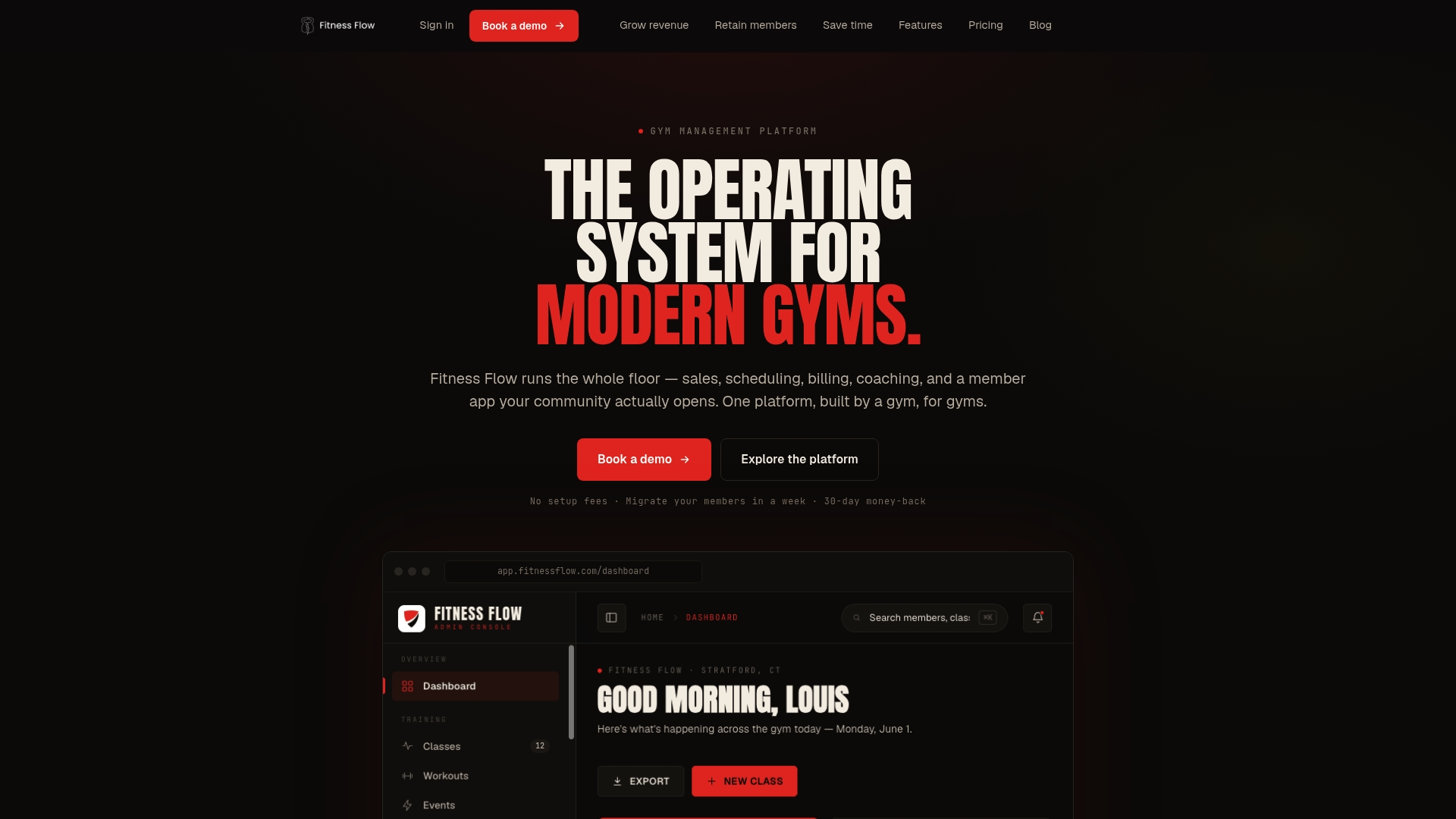
It is the only platform built specifically for gym operators that connects lead generation, member management, billing, and scheduling without requiring you to stitch together five separate tools. Whether you run a single boutique studio or multiple locations, the same system scales with you. Start your free trial and see how much faster your pipeline moves when everything works together.
Key Takeaways
Gym lead generation succeeds when fast automated follow-up, targeted digital advertising, and a structured referral program work together inside a single managed pipeline.
PointDetails
Speed to lead is the biggest lever
Leads contacted within 1 minute convert at 30–45%; the same lead at 24 hours converts at just 4%.
Referrals outperform paid ads
Member referrals convert at — lead-to-tour, the highest of any channel.
Chat-based capture beats forms
WhatsApp and Messenger lead capture substantially increases lead-to-tour conversion compared to traditional forms.
Track true acquisition cost
Calculate CAC as total marketing spend divided by new members, not cost per lead times conversion rate.
Joinfitnessflow unifies the pipeline
The platform connects lead capture, CRM, automated follow-up, and member onboarding in one place.