

Gym Revenue Streams: What Pays and How to Grow Them

A gym earns money from recurring dues first and from add-ons second, and the owners who grow fastest treat both as one system: sell the add-on to the member you already keep. The revenue is easy to list. The hard part is knowing which stream deserves your next hour, and that depends on your format, your retention and how well you can see your own numbers in one place.
This guide walks through the streams US gyms and studios actually use, the benchmarks to hold your own figures against, and how to raise revenue without starting a discount war. If you run an independent gym, a studio or several locations, it is written for you.
Getfitnessflow
getfitnessflow.com
See Your Gym Revenue More Clearly
Fitness Flow brings sales, scheduling, billing, member engagement and analytics together to help gym owners manage revenue streams in one place.
TL;DR
- Recurring memberships carry the business: among profitable strength studios, most earn 50 to 99% of monthly revenue from recurring payments.
- Non-dues income such as training, passes and rentals typically adds 15 to 25% of revenue at big-box gyms, so it is worth building deliberately.
- Retention is the multiplier: industry-wide member retention was 66.4% in 2024, so every member you keep is revenue you do not have to buy again.
- Discounts cost more than they look: a 15% promotion can cut per-client profit from $36.74 to $11.69.
- One system for sales, scheduling, billing and the member app makes each stream measurable.
Table of Contents
- The core streams every gym runs on
- Recurring memberships: the foundation
- Group classes and capacity
- Personal and small-group training
- Add-ons: passes, recovery, rentals and retail
- Digital classes and on-demand content
- How to increase gym revenue without discounting
- Retention is the stream behind every other stream
- What to measure for each stream
- Our view: one system makes every stream visible
- Run your revenue streams in one place
- FAQ
- Sources
The core streams every gym runs on
Most gym income falls into five buckets:
- Recurring memberships: monthly or annual dues, plus class packs that renew automatically.
- Group classes: per-class drop-ins, unlimited plans and large-group programming.
- Personal and small-group training: one-on-one sessions, packages and semi-private groups.
- Add-ons and retail: guest passes, recovery services, rentals, supplements, merchandise.
- Digital and corporate: on-demand or live-streamed classes, and corporate wellness contracts.
The mix changes by format. Industry pricing data for US fitness centers shows budget gyms charging roughly $10 to $30 a month and relying on volume with minimal staffing, premium clubs adding personal training, spa services, childcare and nutrition coaching at dues above $100, and boutique studios charging per class or for unlimited access. Corporate wellness contracts sit alongside all three.
How the mix differs by gym type
FormatTypical duesWhere the money comes from
Big-box
$15 to $55 a month
Volume, plus 15 to 25% from non-membership sources
Boutique studio
$100 to $300 a month
Class-based revenue and packs
Hybrid
$50 to $80 base, $150 to $250 premium
Tiered access and upgrades
The ranges come from a 2026 US gym business-model guide. The same guide gives a useful boutique example: a $35 reformer class with 15 people brings in $525 in 55 minutes. That is the logic of class-based revenue: the room is the product, and a full room is the profit.
If your gym sits between formats, the hybrid model is the easiest to build on. A low base tier brings people in, and a premium tier captures the members who want classes, recovery or coaching.
Recurring memberships: the foundation
Predictable monthly billing is what lets you plan payroll, rent and equipment. The BFS Strength Report from October 2025, which analyzed 109 profitable strength, personal training, HIIT, bootcamp and CrossFit studios, found that 92% of city studios and 90% of suburban studios offer auto-renewing memberships or class packs. Most of them earn 50 to 99% of monthly revenue from recurring payments, at typical price points of $150 to $199 a month. Among those profitable studios, 38% in cities and 32% in suburbs gross more than $1 million a year.
Two things follow for you.
Auto-renewal is the default, not an upsell. If a share of your members still pay by card at the front desk or by punch card, you are carrying collection work and cancellation risk that recurring billing removes. Billing also has rules attached: our guide to FTC-compliant recurring gym billing covers what to set up so the process stays clean.
Price per member matters more than member count. Two-Brain Business’s fall 2025 gym audit benchmarks average revenue per member (ARM) by format: $167.76 a month in large-group gyms, $230.18 in small-group gyms and $353.37 in one-on-one studios. The same audit puts average retention at 18 months in US big-group gyms against three years or more for personal training gyms. Calculate your own ARM by dividing monthly revenue by active members, then see which row you resemble.

Group classes and capacity
Group classes are the engine of most boutique and hybrid models. In the BFS data, large-group classes with 13 or more participants were the leading revenue driver for 48% of city and 47% of suburban studios, supported by 25 to 49 classes a week.
The revenue question in a class business is simple: how full is each slot, and which slots stay empty? Three habits move the number:
- Cap classes at a size you can fill. A class set too high looks empty, and one set too low turns members away. Our guide to class capacity planning shows how to set limits in a week.
- Move or merge weak slots. Look at attendance by time of day before adding anything to the schedule. Our piece on fixing class scheduling covers three moves you can apply this week.
- Program on purpose. A repeatable weekly structure fills classes more reliably than a rotating guess. There are ready-to-run group class templates for instructors.
If your classes sell more than one bookable service, such as a class plus a recovery slot, it helps to understand booking multiple services at once, because the same principle applies: members book a bundle in one flow instead of three separate steps.
Personal and small-group training
Training is usually the highest-value stream beyond dues. At Life Time Boulder, training and related services are the most profitable non-dues stream, according to a 2025 Club Solutions Magazine report. The general manager there describes personal training as a business, not just a program, and uses complimentary assisted-stretching sessions so members can try a service before they buy it.
One-on-one instruction commonly sells at $60 to $120 an hour, usually in multi-session packages that bring revenue in upfront. Training also keeps members longer. HFA data reported by Private Club Marketing shows 2024 retention of 80% for personal-training studios, against 71.4% for traditional health clubs and 66.4% industry-wide. The more personal the service, the stickier the member.

For a gym that offers only group classes, small-group training is the natural step up: more attention than a class, a lower price than one-on-one, and a clear path from the first to the second.
Add-ons: passes, recovery, rentals and retail
Non-dues income looks small per item and adds up. The 2025 Club Solutions Magazine report gives real figures from US clubs:
- Weymouth Club earns over $3.5 million a year from racquet sports, about $275,000 per court, and sells a $39 a month premium recovery tier.
- Rochester Athletic Club’s guest-pass sales exceed $250,000.
Big-box gyms draw their 15 to 25% non-membership share from personal training, locker rentals, tanning, hydro massage and guest passes. Recovery services in particular are a growing add-on: if you are weighing hydromassage, for example, session and membership pricing for hydromassage gives a sense of what clients pay elsewhere in the wellness market.
A workable add-on list for an independent gym:
- Guest passes and bring-a-friend days.
- A paid recovery or stretching tier.
- Workshops and challenges with a fixed fee.
- Retail, kept to a small range that matches your brand.
- Corporate wellness contracts for local employers.
Pick one, price it, and track it for a quarter before adding another.
Digital classes and on-demand content
Members who cannot make a studio slot can still pay you. Live-streamed and on-demand classes turn your programming into a second product that does not need floor space, and they keep members connected between visits. If you want to sell them, how to sell on-demand classes lays out the approach. A branded member app is the natural place for them, so the content lives under your name, not a third party’s.
How to increase gym revenue without discounting
When revenue stalls, the reflex is a promotion. The math says be careful. Two-Brain Business’s analysis found the average big-group gym earns $167 per client per month at a 22% margin. A 15% Black Friday discount cuts per-client profit from $36.74 to $11.69. At $140 ARM and a 16% margin, the same discount leaves $1.40. You then need many more clients, and the space, equipment, staff and marketing that go with them, just to stand still.
So the better levers are:
- Raise ARM through tiers. A premium tier for classes plus recovery or training lifts revenue from the members you already have.
- Fill existing capacity. An empty class slot costs the same to run as a full one.
- Add one non-dues stream at a time.
- Keep members longer. Retention is the cheapest revenue there is.
Retention is the stream behind every other stream
The HFA’s 2025 Fitness Industry Benchmarking Report, based on confidential surveys of 175 companies, found median 2024 revenue growth of 9.9%, net membership growth of 5.5% and member retention of 66.4%. Put plainly, a third of members leave in a year, and growth has to replace them before it adds anything.
A higher retention rate raises everything else: more months of dues per member, more time to sell training, more chances to convert a guest into a member. A sound routine looks like this:
- Watch the first 90 days. That is when most cancellations are decided. See our 90-day retention playbook.
- Track attendance, not just billing. A member who stops coming is a cancellation waiting to happen. Our guide to attendance tracking shows how to catch it within 30 days.
- Study cohorts. Comparing groups who joined in the same month shows which behaviors predict staying. Our cohort analysis playbook uses nine visits in six weeks as a marker.
- Know the right metrics. See the retention metrics every membership manager should track.
What to measure for each stream
A new stream is worth keeping when it earns more than it costs and does not pull members away from the core. Track these for each one:
- Revenue per member, before and after launch. Compare against the ARM benchmarks above.
- Contribution margin: revenue minus the direct staff and supply cost of delivering it. Staffing is a heavy cost line: the Two-Brain audit reports the average gym spends 33% of gross revenue on staff and 47% on fixed expenses.
- Attach rate: the share of members who buy the add-on.
- Retention of buyers versus non-buyers. If buyers stay longer, the stream is paying twice.
- Utilization: classes filled, hours booked.
On margins, expect a wide range. One estimate built on Census data puts the average US fitness center at $785,000 in annual revenue and a 12% profit margin, with labor around 40% of revenue. Among profitable strength studios in the BFS report, 10 to 19% margins were the most common. Use these as context, then judge yourself against your own books. Our guide to three KPIs for gym owners is a good place to start.
Our view: one system makes every stream visible
Most gym owners we talk to are not short of ideas for revenue. They are short of a clear picture. Memberships live in one tool, class bookings in another, payments in a third, and the member app, if there is one, is a generic template with someone else’s logo.
We built Fitness Flow so sales and lead tracking, scheduling, recurring billing, a fully branded member app, live and on-demand classes, and analytics sit in one platform. When they do, you can see which class fills, which member is drifting away and which add-on earns its keep, without stitching reports together by hand.
Our customers see a 27% average increase in member retention and save 12 hours a week on administrative tasks. Retention is the stream behind every other stream, and the hours you recover are the hours you can spend on coaching, community and selling the next service.
Start with the core: recurring billing, a full schedule and a member base that stays. Add streams one at a time on top of it.
Louis
Run your revenue streams in one place
Fitness Flow is all-in-one gym management software for independent gyms, studios and multi-location operators. It covers sales and lead tracking, class scheduling and booking, recurring billing, a fully branded member app, live and on-demand classes, reporting and analytics, and migration support. Plans are Solo at $149 per month and Studio at $349 per month, and Multi-site is available without a published price.
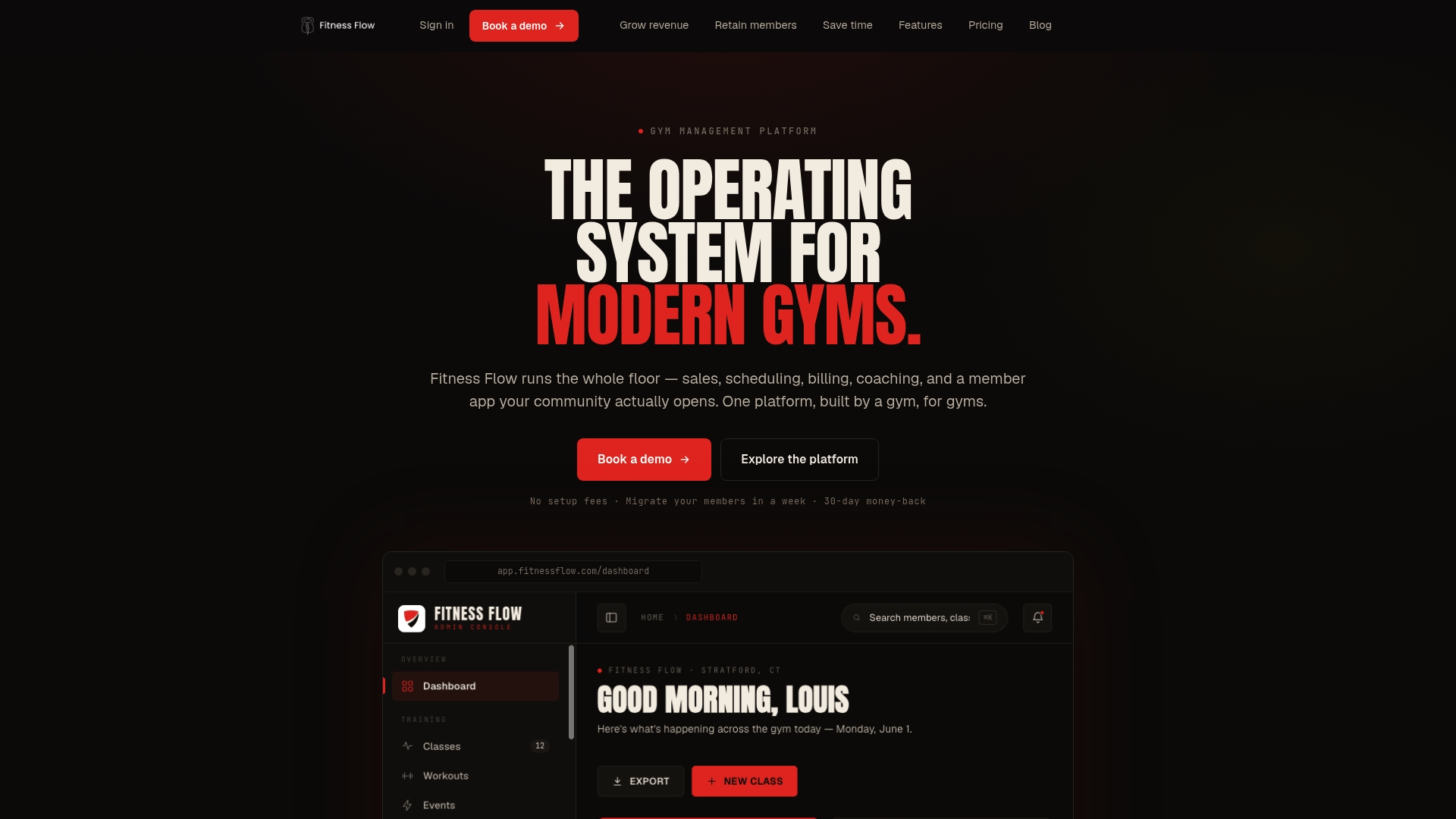
See the plans and what each includes on the Fitness Flow plans page, or read how the platform works for modern gyms.
FAQ
What are the main revenue streams for a gym?
Recurring memberships are the base, followed by group classes, personal and small-group training, add-ons such as guest passes and recovery services, and digital or corporate offerings. The balance depends on your format: budget gyms lean on volume, while boutique studios lean on classes and packs.
How much of gym revenue comes from outside membership dues?
At big-box gyms, 15 to 25% of revenue comes from non-membership sources such as training, locker rentals and guest passes. Boutique studios earn more through class-based and package revenue within the core offer.
What is the fastest way to increase gym revenue?
Fill the capacity you already have and keep the members you already have. Raising retention and revenue per member through tiers usually pays off faster than adding members through promotions, since a 15% discount can cut per-client profit sharply.
How profitable is a typical gym?
Estimates vary by source and format. One Census-based estimate puts the average US fitness center at a 12% profit margin, and profitable strength studios most often report 10 to 19%. Your own books are the benchmark that counts.
Sources
- HFA 2025 Fitness Industry Benchmarking Report
- BFS Strength Report: Profitability Benchmarks & Insights
- Gym Business Models: Boutique vs Big Box vs Hybrid
- Fitness and Recreational Sports Centers Industry Report
- The Essential Fall Gym Audit
- Burning Earnings: The Brutal Math of Discounts in Gyms
- Increasing Non-Dues Revenue Streams in Fitness Clubs
- Are Gyms Profitable? Profit Margins and Startup Costs
- The Economics of Wellness Membership
- Fitness and Recreational Sports Centers: Rates, Revenue