

Nutrition Challenge Design: A Gym Owner’s Blueprint

A good gym nutrition challenge runs four to eight weeks, asks members to build two or three simple habits, scores what they control (logging days, protein range days, vegetable servings) instead of pounds lost, and has a plan for the day it ends. Most of the work is not the idea. It is the structure around it: one shared tracker, written rules, scheduled check-ins and a way to keep members coming after the finale. Get those right and a challenge becomes a retention tool. Skip them and attendance spikes, then falls.
This guide walks through the design in the order you would build it, with ideas for different member types and a way to measure the result.
Getfitnessflow
Keep Members Engaged Beyond the Challenge
Fitness Flow brings scheduling, billing, analytics and a branded member app together to help gyms support member engagement between visits.
TL;DR
- Choose a 4 to 8 week window, one or two goals and a single tracker everyone uses.
- Score behaviors members control, such as days logged or vegetable servings, not weigh-ins or body-fat change.
- Plan weeks 3 to 5 on purpose: that is where participation drops, and where outreach pays off.
- Write the rules, privacy terms and opt-out on one page before sign-ups open.
- Build the exit in advance: a published study found attendance fell below pre-challenge levels once the challenge ended.
Table of Contents
- Start with the goal, not the theme
- How long should it run?
- Score behaviors, not body weight
- Set protein and nutrition targets responsibly
- Keep tracking sustainable
- Ideas for different members
- A week-by-week rhythm
- Plan the finish before you launch
- Measure it afterward
- Where the work goes when you run it by hand
- Fitness Flow for running challenges
- Our view on challenge design
- FAQ
- Sources
Start with the goal, not the theme
Owners often start with a theme: a sugar reset, a protein push, a hydration month. The theme is the wrapper. The design starts with one question: what should members do differently in week six that they were not doing in week zero?
Two useful constraints:
- Pick one or two behaviors. “Log every meal and hit your protein range” is a complete brief. A list of seven rules is a list members abandon in week two.
- Name a concrete result. A specific promise such as a seven-day sugar reset reads as achievable, while “healthy eating month” does not say what to do on Tuesday.
Then decide who it is for. A challenge for your whole membership needs low-friction habits. A challenge for a performance crowd can use more detail. If it is your first run, aim for a manageable group. Using staff, family and friends as the first participants is a tactic ACE recommends for a first-ever challenge, because it creates buzz and produces testimonials for the next round.
How long should it run?
ACE describes three to 10 weeks as typical in the industry: short enough that the commitment does not overwhelm people, long enough to see results. Most gym owners land on four to eight weeks, and that is a sound range. A 30-day format is easy to explain and easy to calendar. Eight weeks gives habits more time to stick but needs a stronger middle.

A simple rule: the more habits you ask for, the shorter the challenge should be. Two habits can carry eight weeks. Four habits rarely survive three.
Score behaviors, not body weight
This is the design decision that matters most. If the leaderboard ranks weight or body-fat change, you reward crash dieting and you discourage everyone who is not in the top few. If it ranks behaviors, every member can win at their own level.
Fair, controllable measures include:
- Days with a complete food log.
- Days within a protein range set for each member’s body weight.
- Vegetable or fiber servings per day.
- Check-ins attended and workouts completed.
Unfair measures include weekly weigh-in comparisons and body-fat percentage rankings between members. They put the focus on the scale and invite extreme tactics.
There is professional support for this. ACE’s guidance on a weight-neutral approach argues that behavior-focused goals raise motivation, enjoyment and participation, and make a program accessible to a wider range of clients than a weight-loss contest does.
A sample points scheme
Award points only for things your staff can verify, and publish each definition before the first check-in:
BehaviorPoints
Food log completed for the day
1
Protein range met
2
Vegetables at two meals
2
Weekly check-in attended
5
Personal milestone reached
10
Encouraging a teammate
2
Adjust the numbers to fit your rhythm. What matters is that every line is a behavior, and that someone who starts late can still catch up. For more ways to run the scoreboard without turning it into a weight race, see our piece on gym leaderboard ideas.
Set protein and nutrition targets responsibly
If protein is one of your habits, work from published guidance and give ranges, not a single number.
HHS and USDA released the Dietary Guidelines for Americans 2025 to 2030 on January 7, 2026, replacing the 2020 edition. The new edition emphasizes real food and nutrient-dense protein, and it advises limiting highly processed foods, added sugars and refined carbohydrates. According to the University of Arkansas Extension, highly processed foods make up about two-thirds of U.S. energy intake, protein should supply 10 to 35 percent of total energy, and active people can aim for an upper limit of 1.4 to 1.6 grams per kilogram of body weight. The same source notes that extra protein should come with fewer calories elsewhere or more activity.
Coverage of the guidelines from PBS reports a recommended range of 1.2 to 1.6 grams per kilogram. Turn that into practice this way:
- Let each member choose a point inside a range, rather than assigning one target to everyone.
- Make the habit “hit your range five days a week,” not “hit it every day.”
- Tell members with a medical condition, such as kidney disease or diabetes, or who are pregnant, to check any change in eating with their physician or a registered dietitian before they start. Put that line in the rule sheet.
Timing matters too. If members train fasted or early, a short note on pre-workout snack timing helps them fit the challenge around their schedule.
Keep tracking sustainable
Daily logging is the easiest habit to measure and the easiest to burn out on. Two ways to keep it healthy:
- Offer a lighter mode. ACE’s March 2026 article on coaching instead of counting suggests short periodic tracking, such as a three to seven day food audit, and pattern journaling (hunger before and after eating, mood, sleep, protein and produce) for people who find detailed numbers stressful.
- Expect variability. In a randomized trial of 100 adults in a 12-week app-based weight-loss program, 84 percent completed the one-month visit and 76 percent the three-month visit, while median diet self-monitoring ranged from 1.9 to 5.3 days per week depending on the group. Regular logging is possible, but it is not uniform. Build your scoring so that five logged days is a strong week.
Use one tracker for everyone. Mixed tools make results impossible to compare and multiply the questions your staff has to answer.
Ideas for different members
The best nutrition challenge ideas match a member’s goal, schedule and food budget. A few formats that work:
- Plant-forward month. Members add vegetables, beans and whole grains. Printable trackers and a cultural food-sharing night keep it social, and food samples take pressure off grocery bills.
- Hydration month. Members track daily cups of water. Infused-water recipes and a taste-test prize give it a light, fun feel.
- Protein and produce. The simplest performance format: a protein range plus vegetables at two meals.
- Fit-the-clothes challenge. ACE describes an eight to 12 week “Drop Two Sizes” program at a California gym that centers on body shape instead of pounds, with guided workouts, nutrition coaching, accountability meetings, a journal and prizes for everyone who completes.
- Meal prep swap. Mid-challenge, members trade a prepped meal. It builds community and answers the “what do I eat?” question.
Allow substitutions for schedules, preferences and food access. Rules should create clarity without forcing every member onto the same meal plan. If you want more formats beyond nutrition, our lists of gym challenge ideas cover workout-based options as well.
A week-by-week rhythm
The structure below suits a 30-day run and stretches to eight weeks by repeating the middle.
- Before launch. Publish the one-page rules. Cover what is measured, when, how missed check-ins are made up, what approaches are off limits (extreme or unsafe methods), how winners are chosen and when someone can be removed.
- Day 1. Hold a group onboarding. Every participant logs a first meal before leaving, so the tracker works on day one.
- Week 1. Send daily messages to the group. Reach out individually to anyone who has not logged by day three. Most logging problems surface in the first seven days.
- Weeks 2 and 3. Post a leaderboard on the same day each week. Around day 15, send each active member a personal midpoint message.
- Weeks 3 to 5, if you run longer. Change the rhythm: a surprise recognition moment, reshuffled accountability partners, a short reset session. Publish a way to recover missed days so one bad week is not the end.
- Final week. Celebrate group progress, introduce your ongoing nutrition offer and hold an optional closing event.
- Days after. Send individual follow-up messages and collect testimonials.
Define a return path for anyone who misses a week: one specific action, such as booking a check-in, joining the next group session or replying to a short message. Watch for early signals in week three, like a missed check-in or messages going unopened, and use a friendly re-entry message.
Accountability is the engine here. In a 2026 multi-brand transformation challenge, roughly 125,000 participants completed a six to eight week program, and more than a quarter of one brand’s participants named accountability the single biggest contributor to their results. Your check-ins are not a bonus. They are the product.
Plan the finish before you launch

A challenge ends, and attendance often ends with it. In a peer-reviewed study of 91 members at three Minnesota group fitness studios, weekly attendance rose from 2.73 classes to 3.61 during an eight-week challenge, then fell to 2.54 afterward. Members with higher enjoyment motives declined less.
The lesson is design-level: reward enjoyment and habits, not just the contest, and give members something to join on day 57. Options:
- An ongoing nutrition or accountability program with a clear next-step price.
- A recurring challenge, two or three times a year, so there is always a next one.
- A habit streak that carries on in your app or group chat after the finale.
- A non-member price for friends, which ACE suggests as an easy path from challenge participant to ongoing client. Our referral program guide covers how to make that invitation work.
For members who still drift, a short sequence of win-back emails tied to attendance picks up where the challenge left off.
Measure it afterward
Review the challenge in the same week it ends, while details are fresh. Track:
- Sign-ups against your target and your capacity.
- Completion rate: how many finished what they started. If it is low, the challenge was probably too long, too hard or too thin on engagement.
- Engagement: check-ins attended, days logged, group-chat activity.
- Attendance in the four weeks before, during and after, compared with the pattern in the study above.
- Conversion: how many finishers joined the follow-on offer or became members.
- Member feedback and testimonials.
Write down what you would change. Then run the next one with that change. A challenge that improves each round compounds, and members begin to expect it.
Where the work goes when you run it by hand
Every step above creates admin: a sign-up list, a tracker, reminders, a leaderboard, a message to everyone who went quiet, a report afterward. For a small team, that is where good challenges stall.
Fitness Flow for running challenges
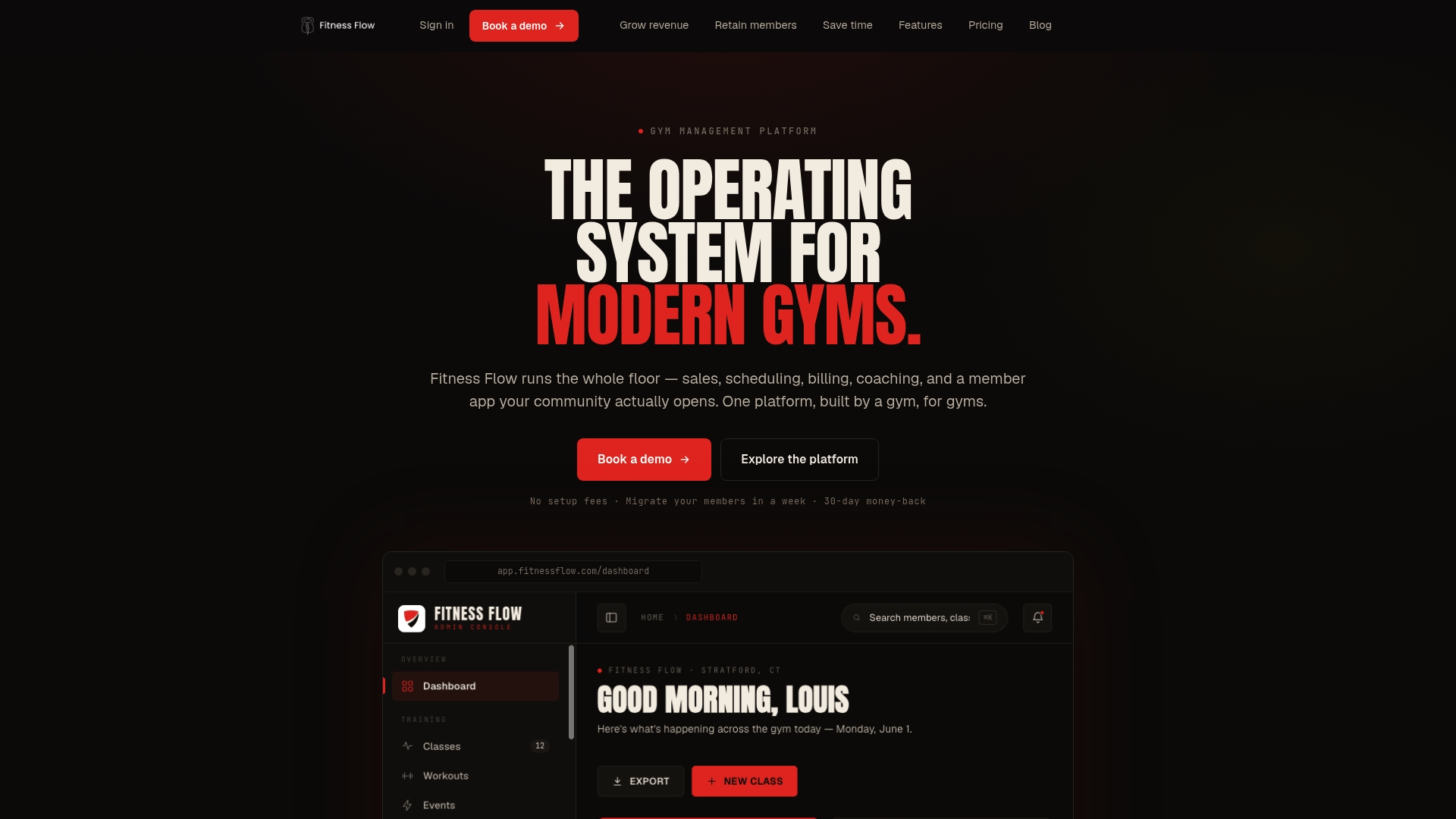
Fitness Flow is an all-in-one gym management platform with a fully branded member app, gamified retention features, workout and nutrition planning, automated member retention workflows and reporting and analytics. That puts the tracker, the points, the reminders and the results in one place for your gym instead of across several subscriptions. The platform’s published results, as we state them, are a 27% average increase in member retention and 12 hours saved on admin each week. Solo is $149 per month and Studio is $349 per month; Multi-site pricing is not published. See the plans and the platform.
For a low-risk way to test nutrition programming first, read our 4 to 8 week pilot for nutrition planning, and see how gamification supports retention.
Our view on challenge design
Most challenges fail in the same place: they are designed as an event, not as a path. The launch is exciting, the leaderboard is busy for two weeks, and then the member who needed the most help is the first to disappear.
We build Fitness Flow around the idea that retention is made between visits. A branded app, gamified features and automated retention workflows exist so a member who goes quiet in week three hears from you before they decide to leave. That is why we argue for scoring behavior, publishing the return path and planning the exit.
A challenge is the best moment you will get all quarter to learn who engages, who needs a nudge and who is ready for an ongoing offer. Treat it as a retention program with a start date, and keep the data from it.
Louis
FAQ
How long should a gym nutrition challenge last?
Four to eight weeks suits most gyms, and ACE describes three to 10 weeks as typical. Use fewer habits for shorter runs. A 30-day format with one or two habits is the easiest first challenge.
What is the best way to score a nutrition challenge?
Score behaviors members control: logging days, protein range days, vegetable servings and check-ins. Avoid ranking weight or body-fat change, which rewards extreme dieting. Publish each point value before the first check-in.
How many members should join a first challenge?
Start with a group your staff can personally follow up with. For a first run, staff, family and friends make good early participants because they create buzz and testimonials. Grow the cap once your check-in routine works.
What should I do when members have medical conditions?
Add a line to the rule sheet telling members with a medical condition, or who are pregnant, to speak with their physician or a registered dietitian before changing how they eat. Keep medical questions out of group chats.
Sources
- ACE: Creating a Profitable Nutrition and Weight Loss Challenge
- ACE: Increase Your Impact By Taking a Weight-neutral Approach
- ACE: Stop Counting, Start Coaching
- Gibson Dunn: HHS and USDA Publish Updated Dietary Guidelines for Americans
- University of Arkansas Extension: Taking protein into account with the new food pyramid
- PBS NewsHour: Why nutrition experts are wary of new federal dietary guidelines
- JMIR mHealth and uHealth: Comparing Self-Monitoring Strategies
- Athletech News: Accountability Beats Motivation in Delivering Fitness Results
- Furman and Volz: Who stays for the after party?
- Pre-workout focus snacks: what to eat and when