

Class Naming Conventions for Gyms and Studios

A good class naming convention is a short, written rule that every class on your schedule follows: the same word order, the same capitalization, the same labels for level, length and format. Members then know what they are booking before they read a description, and your front desk stops answering the same “what is that class?” question all day. This guide is for gym and studio owners and managers, so it covers naming the classes on your schedule, not naming classes in code.
If you came here from the programming side, the idea is the same: a naming convention is a team agreement that makes things predictable. We borrow that thinking below, because it works just as well on a class timetable.
Getfitnessflow
Make Class Schedules Easier to Manage
Fitness Flow brings gym scheduling and member engagement together in one platform, helping owners keep class information organized and members connected.
TL;DR
- Use one formula for every class name: format first, then level or focus, then length (for example, “Strength Foundations 45”).
- Name classes for what members will do, not for clever branding they have to decode.
- Write the convention down on one page: capitalization, abbreviations, level labels, live and on-demand tags.
- Multi-location operators should use one shared naming list so a member can book at any site without relearning your vocabulary.
- Rename in batches, announce changes, and update the name everywhere members see it: schedule, app, emails and signage.
Table of Contents
- Why the software world’s naming rules apply to your schedule
- The five problems bad class names cause
- A simple formula for class names
- Capitalization, punctuation and abbreviations
- Worked example: cleaning up a real-looking schedule
- Naming live, on-demand and in-person classes
- Naming across multiple locations
- Building the convention in one week
- Naming and retention
- Our perspective
- Put your convention to work in one platform
- FAQ
- Sources
Why the software world’s naming rules apply to your schedule
Developers have written down naming rules for decades because unclear names slow every team down. Kotlin’s official conventions, for instance, say a class name is usually a noun or noun phrase that explains what the class is and makes its purpose clear, and they warn against empty words such as Manager or Wrapper. Microsoft’s C# guidance asks for meaningful, descriptive names and clarity over brevity, and cautions against abbreviations except widely known ones.
Swap “class” for “group fitness class” and the advice holds:
- Name what it is. A noun phrase that describes the format beats a mood or a pun.
- Avoid empty words. “Total Body Blast” or “Fitness Fusion” could mean anything. “Full-Body Strength” cannot.
- Be consistent. The pattern matters more than the specific pattern you pick. Developer guidance on naming puts consistency inside the team first: personal preference matters less than everyone following the same rules.
- Skip obscure abbreviations. Members are not on your staff group chat.
A schedule is a product interface. Members scan it on a phone, often between meetings, and decide in seconds. Names are the first thing they read.
The five problems bad class names cause
Before building a convention, it helps to know what you are fixing.
- Booking hesitation. A new member sees “Inferno” and “Flow” and cannot tell which is easy. They book nothing, or book the wrong one and do not return.
- Level mismatch. A beginner in an advanced class has a bad first visit. Unclear names are a common cause, because the level is hidden in the description or nowhere at all.
- Front desk load. Every ambiguous name becomes a question your staff answer in person, by phone or by DM.
- Messy reporting. If the same class is called “HIIT 30”, “HIIT Express” and “30 Min HIIT” across weeks, you cannot see whether the format is actually working. Inconsistent names make attendance data hard to compare.
- Brand drift across sites. Two locations naming the same format differently confuses members who visit both and makes centralized management harder.
The last two matter most for retention. You cannot improve what you cannot compare, and members stay when the right class is easy to find and easy to book.
A simple formula for class names
The most dependable convention is a fixed word order:
[Format or Discipline] + [Level or Focus] + [Length, if you run more than one]
Examples:
- Strength Foundations 45
- Cycle Endurance 60
- Yoga Gentle 60
- Mobility Reset 30
- Boxing Fundamentals 45
Why this order works: members search by what they want to do first (strength, cycling, yoga), so the discipline leads. Level comes second because it is the most common reason someone rules a class in or out. Length goes last because it is the detail they check against their calendar.
Keep the format word recognizable
Use the word a member would use. “Cycle” or “Spin”, “Yoga”, “Pilates”, “Boxing”, “Strength”, “Barre”. If you run a branded format that has a house name, pair it with a plain descriptor the first time: “Forge: Full-Body Strength”. After a few months the house name can stand alone on the schedule, but new members always get the plain version in the description.

Use a short, fixed list of levels
Pick three or four level labels and never invent new ones. A common set is:
LabelWho it is forWhat it signals
Foundations
First-timers and returners
No experience needed, slower pace, coaching on basics
All Levels
Mixed groups
Options for easier and harder versions
Intermediate
Members with regular training
Assumes you know the main movements
Advanced
Experienced members
Higher intensity or skill demands
Write one sentence defining each label and put it on your website, in your app and at the front desk. A label without a definition is just another vague name.
Put length in the name only when it varies
If every class is 45 minutes, a number in each name is noise. If you run 30, 45 and 60 minute versions of the same format, the number is useful and belongs at the end. Use the same style everywhere: “45” or “45 min”, never both.
Capitalization, punctuation and abbreviations
Software teams write these rules down because small inconsistencies pile up. Do the same.
- Capitalization: Use title case for every class name (“Mobility Reset”, not “MOBILITY RESET” or “mobility reset”). It reads cleanly on a phone and looks the same across every channel.
- Punctuation: No exclamation marks, emojis or slashes. Use a colon only for a house-name-plus-descriptor pair.
- Abbreviations: Allow only the ones your members already know and list them. HIIT is widely understood in fitness; “CTC” or “MBT” invented by a coach is not. When in doubt, spell it out.
- Numbers: Use numerals for length and levels (“Level 1”), spelled-out words nowhere.
- Length of the name: Aim for no more than four words so it does not truncate in a calendar view or an app list.
The same logic appears in code style guides. One widely used Kotlin rule, for example, is to treat short and long acronyms differently so that names stay readable. Your equivalent is a short approved list of abbreviations, nothing outside it.
Worked example: cleaning up a real-looking schedule
Imagine a studio with this Monday to Wednesday schedule:
- Monday 6:00: “Rise & Grind”
- Monday 12:15: “Lunch Burner HIIT”
- Tuesday 6:00: “Power Hour”
- Tuesday 18:30: “Iron Therapy”
- Wednesday 6:00: “Rise and Grind Express”
- Wednesday 18:30: “Yoga”
A new member cannot tell which are strength, which are cardio, which are for beginners, or how long they last. Rise & Grind and Rise and Grind Express may or may not be related. Applying the formula:
BeforeAfterWhat changed
Rise & Grind
Strength Full-Body 60
Format, focus and length now visible
Lunch Burner HIIT
HIIT Express 30
Plain format, length matches the lunch slot
Power Hour
Strength Foundations 60
Level added, “hour” replaced by a real number
Iron Therapy
Strength Intermediate 45
Pun removed, level explicit
Rise and Grind Express
Strength Full-Body 30
Same format as Monday, shorter version, now comparable
Yoga
Yoga All Levels 60
Level and length clarified
Notice what the cleanup also does for reporting: Monday and Wednesday morning classes are now clearly the same format at two lengths, so you can compare their attendance directly.
If you want to keep personality, keep it in the description and the coach’s intro, not in the name. A coach’s voice is a strength. A schedule is the wrong place to make members solve a riddle.
Naming live, on-demand and in-person classes
If you stream classes or offer recordings, members need to know how a class is delivered before they book. Add a delivery tag at the end, in the same place every time:
- Strength Foundations 45 (In Studio)
- Strength Foundations 45 (Live)
- Strength Foundations 45 (On Demand)
Use the same tag words in every channel. If your schedule says “Live” and your app says “Virtual”, members will wonder whether they are different things. Our guide to running live classes for gyms covers how to pilot streaming in a week and scale it over 30 to 90 days, and a consistent tag makes that rollout far easier to explain to members.
Naming across multiple locations
For owners with more than one site, the convention is the difference between a network and a handful of separate gyms. Three rules help:
- One master list. Keep a single document of approved class names, level labels and tags. Site managers pick from it; they do not invent new names.
- Location lives in the location field, not the class name. “Downtown Strength Foundations 45” duplicates information your schedule already shows and breaks comparisons. Keep the class name identical at every site.
- One owner for changes. Someone, often an operations lead, approves additions. Otherwise every site adds its own “special” version within a quarter.
With the same names everywhere, a member who moves between sites finds the same experience, and you can compare formats across locations in your reporting without translating between vocabularies.
Building the convention in one week
You do not need a project team. A single manager can do this in about a week.
- Export your current class list. Include every name used in the last 90 days, with attendance if you have it.
- Group by real format. Put all the near-duplicates together (the three HIIT variations, the two yoga versions).
- Pick the formula and level labels. Use the structure above. Limit yourself to three or four levels.
- Write the one-page rulebook. Capitalization, approved abbreviations, level definitions, delivery tags, maximum length.
- Rename in one batch. Changing names piecemeal means members see both versions for months. Pick a date, update everything together.
- Tell members. A short note in your app and emails (“Same classes, clearer names”) plus signage at the front desk prevents confusion for regulars.
- Brief the coaches. They are the ones members ask. Give them the new names and the level definitions.
- Review after 60 days. Check which names still cause questions and adjust the rulebook.
When you rename, update the name everywhere a member sees it: schedule, booking page, app, reminder emails and printed timetables. A name that differs between channels is worse than a name that was never changed.
Pair naming with capacity and programming
A clear name also sets expectations for size. Beginner formats often need smaller groups; a high-volume format may suit a bigger room. Our class capacity planning guide shows how to set limits in a week, and our group class programming templates give instructors ready-to-run structures that match the naming formula, so the label on the schedule matches what actually happens in the room.
Naming and retention
Names feel cosmetic, but they act on the moments that decide whether a new member stays: the first booking, the first visit and the second booking. A beginner who can identify “Foundations” classes books one, has a good experience and books another. A beginner who guesses wrong may not come back.

A clean convention also helps you group members by what they attend. If “Strength Foundations” is always spelled the same, you can see who comes to it, who stopped and who might be ready to step up. Our guide to gym member segmentation shows how to use groups like that to keep members engaged.
Our perspective
We built Fitness Flow around a simple observation: gym owners lose hours every week to small, avoidable friction, and the schedule is where much of it starts. A class list that members cannot read generates questions, no-shows and quiet drop-offs.
Our view is that the class name is part of your operating system, not a creative afterthought. When scheduling, booking, billing, your branded member app and your live and on-demand classes all sit in one platform, the names you choose appear consistently in every place a member looks. That is why we encourage owners to settle their naming convention first and then run the whole business from one system, instead of retyping the same class names into several separate tools.
Our platform is designed to cut administrative work, with an average of 12 hours saved each week and a 27% average increase in member retention across our customers. Clear, consistent class names are one of the cheapest ways to start earning that back.
Louis
Put your convention to work in one platform
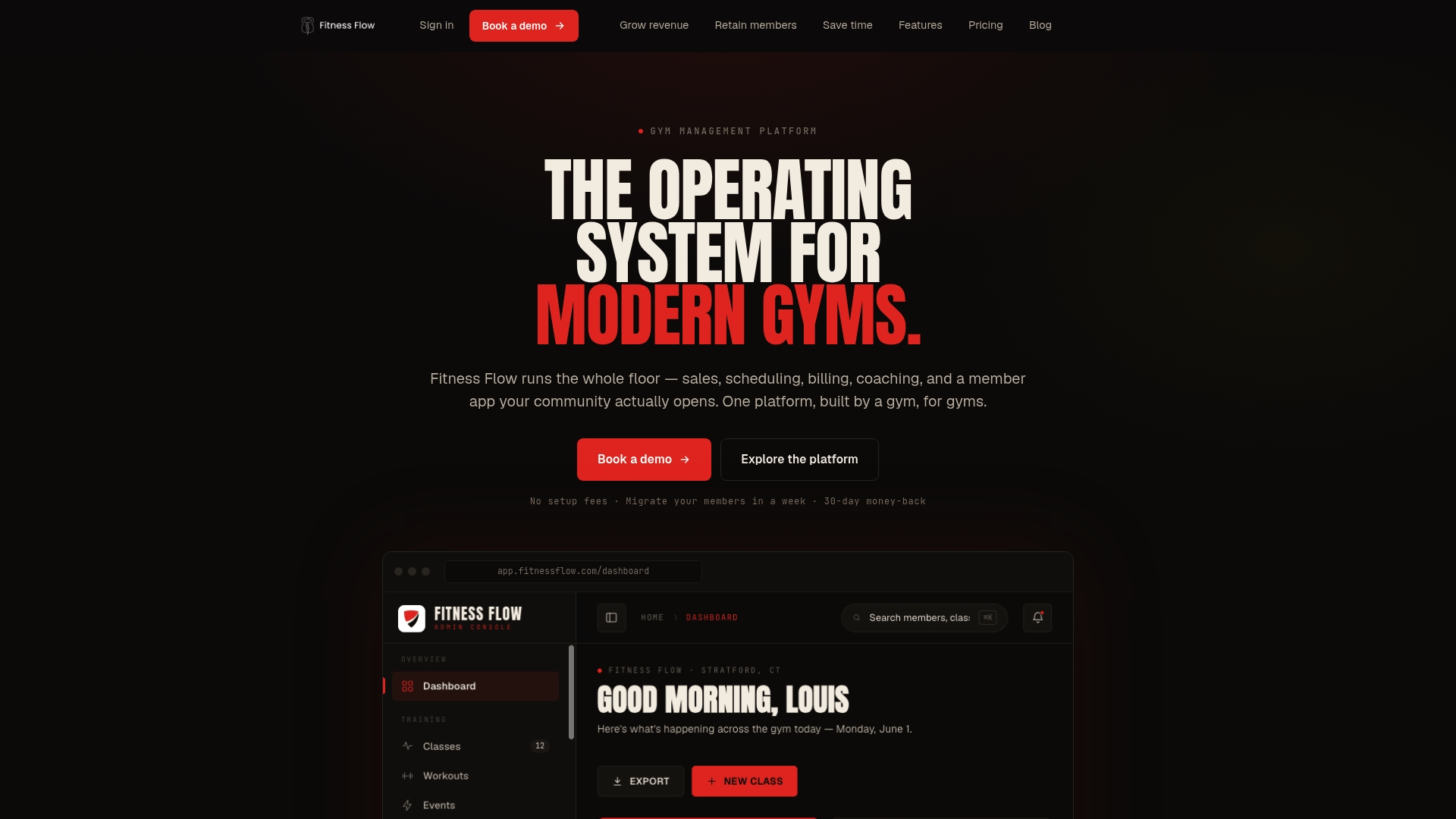
A naming convention is only as good as the tools that carry it to members. Fitness Flow combines class scheduling and booking, recurring billing, a fully branded member app, live and on-demand class streaming and reporting in one platform, so your class names look the same everywhere your members see them.
The Solo plan is $149 per month and the Studio plan is $349 per month; Multi-site pricing is not published. You can compare plans on our plans page or see how the platform works for modern gyms. If you are moving from another system, our gym software implementation playbook walks through the rollout, and we offer migration support.
FAQ
What is the best format for a group fitness class name?
Use a fixed order: format first, then level or focus, then length if you run several. “Strength Foundations 45” tells a member what they will do, how hard it is and how long it takes. Keep the order identical for every class.
Should I use creative names for my classes?
Keep creative names for your description and your coaches’ introductions. On the schedule, a plain format word helps members decide quickly. If you have a branded format, pair its house name with a plain descriptor, such as “Forge: Full-Body Strength”.
How many level labels should I use?
Three or four is enough, for example Foundations, All Levels, Intermediate and Advanced. Write a one-sentence definition for each and publish it where members book. More labels create new confusion instead of removing it.
How do I rename classes without confusing regulars?
Rename in a single batch on a set date, update every channel at once and tell members in advance through your app, email and front desk. Brief your coaches so they can answer questions, and review after about 60 days.
Do class naming conventions in programming have anything to do with this?
The principle is shared: use clear nouns, stay consistent and avoid vague words. In code, rules differ by language; for example, Python’s official style guide asks for CapWords for class names. For a gym schedule, the equivalent is the written formula and rulebook above.
Sources
- Coding conventions | Kotlin Documentation
- Identifier names: rules and conventions | Microsoft Learn
- Naming Things | DevIQ
- PEP 8: Style Guide for Python Code