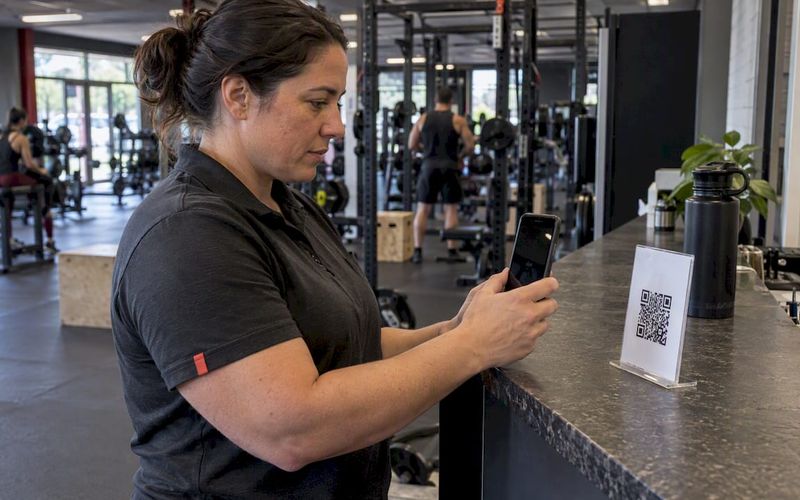

30 Day Fix for Gym Sales Funnel: Five Number Audit for Owners

A gym sales funnel maps how strangers become retained members through staged touchpoints: discovery, first contact, trial, conversion, and retention. The single fastest lever to pull right now is a specific, time-limited offer on a dedicated landing page paired with follow-up inside 60 minutes. Everything else, including channels, sequences, and dashboards, exists to support that one mechanism.
TL;DR:
- Improving response times to inquiries within one hour significantly increases the chances of converting leads into trial bookings and memberships.
- A clear, specific, and risk-reversal offer on a streamlined landing page boosts trial engagement and reduces booking friction.
- Automating follow-up texts and emails immediately after a lead’s inquiry can increase trial attendance rates by up to 40 percent.
- Regular weekly tracking of key metrics such as trial show rate, booked-to-attended ratio, and retention helps identify and fix funnel leaks quickly.
- Using an all-in-one platform reduces data loss and manual errors, ensuring a seamless experience from lead capture to retention analysis.
Table of Contents
- What Is a Gym Sales Funnel, and Where Do Prospects Drop Off?
- Build Your Funnel Step by Step: Channels, Offers, and Booking
- The Follow-Up Sequence That Actually Gets Trials Attended
- The Numbers That Tell You If Your Funnel Is Working
- Diagnose Leaks Fast: The Five-Number Weekly Audit
- Running the Funnel Without Duct Tape and Spreadsheets
- Legal and Privacy Considerations You Can’t Skip
- Segmenting Members So Your Messaging Actually Lands
- Handling Pricing Pushback and Commitment Fears
- What I’d Fix First in a Struggling Gym
- Run This Funnel Without the Spreadsheet Chaos
- Sources
What Is a Gym Sales Funnel, and Where Do Prospects Drop Off?
Most gyms don’t have a broken funnel. They have a funnel with one or two stages leaking badly, and nobody has measured which ones.
A practical model has six stages: Discovery (someone sees your ad, Google listing, or a friend’s post), First Contact (they message or call), Trial (they book and show up for a class or session), Conversion (they sign a membership), First 90 Days (the make-or-break onboarding window), and Retention (they stay past month three). Boutique studios often collapse this into a leaner four-stage version: Attention, Interest, Trial, and Membership, borrowing directly from the classic AIDA marketing framework of Attention, Interest, Desire, Action. Either model works, as long as you assign a metric to each stage transition.
Drop-off tends to cluster in predictable places:
- Slow reply times. A lead who messages on Instagram at 7 p.m. and hears nothing until the next morning has usually already booked a trial somewhere else.
- Vague offers. “Come try a class” converts worse than “Free 7-day trial, no card required, ends Sunday.”
- Booking friction. A five-field form asking for emergency contacts before someone has even seen the gym kills momentum.
- No-shows. Trials booked without a confirmation and reminder sequence often see attendance rates well under half.
- Weak onboarding. A signed member who never gets a second touch in their first two weeks is a cancellation waiting to happen.
Every one of those leaks is fixable without new ad spend. That’s the part most gym owners overlook.
Build Your Funnel Step by Step: Channels, Offers, and Booking
Building the funnel isn’t about doing everything at once. It’s about matching the right tactic to the right stage, in the right order.
- Pick channels by intent, not popularity. Meta (Facebook and Instagram) remains the workhorse for cold traffic because its targeting still reaches people who aren’t actively searching but fit your ideal member profile, and fitness marketing benchmarks consistently point to the offer, not the creative, as the real lever. Google Ads captures people already typing “gym near me,” which means higher intent and usually higher cost per click. Your Google Business Profile and local SEO catch persistent, ongoing demand for free, and deserve at least as much attention as your ad budget.
- Design an offer people can say yes to immediately. Specificity beats cleverness. “14-day trial, $19, includes one free personal training session” outperforms “Try us out” almost every time because it removes ambiguity about cost and commitment. Risk-reversal matters too: a no-lock-in guarantee or a refund on the trial fee if they’re not satisfied lowers the psychological barrier to booking.
- Strip your landing page down to one job. No navigation menu. No links to your blog or class schedule. One offer, one headline, a short testimonial or before/after photo for social proof, and a single button that says “Book My Trial.” Every extra link is an exit ramp.
- Make the booking flow short and mobile-first. A multi-step form (name and phone first, goals second, calendar last) converts better than one long form because each completed step creates commitment. Add a calendar widget so people pick a real time slot instead of waiting for a callback, and use simple qualification logic (a question about goals or availability) to keep your front desk from wasting time on unqualified leads.
Pro Tip: Run two versions of your offer headline for two weeks using a tool like VWO before committing ad spend to either one. A/B testing landing pages is one of the most reliable, low-risk ways to lift conversion without touching your creative or budget.
The channels matter less than most owners think. Get the offer and the landing page right first. A mediocre ad pointed at a great landing page beats a great ad pointed at a confusing one, nearly every time.
The Follow-Up Sequence That Actually Gets Trials Attended
Here’s the uncomfortable truth: the best ad campaign in the world is wasted if your follow-up is inconsistent. Industry data backs this up hard.
Timing is everything. Send an SMS within 5 to 60 seconds of a lead submitting a form. Follow with an email the same day that includes more detail: directions, what to bring, and a photo of the space. Send a reminder the day before the trial, another the morning of, and if they don’t show, a same-evening recovery message offering to reschedule. Miss that window and the lead goes cold fast.
SMS works because people read texts within minutes; email works because it can carry more context and social proof without feeling like a demand. Use both, not one or the other.
Automation rules of thumb:
- Confirmation and reminder messages can run entirely on templates or AI-driven sequencing.
- Messages involving pricing objections, injury concerns, or a canceled trial should route to a human within the hour.
- Scarcity and social proof messages (“3 spots left this week” or a client success story) perform best mid-sequence, not in the first text.
A structured, multi-touch nurture sequence combining SMS and email can increase booked-trial conversion by 30 to 40 percent compared to inconsistent manual follow-up. That gap is almost entirely a systems problem, not a sales-skill problem.
If your front desk is manually texting leads whenever they remember, you’re leaving a third of your conversions on the table.
The Numbers That Tell You If Your Funnel Is Working
You can’t fix what you don’t measure weekly. Six numbers matter more than the rest.
- Enquiries — total leads by source (Meta, Google, walk-in, referral).
- Replied within 1 hour — the percentage of leads who got a response inside 60 minutes.
- Booked trial rate — enquiries that convert to a scheduled trial.
- Trial show rate — booked trials that actually walk through the door.
- Trial-to-member — attended trials that convert to a paid membership.
- 90-day retention — signed members still active after three months.
Two quick formulas make this actionable. Cost per booked trial = total ad spend ÷ number of trials booked. Rough lifetime value = average monthly dues × average retention in months. Track both monthly.
Benchmark ranges from operator case studies put cost per booked trial around $35 to $80, with trial-to-member conversion landing between 35% and 55% depending largely on front-desk follow-up quality. Track all of this in Google Analytics alongside your CRM so channel data and conversion data live in one place, reviewed weekly, not quarterly.
Diagnose Leaks Fast: The Five-Number Weekly Audit
Run this audit every Monday morning and you’ll know exactly where to spend your next hour of effort.
- Enquiries by source. If one channel dried up, check ad spend or Google Business Profile activity before touching anything else.
- Reply-within-hour rate. Below 70%? Fix this before spending another dollar on ads. It’s the cheapest lever in the entire funnel.
- Booked-to-attended ratio. Low attendance points to a reminder cadence problem, not a scheduling problem.
- Attended-to-signed ratio. Weak here usually means the trial experience itself, or the close, needs work, not the marketing.
- Signed-to-90-day-retained. A steep drop here is an onboarding failure, and no amount of new lead flow will fix it.
Triage by whichever number is worse. Fixing reply time is nearly always the fastest win because it costs nothing and takes a day to implement.
Running the Funnel Without Duct Tape and Spreadsheets
Most gyms run this funnel across four or five disconnected tools: a lead form, a separate texting app, a spreadsheet for trial tracking, and a different system entirely for billing once someone signs. Every handoff between those tools is a place a lead can vanish.
An all-in-one platform like Fitness Flow puts booking, CRM, automated SMS and email sequences, payments, and analytics on one data source, so a lead who books a trial on your landing page automatically enters the nurture sequence and lands on your retention dashboard without anyone re-typing their information into a second system.
Pro Tip: Before switching platforms, map your current funnel: landing page, booking form, CRM, nurture sequence, and dashboard. If any two of those live in different systems today, that gap is your biggest hidden leak.
- Single data source eliminates re-entry errors between booking and billing.
- Automated multi-touch SMS and email sequences run without manual triggering.
- Analytics dashboards track the same five audit numbers automatically.
Legal and Privacy Considerations You Can’t Skip
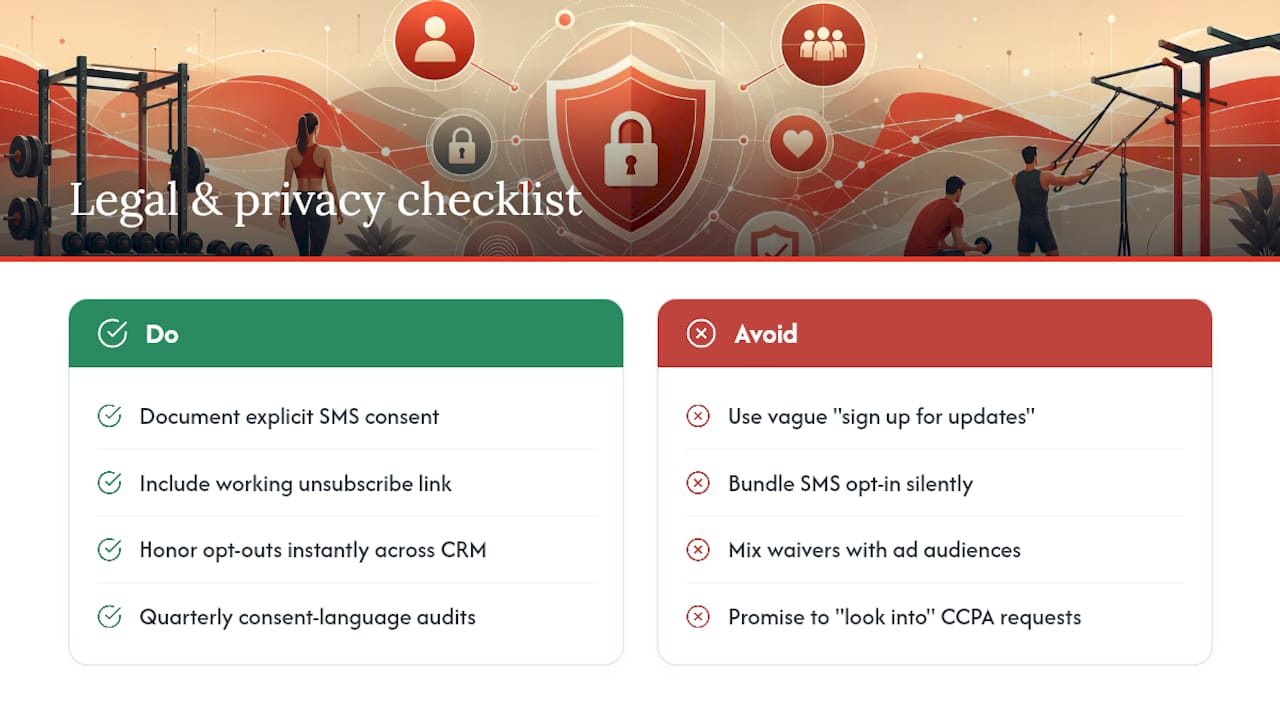
Every lead form, SMS opt-in, and CRM entry in your funnel involves personal data, and that carries real legal weight, not just a checkbox.
If you send marketing texts, you need explicit consent under the Telephone Consumer Protection Act, and that consent has to be clearly documented, not implied because someone filled out a form. Bundle SMS opt-in into a vague “sign up for updates” checkbox and you’re exposed if a lead later disputes it. Email marketing carries its own requirements: every message needs a working unsubscribe link, and once someone opts out, your CRM has to honor that instantly across every sequence, not just the one they clicked out of.
Waivers and liability forms collected during the trial or signup stage typically contain health information, which deserves tighter storage rules than a general marketing list. Keep that data segmented from your ad-retargeting audiences. If you use California-based ad platforms or serve California residents, the California Consumer Privacy Act gives members rights to request what data you hold and to ask for deletion, and your CRM needs a real process for honoring that request within the legal window, not a promise to “look into it.”
The safest habit: audit your CRM and texting platform’s consent language once a quarter, and make sure every automated sequence has an obvious, working opt-out. A retention win from a great nurture sequence isn’t worth a compliance complaint that follows your gym online for years.
Segmenting Members So Your Messaging Actually Lands
A 22-year-old training for a bodybuilding show and a 55-year-old recovering from knee surgery should never get the identical email.
Segment first by funnel stage: cold leads need attention-grabbing offers, active trial members need confidence-building reminders, and existing members need entirely different messaging focused on habit reinforcement, not acquisition. Within each stage, split further by goal. Weight-loss-focused leads respond to before/after proof and class variety; strength-focused leads respond to progressive overload tracking and PR celebrations; older or rehab-focused members respond to safety, pacing, and low-pressure language.
Time-of-day and schedule data matters too. A member who only ever books 6 a.m. classes is a different segment from one who trains at 7 p.m., and your retention nudges should reflect that (an early riser doesn’t need a reminder about your evening yoga series). Referral-source segmentation helps as well: leads from a corporate wellness partnership convert differently than leads from a Meta ad, and treating them identically wastes the context you already have.
The practical move is tagging every lead and member with two or three attributes at signup (goal, schedule preference, source) inside your CRM, then building your nurture sequences around those tags rather than a single generic sequence for everyone. It’s a small amount of setup work that pays off every single week your automation runs.
Handling Pricing Pushback and Commitment Fears
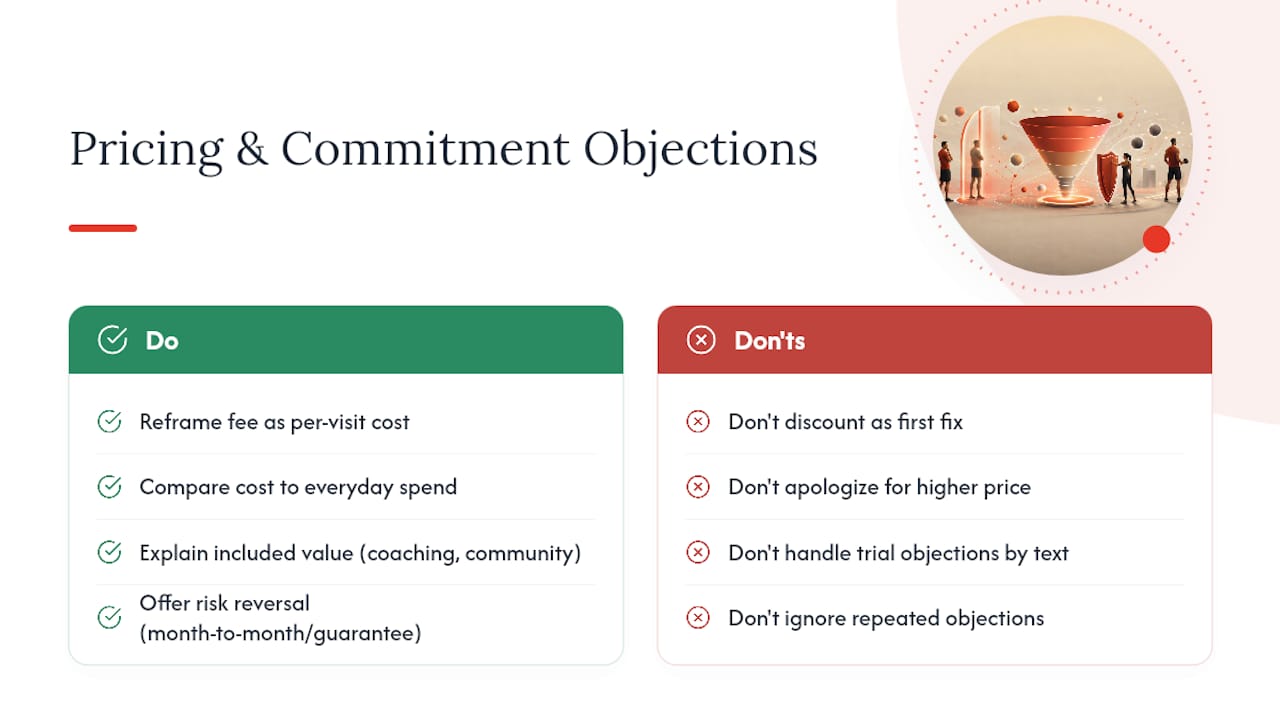
Two objections kill more memberships than everything else combined: “it’s too expensive” and “I don’t want to be locked in.”
On price, the fix isn’t discounting. It’s reframing. Break the monthly fee down to a per-visit cost and compare it to something the prospect already spends money on without hesitation, like a few coffees a week. If your gym genuinely delivers more value at a higher price point, don’t apologize for the number; explain what’s included that a $10-a-month box gym doesn’t offer; coaching, community, programming.
Commitment fear needs a different answer entirely: risk reversal. A month-to-month option, or a guarantee that lets someone cancel a longer-term plan within the first two weeks if it’s not a fit, removes the fear of being stuck. This is exactly why the offer language matters so much back at the landing-page stage; a trial that already promises “no long-term commitment” preempts this objection before it ever comes up at the front desk.
Timing matters too. Objections raised during the trial itself should be handled by a coach or manager in person, where tone and reassurance carry weight. Objections raised over text or email are better handled with a short, specific answer and a link back to your FAQ or pricing page rather than a long paragraph that reads like a sales pitch. And if the same objection keeps surfacing across many leads, that’s a signal to fix your landing page copy, not just train your staff to handle it better one conversation at a time.
What I’d Fix First in a Struggling Gym
Fix reply time and offer clarity before spending another dollar on ads. Then A/B test the landing page. Watch trial show rate and cost per booked trial for proof it’s working.
— Louis
Run This Funnel Without the Spreadsheet Chaos
Everything covered here, the offer, the landing page, the follow-up sequence, the KPI tracking, works best when it lives in one connected system instead of four disconnected tools fighting each other. Fitness Flow is built specifically for that gap: it handles lead capture, booking, automated SMS and email nurture, payments, and retention analytics from a single dashboard, so the five audit numbers from this guide update automatically instead of living in a spreadsheet nobody updates.
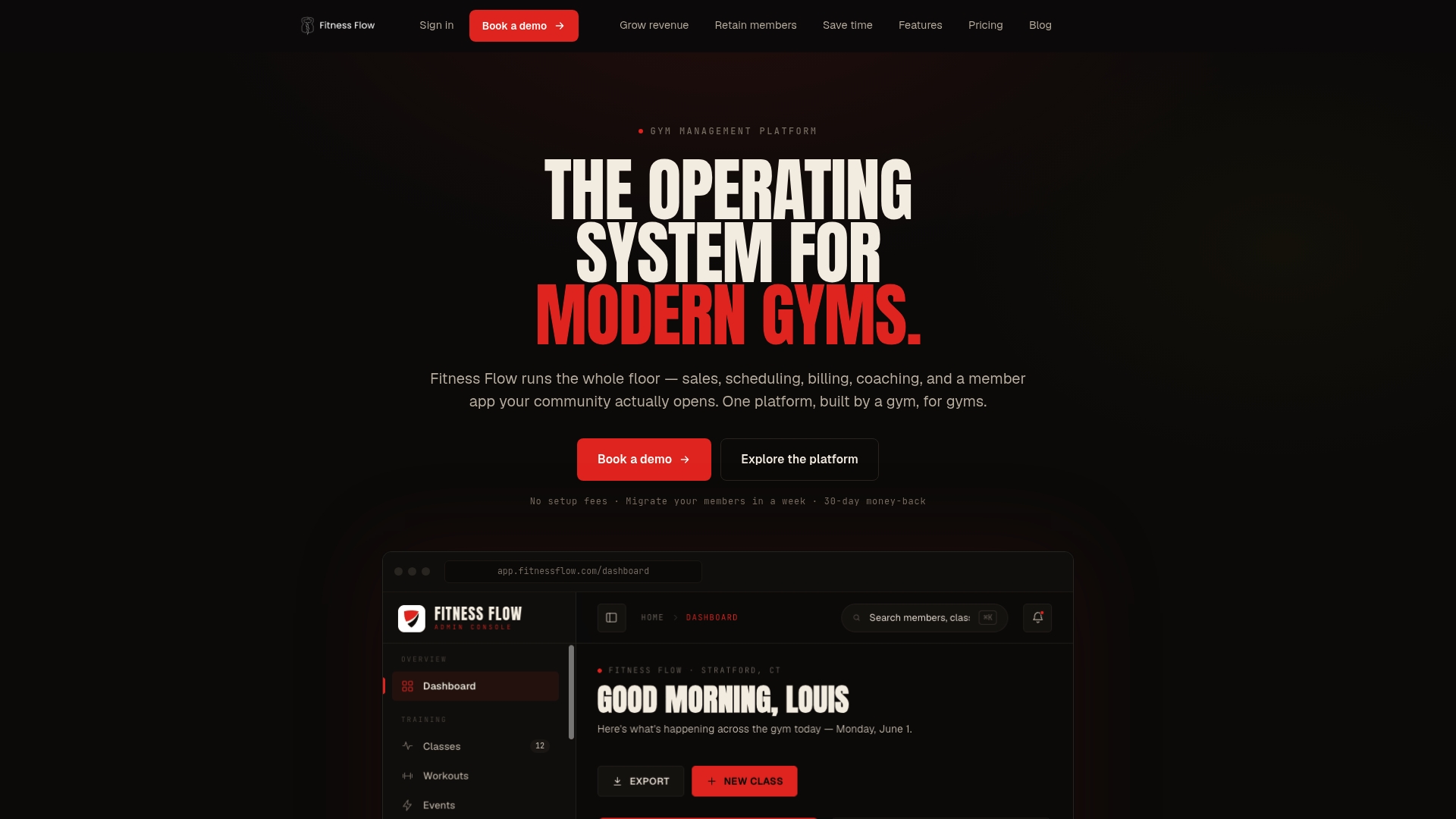
It’s not a replacement for a clear offer or good coaching. It’s the operational backbone that makes sure the funnel you just built doesn’t leak through gaps between software subscriptions. If you’re ready to see how a connected setup handles your trial-to-member handoff, book a demo of Fitness Flow and walk through your own funnel numbers with the platform live.