

Best Mindbody Alternatives for Studios in 2026

For most mid-sized studios, Joinfitnessflow is the strongest all-in-one move away from Mindbody: branded member app, CRM, billing, scheduling, and retention automation in one platform at predictable pricing. If your budget is tight and you mainly need scheduling, a value-oriented platform like Vagaro or Fresha covers the basics. If you want to keep your current booking system and just fix your retention problem, an automation-first layer is the lower-risk path.
Here is the quick shortlist:
- Best for mid-market studios (recommended): Joinfitnessflow — full operating system with branded app, CRM, multi-location reporting, and built-in automation
- Best for tight budgets: Fresha or Vagaro — low entry cost, solid scheduling, limited automation depth
- Best for retention automation: Automation-first platforms (e.g., behavior-based campaign tools layered over existing booking) — ideal when migration risk is high
- Best for niche modalities (yoga, martial arts, CrossFit): Zen Planner or Wodify — purpose-built workflows for specific training formats
- Best for fast-growing boutique studios: WellnessLiving or Momence — strong CRM and class management with growth-friendly pricing
One honest nuance: if your studio runs on marketplace discovery and new-member acquisition is your top priority right now, staying on a marketplace-adjacent platform while you build your branded audience is a defensible short-term call. The moment retention becomes the bottleneck, that calculus flips.
Table of Contents
- What do the top Mindbody alternatives actually look like side by side?
- Deep dives: trade-offs, pricing, and when to pick each category
- How do you choose the right alternative for your studio?
- Why Joinfitnessflow stands out as a leading alternative
- Key Takeaways
- The platform decision is more consequential than most studios realize
- Fitness Flow: what the demo and migration process actually cover
- Useful sources and next-step links
- FAQ
What do the top Mindbody alternatives actually look like side by side?
The table below maps the major platform categories across the dimensions that matter most to mid-market operators. Rows use category labels rather than brand names to keep the comparison honest.
CategoryBest ForPricing BandCore FeaturesBranded App vs. MarketplaceMulti-LocationIntegrations & APIMigration EaseSupport
Publisher recommended — all-in-one
Mid-market studios, multi-location gyms
Mid-tier subscription, tiered by size
Scheduling, CRM, billing, automation, video, referrals, compliance
Branded iOS/Android/web app
Yes, cross-location reporting
API + native integrations
Guided migration with data transfer & parallel run
Dedicated onboarding
Value-oriented scheduling-first
Solo operators, small studios under 200 members
Low entry (~$20/mo)
Scheduling, basic payments, client profiles
Marketplace presence; limited branded app
Limited or add-on
Zapier-dependent for advanced flows
Self-serve, low friction
Email/chat; slower SLA
Automation-first add-on
Studios keeping existing booking, fixing retention
Varies; often per-seat or per-campaign
Behavior-based campaigns, churn prediction, SMS/email flows
No app; sits on top of existing stack
Depends on host platform
API-required; middleware-heavy
Low migration risk; adds to existing setup
Varies by vendor
Niche modality specialist
CrossFit boxes, yoga studios, martial arts
Mid-tier ($100–$199/mo typical)
Workout tracking, belt/rank management, class packs, WOD builder
Branded app available
Limited multi-location
Moderate; some native, some Zapier
Moderate; modality-specific data mapping needed
Community forums + support tickets
Budget single-calendar option
Salons, spas, single-service studios
Free to low-cost entry
Appointment booking, basic POS, client notes
Marketplace-first (Fresha, Vagaro marketplace)
Minimal
Limited native integrations
Very easy; minimal data
Self-serve
Footnote: Starting prices across the market range from roughly $20–$199/month depending on model and promotional offers; add-ons for branded apps, SMS, and migrations materially change the total cost. A full migration for a mid-market studio typically runs 5–8 weeks and $3,000–$8,000 all-in.
Deep dives: trade-offs, pricing, and when to pick each category
Publisher recommended: Joinfitnessflow (all-in-one)
Joinfitnessflow is built specifically for independent and mid-sized gyms that have outgrown scheduling-only tools. The platform covers CRM and lead capture, sales pipeline, unified scheduling calendar, class and workout builder, branded member apps on iOS, Android, and web, live and on-demand video, nutrition and meal plan tools, member and employee management, billing and recurring payments, referral and review management, multi-location oversight with cross-location reporting, compliance and waiver tracking, wearable device integration, and automation with API access.

Pricing model: Tiered subscriptions based on gym size and features, paid monthly or annually, with enterprise/multi-site clients on custom plans. No publicly listed per-location penalty structure.
Strengths: Everything in one place means no middleware dependencies for core workflows. The branded app keeps member data and the renewal journey inside your ecosystem, not a third-party marketplace. Multi-location reporting is native, not bolted on.
Limitations: Richer feature set means a steeper initial setup than a single-calendar tool. Best fit for studios with 200+ members or clear growth ambitions.
When to pick it: You want to stop duct-taping scheduling, CRM, and marketing tools together. You are ready to own your member experience end-to-end.
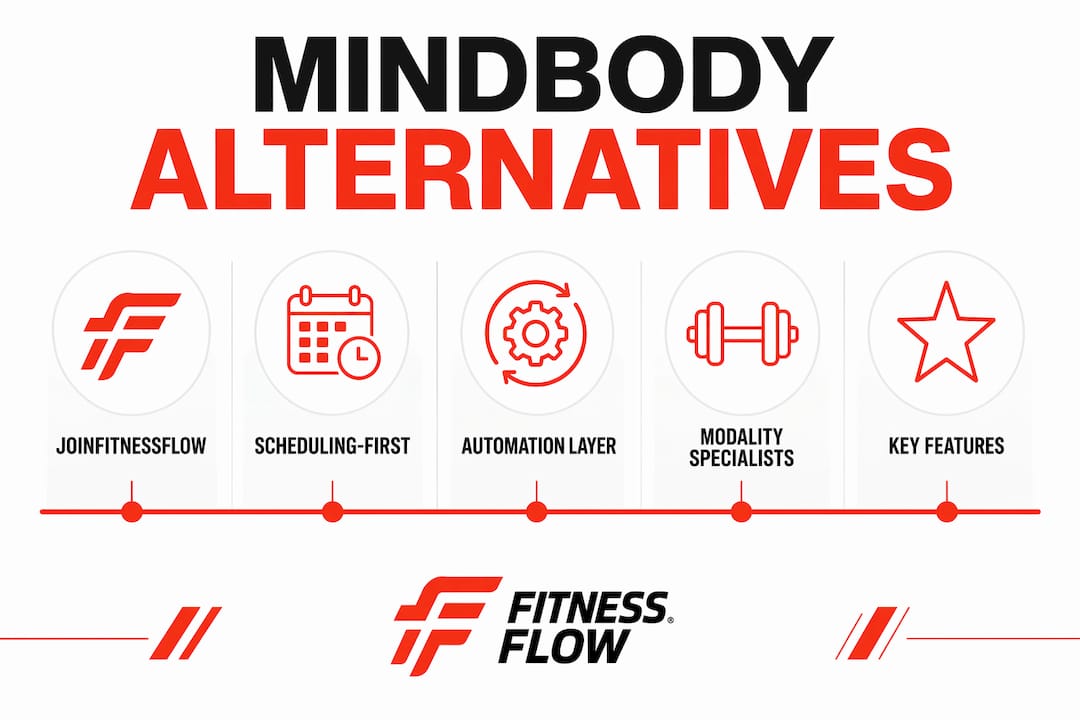
Value-oriented scheduling-first: Vagaro, Fresha, Bookee
These platforms win on price and simplicity. Vagaro and Fresha both offer marketplace exposure alongside their booking tools, which helps with discovery for newer studios. Fresha is particularly aggressive on pricing for appointment-based businesses. Bookee targets boutique fitness with a cleaner class-management interface.
Pricing: Entry-level options start as low as $20/month, though add-ons for SMS, branded apps, and advanced reporting push real costs higher. Pricing transparency varies across vendors, and add-ons can materially change the total.
Strengths: Fast to set up, low friction for small teams, marketplace presence aids discovery.
Limitations: Automation depth is shallow. CRM is basic. Retention workflows typically require Zapier or a separate tool, which introduces hidden costs and failure points. Member data lives partly on the marketplace, not fully in your hands.
When to pick it: You are under 150 members, budget is the primary constraint, and you are not yet running behavior-based retention campaigns.
Automation-first add-on layer: WellnessLiving, Momence, Hapana
Some studios get the best return by keeping a reliable booking system and adding a dedicated automation layer on top. This hybrid approach reduces migration risk while delivering better retention workflows. WellnessLiving and Momence both offer stronger CRM and automation than pure scheduling tools, and Hapana is built for enterprise and franchise operators who need multi-location automation at scale.

Pricing: Mid-tier, typically $100–$199/month for core plans; enterprise tiers are custom-quoted.
Strengths: Behavior-based campaigns, churn prediction, and SMS/email flows that respond to actual member activity. WellnessLiving has a strong G2 review profile for customer support. Momence is well-regarded for class management and reporting.
Limitations: If the automation layer requires API access to your booking system, you are dependent on that integration staying stable. Middleware-heavy setups can break quietly.
When to pick it: Migration risk is high (large member database, complex membership structures), and you need retention improvement now without a full platform swap.
Niche modality specialists: Zen Planner, Wodify, Glofox
Zen Planner is purpose-built for CrossFit boxes, martial arts studios, and functional fitness gyms. Wodify is the go-to for WOD tracking and performance logging. Glofox targets boutique fitness with a clean member app and strong class management.
Pricing: Typically $100–$199/month for core plans; Zen Planner and Wodify both have add-on fees for advanced reporting and branded apps.
Strengths: Workflow alignment with specific modalities. Zen Planner’s belt and rank tracking, Wodify’s performance logging, and Glofox’s boutique-focused UX are genuinely differentiated for their target users.
Limitations: Outside their target modality, these platforms feel narrow. Multi-location support is limited or expensive. Integration depth is moderate.
When to pick it: Your studio’s operations are tightly tied to a specific training format and you need software that speaks that language natively.
Retention benchmark: Industry retention rates across fitness platforms cluster between the low-70s and high-70s percent, which means even a few percentage points of improvement from better automation workflows translates directly to revenue.
Pro Tip: Before signing any contract, model your total cost at realistic volume: members, monthly transactions, SMS sends, and branded app monthly active users. Base subscription alone underestimates real running costs by as much as 30–60% for mid-market studios once add-ons and processing fees are included.
How do you choose the right alternative for your studio?
The evaluation process has a logical sequence. Skipping steps here is how studios end up locked into a platform that looked cheap at demo and expensive six months later.
Evaluation checklist
- Define your non-negotiables first. List the three workflows that, if broken, would stop your studio from operating: typically scheduling, billing/recurring payments, and member communication.
- Map your current data. Audit what you need to export: member profiles, membership history, payment methods, class attendance, waivers. Incomplete exports are the most common migration failure point.
- Run a realistic demo scenario. Ask the vendor to walk through a 500-member studio use case, not a toy demo. Test class booking, a failed payment recovery, a membership cancellation and win-back, and a multi-location report if relevant.
- Test the automation builder. Build one behavior-based campaign yourself during the trial. If you need a developer or Zapier to do it, that is a signal.
- Validate integrations. Check whether your current tools (email marketing, payroll, access control) have native integrations or require middleware. Enterprise-grade platforms typically offer 100+ native integrations; budget solutions often rely on Zapier.
Questions to ask every vendor
- What is the base subscription price, and what is explicitly excluded from it?
- What does the branded app cost, and is it a one-time fee or recurring?
- What are your payment processing rates, and do they change at volume?
- What are SMS fees per message, and is there a monthly cap?
- What does onboarding and migration support include, and what is the timeline?
- What is your SLA for support tickets, and what channel gets the fastest response?
- Who owns the member data, and what does a full data export include?
- What are the contract term and cancellation terms?
Red flags to watch for
- Per-location billing that scales faster than your revenue
- Core functions (failed-payment recovery, lead follow-up) that require Zapier to work
- Vague answers on data export rights or format
- Onboarding fees that are not itemized in the contract
- No parallel-run option during migration
Pro Tip: Ask for a sample data export file before you sign. If the vendor cannot produce one, or if it is in a proprietary format with no migration path, treat that as a hard stop. Understanding business systems and workflow alignment before you commit saves weeks of pain later.
Migration readiness checklist
- Export all member data, payment methods, and attendance history from current platform
- Validate exported data for completeness before import
- Run a one-week parallel operation (both systems live) to catch gaps
- Schedule 2–3 days of staff retraining after cutover
- Confirm automation triggers are live and tested before decommissioning old system
A full migration typically takes 5–8 weeks for a mid-market studio. Budget accordingly.
How we compared these alternatives
Evaluation criteria used:
- Feature completeness against a 500-member mid-market studio profile
- Automation flexibility (native vs. middleware-dependent)
- Pricing transparency (base price, add-on structure, processing fees)
- Migration complexity (data portability, parallel-run support, onboarding timeline)
- Integration depth (native count vs. Zapier-dependent)
- Customer support quality and SLA expectations
Test scenarios applied:
- A 500-member independent studio with two class types and recurring memberships
- A two-location gym needing cross-location reporting and unified billing
- A retention automation scenario: win-back campaign triggered by 14-day absence
Pricing estimates draw from published vendor pricing pages and aggregated market research. Migration cost and timeline ranges come from migration-service data. The “best for” labels reflect workflow fit, not marketing positioning.
Market context: The studio management software market was valued at $485M in 2025 and is projected to grow at roughly 8.0% annually toward $1.1B by 2036. That growth is pulling in new entrants and pushing incumbents to add features, which means the platform you choose today will look different in three years.
Why Joinfitnessflow stands out as a leading alternative
Joinfitnessflow was built by gym operators, which shows up in the feature set in ways that matter operationally. It is not a salon booking tool with a gym skin on top.
Feature coverage for mid-market studios:
- CRM with lead capture and sales pipeline tracking
- Unified scheduling calendar and class builder
- Branded member apps on iOS, Android, and web
- Live and on-demand video
- Nutrition and meal plan builder
- Member and employee management
- Billing and recurring payments with automation
- Referral and review management
- Multi-location oversight and cross-location reporting
- Compliance and waiver tracking
- Wearable device integration
- API access and native integrations
The branded app is the piece most studios undervalue until they lose a renewal to a competitor’s app. Keeping the member experience inside your ecosystem, not a third-party marketplace, is the difference between owning your retention data and renting access to it.
Migration support: Joinfitnessflow provides guided data transfer, a parallel-run phase, and staff training. Typical onboarding runs in line with the industry standard of 5–8 weeks for a full migration, with dedicated support throughout.
Ready to see how it fits your studio? Book a demo and ask specifically about migration support for your current platform.
Key Takeaways
For mid-market studios evaluating alternatives in 2026, the platform decision comes down to three things: branded control over member data, automation depth for retention, and total cost transparency before you sign.
PointDetails
Joinfitnessflow is the recommended all-in-one
Branded app, CRM, billing, and automation in one platform built for mid-market gyms.
Total cost exceeds the base price
Add-ons and processing can raise real running costs 30–60% above the listed subscription for mid-market studios.
Migration takes 5–8 weeks and $3,000–$8,000
Budget time and money for data transfer, parallel run, and staff retraining before committing.
Middleware dependencies are the hidden risk
Platforms that require Zapier for core functions like failed-payment recovery introduce failure points and ongoing admin overhead.
Retention rates cluster in the low-to-high 70s percent
Even a small improvement from better automation workflows has a direct revenue impact worth prioritizing in your selection criteria.
The platform decision is more consequential than most studios realize
The conventional wisdom says pick the cheapest tool that covers your scheduling and upgrade later. That advice made sense when studio software was just a calendar. It does not hold in 2026.
The studio management software market is consolidating fast. A market growing toward $1.1B by 2036 attracts capital, which means the platforms you are choosing between today will be acquired, repriced, or feature-locked within a few years. Choosing a platform with strong API access and clean data export rights is not paranoia; it is basic operational hygiene.
The marketplace-versus-branded-app question is where most operators get it wrong. Marketplaces feel like free marketing, and early on, they are. But every booking that flows through a third-party marketplace is a renewal conversation you do not control. The member’s next booking prompt comes from the marketplace’s algorithm, not your studio’s communication. At scale, that erodes retention in ways that are hard to see in monthly reports but obvious in annual churn numbers.
The studios that win long-term are the ones that treat their software stack as a member experience system, not a scheduling utility. That means owning the app, owning the data, and running automation that responds to actual member behavior, not just sends a birthday email. The platforms that make that possible at mid-market price points are the ones worth the migration effort.
Fitness Flow: what the demo and migration process actually cover
Joinfitnessflow offers a straightforward path from evaluation to live operation, with no guesswork about what migration support includes.
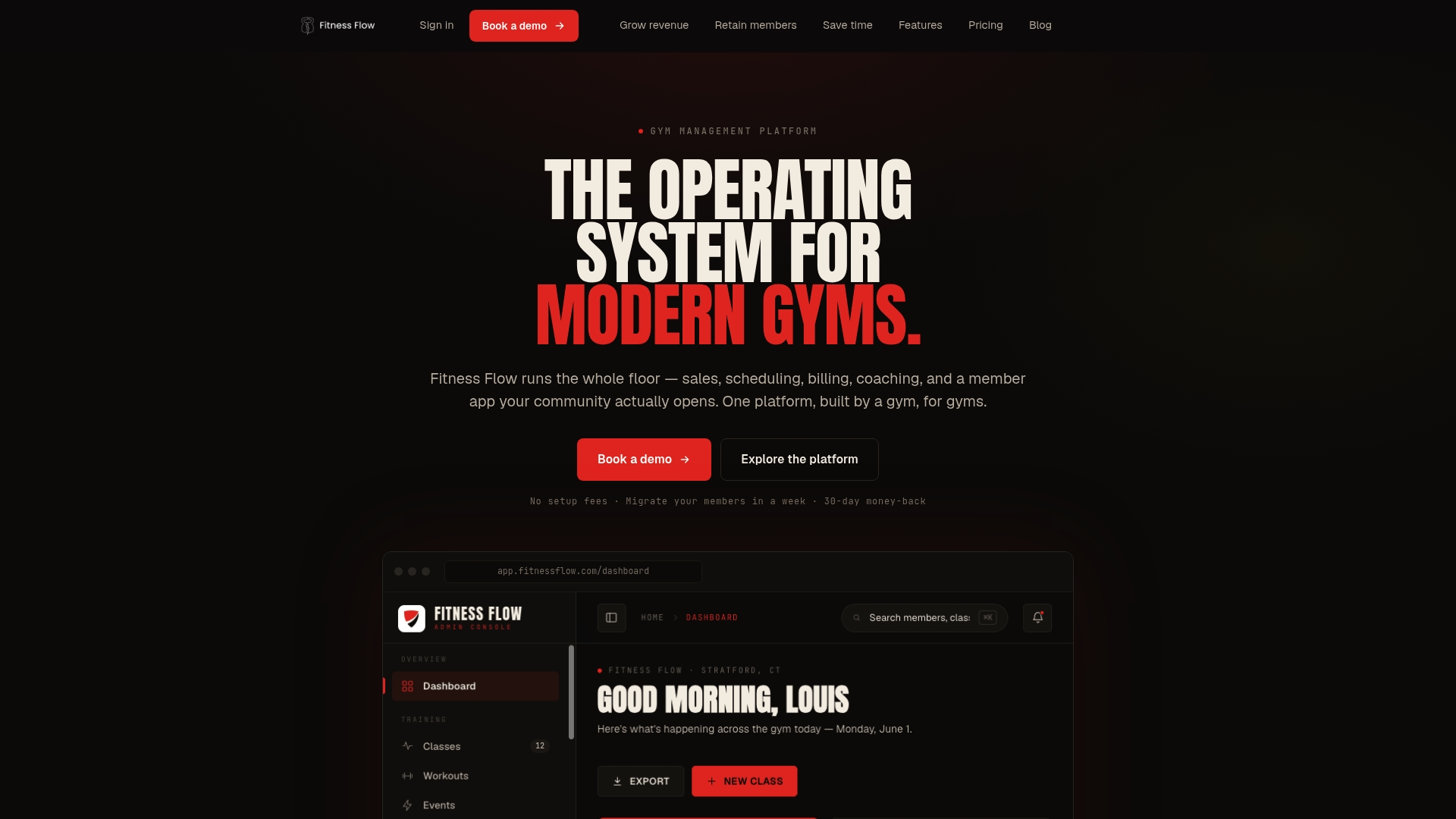
What you get when you book a demo:
- A walkthrough built around your studio’s actual size and membership structure
- A live test of the automation builder, branded app, and multi-location reporting
- A migration consult that covers data transfer scope, parallel-run timeline, and staff training plan
What migration support covers:
- Full data export and import (member profiles, membership history, payment methods, waivers)
- Parallel-run phase to validate data before cutover
- Staff retraining on core workflows post-migration
Pricing is tiered by gym size and feature set, paid monthly or annually. Enterprise and multi-site operators get custom quotes. There are no per-location penalties baked into the base structure.
The next step is a 30-minute demo. See Joinfitnessflow in action and come with your current platform’s pain points. The migration consult is part of the conversation, not a separate sales call.
Useful sources and next-step links
Research and market data referenced in this article:
- Why boutique fitness studios are ditching legacy software — pricing transparency, marketplace trade-offs, and migration cost context
- Mindbody alternatives for fitness studios 2026 — automation inflexibility data, migration timelines, and hybrid-approach analysis
- Fitness SaaS platforms 2026: 50 solutions feature rankings — retention benchmarks, integration depth analysis, and middleware cost warnings
- Studio management software market sizing — $485M market valuation and 8.0% CAGR growth projection
- Event scheduling tools: a guide for organizers — scheduling tool fundamentals and selection criteria primer
- Joinfitnessflow — platform demo and product overview — publisher’s platform for mid-market gym and studio operators
FAQ
What are the main reasons studios leave Mindbody?
The three most common drivers are pricing that scales by location rather than value, rigid automation templates, and weak integration with modern marketing tools. Capterra research cited 38% of studios leaving specifically due to automation inflexibility.
How much does a full migration to a new platform cost?
A ground-up migration for a mid-market studio typically runs $3,000–$8,000 all-in, covering setup, automation build, and 30 days of support, with a timeline of 5–8 weeks.
What is the difference between Mindbody and Zen Planner?
Mindbody is a broad marketplace-and-booking platform with wide consumer discovery; Zen Planner is a niche specialist built for CrossFit boxes, martial arts studios, and functional fitness gyms, with purpose-built workflows like belt/rank tracking and WOD management.
Do you have to fully replace your booking system to improve retention?
No. Many studios keep their existing booking system and add a dedicated automation layer on top. This hybrid approach reduces migration risk while delivering better retention workflows through behavior-based campaigns and churn prediction.
Is Joinfitnessflow a viable alternative for multi-location gyms?
Yes. Joinfitnessflow includes native multi-location oversight and cross-location reporting, along with CRM, branded apps, and billing, making it a practical fit for operators running two or more locations who need unified visibility without per-location pricing penalties.