
Trainerize Alternatives for Trainers & Studio Owners

For most personal trainers and small studios, the best Trainerize alternative is a flat-priced platform that includes a polished client app, predictable billing, and room to grow without per-client fees eating into your margin. The shortlist breaks into four categories: flat unlimited pricing platforms (best for scaling coaches), brand-first platforms with a full App Store listing under your name, UX-first coaching apps built around client engagement and retention, and enterprise gym management systems that fold in CRM, scheduling, and billing alongside the coaching layer.
For studios that want all of that in one place, Joinfitnessflow is the recommended all-in-one replacement.
Top picks at a glance:
- Fitness Flow (Joinfitnessflow) — best for independent and mid-sized gyms that want CRM, scheduling, billing, and a branded member app without stitching tools together
- PT Distinction — best for solo coaches who want flat unlimited pricing and deep program customization
- TrueCoach — best for coaches who prioritize a clean, frictionless client experience over feature depth
- Everfit — best for growing coaches who want a free starting tier and a clear upgrade path
- My PT Hub — best for UK-based coaches (strong US availability too) who want an affordable all-rounder
- Movement (movement.so) — best for brand-first coaches who want their own App Store listing
A clean, integrated client app that consolidates workouts, nutrition, and habits measurably reduces churn compared with asking clients to toggle between multiple tools. That single fact should anchor every platform decision you make.
Table of Contents
- How do these Trainerize alternatives compare on features and pricing?
- Platform snapshots: who each alternative is actually built for
- How were these platforms evaluated?
- How do you choose the right platform and plan the switch?
- What trial and support options do these platforms offer?
- Key Takeaways
- The platform switch most coaches make too late
- Joinfitnessflow is the all-in-one gym platform built for this exact switch
- Useful sources
- FAQ
How do these Trainerize alternatives compare on features and pricing?
Fitness FlowPT DistinctionTrueCoachEverfitMy PT HubVirtuagymMovementHevy CoachKahunas
Best for
Studios: CRM + branded app
Solo coaches, flat pricing
Clean client UX
Free-tier starters
Affordable all-rounder
Enterprise gyms
Brand-first coaches
Strength-focused coaches
Boutique studios
Pricing model
Tiered / enterprise
Flat unlimited
Per-client tier
Freemium + tier
Flat tier
Enterprise / custom
Flat + setup
Freemium + tier
Flat tier
Starting price
Custom / demo
—
—
Free tier available
~$25/mo
Custom quote
—
Free tier available
—
White-label / branded app
Yes (iOS, Android, web)
Partial (custom branding)
No
No
No
Yes (enterprise)
Yes (full App Store listing)
No
Partial
Per-client fees
No
No
Yes
Yes (above free tier)
No
No
No
No
No
Workout / program builder
Yes
Advanced
Good
Good
Good
Advanced
Good
Advanced (strength focus)
Good
Client mobile app
Branded iOS/Android/web
Vendor app, custom colors
Clean, highly rated
Clean
Solid
Full-featured
Fully branded
Clean
Clean
Scheduling & classes
Yes (unified calendar)
Limited
Limited
Basic
Basic
Full
Limited
No
Basic
Billing & payments
Yes (recurring, Stripe)
Via Stripe
Via Stripe
Via Stripe
Yes
Yes
Via Stripe
No
Yes
Integrations
Stripe, Zapier, wearables, Zoom
Zapier, Stripe
Zapier, Stripe
Zapier, Stripe
Zapier, Stripe
API, wearables
Stripe, Zapier
Limited
Stripe, Zapier
Support & onboarding
Dedicated onboarding
Email + docs
Email + docs
Email + docs
Email + live chat
Dedicated CSM
Email + docs
Community + docs
Email + docs
Free trial / demo
Demo on request
14-day trial
14-day trial
Free tier (5 clients)
30-day trial
Demo on request
Demo on request
Free tier
14-day trial
Three pricing traps to watch:
- Add-on stacking: Automation, payments, and nutrition modules are frequently sold separately. Headline prices can multiply 2–4x once you add what you actually need.
- Branded app setup fees: “Custom-branded” usually means your logo inside the vendor’s app. A fully white-labeled App Store listing is a different product entirely, and costs on larger platforms can exceed $200/month when setup and developer account maintenance are included.
- Per-client fees at scale: A $1–3 per-client fee looks harmless at 10 clients. At 75, it’s a meaningful line item every month.
“White-label” in this table means a separate App Store entry published under your brand name. “Custom-branded” means the vendor’s app with your logo and colors applied inside it. Movement is the only platform in this shortlist that offers a true white-label App Store listing at a flat monthly rate without enterprise pricing.
Platform snapshots: who each alternative is actually built for
Fitness Flow (Joinfitnessflow)
Built specifically for independent and mid-sized gyms, Joinfitnessflow covers the full operational stack: CRM and lead capture, scheduling with a unified calendar, class and workout builder, branded member apps on iOS, Android, and web, live and on-demand video, nutrition and meal plan builder, billing with recurring payments, multi-location reporting, compliance and waiver tracking, and wearable integrations. It’s the platform you choose when you’re tired of running your gym on three separate tools.

Pros: True branded app across all platforms; full gym management (not just coaching); multi-location support Cons: Built for gyms and studios, not solo coaches with 5 clients; pricing requires a demo conversation
PT Distinction
PT Distinction charges a flat monthly fee regardless of how many clients you coach, which is the right model once your roster grows past 20–30 clients. The program builder is genuinely deep, with custom questionnaires, automations, and habit tracking. Branding is partial: you can apply your logo and colors, but clients still download the PT Distinction app.
Pros: Flat pricing, no per-client fees; strong automation and habit tracking; 14-day free trial Cons: No true white-label app; scheduling is limited; no native class management
TrueCoach
TrueCoach’s reputation is built almost entirely on client experience. The app is clean, the workout logging flow is fast, and clients actually use it. The trade-off is feature depth: no native scheduling, no class management, and payments run through Stripe with no native billing layer. Per-client pricing means costs rise predictably with your roster.

Pros: Best-in-class client UX; fast onboarding; 14-day trial Cons: Per-client fees; no scheduling or class management; limited gym-side features
Everfit
Everfit’s free tier supports up to 5 active clients, which gives you a real working environment to test the platform before committing. The program builder is solid, the client app is clean, and Zapier and Stripe integrations cover most automation and payment needs. It’s a natural first platform for coaches just starting out.
Pros: Free tier available; clean client app; good integrations Cons: Per-client fees on paid tiers; no white-label option; limited scheduling
My PT Hub
My PT Hub packs a lot into a flat monthly fee: workout builder, nutrition tracking, habit tracking, scheduling, and payments. The client app is solid. It’s not the flashiest platform, but at roughly $25/month it’s hard to argue with the value for a solo coach managing 20–40 clients.
Pros: Flat pricing; broad feature set; 30-day free trial Cons: UI feels dated compared to newer platforms; no white-label app; limited multi-trainer tools
Virtuagym
Virtuagym targets gyms and fitness clubs at the enterprise end of the market. It covers member management, class scheduling, a coaching module, a white-label app, and a point-of-sale system. Pricing is custom, and all-in costs for enterprise-level bundles commonly exceed $200/month but include setup, multi-trainer tools, and premium support.
Pros: Full gym management suite; white-label app available; strong enterprise support Cons: Custom pricing only; overkill for solo coaches; longer implementation timeline
Movement (movement.so)
Movement is the platform for coaches who want their own App Store listing without building a custom app. Clients download an app with your brand name, your icon, and your colors. The coaching features cover programs, check-ins, and messaging. It’s not a gym management system, but as a brand-first coaching platform it’s in a category of its own.
Pros: True white-label App Store listing; flat pricing; strong brand experience for clients Cons: No scheduling or class management; no CRM; not built for gyms
Hevy Coach
Hevy Coach is purpose-built for strength and hypertrophy coaching. The workout builder is excellent for barbell-focused programming, and the client-facing app has strong reviews on Capterra and G2. It has a free tier, which makes it easy to test. Outside of strength programming, the feature set is narrow: no scheduling, no billing, no nutrition.
Pros: Best workout builder for strength coaches; free tier; highly rated client app Cons: Very narrow feature set; no billing, scheduling, or nutrition; not suitable for gyms
Kahunas
Kahunas targets boutique studios and small gyms with flat-tier pricing, scheduling, billing, and a coaching module. It sits between a pure coaching app and a full gym management system. The client app is clean and the onboarding is straightforward. It’s a reasonable option for a small studio that wants more than a coaching-only tool but doesn’t need the full enterprise stack.
Pros: Flat pricing; scheduling and billing included; clean client app Cons: Smaller platform with less third-party review coverage; partial branding only; limited multi-location support
Pro Tip: Before committing to any platform, check whether the nutrition module and payment processing are included in the base price or sold as add-ons. That single check will save you from a surprise invoice in month two.
How were these platforms evaluated?
The shortlist was built using a consistent set of criteria applied to each platform:
- Pricing model and scalability — flat vs. per-client vs. enterprise; break-even at 10, 30, and 75 clients
- White-label and branding options — distinguishing “custom-branded” (logo in vendor app) from “fully white-labeled” (separate App Store listing)
- Client app quality — UX, workout logging flow, notification reliability, mobile performance
- Gym management depth — scheduling, class management, CRM, compliance, multi-location
- Integrations — Stripe for payments, Zapier for automation, wearable device support, Zoom for live sessions
- Onboarding and support — trial availability, migration assistance, documentation quality
- Data portability — ability to export client data (names, emails, program history) before and after switching
Sources used: vendor pricing pages and documentation, independent review aggregators, user reports, and practitioner-facing comparison guides. Pricing was checked against live vendor pages. Because pricing pages and branded app policies change frequently, every figure in this article should be confirmed directly with the vendor before you sign.
Confidence note: starting prices reflect publicly listed monthly rates at the time of research. Annual billing typically reduces costs by 15–20%. Enterprise and custom plans are not publicly listed and require a demo or sales conversation.
How do you choose the right platform and plan the switch?
Decision checklist
Answer these questions before you book a single demo:
- How many active clients do you have now, and what’s your 12-month target?
- Do you need class scheduling and a unified calendar, or just 1:1 coaching tools?
- Is a branded app (your name in the App Store) a genuine business priority, or is custom branding inside a vendor app sufficient?
- Which integrations are non-negotiable: Stripe, Zapier, Zoom, specific wearables?
- Do you need in-app payments and recurring billing, or will you invoice separately?
- Are any of your clients non-English speakers, or do they use devices outside iOS/Android?
Vendor questions to ask during demos
- What exactly is included in “white-label”? Is it a separate App Store listing or branding inside your app?
- What are the setup fees, developer account costs, and ongoing maintenance fees for the branded app?
- What format does data export in, and does it include program history and media?
- How long does client data migration take, and do you provide migration support?
- What is your uptime SLA and average support response time?
Migration timeline: 30–90 days
A realistic migration runs in five sequential phases:
- Data audit (Days 1–7): Export all client data from Trainerize — names, emails, phone numbers, program history. Confirm video files are transferable.
- Platform setup (Days 8–21): Build your program library, configure billing, and set up integrations on the new platform.
- Parallel run (Days 22–45): Run both platforms simultaneously with a small pilot cohort of 3–5 clients. Test the full client experience: onboarding flow, workout logging, payment processing, and notification reliability.
- Client communication (Days 46–60): Notify all clients with clear instructions, a deadline, and a walkthrough video or guide.
- Cutover (Days 61–90): Migrate remaining clients, cancel the old subscription, and confirm all billing has transferred correctly.
Pricing model: break-even at different client volumes
Per-client pricing scales quickly; flat-fee models give you predictable costs as your roster grows. Here’s a simple model:
Break-even in this example sits at roughly 26 clients. Below that, per-client pricing is cheaper. Above it, flat pricing wins. At 50+ clients, enterprise bundles and flat unlimited tiers often become the most cost-effective option, even if the headline price looks higher.
Pro Tip: During your trial, run this exact test with a real client: have them complete the onboarding flow, log a workout, make a payment, and check that they received the confirmation notification. If any step breaks or confuses them, it will confuse every client you onboard.
What trial and support options do these platforms offer?
Trial availability varies more than vendors advertise. Everfit and Hevy Coach both offer free tiers — Everfit supports up to 5 active clients with no time limit, Hevy Coach’s free tier is similarly open-ended. TrueCoach and PT Distinction offer 14-day free trials. My PT Hub gives you 30 days. Virtuagym and Joinfitnessflow operate on a demo-first model where pricing and onboarding are scoped to your gym’s size.
Support quality matters most during migration. Platforms with dedicated onboarding (Joinfitnessflow, Virtuagym) give you a named contact who walks you through setup. Most mid-tier platforms (TrueCoach, PT Distinction, Everfit, My PT Hub) rely on email support and documentation, which is adequate for solo coaches but can slow down a multi-trainer studio migration. Hevy Coach and Movement lean on community forums and self-serve docs.
One thing worth checking before you start a trial: whether the free tier or trial period lets you test the actual features you need. A 14-day trial that restricts billing or branded app features tells you nothing about the experience your clients will have on day 90.
Key Takeaways
For most studios and growing coaches, a flat-fee platform with a branded client app and integrated billing will outperform Trainerize on both cost and client experience once your roster exceeds around two dozen clients.
PointDetails
Flat pricing beats per-client at scale
Break-even typically hits around the mid-twenties in client count; above that, flat or unlimited plans cost less.
White-label has two meanings
A separate App Store listing costs significantly more than custom branding inside a vendor app.
Add-ons multiply headline prices
Payments, automation, and nutrition modules can push base fees 2–4x higher than advertised.
Trial depth matters
Test billing, client onboarding, and notifications during any trial — not just the program builder.
Joinfitnessflow for studios
The recommended all-in-one option for gyms that need CRM, scheduling, branded apps, and billing in one platform.
The platform switch most coaches make too late
The conventional wisdom in fitness software is to start cheap and upgrade when you need to. That logic works fine for a solo coach with 8 clients. It breaks down fast once you’re running a studio with staff, classes, and members who expect a branded experience.
What most platform comparisons miss is the compounding cost of fragmentation. A coach running Trainerize for programming, a separate tool for scheduling, another for billing, and a generic app for client communication isn’t saving money. They’re spending it in time, client confusion, and the quiet churn that happens when the experience feels patched together.
The platforms that win at scale aren’t necessarily the ones with the most features. They’re the ones where the client experience feels like a single product. A member who books a class, logs a workout, pays their membership, and watches an on-demand video all inside one branded app is a member who stays. That’s not a UX preference. It’s a retention mechanic.
The migration pain is real and it’s worth planning for. But the coaches who wait until they’re at 80 clients and three tools deep to make the switch pay a much higher price than the ones who build on the right foundation at 30.
Joinfitnessflow is the all-in-one gym platform built for this exact switch
If you’ve been running your studio on Trainerize plus a scheduling tool plus a billing platform, Joinfitnessflow replaces all three with one system that your members actually see as your brand.
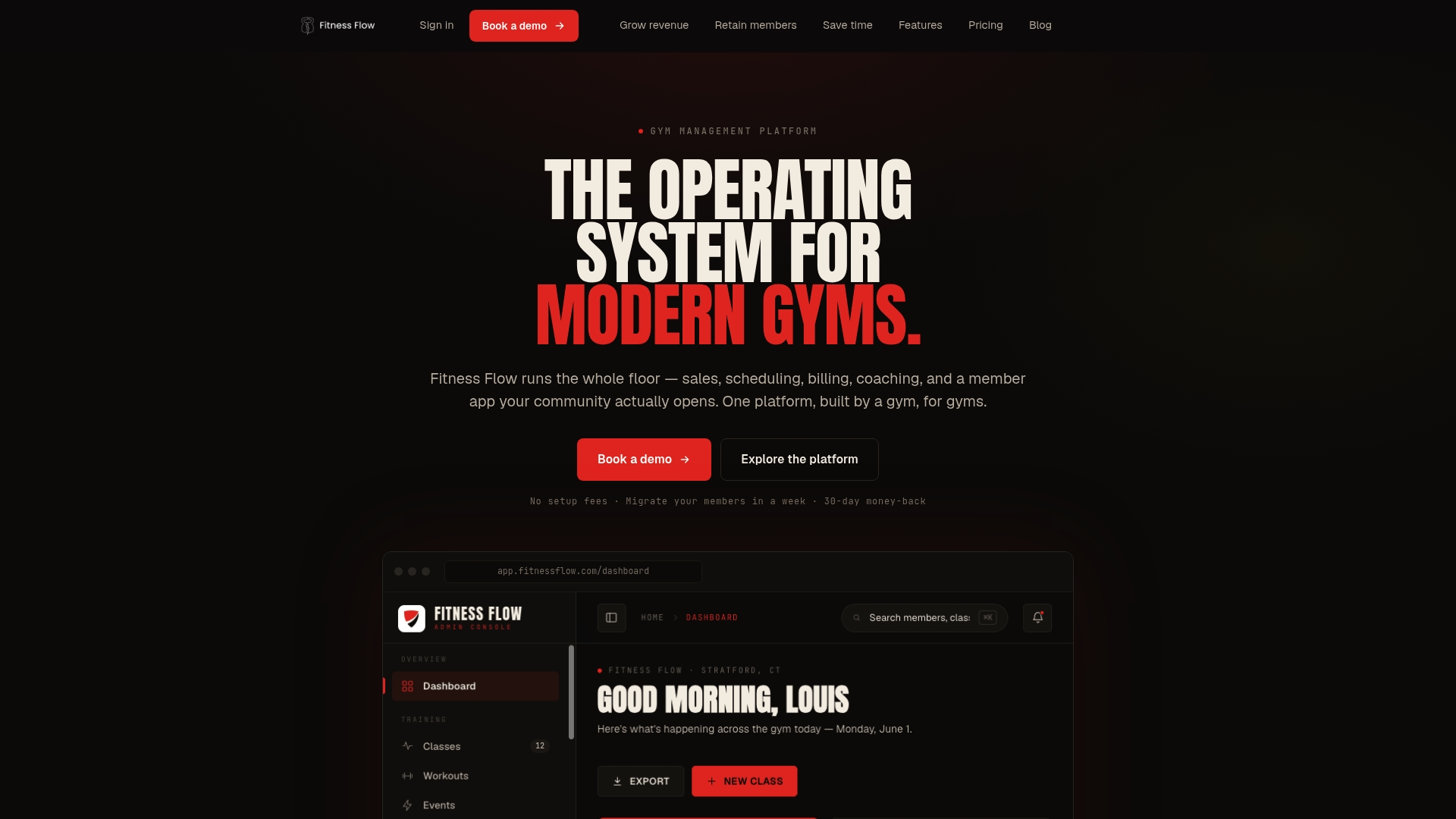
The platform covers CRM and lead capture, a unified scheduling calendar, class and workout builder, branded member apps on iOS, Android, and web, live and on-demand video, nutrition and meal plan builder, recurring billing, multi-location reporting, compliance and waiver tracking, and wearable integrations. No add-on stacking. No developer account to manage. No separate billing vendor.
For studios switching from Trainerize, Joinfitnessflow includes dedicated onboarding support and migration assistance. The gym management platform is built specifically for independent and mid-sized gyms that want a professional member experience without enterprise pricing.
Book a demo to see the branded app and full feature set scoped to your gym’s size.
Useful sources
Pricing, white-label policies, and add-on structures change frequently. Confirm every figure directly with the vendor before signing. These sources were used to compile the shortlist and comparison:
- How to Choose Coaching Software in 2026 (QuickCoach) — free tier comparisons, pricing model guidance, and add-on cost warnings
- Real Cost of Fitness Coaching Software (AssistantCoach.fit) — per-client vs. flat pricing break-even analysis
- How to Choose a Coaching Platform in 2026 (Keedia) — enterprise pricing thresholds and client UX retention data
- FitBudd Review (Coachway) — white-label cost breakdown including setup fees and developer account maintenance
- Best Personal Trainer Apps in 2026 (FitEcho) — independent review methodology and pricing verification notes
- Hevy Coach on Capterra — user reviews and feature ratings for Hevy Coach
- Hevy Coach on G2 — independent user reviews for Hevy Coach
- Hevy Coach vs. Trainerize (Hevy) — direct feature comparison between Hevy Coach and Trainerize
- Best Trainerize Alternative (Movement) — Movement’s own positioning against Trainerize, useful for white-label feature details
- Best Gym Management Software (Joinfitnessflow Blog) — white-label features and enterprise branded app options explained
Prices and policies listed above reflect publicly available information at the time of research. Always verify current pricing and feature availability directly with each vendor.
FAQ
What is the best free Trainerize alternative?
Everfit and Hevy Coach both offer free tiers with no time limit. Everfit supports up to 5 active clients; Hevy Coach’s free tier is open-ended but limited to strength-focused programming with no billing or scheduling.
Is flat-fee or per-client pricing better for personal trainers?
Per-client pricing is cheaper below roughly 25–30 clients; flat-fee plans become more cost-effective above that threshold. Calculate your break-even at your target roster size before choosing a model.
Which Trainerize alternative offers a true white-label app?
Movement (movement.so) offers a fully white-labeled App Store listing at a flat monthly rate. Joinfitnessflow offers branded iOS, Android, and web apps for gyms and studios. Most other platforms in this shortlist offer custom branding inside a vendor-owned app, which is a different product.
How long does it take to migrate from Trainerize to a new platform?
A realistic migration takes 30–90 days: data audit and export, platform setup, a parallel run with a small client cohort, client communication, and full cutover. Platforms with dedicated onboarding support (Joinfitnessflow, Virtuagym) can compress the timeline.
Do Trainerize alternatives include scheduling and class management?
Most coaching-only platforms (TrueCoach, PT Distinction, Hevy Coach, Movement) do not include class scheduling. Joinfitnessflow, Virtuagym, and Kahunas include scheduling and class management as part of their core feature set.