

CCPA Compliance for Gyms: What California Law Requires

The California Consumer Privacy Act (CCPA) applies to a gym when three things are true: it is a for-profit business that does business in California, it decides why and how it collects member data, and it crosses at least one size or data threshold. Many single-location gyms fall below those thresholds. Chains, multi-site operators and gyms with large lead and app databases may not. If you are covered, the work is concrete: tell members what you collect, honor their requests, secure the data, and put the right contracts in place with every vendor that touches it. When your scheduling, billing, CRM and member app live in one platform, there are fewer vendors to map and fewer contracts to manage, which is why we built Fitness Flow as a single system for gym operations.
Getfitnessflow
Simplify Gym Operations in One Platform
Fitness Flow brings scheduling, billing, sales, and member engagement together, helping reduce the number of systems involved in gym operations.
TL;DR
- The CCPA covers a for-profit gym doing business in California that meets one threshold: annual gross revenue above $26,625,000, data on 100,000 or more consumers or households, or 50% of revenue from selling or sharing personal information.
- You do not need a California address. Online sales to California residents, website tracking and remote employees in the state can all count as doing business there.
- Member data that gyms routinely hold, such as fingerprint check-in, payment credentials, precise location and health information, can be sensitive personal information with extra obligations.
- Every vendor that processes member data needs a written contract with specific privacy terms.
- Fewer systems mean a shorter data map, fewer contracts and faster responses to member requests.
Table of Contents
- Does the CCPA apply to your gym?
- Which member data counts as personal information
- What a covered gym must do
- Vendor contracts: the part owners miss
- Where other gym privacy rules overlap
- A practical CCPA routine for gym owners
- Why a single platform makes compliance easier
- Promo: one system for the member record
- Our perspective
- FAQ
- Sources
Does the CCPA apply to your gym?
Start with the test, because it decides whether everything else in this article is a legal duty or a good habit.
According to the California Privacy Protection Agency (CPPA), the state’s privacy regulator, a business is covered when it is a for-profit entity that collects consumers’ personal information, determines the purposes and means of processing it, does business in California, and meets at least one of three thresholds. Those thresholds, as laid out in the CPPA’s coverage guide:
- Gross annual revenue above $26,625,000 in the previous calendar year.
- Buying, selling or sharing the personal information of 100,000 or more consumers or households.
- Earning at least 50% of annual revenue from selling or sharing consumers’ personal information.
The revenue figure is adjusted for inflation. The statute ties the number to a cost-of-living adjustment, and Jackson Lewis, a employment and privacy law firm, reports it moves every odd-numbered year and is measured on January 1 using the previous year’s revenue. It counts total revenue, not only California revenue.
Three details that surprise gym owners
You can be covered without a California location. Per the same Jackson Lewis analysis, doing business in California can include online transactions with California residents, tracking their activity through cookies, or having employees who work in the state, including remotely. A franchise brand that sells online memberships to travelers or runs a digital program is a good example.
Common branding can pull in related entities. The CPPA guide says an entity controlled by a covered business that shares its branding and shares consumers’ personal information is also covered. If you run several locations under one name and share member data across them, treat the whole group as one for this test.
Staff and business contacts count too. Jackson Lewis notes the law has no general exception for business-to-business contacts, so email addresses and job titles of California residents acting in a commercial capacity are protected. The same goes for employee data.
A small independent gym that sits under every threshold is not bound by the CCPA. It still faces other rules on payments, texting and health data, covered further down, and many owners adopt the same routine anyway because it is simply good data hygiene and members increasingly ask about it.

Which member data counts as personal information
Personal information is anything that identifies or can reasonably be linked to a person or household. For a gym that means the obvious items (name, email, phone, address, date of birth) and the less obvious ones: class booking history, app usage, workout logs, photos, check-in times, and IP addresses from your website and app.
The law adds a stricter tier called sensitive personal information. Under the regulations effective January 1, 2026, that tier includes account logins, financial account or card numbers combined with access codes, precise geolocation, biometric information processed to uniquely identify a person, and personal information collected and analyzed about a consumer’s health. The same text treats personal information of consumers you actually know are under 16 as sensitive.
This maps directly onto gym operations:
Gym dataWhy it matters under the CCPA
Fingerprint, face or palm check-in
Biometric information used to identify a person is sensitive. The statute’s definition also reaches gait patterns and exercise or health data that contains identifying information.
Card numbers and bank details
Financial numbers combined with access credentials are sensitive.
Body measurements, injury notes, nutrition plans
Health information that is collected and analyzed is sensitive.
App location for check-in or outdoor classes
Precise geolocation is sensitive.
Minors’ memberships and youth programs
Data on consumers known to be under 16 is sensitive.
Lead forms, trial sign-ups, website cookies
Ordinary personal information, but still subject to notice and opt-out rules.
Before you decide what to do, write down every place each of these lives. Most gyms discover the same data sitting in a billing tool, a CRM, a booking system, an email platform, a door-access system and a spreadsheet at the front desk.
What a covered gym must do
Tell members what you collect, at the point of collection
Under Civil Code section 1798.100, you must notify people at or before collection of the categories of personal and sensitive information you collect, the purposes, whether it is sold or shared, and how long you keep it. You cannot keep data longer than reasonably necessary for the disclosed purpose.
In practice that means a short notice link on your lead form, trial sign-up, membership agreement and app registration screen, pointing to a full privacy policy. The 2026 regulations add that collection, use and retention must be reasonably necessary and proportionate to the purpose you disclosed, and consistent with what members would reasonably expect. A fingerprint reader to open the door is within expectations for many members. Reusing that data for marketing is not.
Honor member rights
The California Attorney General lists the rights consumers hold:
- Know what you collected about them (free, up to twice a year).
- Delete their information.
- Correct inaccurate information.
- Opt out of the sale or sharing of their information, including through a global privacy control signal from their browser.
- Limit the use and disclosure of sensitive personal information.
You cannot discriminate against members who use these rights or make them waive them. The regulations set fixed deadlines for acknowledging and completing each type of request, so check the current timelines on the Attorney General’s page and build them into your process before the first request arrives.
The practical challenge is retrieval. If a member asks you to delete their data, someone must find it in every system. That is where tool sprawl hurts: the more places a member’s record is copied, the longer a request takes and the likelier something is missed.
Keep the data secure
Section 1798.100(e) requires reasonable security procedures appropriate to the nature of the information. For a gym this includes role-based access so front-desk staff cannot see everything, strong logins for managers, and prompt removal of access when someone leaves. If you take cards, also read our guide to PCI compliance for gyms.
Assess risk for sensitive data
The CPPA’s summary of the 2026 updates says a business must conduct a risk assessment before it starts activities such as selling or sharing personal information or processing sensitive personal information, and document the safeguards that address negative impacts. For a gym, the trigger to watch is biometric check-in or analyzing members’ health data. Decide before you launch, not after.
Vendor contracts: the part owners miss
Your software vendors hold your members’ data, and the law makes you responsible for the paperwork. Under section 1798.100(d), when you disclose member information to a service provider, contractor or third party, you need an agreement that:
- Limits the purposes for which the data may be used.
- Requires the recipient to comply with the CCPA and give the same level of privacy protection.
- Gives you rights to make sure the data is used consistently with your obligations, and to stop and fix unauthorized use.
- Requires the recipient to tell you if it can no longer meet its obligations.
To qualify as a service provider, the written contract must also prohibit selling or sharing the data, using it for any other purpose, keeping it outside the direct business relationship, or combining it with data from other sources, according to the statutory definition. The contract may allow you to audit the provider, and subcontractors must be bound by the same terms.
List every vendor that touches member data: billing, scheduling, email and SMS, door access, website analytics, ad pixels, a member app, a personal-training tool. Then check that each has a contract with these terms. Advertising pixels on your website deserve special attention, because passing visitor data to an ad network can count as sharing, which triggers the opt-out right.
Where other gym privacy rules overlap
The CCPA is one layer. If you text members, TCPA consent rules govern what you must collect and keep. If you offer anything resembling clinical services, see what triggers HIPAA coverage. Note that the CPPA guide says data governed by HIPAA, the Gramm-Leach-Bliley Act or the Fair Credit Reporting Act can be exempt from the CCPA, so map which regime applies to which data. If you also serve members in Europe, there is a separate guide to GDPR for gyms.
A practical CCPA routine for gym owners
- Check coverage once a year. On January 1, compare last year’s revenue and your data volumes to the thresholds. Include all locations that share a brand.
- Map your data. For each system, record what member data it holds, why, and how long you keep it. Fewer systems make this a one-page exercise.
- Write the notice and privacy policy. Place the notice at every point of collection: web forms, trial sign-ups, the app and the membership agreement. Update the policy at least yearly.
- Set up request intake. Give members a clear way to submit requests, and name one person who owns them. Decide how you will verify identity before releasing or deleting data.
- Decide on biometrics and health data. If you use fingerprint or face check-in, document the purpose, the retention period and the risk assessment first.
- Sign vendor agreements. Confirm each contract includes the terms above. Remove tools you no longer use, along with their stored data.
- Restrict access. Give staff only the permissions their role needs, and revoke them on departure.
- Review waivers and forms. Make sure digital waivers and sign-up forms point to your notice and collect only what you need.
Why a single platform makes compliance easier
The hardest parts of the routine above are mapping data, answering requests and managing vendors. All three scale with the number of systems that hold member records. A gym running separate tools for leads, billing, scheduling, app, streaming and workout plans has half a dozen places to search and half a dozen contracts to review.
Fitness Flow is an all-in-one platform that covers sales and lead tracking, CRM, class scheduling and booking, recurring billing, a fully branded member app, live and on-demand classes, workout and nutrition planning, waivers, and reporting. It also includes employee and role management and compliance tools, and it supports integrations with payment and communications tools. One platform means one place where a member’s record sits and one vendor agreement to review for those functions.
Promo: one system for the member record
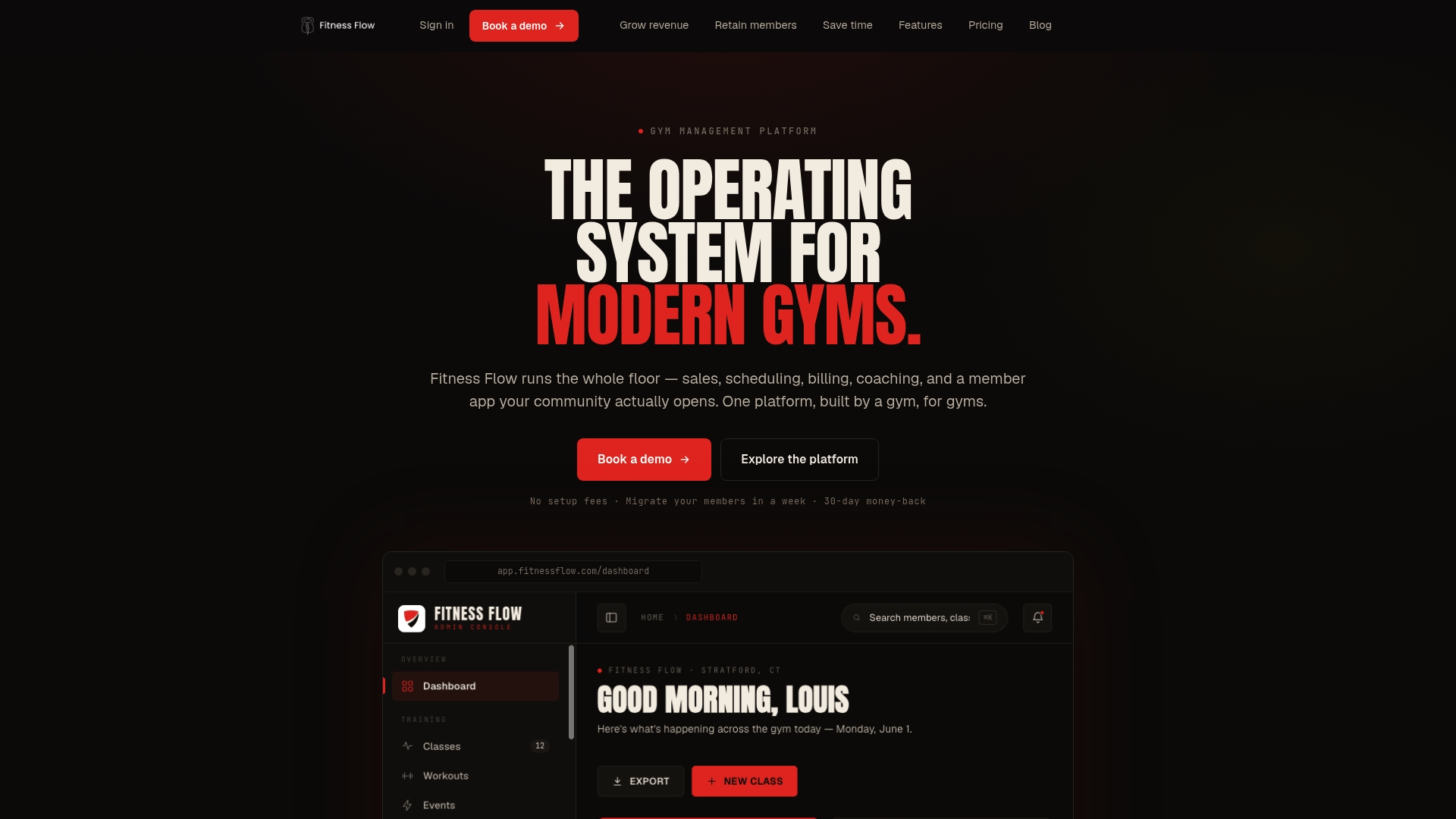
Fitness Flow gives owners and managers sales, scheduling, billing, member engagement and reporting in one platform, with migration support when you move from existing tools. Plans are Solo at $149 per month and Studio at $349 per month, and Multi-site is available for owners running several locations, with no published price. See the plans on our pricing page or read how the platform works for gyms.
Adopting one system does not replace your own legal duties, so have a California privacy attorney review your notice, policy and vendor agreements.
Our perspective
Most gym owners we talk with do not lose sleep over the CCPA until a member asks, “What do you have on me?” At that moment, the question is not legal theory. It is whether you can answer quickly and correctly.
That is why we built Fitness Flow as one platform. When leads, billing, scheduling, waivers, the branded app and workout plans sit together, the member record is not scattered across subscriptions. Our platform is designed to reduce the administrative load of running a gym, with owners saving an average of 12 hours a week on admin tasks, and a tidy, single system of record is part of why that is possible.
Privacy is also a retention issue. Members who trust you with their health information, payment details and check-in data stay with gyms that treat that information carefully. We would rather you build that trust with a short, honest notice and a clear process than scramble when a request arrives.
Louis
FAQ
Does the CCPA apply to a small gym with one location?
Only if it does business in California and meets a threshold: revenue above $26,625,000, personal information of 100,000 or more consumers or households, or at least half of revenue from selling or sharing personal information. Most small independents fall below all three. Check again each January, since revenue and data volumes change.
Is fingerprint or face check-in covered?
Yes, for a covered gym. Biometric information processed to uniquely identify a person is sensitive personal information under the 2026 regulations. That brings notice, purpose and risk assessment obligations, so document why you use it and how long you keep the data.
Do I need a contract with my software vendors?
If you are covered, yes. Section 1798.100(d) requires an agreement with any service provider, contractor or third party that receives member data, limiting its use and requiring CCPA-level protection. Review billing, scheduling, messaging, access control and analytics vendors.
Can members ask me to delete their data?
Yes. Covered businesses must honor deletion, correction and access requests, and members cannot be penalized for making them. Some records you must keep for other legal reasons, so confirm what to retain with your attorney.
What happens if a covered gym ignores the law?
The California Privacy Protection Agency and the Attorney General can both enforce the CCPA, and penalties are assessed per violation. The Attorney General’s CCPA page explains enforcement and is updated regularly.
Sources
- Does My Business Need To Comply With The CCPA (CPPA)
- California Civil Code section 1798.140
- California Civil Code section 1798.100
- AB-947 bill text, biometric information definition
- CCPA regulations effective January 1, 2026 (CPPA)
- California Attorney General: CCPA
- 7 Things to Know Before 2026 CCPA Updates Take Effect (CPPA)
- Navigating the California Consumer Privacy Act: 30+ FAQs (Jackson Lewis)
- Cal. Civil Code section 1798.140, service provider definition