Gym Sales Playbook: From First Inquiry to Signed Member

A gym sales playbook is a written, repeatable process that takes every inquiry through the same stages: first response, consultation, tour, price presentation, close, follow-up and onboarding. It works when everyone on your team runs it the same way and when every lead sits in one place where you can see it. A playbook kept in someone’s head, or spread across a phone, an inbox and a spreadsheet, loses leads at every handoff. This guide gives you the stages, the scripts and the numbers to track, and shows where a single system for leads, scheduling and billing keeps the process intact.
Getfitnessflow
Keep Gym Sales and Operations Connected
Fitness Flow brings sales, scheduling, billing, and member engagement together in one platform designed for modern gyms.
TL;DR
- Build the process around stages: respond, qualify, consult, tour, present, close, follow up, onboard. Write down who owns each one and how fast it happens.
- Lead the consultation with the prospect’s goals, then fit the tour and the membership to them. A tour that is an equipment showcase rarely connects.
- Follow up on a fixed schedule with a reason in every message. Undecided is not the same as no.
- Track five monthly numbers (leads, booked visits, shows, second visits, new members) and fix the stage that drops most.
- Sell the first week of the membership before the prospect leaves, so the sale connects to retention.
Table of Contents
- What a gym sales process has to cover
- Stage 1 and 2: capture every lead and respond fast
- Stage 3: qualify without interrogating
- Stage 4: the consultation and tour
- Stage 5: present options matched to the goal
- Stage 6: close without pressure
- Stage 7: follow up on a schedule
- Stage 8: onboard so the sale sticks
- The numbers that show where leads drop out
- Standardizing the playbook across staff and locations
- Perspective: why the playbook belongs in one system
- Run the playbook inside Fitness Flow
- FAQ
- Sources
What a gym sales process has to cover
Most gyms already have a sales process. It just lives in habits: one trainer calls back quickly, another forgets, the front desk quotes prices differently depending on who is working. A playbook turns the best version of those habits into the default.
The Global Fitness Association’s sales guide for gym staff is a good example of how granular this can get. It lays out a numbered sequence that starts with the greeting and logging the appointment in the appointment book, moves through a controlled tour, and ends with a presentation that establishes the time commitment needed to reach the prospect’s goals and ties it to your facility hours. The details differ from gym to gym. The principle does not: every step is named, and every step has an owner.
A workable playbook for an independent gym or studio has eight stages:
- Capture. Every inquiry (phone, walk-in, website form, social message) enters one list with its source.
- Respond. A named person makes first contact within minutes during business hours.
- Qualify. A few questions about goals, location, schedule and experience.
- Consult and tour. A conversation first, then a tour tailored to what you heard.
- Present. Membership options matched to the goal, with the price explained.
- Close. Ask for the decision, then stop talking.
- Follow up. A scheduled cadence for everyone who did not join on the spot.
- Onboard. The first weeks are booked before the new member walks out.
The next sections take these in order.
Stage 1 and 2: capture every lead and respond fast
Speed is the cheapest improvement in the whole process. Leads who reach out at 9 p.m. after a long day are comparing you with the other gym in town, and the first one to start a real conversation usually gets the visit.
A simple response standard looks like this:
- During business hours: a person calls within five minutes, then sends a text if there is no answer. Call first, text second, because a voice builds more rapport than a message.
- After hours: an automatic text acknowledges the inquiry and names a specific callback window the next morning.
- Ownership: one named person is accountable for response time, not “whoever is free.”
- First message: offer two appointment options and ask which works, rather than asking whether they would like to come in.
The last point matters. A yes-or-no question invites “I’ll think about it.” A choice between Tuesday at 6 p.m. and Thursday at noon assumes the visit is happening and only asks about logistics.
The usual failure here is not laziness but visibility. If inquiries arrive in three places, nobody knows which have been answered. Put them all in one queue that records the source, the stage and the next action. Our guide to stopping 48-hour lead leaks walks through that setup in detail, and the gym CRM setup guide covers how to get it running in a single session.
Stage 3: qualify without interrogating
Qualifying is five short questions asked as part of a friendly conversation, whether by phone or at the desk:
- How did you hear about us?
- Do you live or work nearby?
- What are you hoping to achieve?
- How many days a week do you realistically want to train?
- Have you trained at a gym before, and what did or didn’t work?
These questions do two jobs. They tell you which membership fits, and they give the prospect a reason to talk about themselves, which is where the sale happens. A good rule on the phone: whoever is talking is the one who is not selling, so keep your answers short and your questions open.
Write the answers into the lead record straight away. The consultation, the follow-up messages and the price presentation all draw on them, and a manager reviewing the pipeline later can see why a lead did or didn’t convert.
Stage 4: the consultation and tour
The consultation is where a playbook either earns its keep or becomes a script nobody believes.
The IDEA Health & Fitness Association’s guide to the initial consultation recommends a 5 to 10 minute conversation covering needs, history, motivation, availability, readiness screening and goals. Its practitioners suggest three simple questions that carry most of the weight: what are you looking to achieve, what have you tried in the past, and how can I best help.
The Association of Fitness Studios describes a longer version for training-focused gyms: a 60-minute initial consultation with goal setting, injury history, a pricing breakdown and a physical assessment. Which length suits you depends on your format. A boutique studio selling small-group training can justify the full hour. A larger open-floor gym may keep it to ten minutes plus a tour.
Make the tour about benefits
The same IDEA guide quotes practitioners who warn that tours fail when they become a showcase of equipment. Their point is that listing features does not connect with a person who told you they want to feel confident again after an injury, or who needs a 6 a.m. class before work.
In practice:
- Stand up, come out from behind the desk and walk the prospect through only the areas that match their stated goal.
- Keep asking questions during the walk. You are still qualifying.
- Introduce them to one coach or member if the moment arises. Community is a benefit no equipment list can match.
- Keep it short. Five to ten minutes is enough when the conversation came first.
Some prospects also arrive comparing a membership with buying equipment for home. It helps to know the economics: a guide to the best time to buy fitness equipment shows how prices on home gear move through the year, which gives you context when someone asks whether a membership is worth it.
Stage 5: present options matched to the goal
Price should come after the prospect has said what they want, not before. By then you can connect each membership to a stated goal and a time commitment: “You said three mornings a week and you want coaching, so this plan covers that.”
A few habits make price conversations calmer:
- Show tiers. Presenting two or three options lets the prospect choose which one, instead of whether. Jim Thomas’s membership sales manual, for example, reports that tiered presentation moves roughly one in five buyers above the basic plan.
- Recommend the smallest suitable step. For a nervous first-timer, that may be a trial or a short-term start rather than a 12-month commitment.
- Answer price questions when asked. Dodging the question on the phone costs you trust. Give the number, then ask about goals.
- Be honest about fit. If your gym is not right for someone, saying so protects your reputation and the referrals that come with it.
Stage 6: close without pressure
Closing is not a trick. It is a clear request after the prospect has told you, in their own words, why they came. Two techniques cover most situations.
The alternate choice. Offer two real options and ask which one: “Would you rather start on the monthly plan today or the annual with the lower rate?” Both answers are a membership.
The pause. After you ask, stop talking. It feels uncomfortable and it is the single most skipped step in sales training. The prospect needs a few seconds to decide, and filling the silence with discounts teaches people to wait for them.
When the answer is “let me think about it,” do not push. Ask what specifically they want to think through. Often it is not price at all. They need to check a work roster, talk to a partner, or see a class first. A discount does not solve any of those, but a scheduled trial class or a follow-up call on a specific day does.
Stage 7: follow up on a schedule
Most people who tour a gym do not sign that day. The follow-up cadence decides how many of them come back.
The Association of Fitness Studios publishes a trial follow-up schedule that shows the rhythm: a thank-you and a helpful resource immediately, an in-person check-in around day 8, then calls or texts and emails around days 10, 20 and 30. An offer appears in the second email and call, not the first. You can adapt it to your own format, but keep its logic:
- Every touch has a reason. A class they asked about, a schedule change, a member story. “Just checking in” earns nothing.
- The cadence has an end. Tell people when you will stop contacting them. It respects their time and makes the last message more likely to get an answer.
- No invented scarcity. A deadline that is not real damages trust the first time someone notices.
- Mix channels. A call, a text and an email each reach a different kind of person.
The tool that makes this possible is a lead record with a next-action date. Without it, follow-up depends on memory, and memory fails on busy weeks. For a deeper look at turning trial visitors into members, see our trial to membership conversion playbook.
Stage 8: onboard so the sale sticks
The sale does not end at the signature. The Club Solutions Institute’s membership sales class guide states that onboarding and follow-up determine long-term success, and it recommends orientation, assessments and program consultations as part of the sales process rather than something that happens afterward.
The easiest way to build that in is to schedule the first week before the new member leaves:
- Book their first three visits or classes at the desk.
- Schedule a welcome touchpoint with a coach in week one.
- Set a usage check at the end of the first month.
- Give them an easy way into the community, such as a class group, a challenge or an app.
The people most at risk are those who joined and never really started. A booked first week is the simplest protection. For the full retention side, read our 90-day member retention playbook.
The numbers that show where leads drop out
You do not need a dashboard full of metrics. Track five numbers each month:
NumberWhat it tells you
Leads
Whether marketing is feeding the process
Booked visits or trials
How well you respond and invite
Shows
Whether reminders and confirmations work
Second visits
Whether the first experience delivers
New members
Whether your offer and close work
Compare each number with the one before it. The stage with the biggest drop is where to focus. Few bookings points to response speed and the first message. Few shows points to reminders. Few second visits points to the first-class or first-tour experience. Few new members points to the offer or the membership conversation.
For a reference point, the Association of Fitness Studios suggests a training-focused gym aim for 30 to 40 leads a month, 20 paid trials and 12 new members, which is 60% of trials converting. Treat that as a reference for a studio with a paid trial, not a promise. Your own month-over-month trend is the benchmark that matters.

Our five-number funnel audit shows how to run this review in 30 days, and the 30/60/90 pipeline guide helps you decide what to fix first.
Standardizing the playbook across staff and locations
A playbook only works if the second salesperson and the second location run it the way the first one does. Three things keep it consistent:
- One set of stage names. “Contacted” means a real conversation happened, not that a message was opened. “Attended” means they came, not that they booked.
- One handoff rule. When a lead moves from front desk to coach to sales manager, the record moves with them and one person always owns the next action.
- One place to look. Source and location are tagged on every lead, so a manager can compare locations on the same numbers.
Roleplay is the cheapest training. Have staff run the first call and the consultation on each other weekly for fifteen minutes, using the same questions, until the phrasing sounds like them and not like a script.
Perspective: why the playbook belongs in one system
We built Fitness Flow because most gym owners we talk to do not have a sales problem as much as a handoff problem. The lead comes in through one channel, the booking lives in another tool, the billing in a third, and the follow-up in someone’s notes. Every gap is a place for a good prospect to disappear.
A playbook is only as strong as the system that carries it out. When lead tracking, class scheduling, recurring billing and the member app sit in one platform, the stages in this article stop being a document and become what actually happens: the new lead is visible, the trial is booked, the signup flows into billing, and the member lands in an app that keeps them connected between visits.
That is also why we focus on retention alongside sales. Our members report a 27% average increase in member retention and about 12 hours saved on administrative tasks each week. Those hours are the ones you can spend on the consultation, the tour and the follow-up call, which is where memberships are won.
Louis
Run the playbook inside Fitness Flow
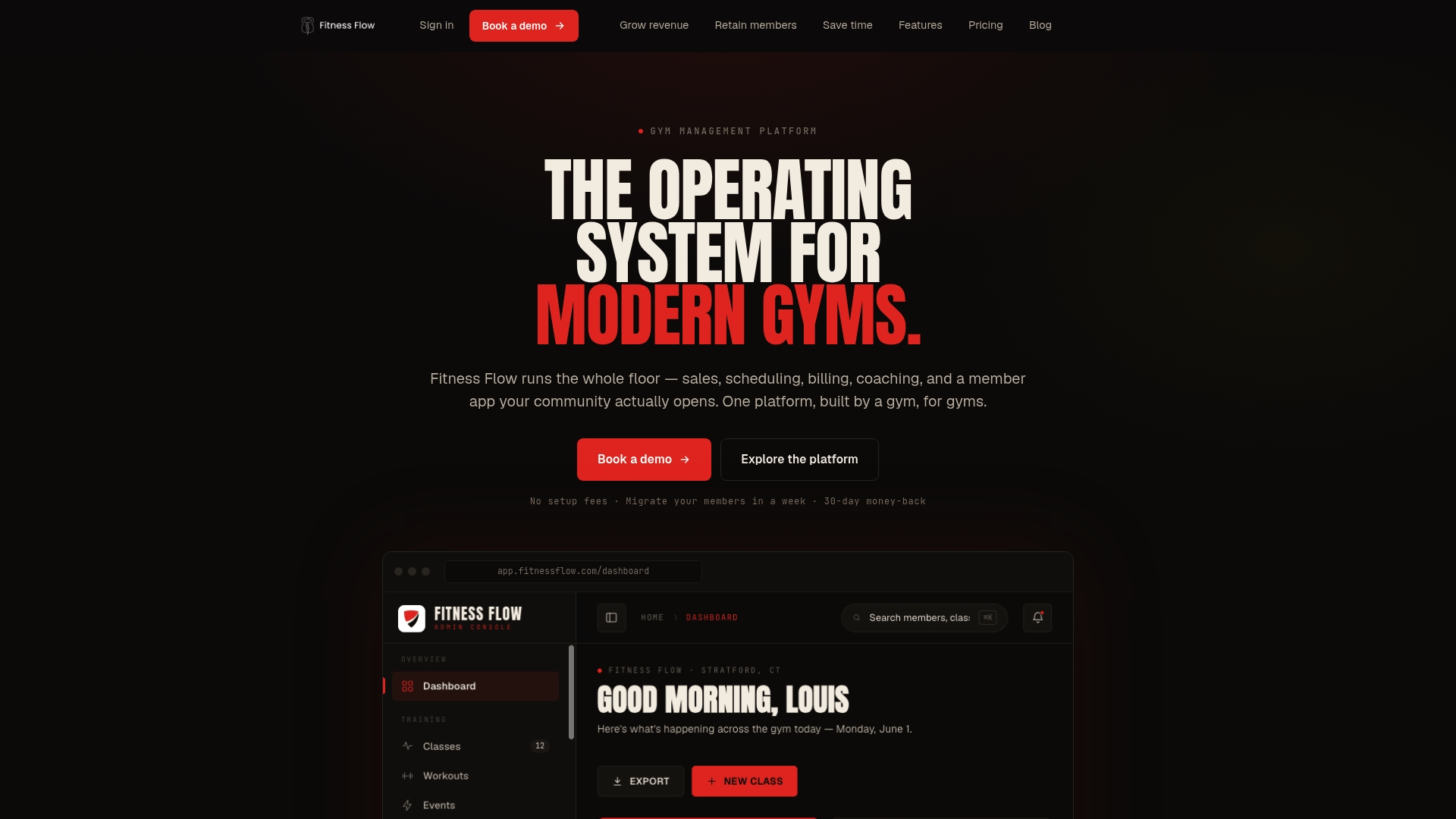
Fitness Flow is all-in-one gym management software that covers sales and lead tracking, CRM, class scheduling and booking, recurring billing, a fully branded member app, automated retention workflows, reporting and multi-location management. Plans are tiered by gym size: Solo at $149 per month and Studio at $349 per month, with Multi-site available for larger operations. Migration support and integrations with payment and communications tools help you move over without starting from scratch. See the plans on the Fitness Flow site or explore how it works for gyms.
If you want to measure results without adding software first, our guide to gym analytics and three retention KPIs is a good place to begin.
FAQ
How fast should a gym respond to a new lead?
Aim for a real person making contact within minutes during business hours, and an automatic text with a specific callback window after hours. Speed matters because the prospect is usually looking at more than one gym. Make one person accountable for it so it does not depend on who happens to be free.
What should a membership sales process include?
Capture, fast response, a few qualifying questions, a consultation, a tailored tour, a price presentation, a clear close, a scheduled follow-up and an onboarding plan. Each stage should have an owner and a time standard. The important part is that every lead moves through the same steps.
How do I follow up with someone who did not join?
Use a fixed cadence over about a month, with a reason in every message: a class they asked about, a schedule that fits, a trial invitation. Mix calls, texts and emails, and tell them when you will stop. Avoid fake deadlines, which cost you trust.
Which sales numbers should I track?
Start with five monthly counts: leads, booked visits, shows, second visits and new members. The stage with the largest drop shows where to focus, whether that is response speed, reminders, the first-visit experience or the offer.
Sources
- The Art of Converting Leads into Sales, Association of Fitness Studios
- Gym Resources: Sales and Marketing, Global Fitness Association
- The Anatomy of a Successful Initial Consultation, IDEA Health & Fitness Association
- Aligning Process to Consumer Expectations, Club Solutions Institute