

Stop 48 Hour Lead Leaks: Gym Lead Tracking Playbook for Gym Owners

Fix gym lead tracking by doing three things: capture every lead in one system regardless of channel, reply within minutes instead of hours, and run a day-keyed follow-up sequence for every trial. Gyms that nail these three see higher show rates and more trial-to-member conversions, because the leak isn’t lead volume. It’s what happens in the 48 hours after someone raises their hand.
TL;DR:
- Respond to new leads within five minutes during business hours to maximize conversion rates, and automate initial follow-ups for after-hours inquiries.
- Use dedicated landing pages with UTM tags for paid ads and direct CRM integration for forms to capture lead sources accurately and streamline data.
- Keep your lead pipeline simple with clear stages, quick updates, and essential information like source, contact details, and notes to facilitate fast, effective follow-up.
- Track five key metrics weekly: lead volume, lead-to-booked rate, show rate, trial-to-member rate, and cost per acquisition, to identify leaks in the funnel.
- Employ a unified CRM system to automate the entire journey from lead capture to membership, improving follow-up speed, tracking accuracy, and overall conversion.
Getfitnessflow
Track Every Gym Lead in One Place
Fitness Flow brings sales, scheduling, billing, analytics, and member engagement together to streamline gym operations and support retention.
Table of Contents
- What Is Gym Lead Tracking and Why It Affects Your Revenue
- Where Gym Leads Come From and How to Capture Them Without Losing the Source
- Building a Lead Pipeline That Staff Will Actually Use
- Setting Up Tracking So the Data Doesn’t Lie to You
- Why Speed-to-Lead Determines Whether a Prospect Ever Shows Up
- The Numbers That Actually Tell You If It’s Working
- A Real Workflow: Capture to Join, Mapped Out
- What Actually Moves the Needle for Growing Gyms
- Get Your Gym’s Lead Tracking Running on One System
- Sources
- FAQ
What Is Gym Lead Tracking and Why It Affects Your Revenue
Gym lead tracking means recording every prospect’s journey, from the moment they click an ad or walk through your door to the day they sign or disappear, on one connected timeline. Done right, it links marketing spend directly to memberships. Done wrong, it’s a mess of sticky notes, a spreadsheet nobody updates, and a front desk that has no idea a lead called twice last week.
The typical failure modes drain revenue quietly:
- Leads scattered across a phone log, Instagram DMs, and a paper sign-in sheet, with no single record.
- No source data, so nobody knows whether Facebook ads or a member referral produced the sale.
- Slow replies that let a warm lead go cold before staff even see the message.
Every one of those failures shows up downstream in your show rate, your trial-to-member rate, and eventually your cost per acquisition versus lifetime value.
Where Gym Leads Come From and How to Capture Them Without Losing the Source
Prospects arrive through paid social, Google search, local SEO listings, referrals, walk-ins, phone calls, and direct messages. Each channel needs its own capture mechanism, or you lose the one data point that tells you what’s actually working: where the lead came from.
Here’s a practical setup for each channel:
- Paid social and search ads — send traffic to a dedicated landing page tagged with UTM parameters, not your homepage.
- Instant Forms and lead ads — connect them directly into your CRM so a submission creates a contact record automatically, no manual entry.
- Chat and DM inquiries — route them into the same system rather than letting them live in a separate inbox only one staffer checks.
- Phone calls — use call-tracking numbers on your website and ads so every call is logged with the source campaign attached.
- Walk-ins and desk intake — capture name, phone, and “how did you hear about us” on a tablet or short intake form, every single time.
Local search still drives a steady share of walk-ins, and gym-specific SEO work tends to compound over months rather than producing a one-time spike like a paid campaign.
Pro Tip: Standardize your “source” form field into a dropdown, not a free-text box. Free-text fields produce twelve variations of “Instagram” that never roll up cleanly in reporting.
Building a Lead Pipeline That Staff Will Actually Use
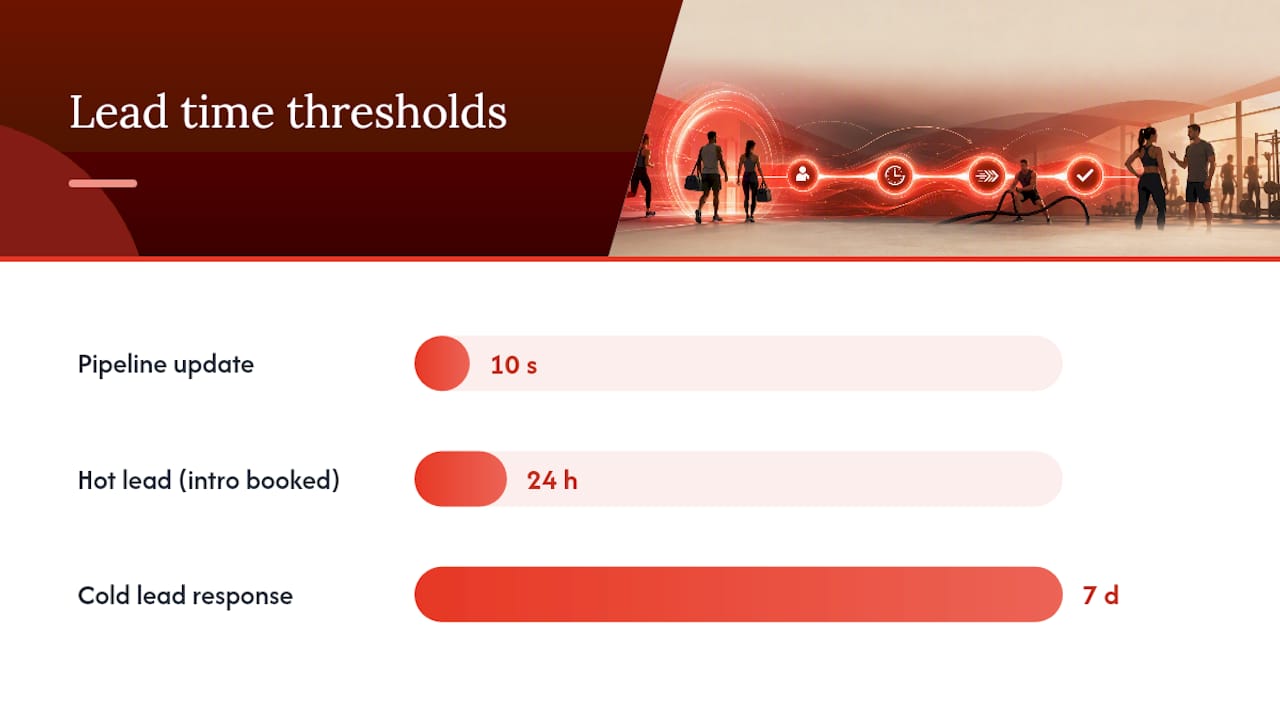
A pipeline only works if front-desk staff can update it in under ten seconds between reps and phone calls. Keep the stages simple and make each one mean something specific:
- New lead — captured, not yet contacted.
- Qualified — confirmed real contact info and genuine interest.
- Intro booked — a tour or consultation is on the calendar.
- Trial started — first workout or class completed.
- Trial completed — the trial period has run its course.
- Join conversation — a membership offer has been presented.
- Member or lost — the outcome, recorded either way.
Every contact record should carry the lead source, the campaign name, the date of last contact, preferred class times, and a short note field. That last one matters more than owners assume: “mentioned bad knee, wants low-impact” is worth more to a closing conversation than any demographic data you’ll collect.
For scoring, keep it dead simple: a lead who books an intro within 24 hours of first contact is hotter than one who takes a week to respond, and staff scripts should ask one qualifying question at intake, “what’s making you look for a gym right now,” rather than running a full interrogation.
Setting Up Tracking So the Data Doesn’t Lie to You
Attribution breaks down when the technical setup is sloppy, not because the concept is complicated. UTM parameters on every ad and social link, mapped straight into a CRM source field, are the foundation. Tagging lead sources consistently and training staff to log where a walk-in or phone lead heard about you closes most of the gap between what you spend and what you can actually prove worked.
A few technical pieces worth setting up:
- GA4 conversion events for booking submissions and trial starts, so website behavior ties back to actual pipeline stages.
- A CRM source field that auto-populates from UTM parameters instead of relying on manual entry.
- Call-tracking numbers assigned per channel (one for Google ads, one for the website, one for print or local partnerships).
- A monthly lead-source report that rolls booked calls, form fills, and walk-ins into one view.
Pro Tip: Consolidate phone and DM leads onto the same contact timeline as your web leads. If someone calls after clicking a Facebook ad, you want one record showing both touches, not two disconnected ones that make your source data look wrong.
Why Speed-to-Lead Determines Whether a Prospect Ever Shows Up
Response time is the single biggest lever most gyms ignore. Industry data on gym marketing shows a clear link between how fast a lead gets a reply and how likely they are to actually book and show up, with faster response times correlating to meaningfully higher conversion. A lead who fills out a form at 9 p.m. and hears nothing until the next afternoon has probably already booked a tour somewhere else, or lost the motivation entirely.
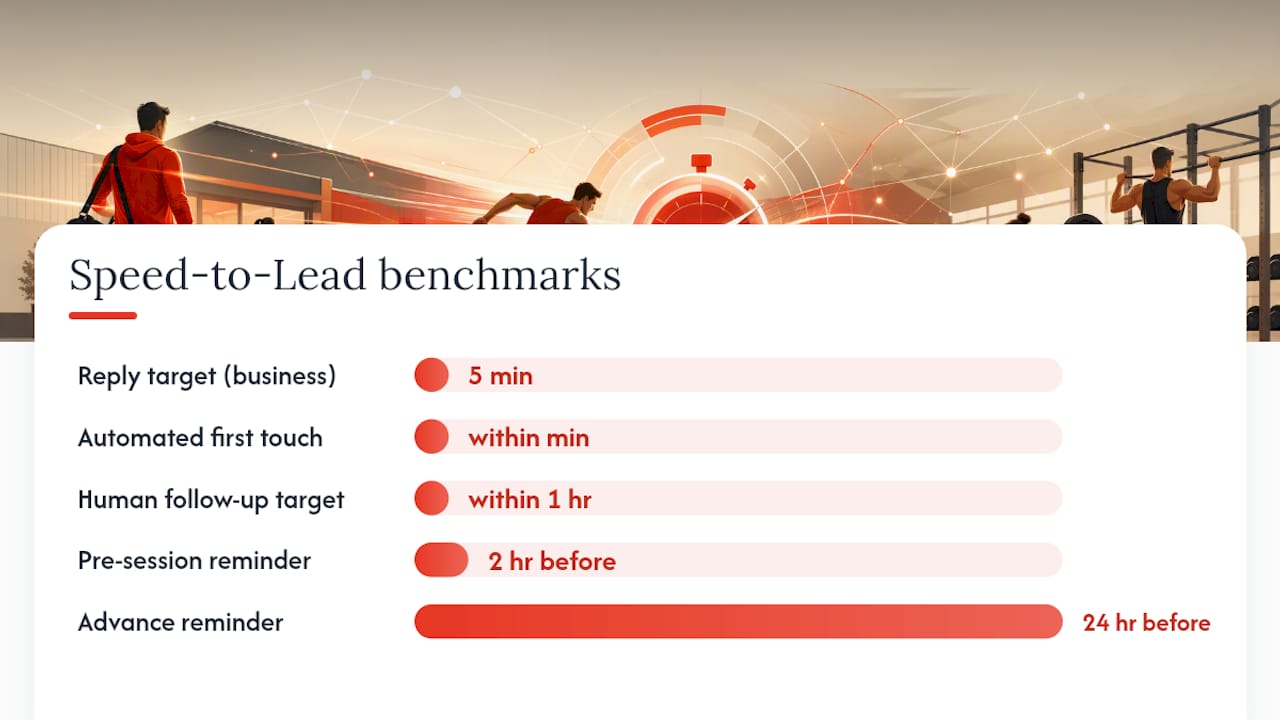
Aim for a reply within five minutes during business hours and use automated texts to bridge the gap after hours. A staffing trade-off is real here: if you can’t guarantee a human reply that fast, automate the first touch and have a person follow up within the hour.
A sample day-keyed cadence for a 7-day trial:
- Day 0 — automated thank-you text with a booking link, sent within minutes of signup.
- Day 1 — personal check-in call or text asking how the first visit felt.
- Day 3 — email with a class schedule and a nudge to book a second session.
- Day 5 — SMS reminder for any unbooked sessions, plus a soft mention of membership options.
- Day 7 — the join conversation, ideally in person or by phone, before the trial officially ends.
Reminder texts sent 24 hours and 2 hours before a booked session cut no-shows more than any single other change most gyms make.
The Numbers That Actually Tell You If It’s Working
Track five numbers weekly: total leads, lead-to-booked rate, booked-to-show rate, trial-to-member rate, and cost per acquisition. Everything else is noise until those five are healthy.
- Lead volume — raw count by source, not just total.
- Lead-to-booked rate — what percentage of leads actually schedule an intro.
- Show rate — of those booked, how many actually walk in.
- Trial-to-member rate — the number that tells you if your sales conversation works.
- CPA and its relationship to LTV — connecting acquisition cost to lifetime value shows you which channels are worth scaling versus which just look cheap.
Weekly funnel check: a simple dashboard tracking these five numbers by source lets owners spot a leaking stage fast. A funnel-ratio benchmark approach helps prioritize which stage to fix first instead of chasing more raw leads when the real problem is a low show rate.
Run a monthly ROI check that ties total ad spend to net new members that month. If a channel produces leads but no members, the fix usually isn’t more budget, it’s a broken step somewhere between lead and trial.
A Real Workflow: Capture to Join, Mapped Out
A connected CRM system that keeps every lead on one timeline, automates the first reply, books the intro, and sequences trial nurture is what closes most of the gap between “generated a lead” and “signed a member.” Here’s how that maps to Getfitnessflow in practice:
- A lead fills out a Facebook Instant Form; Getfitnessflow logs it instantly with the campaign source attached.
- An automated text goes out within minutes, with a direct booking link for an intro session.
- Once booked, automated SMS and email reminders fire at 24 hours and 2 hours before the appointment.
- After the intro, the trial nurture sequence kicks off automatically, day 1 check-in through day 7 join conversation.
- Analytics roll every stage into one dashboard, so an owner can see lead-to-booked and trial-to-member rates without pulling three separate reports.
That’s the operations backbone Getfitnessflow was built around, and gyms running it report a 27% average increase in member retention once the follow-up and nurture pieces run on autopilot instead of memory.
What Actually Moves the Needle for Growing Gyms
Two things separate gyms that grow from gyms that plateau: speed-to-lead and a single contact timeline. Everything else is optimization on the margins. Measure show rate and trial-to-member conversion before you obsess over lead volume, because more leads into a broken follow-up process just produces more no-shows.
— Louis
Get Your Gym’s Lead Tracking Running on One System
Getfitnessflow replaces the spreadsheet-plus-three-apps setup most gyms limp along with a single platform that captures every lead, replies instantly, books the intro, and runs the day-keyed trial nurture described above, all tied to one member record instead of scattered across tools. Instead of piecing together a CRM, a booking calendar, and a separate texting app, you get one timeline per prospect from first click to signed membership.
Getfitnessflow also builds in the branded member app, class scheduling, and billing your gym needs after the join conversation closes, so the same system that tracked the lead keeps the member engaged. Plans run from Solo to Studio tiers per month, with a Multi-site option for franchises (pricing available on request). Check plan details and start a trial to see the pipeline and nurture workflows running on your own leads.
Sources
- The 2026 State of Gym Marketing: Trends, Data, and Predictions | Pilotium Blog | Pilotium
- How to Get More Gym Members in 2026 | Complete Playbook | Optimized Growth
FAQ
What Is Gym Lead Tracking Exactly?
Gym lead tracking is the process of recording every prospect’s journey, from first contact through trial to membership, on one connected system. It ties marketing source, follow-up activity, and conversion outcome together so owners can see which channels actually produce members.
How Fast Should a Gym Respond to a New Lead?
Aim for a reply within five minutes during business hours, since faster response times correlate strongly with higher conversion. Use automated texts to cover after-hours gaps until staff can follow up personally.
What Metrics Matter Most for Tracking Gym Leads?
Focus on lead-to-booked rate, booked-to-show rate, trial-to-member rate, and cost per acquisition relative to lifetime value. These four numbers reveal exactly where prospects are dropping out of your pipeline.
Does Getfitnessflow Handle Lead Tracking and Follow-Up Automation?
Yes. Getfitnessflow captures leads from every channel onto one contact timeline, sends instant automated replies, books intro sessions, and runs day-keyed trial nurture sequences automatically. Plans start at $149 per month for Solo and $349 per month for Studio, with Multi-site pricing available on request at Getfitnessflow.
How Do UTM Parameters Help With Gym Lead Tracking?
UTM parameters tag each ad or link with its campaign and source, so when a lead clicks through and fills out a form, that source data flows automatically into your CRM. This lets you see exactly which channels produce paying members instead of guessing.