

Gym Membership Pricing for Owners: The Automation Playbook

Set three membership tiers, pick one primary billing cadence, write down your proration and cancellation rules, then automate the whole system. That’s the entire game. Gym membership pricing fails most often not because the price is wrong, but because the billing process behind it is inconsistent and unprotected against payment failures.
Here’s what to do this week:
- Lock in tier names and prices (good, better, best) and publish them everywhere your staff quote rates.
- Choose monthly or annual as your default cadence, then decide how you’ll discount the other option.
- Turn on card-updater and smart retry logic before you touch anything else in your billing software.
- Schedule pre-billing notifications 3 to 5 days ahead of every charge.
Pro Tip: If you only fix one thing this month, fix involuntary churn. Enabling card-updater plus a three-step dunning sequence typically costs nothing extra in most gym platforms and recovers revenue you’re currently writing off as “members who quit.”
Key Takeaways
Gym membership pricing succeeds when clean tier structures and written billing policies get paired with automated recovery tools like card-updater and dunning sequences.
PointDetails
Cap tiers at three or four
Basic, standard, and premium tiers increase conversion and give members a clear upgrade path.
Fix involuntary churn first
Card-updater plus smart retry logic recovers a large share of failed-card payments automatically.
Write policy before automating
Standardize proration, freezes, and grandfathering rules so automation enforces consistency, not chaos.
Test pricing changes, don’t guess
Track ARPU, churn, LTV, and conversion across at least one full billing cycle before rolling out widely.
Fitness Flow runs the whole system
Tiered billing, dunning, card-updater, and analytics run in one platform, saving gyms 12 hours weekly on admin.
Table of Contents
- Which Gym Membership Pricing Models Fit Your Business?
- How Do You Structure Tiers, Bundles, and Trials?
- What Billing Automation Features Actually Prevent Churn?
- How Do You Test and Measure Gym Membership Pricing Changes?
- What Does a Pricing Launch Checklist Look Like?
- What Should You Ask a Gym Management Platform Vendor?
- Why Policy Comes Before Automation
- How Fitness Flow Automates Your Gym’s Pricing and Billing
- Frequently Asked Questions
- Sources
Which Gym Membership Pricing Models Fit Your Business?
Most independent gyms default to one pricing model when they actually need two working together. The four core structures are recurring memberships, class packs, drop-in pay-per-class, and prepaid annual plans, and each solves a different retention problem.
Recurring memberships give you predictable revenue and the best forecasting. The tradeoff is that you’re only as strong as your billing system’s ability to catch failed cards before members quietly disappear. Class packs work well for goal-based lifters and program hoppers, since bundling a set number of sessions creates urgency to use them, but idle packs slowly train members to disengage entirely. Drop-in pricing captures tourists, corporate wellness visitors, and undecided prospects, though it produces zero forecasting value. Prepaid annual plans lock in cash flow and lower churn risk since the member has already paid, but they demand a stronger upfront sales conversation and a fair refund policy.
Hybrid models solve the real problem: committed members want a membership, casual users want flexibility, and forcing everyone into one structure leaves revenue on the table. A sustainable pricing strategy blends cost-based, value-based, and utilization-based tactics rather than picking one lane.
PositioningExample Monthly RangeBest Fit
Budget/high-volume
$10–$30
Big-box style, self-service, minimal staffing
Mid-market
$40–$90
Independent gyms with classes and coaching
Premium/boutique
$100–$250
Small-group training, specialty studios
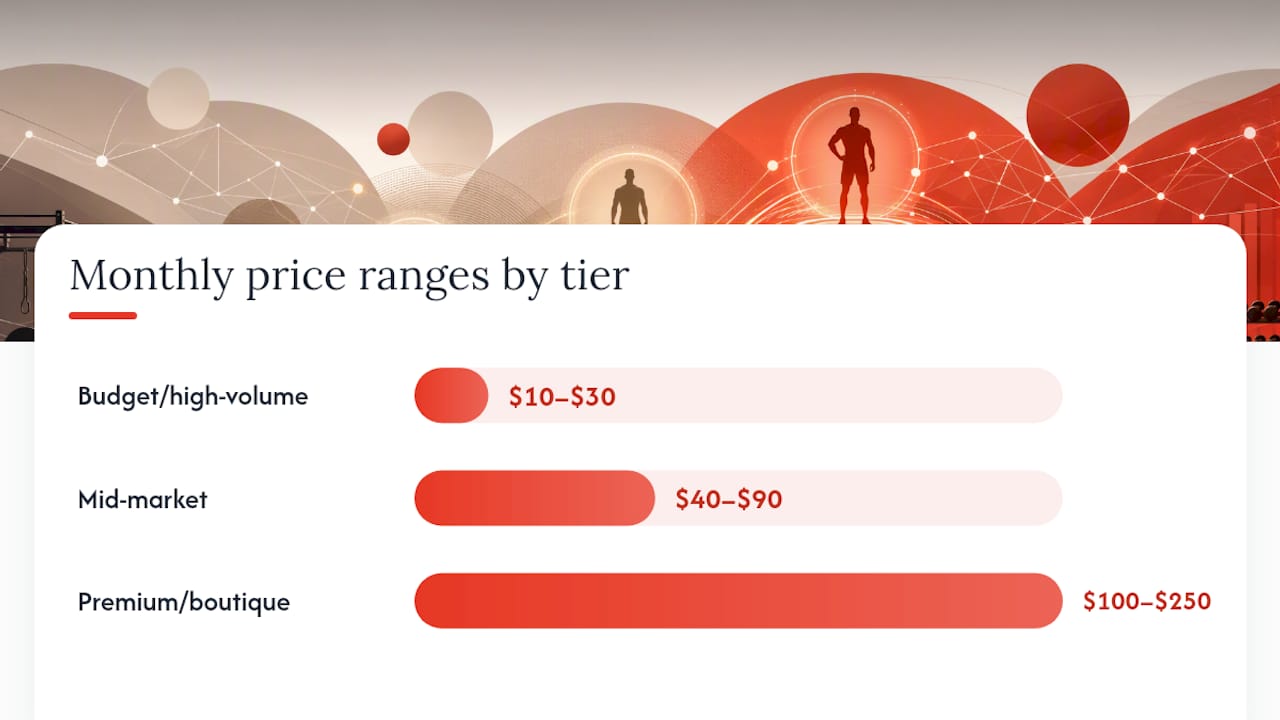
Test locally. National benchmarks tell you the shape of the market, not what your zip code will actually pay.
How Do You Structure Tiers, Bundles, and Trials?
Cap your membership catalog at three or four tiers. More than that, and both your front desk staff and your prospects start guessing instead of deciding. A tiered membership model built around basic, standard, and premium levels increases both conversion and retention because it gives budget-conscious members a real entry point and gives everyone else a visible reason to upgrade.
Build the tiers in this order:
- Map features to tiers deliberately. Basic gets facility access. Standard adds group classes. Premium adds priority booking, guest passes, or a nutrition consult.
- Use pricing psychology on purpose. A mid-tier priced close to the premium tier (the decoy effect) pushes undecided members upward. Charm pricing ($49 instead of $50) still moves the needle at the point of sale.
- Bundle to raise average revenue per member. Pairing a class pack with a basic membership at a small discount lifts spend without discounting your core rate.
- Standardize trial length across every location and salesperson. Seven or fourteen days, pick one and stop negotiating exceptions.
- Write explicit proration and grandfathering rules. Mid-cycle upgrades get prorated to the day; legacy members keep their locked rate for a defined, written period, not an indefinite one.
Pro Tip: Put your grandfathering policy in writing before your first price increase, not after. Verbal promises to “always keep your old rate” become disputes the moment you need to raise prices again.
What Billing Automation Features Actually Prevent Churn?
Involuntary churn, members who wanted to stay but got dropped by a failed card, accounts for up to 30% of total membership loss. That’s not a rounding error. That’s nearly a third of your attrition being a solvable payments problem instead of a satisfaction problem.
The fix is a specific feature set, not a vague “billing software” checkbox:
- A recurring billing engine that handles tiered pricing without manual re-entry each cycle.
- Card-updater integration, which recovers roughly 60–80% of expired-card failures automatically, before the member even notices a lapse.
- Configurable smart retry logic that spaces attempts instead of hammering a declined card three times in one day.
- A tiered dunning sequence combining email and SMS, not email alone.
- Proration rules that calculate automatically on upgrades, downgrades, and mid-cycle joins.
- Freeze management that pauses billing without canceling the underlying membership record.
- Member self-service for updating a card, so your front desk isn’t the bottleneck.
A workable dunning sequence looks like this: day-1 automated email, day-3 SMS reminder, day-7 final notice with a clear deadline before access locks. Locking access too early damages goodwill; waiting past day 7 lets the balance compound into a harder conversation.
Payment method matters more than most owners realize. ACH bank debit runs roughly 0.5–1.5% versus 2.3–3.2% for card processing. At 500 members paying $50 a month, steering members toward ACH where appropriate can save $500 to $1,000 a month in processing fees alone. Connect billing to access control and class booking too, or a canceled membership can keep opening doors for weeks.

Pro Tip: Run your dunning sequence for a full billing cycle before locking access. Most recovered payments happen between day 3 and day 7, not on day 1.
How Do You Test and Measure Gym Membership Pricing Changes?
Don’t roll out a price change gym-wide on a hunch. Run it as a controlled test first, either by location, by new-member cohort, or across a fixed time window, and measure what actually moved.
Track these numbers before and after:
- ARPU (average revenue per user): total membership revenue divided by active members.
- Churn rate: members lost divided by total members over the same period.
- LTV (lifetime value): ARPU divided by churn rate, roughly.
- Blended rate: your average price once every discount and promo is factored in, not your sticker price.
- Conversion rate: trial-to-paid or lead-to-member percentage.
- Upgrade and downgrade rates: how tier movement responds to the change.
KPIWhat It Tells YouWatch For
ARPU
Revenue efficiency per member
Drops after a discount push
Churn rate
Retention health
Spikes after a price increase
LTV
Long-term member value
Should rise with tier upgrades
Conversion rate
Sales effectiveness at new price
Falls if new price scares off leads
Run any pricing test for at least one full billing cycle, ideally two, so you capture a full renewal wave rather than a partial one. Smaller gyms need longer windows since a few dozen members produce noisier data than a few hundred.
What Does a Pricing Launch Checklist Look Like?
Treat a pricing change like a migration project, not a price-tag swap. The right sequence starts with standardizing your catalog before a single new charge goes out.
- Standardize the membership catalog: tier names, prices, initiation fees, and class packs, all in one document.
- Clean member records and flag anyone on a legacy or custom rate.
- Map every grandfathered account explicitly rather than relying on staff memory.
- Set written proration and freeze rules the software will enforce automatically.
- Choose your billing date strategy: anniversary billing or a fixed date for everyone.
- Pilot the new pricing on incoming members only, then migrate existing members in batches.
- Run parallel-charge reconciliation during migration to catch mismatches before members do.
Communication timing matters as much as the policy itself. Pre-bill alerts sent 3 to 5 days ahead of a charge reduce chargebacks by an estimated 30 to 40% because members recognize the charge instead of disputing it. Pair that with failed-payment notices, cancellation confirmations, and freeze confirmations, all templated and automatic, and studios typically save 8 to 12 admin hours a week that used to go into manual follow-up.
What Should You Ask a Gym Management Platform Vendor?
Before you sign anything, get concrete answers to these questions, not marketing language:
Configuration:
- How many retry attempts are configurable, and can you set the intervals between them?
- Is card-updater included, or is it a paid add-on through a third party?
- How is proration calculated, and is that calculation logged for member disputes?
Integration:
- Does billing connect directly to access control so a failed payment can restrict entry automatically?
- Can it link to class booking so a frozen membership also pauses reservations?
- Does it support family or corporate accounts with one consolidated bill?
Cost:
- What’s the full cost of ownership, subscription plus payment processing plus any chargeback fees?
- What’s the actual SLA for dispute and chargeback support, in writing?
- Does the contract lock you in, or can you scale the plan as membership count changes?
Why Policy Comes Before Automation
Automation amplifies whatever process you feed it. Hand a billing system inconsistent proration rules or undocumented grandfathered rates, and it will execute that inconsistency at scale, just faster and with less human judgment to catch the mistake. I’ve come to see policy cleanup as the unglamorous work nobody wants to do before the software rollout, yet it’s the difference between fewer disputes, cleaner forecasting, and admin time that actually goes down instead of just shifting to a different spreadsheet.
How Fitness Flow Automates Your Gym’s Pricing and Billing
Once your tiers and policies are locked, the bottleneck becomes execution, and that’s where most independent gyms lose hours every week to manual card chasing and spreadsheet reconciliation. Fitness Flow is built to run the exact system this article describes: tiered memberships, recurring billing, card-updater integration, smart retry logic, dunning sequences, proration, and freeze management, all inside one platform instead of three stitched-together tools.
Gyms using Fitness Flow report a 27% average increase in member retention and save 12 hours a week on administrative tasks, time that goes back into coaching and sales instead of chasing declined cards. The built-in analytics also let you track exactly what a pricing experiment does to churn and revenue per member, so your next price change is based on your own data instead of a guess. If you’re ready to see the billing automation running on your own membership catalog, book a Fitness Flow demo and bring your current tier list with you.
Frequently Asked Questions
What’s a reasonable starting price range for a new gym membership tier? It depends entirely on your local market and positioning, but budget gyms often sit between $10 and $30 a month, mid-market independents between $40 and $90, and boutique or specialty studios above $100. Test locally rather than copying a national number.
Should I bill monthly or annually? Pick one as your default cadence and offer the other as a discounted alternative. Monthly billing improves cash flow predictability and lowers the barrier to joining; annual billing improves upfront cash position and tends to lower churn since the member has already committed.
How much does involuntary churn actually cost a mid-size gym? It varies by member count and average price, but since involuntary churn can account for up to 30% of total membership loss, even a gym with 300 members losing 5% monthly could be losing close to 90 members a year to fixable payment failures alone.
How often should I revisit gym membership pricing? Review pricing at least annually, and any time a controlled test shows a meaningful shift in conversion or churn. Frequent, unexplained changes erode trust faster than a well-communicated annual adjustment.
Do I need to notify members before a price increase? Yes, and giving advance written notice, ideally 30 days, with a clear explanation protects retention far better than a silent charge that surprises someone on their statement.
Sources
- Automated billing for gyms: a guide for businesses
- Gym Recurring Payments Guide | 2026 | Unison Payment Solutions
- How Gym Membership Billing Automation Works
- Effective Gym Pricing Strategies for Sustainable Growth
- How to Implement a Tiered Membership Model for Increased Profitability in Your Gym