

4 Pillars of Gym Software Training for Gym Owners to Cut Support Load

The fastest path to a successful gym software rollout is a role-based training plan, a pilot run with super users, a staged data migration, and a member engagement push backed by incentives. This article walks through all four pillars: how to build the training plan, deploy and test before go-live, migrate data without losing member trust, and get members using the new system fast. Platforms like Fitness Flow build migration and training support directly into onboarding, which shortens each step.
TL;DR:
- Focusing on role-based training and a pilot run that tests real scenarios reduces the risk of post-launch issues and ensures staff can handle specific tasks efficiently.
- A comprehensive training matrix and schedule should be built before deployment planning to clarify who needs what training and avoid last-minute confusion.
- Running a pilot in a staging environment with representative data helps uncover edge cases like failed payments or class overbooking, preventing support overload during live operations.
- Successful data migration requires inventory, cleaning, field mapping, small batch testing, and reconciling results to maintain member trust and avoid discrepancies.
- Engagement efforts like pre-launch communication, member demos, incentives, and staff training significantly boost member adoption and minimize support questions immediately after go-live.
Getfitnessflow
Reduce Gym Software Support Load
Fitness Flow brings sales, scheduling, billing, analytics, and member engagement into one platform for streamlined gym operations.
Table of Contents
- Build a practical training plan: objectives, scope, audiences, and schedule
- Deployment plan and go-live testing: pilots, staging, and launch readiness
- Data migration checklist and best practices
- Rollout member engagement and change management to maximize adoption
- Key considerations when selecting and sustaining a gym management system
- What implementations get wrong, and what actually reduces support load
- What the research actually supports and what gets overrated
- How Fitness Flow supports this training and rollout plan
- Sources
- FAQ
Build a practical training plan: objectives, scope, audiences, and schedule
Skipping straight to “let’s just show everyone the software” is the single biggest reason gym software rollouts stall. A formal training plan built around clear objectives, defined scope, and audience mapping is critical to adoption, according to Microsoft Learn’s implementation guidance, and the same logic applies whether you are implementing enterprise software or a gym platform.
Start with objectives tied to something measurable, not “get comfortable with the system.” A front-desk objective might be cutting average check-in time. A billing objective might be reducing the number of disputed charges each month. Vague goals produce vague training, and vague training produces staff who revert to old habits within a week.
Scope comes next. Break the system into functional areas so nobody trains on everything at once:
- Check-in and access control for front-desk staff
- Class scheduling and booking for coaches and front-desk staff
- Billing and payment processing for managers and admins
- Reporting and analytics for owners and managers
- Coaching tools and program assignment for trainers
Once scope is set, map roles to topics using a training matrix, a simple grid showing which role needs which subject and at what depth. Microsoft Learn’s guidance recommends exactly this kind of matrix to prioritize who needs deep training versus a quick overview. A front-desk hire needs to master check-in and booking cold. A trainer barely needs to touch billing.
Delivery works best as a blend rather than one format for everyone:
- Short video how-tos for repetitive tasks like processing a walk-in sale
- In-person skills sessions for anything involving judgment calls, like handling a billing dispute
- Self-paced modules for policy and compliance material
- Shadow shifts where new staff work alongside an experienced user before going solo
Schedule and resource planning is where good intentions die. Block actual calendar time for training, not “whenever things are slow.” Assign an owner for each session so nobody assumes someone else is running it. Reserve a few devices specifically for hands-on practice so staff aren’t trying to learn on the same tablet a member needs for check-in.
Validation closes the loop. A training plan without a way to confirm competency is just a slideshow. Use short task-based assessments (can this person process a refund without help?), observed sign-off from a manager, and brief quizzes on policy items. Track early KPIs like check-in time and booking errors during the first two weeks so you know whether training is translating into performance, not just attendance.
Pro Tip: Build the training matrix before you build the schedule. It’s much easier to block calendar time once you know exactly who needs what.
Deployment plan and go-live testing: pilots, staging, and launch readiness
Most go-live failures trace back to skipping the pilot or running one that doesn’t cover real scenarios. A deployment timeline with clear milestones and named owners keeps the project honest: pilot start and end dates, migration windows, and a go-live date that isn’t moved every time something goes sideways.
- Assemble a pilot group of super users that covers every role: front desk, a coach, a manager, and someone from billing.
- Test end-to-end workflows the way members actually experience them: signing up, booking a class, checking in, processing a recurring charge, canceling a membership, and pulling a reporting export.
- Run the pilot in a staging environment with data that mirrors production but is anonymized, and test payment flows wherever the provider allows sandbox transactions.
- Prepare support coverage for launch week: extra staff on the floor, a clear escalation path for issues the front desk can’t solve, and quick-reference guides at every terminal.
- Hold daily standups for the first two weeks after launch to catch and fix problems before they pile up into member complaints.
Pilot testing in a staging environment with representative data before full go-live is standard implementation practice for reducing risk, and gyms are no exception. A pilot that only tests the happy path (a member who shows up, checks in, and leaves) misses the scenarios that actually generate support tickets: a lapsed membership trying to book, a payment method that fails mid-renewal, a class that overbooks.
Pro Tip: Have your pilot group deliberately try to break the system, canceling mid-cycle, booking a full class, using an expired card, before real members find those edge cases for you.
Data migration checklist and best practices
Data migration is where trust is won or lost. Members notice immediately if their balance is wrong or their membership shows as expired when it isn’t, so this step deserves its own checklist rather than a rushed afternoon before launch.
- Inventory every data source first: member records, membership types, payment tokens, class schedules, staff records, and signed waivers.
- Clean and standardize before you move anything: remove duplicate member profiles, normalize membership naming conventions, and confirm payment tokens are valid under your provider’s PCI requirements.
- Map fields between the old and new systems and write down every transformation rule so it isn’t tribal knowledge in one person’s head.
- Test with small sample batches in staging, then reconcile totals against the source system before touching live data.
- Plan the cutover with a change freeze, a final sync, and a documented rollback plan in case something doesn’t reconcile.
- After migration, run a reconciliation report, spot-check a sample of member accounts, and send confirmation messaging so members know their information carried over correctly.
Sample-batch testing and reconciliation before cutover is standard practice in implementation projects, according to Microsoft Learn’s implementation guidance, and it applies just as much to a single-location gym moving a few hundred member records as it does to a multi-site franchise moving tens of thousands.
Rollout member engagement and change management to maximize adoption
Staff training gets a gym ready to run the new system. Member engagement is what determines whether members actually use it. Start communicating before launch day, not on it: explain what’s changing, when it happens, and what members should expect the first time they try to check in or book a class under the new system.
- Send a short pre-launch email or in-app message covering the benefits, the timeline, and a basic FAQ.
- Run in-gym demos at the front desk during peak hours so members can ask questions in person.
- Post QR codes near check-in kiosks linking to 30-second how-to videos for booking and check-in.
- Offer incentives for early adopters, such as a free class credit for the first app booking or a referral boost for members who bring a friend through the new system.
- Track adoption with real numbers: app activation rate, booking conversion, repeat visit rate, and any early movement in retention.
Staff play a bigger role here than most owners expect. A front-desk employee who can calmly walk a confused member through their first app booking prevents that member from giving up and reverting to paper sign-ins. Train staff specifically on the two or three problems members hit most often, a forgotten password, a booking that didn’t save, an app that won’t load, so they can fix it in under a minute instead of shrugging and saying “try again later.”
Pro Tip: Put a staff member near check-in with a tablet for the first week after launch, ready to walk members through their first app booking on the spot.
Key considerations when selecting and sustaining a gym management system
Choosing a system is only half the decision. Choosing one that supports the training and rollout plan above is what actually determines whether the rollout succeeds.
- Vendor-provided migration, onboarding, and training resources matter more for small gyms without in-house technical staff than any single feature on a spec sheet.
- Role-based security and permissions should match your actual staff structure so front-desk employees aren’t accidentally able to edit billing settings.
- A branded member app with engagement features supports the adoption work covered above rather than leaving it entirely to staff effort.
- Confirm the integrations you actually need, payment processing, accounting, access control, and marketing tools, are supported before signing anything.
- Plan for ongoing governance after launch: keep documentation current, schedule periodic retraining for new hires, and monitor analytics to catch adoption slipping before it becomes a pattern.
Platforms like Fitness Flow build several of these considerations into onboarding directly, which reduces how much a gym has to assemble on its own.
What implementations get wrong, and what actually reduces support load
The pattern shows up again and again: training gets scheduled last and squeezed when the project runs behind, the pilot only covers a couple of roles, and every staff member gets the same generic walkthrough regardless of what they actually do. Role-based training and a train-the-trainer model fix this because they turn a handful of staff into first-line support, cutting the volume of basic questions that would otherwise land on a manager or a vendor’s help desk.
The deployments that go smoothly track a few numbers early: adoption rate, reduction in admin hours, and retention lift. Evidence from successful gym software rollouts illustrates what’s possible when training and rollout are treated as a real project rather than an afterthought, including increased member retention and significant hours saved weekly on administrative tasks. Block dedicated practice time on staff calendars before go-live. It’s the cheapest insurance in the whole process.
What the research actually supports and what gets overrated
The advice most owners get is to pick software based on features, then figure out training later. That order is backward. A platform with every feature imaginable fails just as often as a bare-bones one if nobody on staff knows how to use it under pressure on a Monday morning. Training quality and rollout discipline predict success more reliably than the feature list ever does.

What’s overrated is the all-hands training session where everyone sits through the same two-hour walkthrough. It feels thorough and accomplishes little, because a coach doesn’t need to know the billing dispute process and a front-desk hire doesn’t need reporting exports. What’s underrated is the pilot phase. Owners rush it or skip it entirely because it feels like a delay, but a pilot that actually stress-tests cancellations, failed payments, and overbooked classes is what prevents a chaotic first week.
If you take one thing from this: prioritize the training matrix and the pilot before you worry about which features to turn on. Everything else follows from getting those two right.
— Louis
How Fitness Flow supports this training and rollout plan
Fitness Flow builds the pieces this plan depends on directly into the platform rather than leaving gyms to assemble them from scratch.
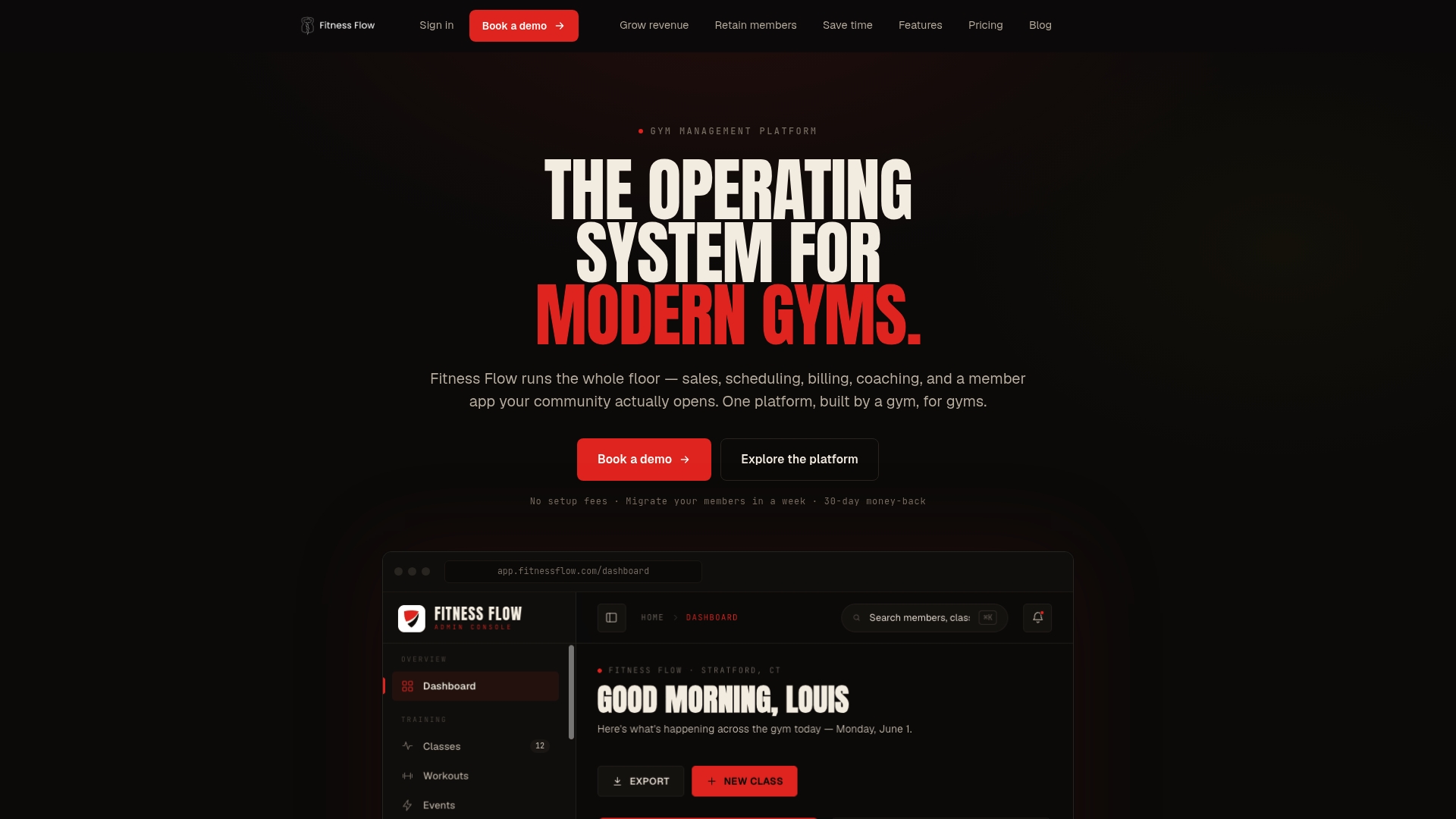
- A fully branded member app that carries your gym’s identity into every booking and check-in
- Migration support to help move member, billing, and schedule data without the guesswork
- Trainer resources and role-based access built for the way gym staff actually work
- Analytics that show adoption and retention trends instead of leaving owners to guess
If you’re planning a rollout, check the Solo, Studio, and Multi-site plans and get a demo before you set your go-live date.
FAQ
What is the best gym software?
There is no single best option since the right choice depends on gym size, staffing, and which features matter most, whether that’s scheduling, billing, or member engagement. Look for a platform with strong onboarding and migration support, since implementation quality often matters as much as the feature list.
What is the 3-3-3 rule in gym?
Definitions vary depending on the source, and this term is used inconsistently across fitness contexts, from workout structure to onboarding cadence. There’s no single agreed-upon definition tied to gym management software specifically.
What is the best gym training program app for staff onboarding?
The strongest option is one built for gym operations specifically, with role-based training features and migration support rather than a generic learning tool. Platforms like Fitness Flow include training and onboarding resources as part of implementation, which reduces reliance on outside tools.
Is there an app that shows you how to use gym machines?
Some gym management platforms include instructional content or workout guidance within their member apps, though coverage varies by provider. Check with your specific platform to see whether machine or exercise tutorials are part of the member experience.
How long should gym software training take before go-live?
Training length depends on system complexity and staff turnover, but a pilot phase combined with role-based sessions typically runs a few weeks rather than a single day. Rushing training to meet a launch date is one of the most common causes of a rocky rollout.