

Cut Gym Churn With 6 Habit Tracking App Features for Gym Owners

Built-in habit tracking and low-friction gamification inside a gym’s branded member app is one of the most reliable levers to boost attendance and retention, especially when the features follow behavior-change research rather than guesswork. Streaks, reminders, and goal tracking give members a reason to show up on an average week, not just a big one. The rest of this piece walks through the evidence, the features worth building, and a rollout plan that avoids the common traps.
TL;DR:
- Habit tracking features like streaks, goals, and reminders are most effective when tailored to individual motivation types and include opt-in options for members.
- A pilot period of six to twelve weeks, with baseline attendance data, is essential to accurately assess whether habit tracking increases retention and engagement.
- Overbuilding reward economies or forcing all members into the same gamification style reduces effectiveness; personalization significantly boosts booking and participation rates.
- Building automatic attendance logs and integrating booking data allows habit features to work seamlessly without extra effort from members.
- Using a platform like Fitness Flow consolidates member app, gamification, and analytics in one system, enabling easier implementation and better retention results.
Getfitnessflow
Keep Members Connected Between Visits
Fitness Flow combines a branded member app, live classes, gamified features, and analytics to support engagement and retention.
Table of Contents
- Why habit tracking works for gym attendance
- Core features to build into your member app
- Personalizing gamification so it does not fall flat
- What to measure and how to test it
- Rollout checklist from spec to full scale
- Quick wins and traps in day-to-day operation
- How Fitness Flow brings habit tracking and gym operations together
- Sources
- FAQ
Why habit tracking works for gym attendance
Habit tracking is not a gimmick bolted onto an app. It works because it maps onto how people actually build routines: through feedback, small wins, and social visibility.
A systematic review of mobile gamification interventions found that apps combining multiple game elements, such as goal-setting, progress bars, points, and feedback, tend to outperform apps that rely on a single mechanic, particularly when the design is guided by behavior-change theory. That review noted only half of the interventions studied used behavior-change theory in their design, which helps explain why results across apps are so inconsistent.
Field research backs this up in a gym-specific setting. A field experiment on gym attendance found that team incentives and periodic feedback produced larger and longer-lasting increases in visits than isolated financial bonuses, and that peer attendance information helped convert non-users into regular visitors.
Three behavior-change ideas explain why these mechanics work and should guide feature design:
- Self-determination theory: people sustain habits longer when they feel autonomous, competent, and connected to others, not just rewarded.
- Social cognitive theory: visible progress and peer comparison build the confidence needed to keep showing up.
- Behavioral economics: small, frequent feedback loops tend to outlast large but infrequent incentives.
41% of average adherence effects in gamified health apps come down to design choices, according to the same systematic review, which is a reminder that the feature set matters as much as the decision to gamify at all.
Core features to build into your member app
An owner does not need every game mechanic invented. A focused set, matched to real member behavior, does most of the work.
- Check-in streaks that count consecutive visits and reset gently rather than punitively.
- Visible goals and progress bars tied to classes booked, visits logged, or personal targets.
- Badges or levels that mark milestones without requiring a purchase to unlock.
- Opt-in reminders sent before a missed pattern becomes a lapsed membership.
- Team or partner challenges that turn attendance into a shared commitment.
- Lightweight rewards, such as recognition or small perks, rather than large cash incentives.
Behind the scenes, three data layers make these features useful instead of decorative. Automatic attendance logs and booking integration should feed the streaks and progress bars without member effort. Optional wearable sync can add step or workout data for members who want it, though it should never be required to participate. Owner-facing tools, including member segmentation, churn-risk flags, and campaign triggers, turn the same data into decisions rather than just a member-facing scoreboard.
Pro Tip: Build the owner-facing churn flag before the member-facing badge. It is the feature that pays for the rest.
Personalizing gamification so it does not fall flat
A single reward scheme rarely works for a whole membership base, because people show up for different reasons.
Roughly four motivation types show up again and again in gym settings: competitive members who respond to leaderboards, social members who respond to team challenges, mastery-driven members who respond to skill progress, and completion-driven members who respond to streaks and checklists. Matching game elements to these types is not a small tweak. A long-term study on personalized gamification found that members who received a gamification set suited to their type increased bookings significantly more compared with members who got an unmatched, generic set.
In practice, this means:
- Let members opt into the elements they want rather than forcing everyone into the same leaderboard.
- Offer anonymity choices for competitive features so social members are not forced into public rankings.
- Adjust challenge difficulty dynamically instead of using one fixed target for every member.
- Give new members a simpler streak-and-welcome-badge set, and give long-term members access to deeper leaderboards and team formats.
What to measure and how to test it
Habit-tracking features are only worth the build if you can show they move the numbers that matter to the business.
Track these as your primary KPIs:
- Visits per member per month, compared before and after rollout.
- Retention at 30, 60, and 90 days, broken out by cohort.
- Trial-to-first-return rate for new members.
- Churn rate segmented by engagement level, not just membership tier.
Underneath those, watch engagement signals that predict the KPIs above: streak persistence, challenge participation rate, and wearable sync frequency where applicable.
Gamified, wearable-linked interventions have produced meaningfully higher step counts and self-monitoring adherence than nongamified apps, according to a cluster randomized controlled trial, which is a useful benchmark for what a well-built feature set can achieve.
Run a simple pilot before a full rollout: a four-week baseline period with no changes, a pilot cohort of a meaningful slice of active members, and a 6 to 12-week evaluation window comparing pilot and baseline attendance.

Rollout checklist from spec to full scale
A habit-tracking rollout fails more often from poor sequencing than from bad features. Follow a build order that limits risk at each stage.
- Specify a minimal feature set: streaks, one goal type, and opt-in reminders, plus a clear consent and data-privacy plan for members.
- Configure the branded app and integrate it with your existing booking and point-of-sale systems so attendance data flows automatically.
- Pilot with a defined member sample for 6 to 12 weeks, collecting baseline attendance data before the pilot starts and comparing it against pilot-period results.
- Scale with staff training on the new features, automated re-engagement campaigns triggered by churn-risk flags, and a standing measurement cadence.
- Mitigate known risks throughout: cap financial incentives to avoid the novelty decay documented in incentive research, watch for participation drop-off after the first few months, and keep wearable data opt-in with plain-language consent.
Pro Tip: Treat the pilot’s baseline period as sacred. Skipping it is the single most common reason owners cannot prove the rollout worked.
Quick wins and traps in day-to-day operation
The fastest wins cost nothing extra to build: booking-linked streaks and a reminder sent the day before a member’s usual class time. Both use data you already have.
The traps are just as consistent. Owners overbuild reward economies with points, tiers, and shop currencies before proving a simple streak works, and they skip personalization entirely, assuming one leaderboard fits every member. Feed the same habit data into your scheduling decisions and
— Louis
How Fitness Flow brings habit tracking and gym operations together
Building streaks, goal tracking, and check-in data into a member app usually means stitching together a booking tool, a separate engagement app, and a spreadsheet for churn tracking. Fitness Flow removes that step by building the branded member app, gamified retention features, and owner analytics into the same platform used for scheduling and billing.
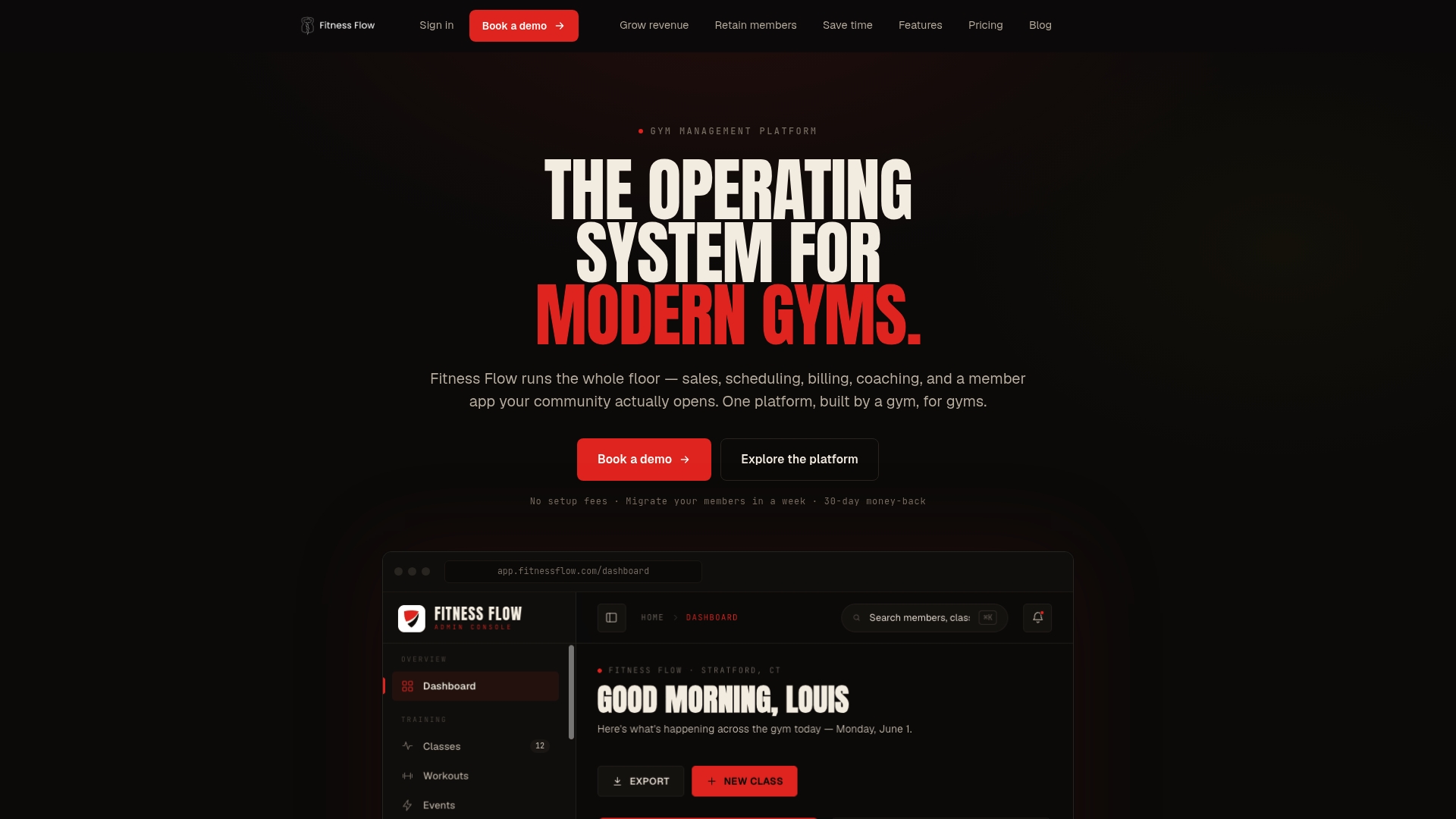
For an owner, that means:
- A fully branded member app with gamified features and live class streaming built in, not bolted on.
- Automatic attendance and booking data feeding directly into retention analytics, without a separate integration project.
- One subscription instead of several, which Fitness Flow’s own positioning ties to fewer administrative hours per week.
Fitness Flow reports an average increase in member retention among gyms using the platform, according to Fitness Flow’s own platform overview. Owners who want the habit-tracking approach described above without assembling it themselves can view the Solo, Studio, and Multi-site plans and start with a demo.
Sources
- The effects of mHealth-based gamification interventions on participation in physical activity: systematic review
- Long-term effects of personalized gamification on participation in a fitness context
- Get thee to the gym! A field experiment on improving exercise habits
FAQ
Does habit tracking actually increase gym attendance?
Yes, when it combines multiple game elements like streaks, goals, and feedback rather than relying on one mechanic alone. A systematic review of gamification interventions found stronger results when the design was grounded in behavior-change theory.
Should gyms use cash rewards or streaks to build habits?
Frequent, low-friction feedback such as streaks and reminders tends to hold up better over time than cash incentives, which often fade in effect once the novelty wears off. Research on financial incentives found short-term boosts but weaker long-term habit formation compared with engagement-contingent rewards.
How long should a gym pilot a new habit-tracking feature before rolling it out?
A pilot of 6 to 12 weeks, following a baseline period with no changes, gives enough time to see whether attendance and streak participation actually shift. Comparing pilot-period data against the baseline is what makes the results usable for a wider rollout decision.
What is the biggest personalization mistake gyms make with gamification?
Treating every member the same and forcing everyone into one leaderboard or challenge format is the most common failure. A long-term gamification study found that members matched to a gamification style suited to their motivation type increased bookings by roughly 30% more than unmatched members.
What does Fitness Flow cost for a gym that wants these features?
Fitness Flow’s Solo plan starts at $149 per month and the Studio plan at $349 per month, both listed on the Fitness Flow plans page; Multi-site pricing is available on request.