

Member Segmentation Strategies That Actually Grow Retention

Build behavior-first, dynamic segments and connect them to automation before you touch demographics. That single shift—from static exports to rule-based groups that update on their own—is what separates programs that lift renewal rates from ones that send the same newsletter to everyone.
Start this week with three moves:
- Pick one measurable goal, like reducing 90-day cancellation among new joiners.
- Build three core dynamic segments: new, active, and at-risk.
- Launch one automated message triggered by a status change.
Track a single primary KPI tied to that goal, and hold out 10% of each segment from your campaign to confirm the lift is real and not seasonal noise.
Key Takeaways
Effective member segmentation strategies combine behavior-first dynamic segments, a simple engagement score, and automated triggers validated with a holdout group.
PointDetails
Start behavior-first
Build status and engagement segments before adding demographic layers.
Use a 0 to 100 engagement score
Bands like 70 to 100, 40 to 69, and 0 to 39 map directly to intervention triggers.
Validate before scaling
Hold out 10% of each segment and confirm lift with an A/B test.
Avoid over-segmentation
Cap active segments at 5 to 8 until your team can manage more.
Use an integrated platform
Joinfitnessflow centralizes member data and automation so segments update without manual exports.
Table of Contents
- What Are Member Segmentation Strategies?
- Why Segmentation Matters for Membership Organizations
- What Are the Core Segmentation Dimensions?
- How Do You Build and Operationalize Member Segments?
- Rules, Scoring, RFM, or Clustering: Which Segmentation Method Fits?
- What Data and Tools Do You Need to Run Segmentation?
- What Segmentation Mistakes Should You Avoid?
- Starter Segment Templates You Can Copy Today
- What Does the Research Say About Effective Segmentation?
- How an Integrated Platform Shortens the Path From Data to Action
- Sources
- FAQ
What Are Member Segmentation Strategies?
Member segmentation strategies group people by their relationship to your organization, not just their purchase history. That distinction matters because membership isn’t a transaction, and leveraging specialized Gym SEO Services can help gyms effectively connect segmentation insights to targeted acquisition messaging. It’s an ongoing status with dues, benefits, tenure, and sometimes governance rights (voting, committee seats, chapter roles) that a retail customer never has.
General customer segmentation asks “what did they buy?” Member segmentation asks “how engaged and how far along their lifecycle are they?” A credit union member six months from renewal behaves differently than one who joined last week, even if both have identical account balances.
Three concepts anchor this practice:
- Engagement score: a composite number reflecting attendance, logins, or transaction frequency.
- RFM model: recency, frequency, and monetary value, borrowed from retail but adapted for dues and visit patterns.
- Member Pulse: Filene’s segmentation framework, built specifically for credit unions.
Why Segmentation Matters for Membership Organizations
Segmented communication changes outcomes you can measure within a quarter, not just brand perception you can’t. Associations using targeted status and engagement segments see 20 to 30% higher open rates than unsorted blast sends. That gap compounds over a year of monthly touchpoints.
The practical benefits stack up fast:
- Higher open and click rates from messages that match where someone actually is in their membership
- Better renewal rates because at-risk members get intervention before they lapse, not after
- Faster onboarding activation when new-member sequences replace generic welcome emails
- More effective upsell and advocacy asks, aimed at members who already show high engagement
There’s a staff-time payoff too. Once segments run on rules instead of manual list pulls, your team stops rebuilding spreadsheets every campaign and starts spending that time on message quality and testing.
What Are the Core Segmentation Dimensions?
Five dimensions cover most membership use cases, and each answers a different question about the member sitting in your database.
- Status and tenure: new, active, lapsed, expiring soon. Drives lifecycle and renewal campaigns.
- Behavioral and engagement: visit frequency, app logins, class bookings, event attendance. Powers retention and win-back triggers.
- Demographic and firmographic: age, location, membership tier, employer (for B2B associations). Useful for benefit relevance and pricing tests.
- Psychographic and attitudinal: motivations, values, perceived organizational ethics. A study on perceived corporate ethicality in fitness centers found it predicts loyalty and referral intent, which makes it a legitimate variable for messaging tone, not just demographics.
- Geographic: chapter, branch, or region. Matters for multi-location gyms and associations with local events.
Treat status and behavioral signals as primary, since they change often and drive the most action. Layer demographic and psychographic data as secondary filters. Set a minimum population rule (most teams use 50 to 100 members) so segments stay statistically meaningful instead of shrinking into a list of three people nobody can email profitably.
How Do You Build and Operationalize Member Segments?
The process is the same whether you run a 500-member gym or a 40,000-member association: define the goal before you touch the data, not after.
- Set the objective. Example: cut 60-day cancellation among members with fewer than two visits.
- Choose the KPI. Reactivation rate or renewal rate tied directly to that objective.
- Pick the signals. Last visit date, login frequency, dues status.
- Choose the method. Rules-based filtering for a first pass, scoring or clustering later.
- Build the rule or model. Example: “last visit > 21 days AND tenure < 90 days” defines a new-member risk segment.
- Validate. Check segment size, overlap with other segments, and whether a human can explain why someone landed there.
- Activate. Connect the segment to an automated email, SMS, or app push.
- Monitor. Watch how members move between segments week over week.
Pro Tip: Build your first segment around a single behavioral trigger, like “no visit in 14 days,” before adding demographic filters. A simple rule you can explain beats a clever model nobody on your team trusts enough to act on.
Rules, Scoring, RFM, or Clustering: Which Segmentation Method Fits?
Your choice depends on data maturity, not ambition. A gym with six months of clean visit logs shouldn’t jump straight to machine learning.
- Rules-based segments: simple if/then filters (“joined in last 30 days”). Easy to build, fully explainable, but brittle if rules aren’t maintained.
- Engagement scoring: a 0 to 100 composite score from visits, logins, and transactions. Bands like 70 to 100 (high), 40 to 69 (medium), and 0 to 39 (low) map directly to intervention protocols.
- RFM model: scores members on recency, frequency, and monetary value. Works well for dues-based and subscription revenue patterns.
- K-means clustering: an unsupervised method that groups members by similarity across multiple variables at once. A clustering study on gym data used K-means with PCA to separate older, low-frequency members from younger, high-frequency, higher-spend members, a split that plain rules would have missed.
- Propensity or ML models: predict future behavior (churn risk, upsell likelihood) using historical patterns. Requires the most data and the most upkeep.
MethodComplexityData requiredInterpretabilityActionabilityUpdate frequencyBest use case
Rules-based
Low
Basic CRM fields
High
High
Static or manual
Onboarding, renewal cohorts
Engagement scoring
Medium
Behavioral events
High
High
Dynamic, near real-time
Retention, escalation triggers
RFM model
Medium
Transaction/visit history
High
Medium
Dynamic
Upsell, dues-based targeting
K-means clustering
High
Multiple behavioral + demographic fields
Medium
Medium
Periodic (monthly/quarterly)
Program design, deep personalization
Propensity/ML
High
Large historical dataset
Low
Medium
Dynamic
Churn prediction, advanced upsell
Start with rules and engagement scoring. Add clustering once you have enough clean data to trust the output and staff time to interpret it.
What Data and Tools Do You Need to Run Segmentation?
Segmentation lives or dies on data hygiene. You don’t need a data science team, but you do need a single source of truth and a handful of canonical fields every member record actually has filled in.

Minimum fields to capture: join date, last visit or class attendance, last app login, lifetime dues or spend, and engagement events (bookings, referrals, reviews left).
Your platform needs to support:
- A unified member database (AMS or CRM) that both marketing and front-desk staff update, so segments never split across two disconnected tools
- Dynamic segments that refresh automatically instead of requiring a manual export every campaign
- Automation that routes messages by channel (email, SMS, app push) based on segment membership
- Fallback rules so a member who doesn’t fit any defined segment still gets a default message instead of nothing
KPIWhat it tracksReporting cadence
Open rate lift
Segmented vs. blast send performance
Per campaign
Reactivation rate
Lapsed members who return to active status
Monthly
Segment movement
Members shifting between engagement tiers
Weekly
Churn probability
Share of at-risk segment that cancels
Monthly
Consistent event capture (every login, booking, and cancellation logged the same way) is what makes engagement scoring reliable. Skip that step and your scores drift within a few weeks.
What Segmentation Mistakes Should You Avoid?
Most segmentation programs don’t fail because the strategy was wrong. They fail because of operational shortcuts that seemed harmless at the time.
- Starting with available data instead of the objective. Fix: write the goal first, then ask what data supports it.
- Over-segmentation. Twenty overlapping micro-segments confuse staff and dilute automation. Fix: cap active segments at 5 to 8 until your team has bandwidth for more.
- Stale static lists. A CSV exported three months ago is already wrong. Fix: convert every list to a dynamic, rule-based segment that refreshes with your CRM.
- Overlapping segments with no precedence. If someone qualifies for both “at-risk” and “high-value,” decide which message wins. Fix: add explicit precedence rules.
- No fallback segment. Members who fit no rule get skipped entirely. Fix: build a catch-all default sequence.
Set a naming convention, a freshness service-level agreement (weekly refresh minimum), and a preview test before every send.
Pro Tip: Run a “segment overlap audit” once a quarter: pull anyone who belongs to three or more segments and check whether your messaging to them actually makes sense stacked together.
Starter Segment Templates You Can Copy Today
You don’t need to design segments from scratch. These three sets cover most membership organizations on day one.
Basic three-segment set:
- New (joined within 30 days, fewer than 2 visits)
- Active (visited within 14 days, tenure over 30 days)
- At-risk (no visit in 21+ days, active dues status)
Renewal cohort set, grouped by days until expiration (60, 30, 14, 7), each triggering a distinct reminder tone: informational at 60 days, urgent by 7.
Engagement tier set, using score bands (high 70 to 100, medium 40 to 69, low 0 to 39) with different cadence and channel for each.
Sample sequence for the at-risk segment: Day 1, a personal check-in email from a staff member. Day 4, an SMS with a class or event invite. Day 10, a save offer if no response.
Gym example: filter for last_checkin > 21 days AND membership_status = active to catch quiet cancellations before they happen. Association example: filter for renewal_date < 60 days AND event_attendance = 0 to flag disengaged members before their vote on renewal.
What Does the Research Say About Effective Segmentation?
Filene’s Member Pulse program surveyed 4,700 credit union members and identified five distinct member types, most driven by relationship and trust rather than pricing alone.
Effective segmentation is explainable, actionable, substantial, measurable, and meaningful, according to Filene’s five-key framework. A segment that fails any one of those five tests usually collapses in practice, either because staff can’t explain it or because it’s too small to act on.
The practical implication extends beyond credit unions. A clustering study on fitness-center churn found that combining attitudinal survey data with behavioral records (visit frequency, spend) produced segments that predicted churn far better than either signal alone, with low-attendance segments churning at nearly double the rate of other groups.
- Validate any new segment with an A/B test or a holdout group before rolling it out organization-wide.
- Re-check segment stability quarterly. Member behavior shifts, and a segment built on last year’s patterns drifts out of date.
A weekly habit worth building
I run a five-minute Monday check on segment sizes before anything else touches my calendar. The micro-metric I watch is simple: net movement into the at-risk tier, week over week. Catching that early has saved more renewals than any single campaign ever has.
How an Integrated Platform Shortens the Path From Data to Action
Every strategy above assumes your data lives in one place and your automation actually fires when a member’s status changes. In practice, that’s where most gyms and studios get stuck, juggling a CRM, a separate scheduling tool, and a spreadsheet nobody trusts.
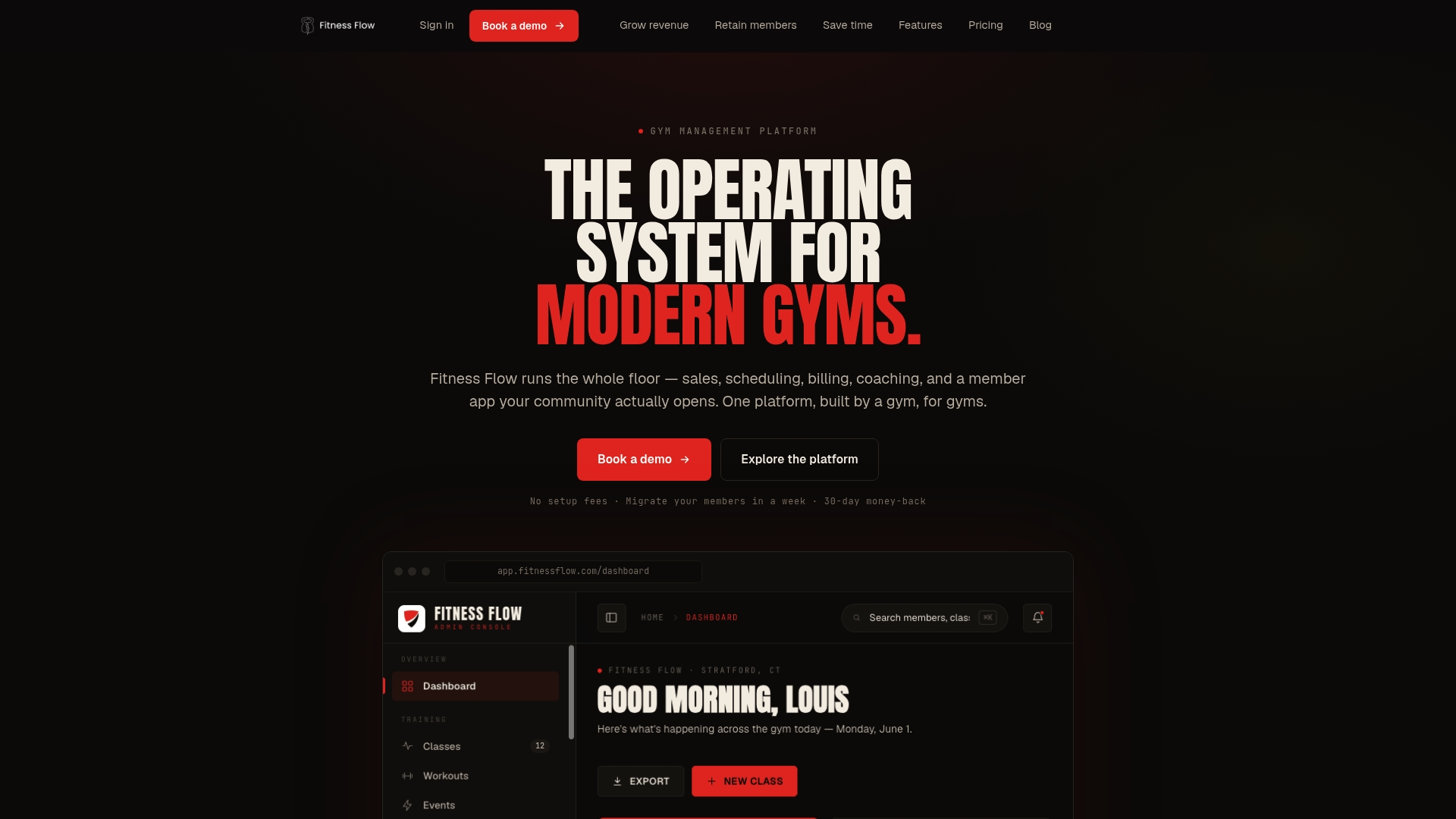
Joinfitnessflow was built around that gap. It gives you a single source of truth for member data, so engagement scores and renewal cohorts pull from the same records your front desk sees. Dynamic segments update automatically as members check in, book classes, or miss visits, no manual export required. And built-in automation templates let you launch an at-risk win-back sequence or a new-member onboarding series without stitching together three separate tools.
If you’re weighing platforms, compare candidates against the best gym management software options and check how each handles dynamic segmentation specifically, not just contact storage. When you’re ready to see how it fits your own KPIs, you can explore the Fitness Flow platform and book a walkthrough of the segmentation and automation tools firsthand.
Sources
- Thinking Forward: Five Keys to Successful Segmentation | Filene Research Institute
- Member engagement tracking and scoring library | Rework
- Email segmentation for associations | I4A blog
FAQ
What Is Member Segmentation?
Member segmentation is the practice of grouping members by shared traits like status, tenure, engagement level, or behavior so an organization can send more relevant communications and interventions to each group.
What Are the Four Types of Segmentation?
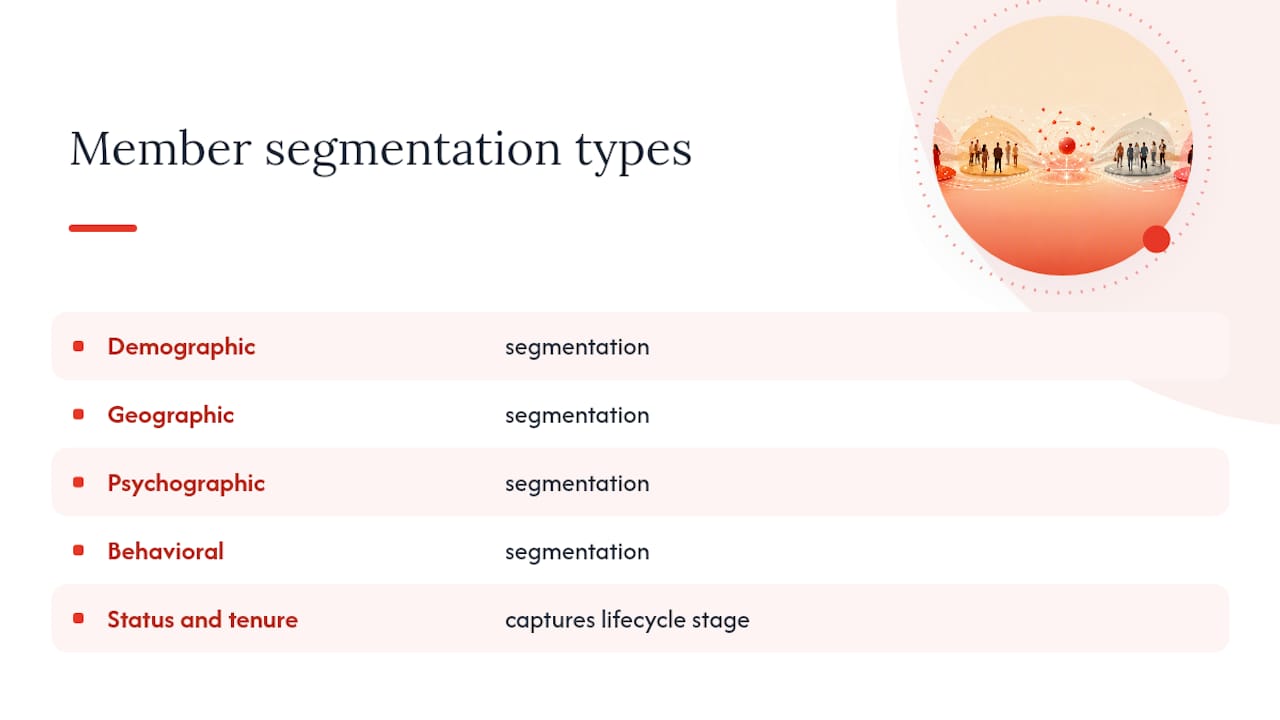
The four traditional types are demographic, geographic, psychographic, and behavioral segmentation, though membership organizations often add a fifth, status and tenure, since it captures the lifecycle stage general customer segmentation misses.
What Are the Five Types of Segmentation?
Adding status/tenure to the four traditional types (demographic, geographic, psychographic, behavioral) gives membership organizations five practical dimensions, which match the taxonomy used earlier in this guide.
What Is a Segmentation Strategy?
A segmentation strategy is the plan for which dimensions and methods (rules, scoring, RFM, or clustering) an organization uses to divide its members and the specific messages or offers each resulting group receives.
Can Segmentation Work Without a Dedicated CRM?
It’s possible with spreadsheets, but stale, manually updated lists are one of the most common reasons segmentation programs stall. A platform like Joinfitnessflow that maintains dynamic, rule-based segments removes that friction.