
Off-Peak Memberships: How Gyms Price, Enforce and Sell Them
An off-peak membership sells your quietest hours at a lower price, and it only pays if the window is real, the discount is fenced to that window and you can measure who uses it. Get those three things right and empty mid-mornings and early afternoons turn into recurring revenue without adding a single person to your 6 p.m. rush. This guide is for owners and managers who want to build that product: how to find the hours, how to price the tier, how to enforce it, how to sell it and how to know it works.
Getfitnessflow
Manage Off-Peak Memberships More Easily
Fitness Flow brings sales, scheduling, billing, and member engagement together in one platform for gyms managing membership options.
TL;DR
- An off-peak membership gives access to the same gym during set quiet hours, at a lower price than full access. Its job is to fill capacity you already pay for.
- Define the window from at least four weeks of hour-by-hour check-in data, then confirm it by watching the floor.
- Make it a named, permanent product with a hard-enforced window and a discount that is meaningful but not huge. Industry guidance runs from 20% to 50%, so test inside that range against your own numbers.
- Sell it as a value choice for people with flexible schedules, with daytime programming good enough to earn the loyalty.
- Track target-window check-ins, off-peak revenue and downgrades from full memberships separately, and change one variable at a time.
Table of Contents
- What an off-peak membership is
- Step 1: Find the hours that are really quiet
- Step 2: Set the window and the price
- Step 3: Sell it as value, not as a lesser tier
- Step 4: Measure whether it works
- Why the tooling matters
- Running it on Fitness Flow
- FAQ
- Sources
What an off-peak membership is
An off-peak membership is a cheaper pass that lets a member use the same gym, with the same equipment and classes, only during set quieter hours. One consumer-side explainer describes typical windows as mid-morning, mid-afternoon or late evening, often with broad weekend access. A standard membership allows entry whenever you are open and carries the highest price. The exact hours differ from gym to gym, so the contract has to state the window plainly.
For you as the operator, the logic is simple. Rent, equipment maintenance, wages and utilities do not drop when the floor is empty. Hours with few visitors are paid-for capacity that earns nothing.
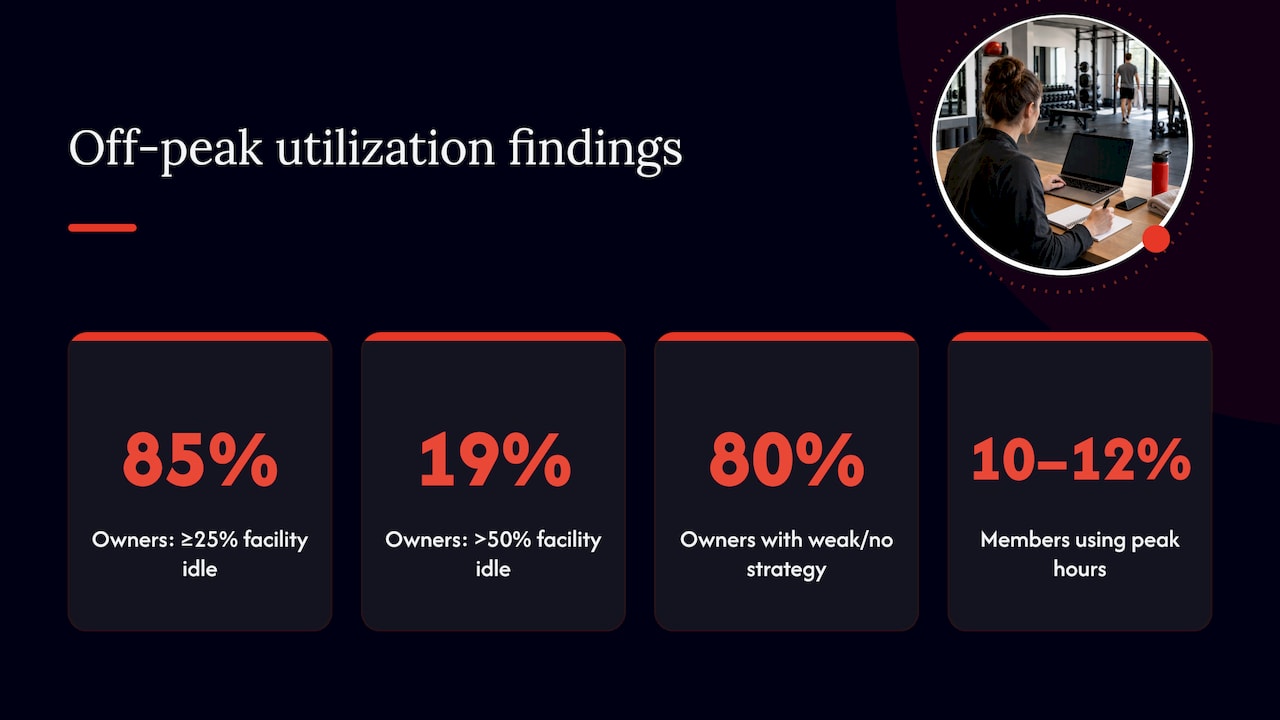
The gap is common. The 2026 Fitness Business Growth Report surveyed 662 gym and studio owners across 11 countries between March 30 and April 9, 2026. It found that 85% said at least a quarter of their facility goes unused during off-peak hours, and 19% said more than half does. The same survey reports that 80% of owners have no strategy, or only an underdeveloped one, for changing that. The figures cover all 11 countries, not only the US, but they describe a problem most owners will recognize on their own floor.
There is also a mix effect. The IDEA Health & Fitness Association, citing IHRSA data from 2011, notes that only 10% to 12% of members use a facility during peak hours. It says reduced-price off-peak memberships produce two quick results: new members sign up for the lower price, and some existing members switch down. The second result frees peak-hour space, shortens waits and can raise revenue and membership counts. That switch-down is also the risk you have to design around, which is why the sections below spend so much time on the window and the price gap.
Step 1: Find the hours that are really quiet
Do not pick a window from instinct. Pull the data.
- Export at least four weeks of check-ins from your access or booking system.
- Group them by hour and day of week. A simple pivot table does it. Look at weekdays and weekends separately.
- Mark the hours well below your average. These are your candidates. The usual pattern is a mid-morning lull, a dip from roughly 1 to 4 p.m. and quiet weekend afternoons, but your gym may differ.
- Remove hours you want to keep quiet, such as cleaning windows and the last hour before close.
- Note which candidate hours are already staffed. Those are the cheapest to fill, because the cost is already sunk.
- Walk the floor in those hours. A check-in count is not the same as occupancy. A member who swipes in at 5:45 p.m. may still be there at 6:30, and two friends through one held door count as one swipe. Confirm what the data says by looking.
The watch-the-floor step matters for another reason: perceived crowding often comes from clustering around free weights and popular cardio machines while other zones sit mostly empty. That is a layout and flow problem, and an off-peak tier will not solve it. Know which problem you have before you build a product.
A worked example: say your log shows about 10 check-ins between 1 and 3 p.m. against 40 or more between 6 and 8 p.m. The afternoon is a candidate window. If your front desk and one coach are already on shift then, the incremental cost of a member in that hour is close to zero.
Good attendance data is the foundation of this step. If your records are patchy, our guide to gym attendance tracking covers a method that holds up, and QR code check-in is one way to capture arrivals without adding front-desk work. For classes, class capacity planning shows how to set limits so the fill rate in each slot is visible.
Step 2: Set the window and the price
Three design choices decide whether the tier makes money or just cuts your average revenue per member.
Make it a named, permanent product
Give the tier a clear name and a clear window, for example a weekday daytime plan with access from 10 a.m. to 3 p.m. Treat it as part of your standard price list, not a one-off promotion. A product that appears and disappears teaches members to wait for the next deal.
Size the discount carefully
Advisers differ on the range. One gym consulting playbook suggests pricing an off-peak tier 30% to 50% below full access and positioning it as a smart value option rather than a discount brand. Other practitioner guidance for studios points to a narrower 20% to 35% band. Treat these as a testing range, not a rule.
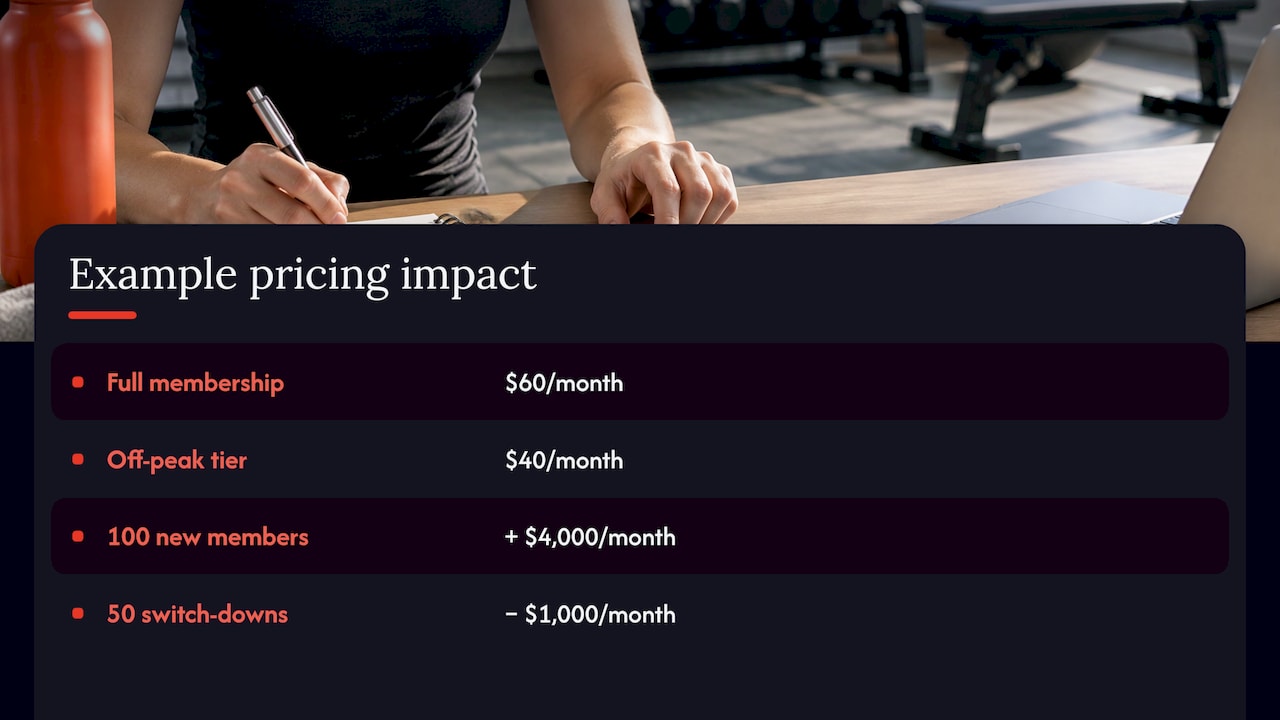
Here is an illustration with made-up numbers. Your full membership is $60 a month. A 33% discount puts the off-peak tier at $40. If 100 new members join at $40 who would not otherwise have joined, you add $4,000 a month in revenue on capacity that was idle. If 50 existing members drop from $60 to $40, you lose $1,000 a month from that group, so the new sign-ups have to outweigh the switch-downs. Run this arithmetic with your own member counts before you publish a price.
A gap that is too wide trains members to downgrade. A gap that is too narrow gives people no reason to accept a restriction. If a time band has sat below roughly 40% occupancy for three months, treat that as a pricing signal rather than only an advertising problem.
Fence the window
The window is the product. An off-peak member who can walk in at 6 p.m. is simply a full member paying less. Enforce the boundary through your access control or your booking system, and write the hours in the agreement in plain words. Also give members a one-step upgrade to full access with no penalty. That keeps goodwill high and turns a satisfied off-peak member into a higher-value one when their schedule changes.
Design choiceWhat to decideCommon failure
Window
Specific days and hours from your own data
Window includes shoulder hours that are already busy
Discount
Test inside a 20% to 50% range
Gap so wide that full members switch down
Enforcement
Hard stop at the door or in booking
Staff waiving the rule at the desk
Upgrade path
One step, no penalty
Upgrade needs a new contract
Naming
A permanent, descriptive product name
Reads as a limited-time deal
If you add perks to make the tier more appealing, keep them cheap and daytime-friendly, such as lounge access or recovery add-ons. If you are weighing what recovery services cost in the market, hydromassage membership prices give a reference point for what members may be used to seeing.
Price changes also affect existing members. If this tier is part of a wider pricing review, our rollout plan for raising gym prices shows how to do it without losing people.
Step 3: Sell it as value, not as a lesser tier
The way you describe the tier changes who buys it. The consultant quoted above recommends presenting it as a smart value option, because there is a large group of people who actually prefer a quieter gym. A message such as “our off-peak members get a quieter, calmer workout” works better than “come at off-peak to avoid the crowds,” which implies that your busy hours are a problem.
The people to aim at are the ones who already have daytime freedom:
- Stay-at-home parents and parents in the school window
- Retirees
- Remote workers and freelancers
- Night-shift employees
- Students with gaps between classes
Price alone will not hold them. Daytime members should get programming that is genuinely good, not the leftover slots nobody wanted. Think express lunch formats of about 45 minutes, school-hours classes with “back before pickup” timing, senior-friendly sessions and beginner or foundations classes. Newcomers often prefer an emptier room, so daytime is a natural home for them.
Corporate wellness is another route. In the same 2026 owner survey, 69% of respondents said improved off-peak utilization was part of their interest in corporate wellness partnerships. A company’s weekly team class at 2 p.m. is recurring revenue that never touches your evening crowd. That figure is also a global survey result, not a US-only estimate.
Good scheduling makes all of this easier. Our piece on class scheduling moves you can apply this week is a practical place to start, and demand-driven staff scheduling helps you match coaches to the hours that actually fill.
Step 4: Measure whether it works
Launch is the start. Track these on a dashboard you review on a fixed schedule:
- Check-ins in the target window, compared with the same window before launch.
- Off-peak revenue, reported separately from full memberships.
- Downgrades from full to off-peak. A steady stream suggests the price gap is too wide or the window too loose.
- Retention of off-peak members against your overall churn.
- Peak-hour feel. Check that evening density has not changed, and ask staff what they see on the floor.
Change one variable at a time. If you move the window, the price and the marketing together, you cannot tell which one worked.
Record the trial period too. A three-month read on a time band tells you far more than a two-week spike after an announcement.
Why the tooling matters
An off-peak product touches almost every part of gym operations at once: the schedule, the access rules, the recurring bill, the member communication and the report that tells you whether it paid off. When those live in separate tools, the window gets enforced in one place and priced in another, and the numbers never quite reconcile. That is where owners lose the margin the tier was meant to create.
For a multi-location operator the problem multiplies. Each site has its own quiet hours, so one off-peak definition rarely fits all of them, and you need to see every location’s data in one view to set windows that fit.
What we think
We built Fitness Flow because owners kept stitching together separate tools for sales, scheduling, billing and member engagement. A time-based membership is a good test of that setup. The decision to make it a product is simple. The hard part is running it every day: classes that fill the quiet slots, billing that matches the plan, a branded app that keeps daytime members connected, and reports that show whether the tier lifted utilization or just lowered your average price.
Our view is that the off-peak member should feel like a member, not a discount customer. That is why we put live and on-demand classes, gamified features and automated retention workflows in the same platform as scheduling and recurring billing. Our own figures from the platform are a 27% average increase in member retention and 12 hours a week saved on administrative tasks, and we design the product so an owner spends those hours on programming for the quiet hours rather than on spreadsheets.
If you run more than one site, we would start with the data: see each location’s quiet hours side by side, then decide what the tier should look like in each.
Louis
Running it on Fitness Flow
Fitness Flow is all-in-one gym management software that covers class scheduling and booking, recurring billing, a fully branded member app, reporting and analytics, automated retention workflows and multi-location management. Instead of paying for several separate subscriptions, you manage the whole off-peak product in one place, and we offer migration support if you are moving from another system.
Plans are tiered by gym size: Solo is $149 per month and Studio is $349 per month. Multi-site has no published price. You can see them on our pricing and plans page.
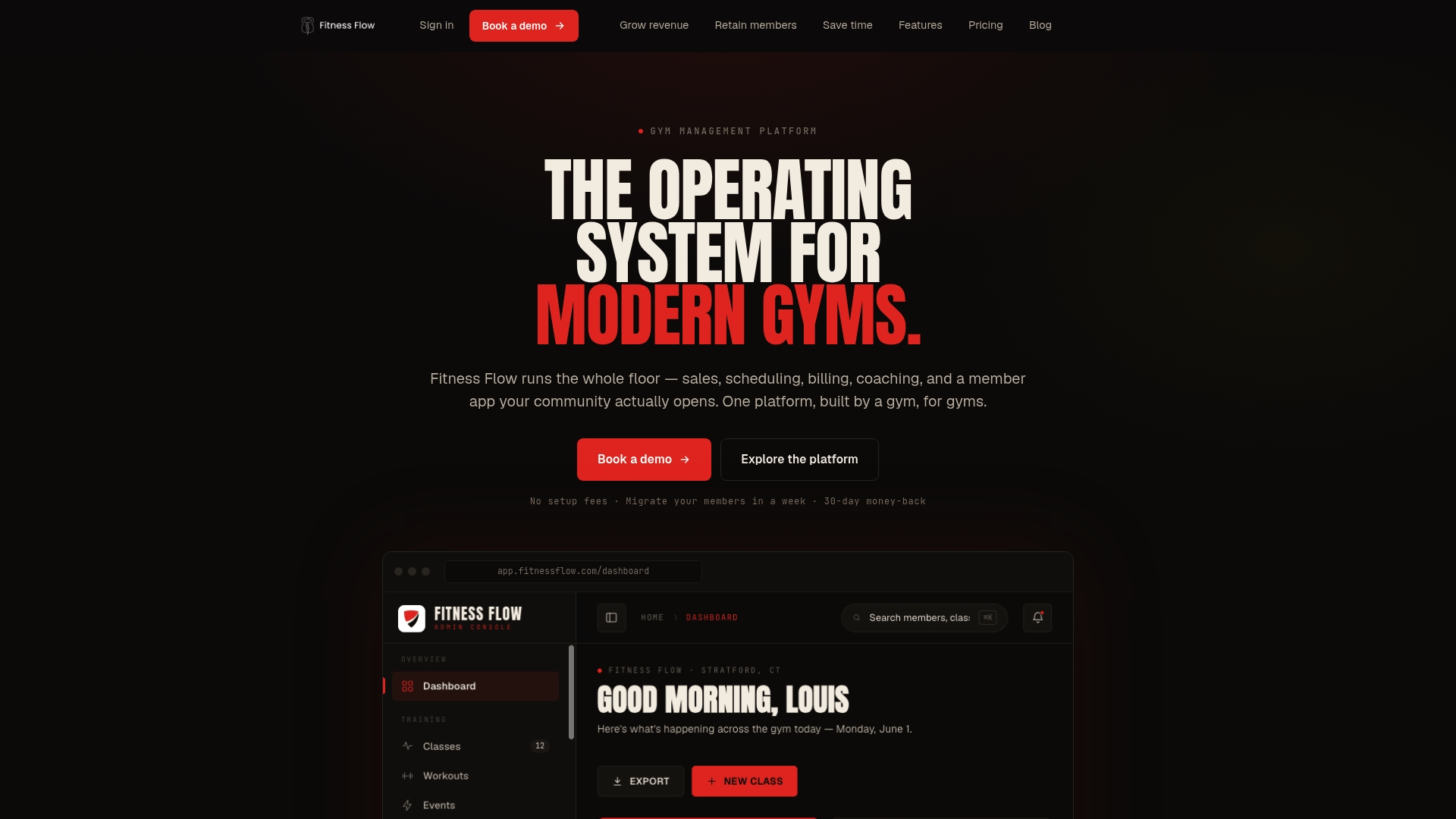
If you manage several locations, the Fitness Flow page for gyms shows how centralized management works across sites.
FAQ
How much cheaper should an off-peak membership be?
Published guidance spans a range. One consultant suggests 30% to 50% below full access, while practitioner guides for studios suggest 20% to 35%. Start inside that range, model how many existing members might switch down, and adjust one variable at a time after launch.
What hours count as off-peak?
There is no universal answer, because it depends on your own check-in pattern. Many gyms find a mid-morning lull, a dip from about 1 to 4 p.m. and quiet weekend afternoons. Pull at least four weeks of hourly data, then confirm it by watching the floor before you fix a window.
Will an off-peak tier cause my full members to downgrade?
Some switching is expected, and industry guidance says it comes with the sign-ups. The way to limit it is a hard-enforced window, a price gap that is meaningful but not huge and a permanent, named product. Track downgrades monthly as a separate line.
Who buys off-peak memberships?
People with daytime flexibility: stay-at-home parents, retirees, remote workers, freelancers, night-shift employees and students. They respond to a value message about a quieter gym and to programming scheduled for their hours.
Can corporate wellness help fill the quiet hours?
Yes. A company team class at a midday slot brings recurring revenue without adding to your evening crowd. In the 2026 owner survey, 69% of respondents named better off-peak use as a reason for interest in corporate wellness partnerships.
Sources
- The Fitness Business Growth Report 2026
- Managing Peak Times at Your Facility, IDEA Health & Fitness Association
- Turn Empty Hours Into Profit, Fitness Management and Consulting
- What Does Off-Peak Gym Membership Mean?