

Least Privilege Role Templates to Fix Staff Permissions for Gym Owners

Set up role-based access with deny-by-default, unique logins, and documented offboarding. Start with four roles: owner/admin, manager, front desk, and instructor, then remove every shared account today. That single change closes most of the exposure gyms carry around refunds, member data, and unauthorized discounts. Enable multi-factor authentication on any account touching billing or member records this week.
TL;DR:
- Enforce unique logins for every staff member and remove shared accounts to reduce risks of unauthorized refunds, member data breaches, and audit issues.
- Use deny-by-default permission settings with predefined role templates covering owner, manager, front desk, instructor, and support to control staff access precisely and limit privilege escalation.
- Implement multi-factor authentication for all accounts handling billing or personal information and regularly review logs of sensitive actions for at least 12 months to support audits and dispute resolution.
- Conduct onboarding with role-specific permissions, MFA activation, and device setup, and ensure offboarding immediately revokes access, recovers keys, and updates schedules to prevent lingering threats.
- Automate enforcement of policies with gym management software that offers templates, multi-site controls, audit logs, and offboarding workflows to maintain consistent, secure permissions.
Getfitnessflow
Simplify Gym Operations in One Place
Fitness Flow brings scheduling, billing, sales, member engagement, and analytics together for more streamlined gym management.
Table of Contents
- Why Staff Permissions Gym Software Should Enforce by Default
- Role Templates and Permission Categories You Can Copy
- How to Configure Gym Staff Permissions Step by Step
- What to Log and How Long to Keep It
- Onboarding and Offboarding Without Gaps
- Policies Every Gym Should Put in Writing
- A Publisher’s Take on Getting This Right
- Turn This Checklist Into a Working System
- Sources
- FAQ
Why Staff Permissions Gym Software Should Enforce by Default
Access control shouldn’t be an afterthought bolted onto your software after a bad incident. NIST’s access-control guidance rests on one rule: give staff only the minimum access their job requires, and start every new account with zero permissions. That’s deny-by-default, and it flips the usual gym habit of granting broad access “just in case” someone needs it later.
The risk of skipping this is concrete, not theoretical. A front desk employee with billing access can quietly waive fees for friends. A part-time instructor with export rights can walk out with your entire member list. Without logs, you can’t prove what happened or reverse it.
Structured permissions pay for themselves operationally, too:
- Disputes resolve faster because you know exactly who touched an account and when.
- New hires ramp up on a fixed set of duties instead of guessing what they’re allowed to click.
- Owners can delegate real work, like class scheduling or POS management, without handing over the keys to billing or settings.
Deny-by-default feels restrictive at first. In practice, it just means nobody gets more rope than their job requires.
Role Templates and Permission Categories You Can Copy
Most gym management platforms let you build custom roles, but you don’t need to start from scratch. Role-based access control mapped to real job functions is the standard model, and six roles cover nearly every gym:
- Owner/Administrator: full access, including settings, financial reports, and permission management itself.
- Manager: member records, scheduling, billing adjustments, and reporting, but not account-level settings.
- Front desk/Staff: check-ins, POS sales, basic member edits, no refund or discount authority above a set threshold.
- Instructor/Coach: class rosters, attendance, and their own schedule, nothing tied to billing.
- Accountant/Finance: billing, refunds, and financial exports, with no member communication or marketing access.
- Support/Temporary: narrow, time-boxed access for substitutes or contractors, expiring automatically.
Permission categories should map across every role: members, scheduling/classes, POS/sales, billing/refunds, reporting/exports, marketing, and account/settings. Grant access by action, not by screen. “Can refund up to $50” is safer than “has billing access.”
For multi-location operators, scope every role to a specific site by default. A front desk hire at your downtown location shouldn’t see member data from the location across town. And treat a shared PIN as a convenience, never a substitute for a unique login. PINs are fine for quick check-ins; they’re not an audit trail.

How to Configure Gym Staff Permissions Step by Step
Setting this up takes an afternoon, not a redesign of your whole operation. Follow this order:
- Inventory every account. List who has access, what role they hold, and whether any login is shared among multiple people.
- Kill shared logins immediately. Create a unique account for each employee, tied to their actual name.
- Set deny-by-default, then add back only the specific actions each role needs: view, edit, refund, or export.
- Restrict privileged actions to approvers. Refunds over a set dollar amount, permission changes, and price edits should require a manager or owner sign-off.
- Turn on MFA for any account touching billing, member PII, or settings.
- Set session timeouts so an unattended front desk terminal doesn’t stay logged in all day.
- Apply location-scoped roles if you run more than one site.
- Test the setup. Log in as a test account for each role and confirm it can’t reach anything outside its lane.
Pro Tip: Run your test step with a role that has zero permissions assigned. If that account can still see member phone numbers or export a report, your deny-by-default setting isn’t actually working.
What to Log and How Long to Keep It
Every permission system is only as good as its paper trail. NIST’s guidance on log management specifies that logs need to capture who did something, what they did, what it touched, and when. For a gym, that means logging refunds, price changes, permission edits, data exports, and password resets, at minimum.
Retain those logs for at least 12 months. That’s the baseline NIST recommends for supporting investigations and resolving disputes, and multi-location gyms growing fast should hold onto them longer.
Logs sitting unused don’t help anyone. Set alerts for privileged actions like bulk refunds or permission changes, and put a monthly log review on someone’s calendar. When a member disputes a charge or a discrepancy shows up in your books, a clean log turns a guessing game into a five-minute lookup.
Onboarding and Offboarding Without Gaps
Getting access right at hire and removing it completely at departure are two separate disciplines, and most gyms only do one well.
Onboarding checklist:
- Create a unique account tied to the assigned role, never a recycled login.
- Enable MFA before the first shift.
- Log completion of required training.
- Enroll any device used for check-ins or POS.
Offboarding checklist:
- Revoke system access the moment employment ends, not at the end of the pay period.
- Recover keys, fobs, or devices tied to the account.
- Remove the person from all upcoming class and shift schedules.
- Confirm completion with one designated coordinator.
That last point matters more than most owners assume. A federal audit of an offboarding process found that without a single point of coordination, tasks stayed incomplete and access removal got delayed or missed entirely. The same failure happens in gyms when three different managers each assume someone else canceled the departing employee’s login.
Review access on a set cadence, not just when someone leaves. Quarterly works for a single-site gym. Fast-growing or multi-location operations should review monthly, and any exception to standard permissions needs a documented approval, not a verbal “just give him access for now.”
Policies Every Gym Should Put in Writing
Permissions fall apart without written rules behind them. Five documents cover the gap:
- Access control policy: who gets which role and why.
- Password and MFA policy: minimum standards for every account.
- PIN policy: what a PIN can and can’t authorize.
- Privileged-access approval workflow: who signs off on refunds, exports, or new privileged accounts.
- Incident response ownership: who acts first when something goes wrong.
Assign a signer to each. Typically the owner approves the access control policy, an operations manager enforces day-to-day password and PIN compliance, and whoever handles your IT or software vendor relationship owns incident response. Record every approval, even informally, so you have a paper trail if a permission dispute ever comes up.
NIST’s small-business guidance also recommends requiring approval before creating any privileged account, rather than defaulting to shared or temporary logins out of convenience.
Tie training to account activation: no completed onboarding training, no live login. Refresh that training annually so PIN habits and password shortcuts don’t creep back in.
Pro Tip: Print your access control policy and post it near the front desk terminal. Staff who can see the rule in writing are far less likely to “borrow” a manager’s login for a quick refund.
A Publisher’s Take on Getting This Right
Some gym management platforms include role templates, multi-site controls, audit logs, and migration support to help address access sprawl, a common operational failure in gyms.
— Louis
Turn This Checklist Into a Working System
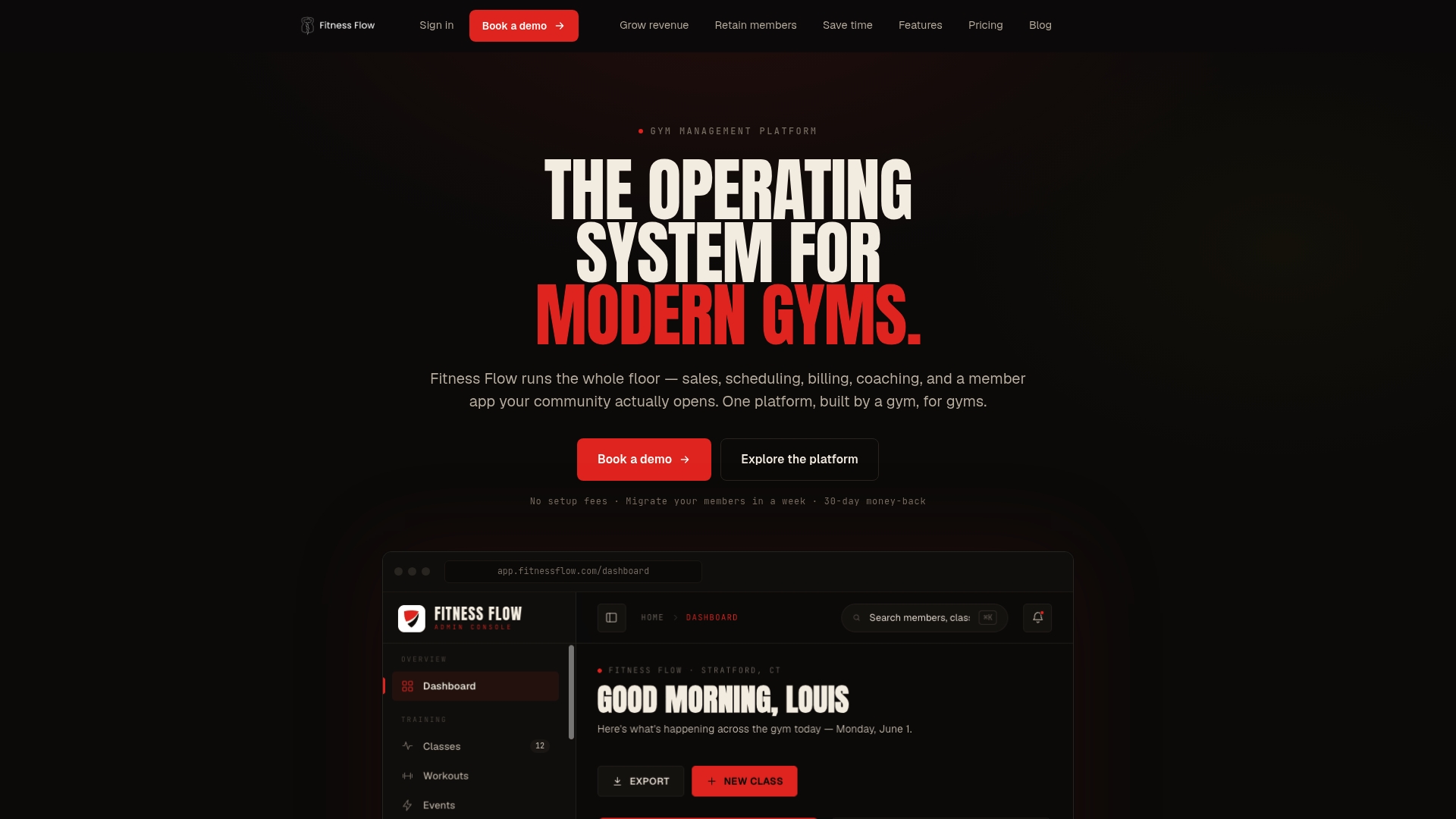
Everything above works best when your software enforces it automatically instead of relying on staff to remember the rules. Fitness Flow ships with ready role templates for owner, manager, front desk, and instructor accounts, along with audit logs, multi-location controls, and offboarding workflows that revoke access the moment someone leaves.
If you’re still running shared logins or guessing who has refund access, that’s the fastest fix available. The Solo plan starts at $149 per month for single-site gyms, and the Studio plan runs $349 per month for growing operations needing deeper reporting and staff controls. Multi-site pricing is available on request. Pair your access setup with a partner like gym-focused SEO services once your marketing team has clean, scoped access to run campaigns without touching billing. Book a demo on the Fitness Flow site and see your role templates configured before your next staff meeting.
Sources
- NIST SP 800-53 Revision 5 (access-control guidance)
- OIG audit: FTC controls over the offboarding process (2025)
FAQ
Can I give my employees a gym membership?
Yes, plenty of gyms offer staff memberships as a benefit, and that’s a separate decision from their system access level. A front desk employee’s personal membership account should stay completely separate from their staff login, with its own permissions and no crossover into admin functions.
Is $25 a month a lot for a gym?
That depends entirely on your local market and what the membership includes, and it isn’t tied to staff permissions. What matters operationally is that whoever sets pricing tiers has the authority logged and restricted to a manager or owner role, not open to every front desk account.
What are gym staff called?
Common titles include front desk staff, instructors or coaches, personal trainers, membership sales reps, general managers, and owners or administrators. Each title should map to one of the core roles in your access system, like role-based access control, rather than getting a custom permission set every time.
Do gyms need to be staffed?
Staffing requirements vary by gym type and local regulation, but most full-service gyms keep at least one staff member present during open hours for safety and member support. However staffing works at your location, every person on shift needs their own unique login rather than a shared front desk account.
How does Fitness Flow handle staff permissions gym owners need?
Fitness Flow includes built-in role templates for owner, manager, front desk, and instructor accounts, plus audit logs and multi-location controls for chains running more than one site. Plans start at $149 per month for single locations, detailed on the Fitness Flow site.