

Win Back Gym Members With 2 to 3 Emails Tied to Attendance

The best immediate move for winning back lapsed gym members is a behavior-triggered, segmented email sequence of two to three messages tied to attendance and last-visit data, not a generic monthly blast. This approach costs far less than acquiring a new member and perceived email ROI supports the investment. Compliance and deliverability rules, plus plug-and-play templates, follow below.
TL;DR:
- Usual attendance should set inactivity thresholds: check in after one to two missed weeks, offer value after 30 days, and ask members absent 60 days for feedback.
- Send two or three messages across the first three weeks, escalate value, then suppress nonresponders or move them to quarterly mailings to protect deliverability.
- Offer recently inactive members a free class or guest pass, reserve renewal discounts for members gone at least 60 days, and make redemption a single click.
- Include a working unsubscribe link in every commercial email, honor opt out requests promptly, and remove hard bounces to protect compliance and sender reputation.
- Test one offer at a time within the same segment, judging completed bookings and 60 to 90 day retention rather than clicks alone.
Getfitnessflow
Reconnect With Members Through Better Engagement
Fitness Flow brings scheduling, billing, sales, and member engagement together, helping gyms stay connected with clients between visits.
Table of Contents
- Who to target: define inactivity and segment lapsed members for gyms
- The reactivation sequence: timing, cadence, and escalation for gym win-back campaigns
- Email content that converts: subject lines, body frameworks, CTAs and personalization for gyms
- Offers and incentives that work for reactivating gym members (what to test and when)
- Deliverability and legal must-dos: CAN-SPAM, unsubscribe handling, and keeping sender reputation healthy
- Automation and measurement: triggers, tools, and KPIs to run a repeatable win-back program
- Plug-and-play templates: three gym-focused win-back email sequences (short, standard, high-value)
- Author perspective: practical priorities for gym owners (Louis, Fitness Flow)
- How Fitness Flow helps run win-back campaigns
- FAQ
- Sources
Who to target: define inactivity and segment lapsed members for gyms
A win-back campaign only works when you know exactly who is lapsed and why. Calendar-only rules, like “anyone who hasn’t opened an email in 60 days,” miss the point for gyms: attendance and bookings tell you far more about real disengagement than inbox behavior does. A member who still opens your newsletter but hasn’t checked in for three weeks is a different problem than someone whose membership payment failed and never resolved.
Start by building operational definitions instead of vague labels. “Recently inactive” should mean a specific attendance gap, say seven to fourteen days past a member’s normal visit pattern. “Lapsed” fits members who have gone quiet for a month or more but remain on an active billing cycle. “Cancelled or former” covers anyone who has formally ended their membership or whose payment method has failed repeatedly, which often connects directly to dunning email flows for recovering failed charges.
Three segmentation buckets work well for most gyms and studios:
- Recently inactive: missed their usual visit window by one to two weeks, best served with a light, no-pressure check-in.
- Lapsed (30 to 60 days): gone quiet with an active membership, suited to a value reminder plus a modest incentive.
- Cancelled or long-lapsed (60+ days): needs a stronger offer or a direct feedback ask before you write them off.
Booking data, class attendance logs, and payment activity are your three best triggers. A member who booked three classes a week and suddenly stopped is a cleaner signal than someone who was always sporadic. Attendance tracking systems make this segmentation almost automatic once attendance thresholds are set.
Before sending anything, run a quick quality check: confirm the segment excludes anyone who already unsubscribed, verify the attendance window matches each member’s historical pattern rather than a blanket rule, and make sure cancelled members are flagged separately from active members on a quiet streak. Skipping this step is how gyms end up emailing someone who already left angry, which does more harm than no email at all.
The reactivation sequence: timing, cadence, and escalation for gym win-back campaigns
Once segments are built, the sequence itself needs timing that matches urgency. Mailchimp’s re-engagement guidance recommends defining inactivity clearly and then escalating value across a short series of emails rather than repeating the same message. A short sequence of a few emails covers most gym scenarios without wearing out your sender reputation.
- Day 1 to 3 after the inactivity trigger fires: a warm, low-pressure check-in. No discount, just a reminder of what they’re missing and an easy way back in.
- Day 7 to 10: a value reminder paired with a modest incentive, such as a free class pass or a guest spot, aimed at members who didn’t respond to the first touch.
- Day 14 to 21: a last-chance message that either offers a stronger incentive or asks directly for feedback, depending on how long the member has been gone.
Escalation logic matters more than the exact days. For recently inactive members, skip the incentive entirely on the first email: a simple nudge often brings them back without training them to expect a discount. For members lapsed 30 days or more, introduce value earlier since the relationship has cooled further. For long-lapsed or cancelled members, the third email should ask what went wrong rather than push another discount, since at that distance the goal shifts from reactivation to honest feedback, something short member surveys handle well.
Deliverability safeguards cap how far this can go. Mailchimp’s re-engagement solutions page suggests two to three emails are a strong starting framework, warning that longer sequences risk spam complaints and damage inbox placement for your entire list. Set a hard limit: after the third email with no response, move the contact to a suppressed or quarterly list rather than continuing to mail them weekly.

Pro Tip: Build the ladder so the first touch changes based on recency, a gentle check-in for members gone one week, straight to an incentive for members gone six weeks, since the same opening message rarely fits both.
This recency-based branching is what separates a true behavioral ladder from a fixed drip campaign. A member who missed one class because of a vacation reacts badly to being treated like someone who quit three months ago, and the reverse is just as true: someone who canceled months back doesn’t need a chatty “we missed you at spin class” email, they need a reason to come back that acknowledges the gap.
Email content that converts: subject lines, body frameworks, CTAs and personalization for gyms
The subject line decides whether any of this sequencing matters. Short, specific lines tied to something concrete outperform vague ones. Formulas that work well for gyms include a name-plus-benefit pattern (“Sarah, your spot in Tuesday’s class is open”), a direct question (“Miss the 6am crew?”), or a time-boxed offer (“Your free week expires Friday”). Avoid anything that reads like a mass blast, since generic lines get ignored and occasionally reported as spam, which hurts future deliverability.
Body structure matters as much as the subject line. A simple four-part framework keeps emails short and effective:
- Check-in: acknowledge the gap without guilt-tripping (“We noticed you haven’t been in for a couple of weeks”).
- Value reminder: reference something specific, a favorite class, a trainer they worked with, or progress they made.
- Social proof: a brief mention of community activity, a new class format, or other members’ results, kept factual rather than invented.
- Single CTA: one clear action, not three competing links.
Personalization tokens make the check-in feel real instead of automated. Referencing a member’s last class type, their regular trainer, or their membership tier works well when it’s accurate and current. What doesn’t work is over-personalizing in a way that feels surveillance-like, such as citing exact visit counts or specific dates that make the email feel like a report card instead of a friendly nudge. Keep the tone closer to “we noticed you’re due for a reset” than “our system logged your 11-day absence.”
CTA best practices for gyms come down to reducing friction. Link directly to the booking widget for a specific class time, not a generic homepage. If the CTA involves redeeming an incentive, the landing page should pre-fill the offer rather than making the member hunt for a promo code. One CTA per email, repeated once near the top and once at the bottom, performs better than multiple competing links that split attention.
Offers and incentives that work for reactivating gym members (what to test and when)
Not every inactivity bucket needs a discount, and leading with one too early can train members to wait for deals instead of just showing up. Incentive choice should match how far gone the member is.
- Free guest pass or single class: works well for recently inactive members who just need a reason to walk back in.
- Discounted add-on (a nutrition session, a specialty class): fits lapsed members who need more than a nudge but shouldn’t be trained to expect a cheaper membership.
- Percentage-off renewal or waived fee: reserved for long-lapsed or cancelled members where the relationship needs a real reset.
- Referral-linked incentive: a strong option once a member returns, turning reactivation into a referral trigger for future growth.
For recently inactive members, value-first messaging usually outperforms discounts: a reminder of what they’re missing, paired with an easy booking link, often works without cutting into margin. Save discounts for the buckets where the relationship has genuinely cooled, since that’s where the cost of inaction (a permanently lost member) outweighs the cost of a modest offer.
A/B testing offers is straightforward if you isolate one variable at a time: test a free class against a percentage discount within the same lapsed bucket, then measure which drives more bookings within the redemption window, not just more clicks. Short-term ROI (bookings completed, revenue from renewed memberships) tells you if the offer worked immediately, while longer-term retention over the following 60 to 90 days tells you if it actually stuck.
Timing and expiry matter as much as the offer itself. A seven to ten day expiration window creates enough urgency without feeling punitive, and redemption should take one click, not a phone call or a front-desk conversation that adds friction right when you’re trying to make returning easy.
Deliverability and legal must-dos: CAN-SPAM, unsubscribe handling, and keeping sender reputation healthy
Win-back emails are commercial messages, and the CAN-SPAM Act requires a clear, working opt-out mechanism along with accurate sender information and subject lines that don’t misrepresent the email’s content. This applies even to current members, and the FTC has clarified that labeling a promotional email as an account notice doesn’t remove these obligations.
A few operational steps keep a gym compliant and protect deliverability at the same time:
- Include a working unsubscribe link in every email, not buried in tiny text at the bottom of a cluttered footer.
- Honor opt-out requests immediately rather than continuing to mail someone who’s already asked to stop.
- Remove hard bounces quickly so your sending domain doesn’t accumulate a pattern of mailing dead addresses.
- Set a sunset policy for contacts who haven’t engaged after the full reactivation ladder, moving them off regular sends entirely.
Mailchimp’s guidance on identifying inactive subscribers recommends archiving or unsubscribing contacts who don’t respond after a re-engagement attempt, since continuing to mail them drags down engagement metrics for the whole list.
A segment full of unresponsive addresses doesn’t just waste a send, it actively lowers inbox placement for every future email you send, because inbox providers weight engagement signals when deciding whether your messages land in the primary inbox or the spam folder. Pruning a stale list protects every campaign that comes after it, including the ones that have nothing to do with win-backs.
Automation and measurement: triggers, tools, and KPIs to run a repeatable win-back program
Manually tracking who missed a class and when is not sustainable past a handful of members, which is why the entire sequence needs to run on triggers rather than someone checking a spreadsheet. The most reliable triggers tie directly to attendance and billing events: a missed recurring class slot, a gap past a member’s typical visit frequency, or a failed payment that didn’t resolve within a few days. Most gym management and email platforms let you set these as automated rules so the right email fires the moment the trigger condition is met, not days later when someone remembers to check.
- Connect attendance and billing data to your email platform so inactivity triggers fire automatically instead of relying on manual list pulls.
- Set the trigger thresholds per segment, for example seven days past normal frequency for “recently inactive” and 30 days for “lapsed.”
- Launch the ladder so each email fires on schedule unless the member re-engages, in which case the sequence stops automatically.
- Route non-responders after the final email into a suppressed or quarterly list instead of the regular send cadence.
- Review KPIs monthly and adjust trigger windows or offers based on what the data shows.
The KPIs worth tracking are reactivation rate (what share of a segment returns to at least one visit or booking), revenue per reactivated member, open and click rates per email in the sequence, and unsubscribe rate as a deliverability health check. These definitions line up with the retention metrics every membership manager should track. Marketing guidance on re-engagement cites typical re-engagement rates around 10% of inactive contacts, with many who do respond going on to open subsequent emails, which is why the ladder structure matters more than any single send.
A simple workflow example: a member’s attendance drops to zero for ten days (data), which fires the recently-inactive trigger (trigger), sending the check-in email (email), and if there’s no click within three days, the sequence automatically queues the value-and-incentive email (post-send action). Run this same logic for the lapsed and cancelled buckets with longer windows and stronger offers.

Plug-and-play templates: three gym-focused win-back email sequences (short, standard, high-value)
Three ready-to-adapt sequences cover most gym scenarios, from a quick nudge to a full-value recovery path.
Short sequence (recently inactive, single email): Subject: “Your spot’s still open this week” Body: a one-line acknowledgment of the gap, a mention of a specific class or time slot, and a direct link to book.
Standard 3-email sequence (lapsed, 30 to 60 days):
- Email 1, check-in: Subject “We saved your spot.” Short body noting their usual class and an easy way back.
- Email 2, incentive: Subject “A free class, on us.” Body offers a guest pass or discounted add-on with a short redemption window.
- Email 3, last chance or feedback: Subject “Before we close your file.” Body offers one final incentive or asks a single question about why they stopped coming, linking to a short feedback form.
High-value sequence (VIPs or long-tenure members, cancelled or long-lapsed): A personalized note referencing their specific history, framed as a concierge check-in rather than a mass email, with a CTA to book a short call or consult with a manager instead of just a class. This fits members whose lifetime value justifies a human touch over an automated discount.
Each CTA should land somewhere specific: the short and standard sequences link straight to the booking widget or a redemption landing page pre-filled with the offer, while the high-value sequence links to a scheduling page for a personal consult or a short feedback form rather than a generic booking page.
Pro Tip: Test one variable per sequence at a time, swap only the subject line or only the incentive, so you know which change actually moved the reactivation rate instead of guessing.
For gyms layering in text reminders alongside these emails, SMS as a last-chance nudge can work well for the final touch in the standard sequence, provided consent requirements are documented ahead of time.
Author perspective: practical priorities for gym owners (Louis, Fitness Flow)
I favor behavioral triggers over calendar-based blasts because gyms already generate the data that makes targeting precise: attendance logs and booking patterns tell you more about a member’s intent than any open rate ever will. The gyms that get this right tend to treat their member-facing app as part of the win-back strategy itself, not just a delivery channel for emails, since a branded app experience gives members an easy path back in in one tap.
If you’re choosing your first campaign, keep it simple: pick one segment (recently inactive is the easiest starting point), build a two-email ladder, and measure reactivation rate before expanding to the other buckets. Resist the urge to launch all three segments and five incentive types in week one.
— Louis
How Fitness Flow helps run win-back campaigns
Running the segmentation, triggers, and templates above by hand works for a handful of members, but most gyms outgrow spreadsheets fast. Fitness Flow ties attendance and booking data directly to automated sequences, so a missed class or a lapsed payment fires the right email without anyone building a manual list every week.
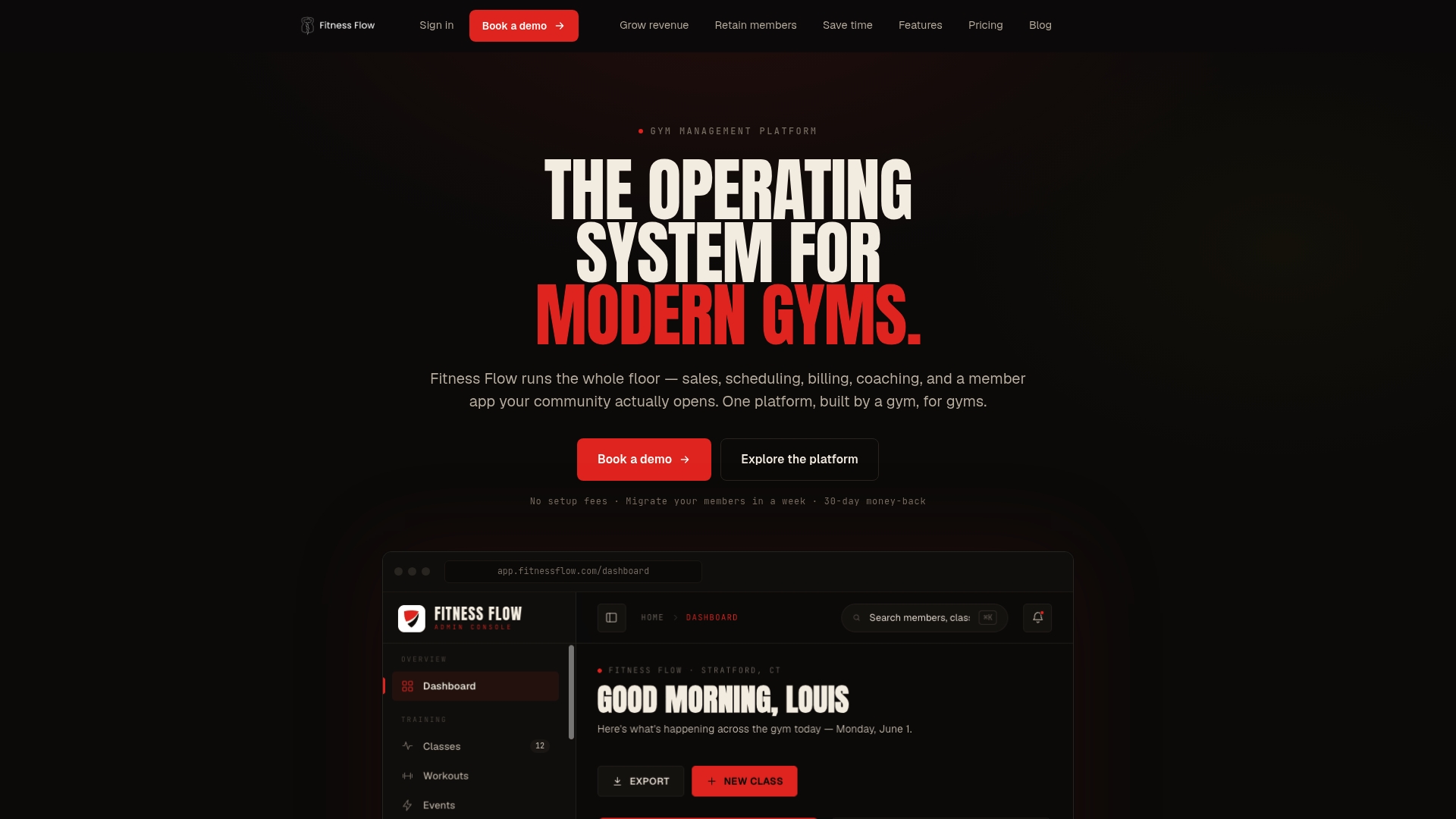
The member app we provide gives lapsed members a one-tap path back to booking, which shortens the distance between opening an email and actually walking back in. Redemption workflows for incentives, attendance-based triggers, and reactivation reporting all live in the same platform, so there’s no juggling a separate email tool and a separate attendance system to keep the sequence running.
If you’re ready to see how this fits your gym, visit the Fitness Flow plans page to compare the Solo, Studio, and Multi-site options and get started.
FAQ
What counts as an inactive gym member?
Definitions vary by gym, but a practical starting point treats “recently inactive” as one to two weeks past a member’s normal visit frequency and “lapsed” as 30 days or more with an active membership. Mailchimp’s guidance on inactive subscribers recommends basing these thresholds on actual engagement data rather than a single fixed rule for everyone.
How many emails should a gym win-back sequence include?
Two to three emails is the recommended range, since Mailchimp’s re-engagement guidance warns that longer sequences risk spam complaints and can hurt inbox placement for future sends. Escalate value across the emails rather than repeating the same message.
Do gyms have to include an unsubscribe link in win-back emails?
Yes, the CAN-SPAM Act requires a clear, working opt-out mechanism in every commercial email, including messages sent to current or former members. Opt-out requests need to be honored promptly to stay compliant and protect sender reputation.
What’s a good incentive for winning back lapsed gym members?
A free class or guest pass works well for recently inactive members, while a stronger discount or waived fee tends to suit members who have been gone 60 days or more. Testing one incentive at a time within a segment shows which offer actually drives bookings rather than just clicks.
Can Fitness Flow automate gym win-back campaigns?
Fitness Flow connects attendance and billing data to automated email sequences, so triggers like a missed class or a lapsed payment fire the right message without manual list building. Plans are listed on the Fitness Flow site starting with the Solo tier.
Sources
- CAN-SPAM Act: A Compliance Guide for Business | Federal Trade Commission
- How to Write a Winback Email: Examples and Best Practices | Mailchimp
- Statista: Email ROI perception