Gym Cleaning Schedule: Daily, Weekly and Monthly Tasks
A gym cleaning schedule works when every task has a frequency, a named owner and a record that it was done. Frequencies come from public health and industry guidance: shared equipment after each use, high-touch surfaces and locker rooms several times a day, floors daily, deeper work weekly and monthly. Ownership and records are where most schedules fail, and that is a management problem more than a cleaning one. We build Fitness Flow for gym owners, and the pattern is the same across operations: the checklist is easy to write and hard to keep running without clear roles and a log.
Getfitnessflow
Keep Gym Operations Running Smoothly
Fitness Flow brings gym management tools together for scheduling, billing, sales and member engagement, helping owners streamline daily operations.
TL;DR
- Clean shared equipment after every use, disinfect skin-contact surfaces daily, and clean locker room and restroom touch points more than once a day.
- Floors, mirrors and drinking fountains are daily tasks. Light fixtures, vents and mats are weekly. Carpet, grout and equipment servicing run on monthly to annual cycles.
- Time heavy wet-area cleaning for slow hours and light sweeps for after the morning, lunch and pre-evening rushes.
- Assign each zone to a named person, use an initialed log, and have a manager walk the floor each morning.
- Cleanliness is a retention issue: members who rate their club as extremely clean are far more likely to renew.
Table of Contents
- Why the schedule matters to your revenue
- The schedule at a glance
- Clean after each use: the member layer
- Daily tasks for staff
- How staff should disinfect safely
- Weekly, monthly and annual tasks
- Fit the schedule to your traffic
- Assign owners and keep records
- Our view: treat cleaning as an operating routine
- Put the schedule into your gym’s operations
- FAQ
- Sources
Why the schedule matters to your revenue
Cleaning is usually treated as a cost. The numbers say it also protects revenue. The International Health, Racquet & Sportsclub Association (IHRSA) surveyed 600 U.S. members and 495 staff for its Guide to Health Club Cleanliness. Of members who saw their club as extremely clean, 90% were likely to renew, against 52% of those who saw it as unclean. An unclean environment played a part in quitting for 10% of recent leavers. The guide put that at about 3% of a club’s membership, or an estimated $41,400 a year at an average club of 2,300 members paying $600 a year.
That survey dates from 2008, so treat the dollar figure as an illustration of scale and run your own numbers with your dues. The direction is clear: a visible cleaning routine is a retention tool.
Locker rooms deserve special attention. American Spa reported IHRSA research in which 69% of members judged a club’s cleanliness by its locker rooms, while only 11% saw them as the cleanest part of the facility. Members form their opinion in the one place where you are weakest.
The schedule at a glance
Use this as a starting template, then adjust for your traffic and equipment mix. The sources behind each row are explained in the sections below.
FrequencyAreaTask
After each use
Shared equipment, benches, mats
Member wipe-down, then let it dry
Several times a day
Locker rooms, restrooms
Door handles, faucets, toilet seats and handles, restocking
Each rush period
Cardio, weight floor
Staff sweep and disinfect touch points
Daily
Flooring, upholstery, fountains, mirrors
Clean and disinfect, inspect for damage
2 to 3 times a week
Cardio machines
Clean guide rods and lubricate per manufacturer
Weekly
Light fixtures, vents, mats, exercise balls
Dust, scrub, wet-mop or steam-clean floors
Monthly
Cardio equipment
Calibration check, plus an independent audit of your logs
Quarterly
Carpet, cardio equipment
Shampoo carpet, service machines
Annually
Grout and tile
Inspect and repair
Clean after each use: the member layer
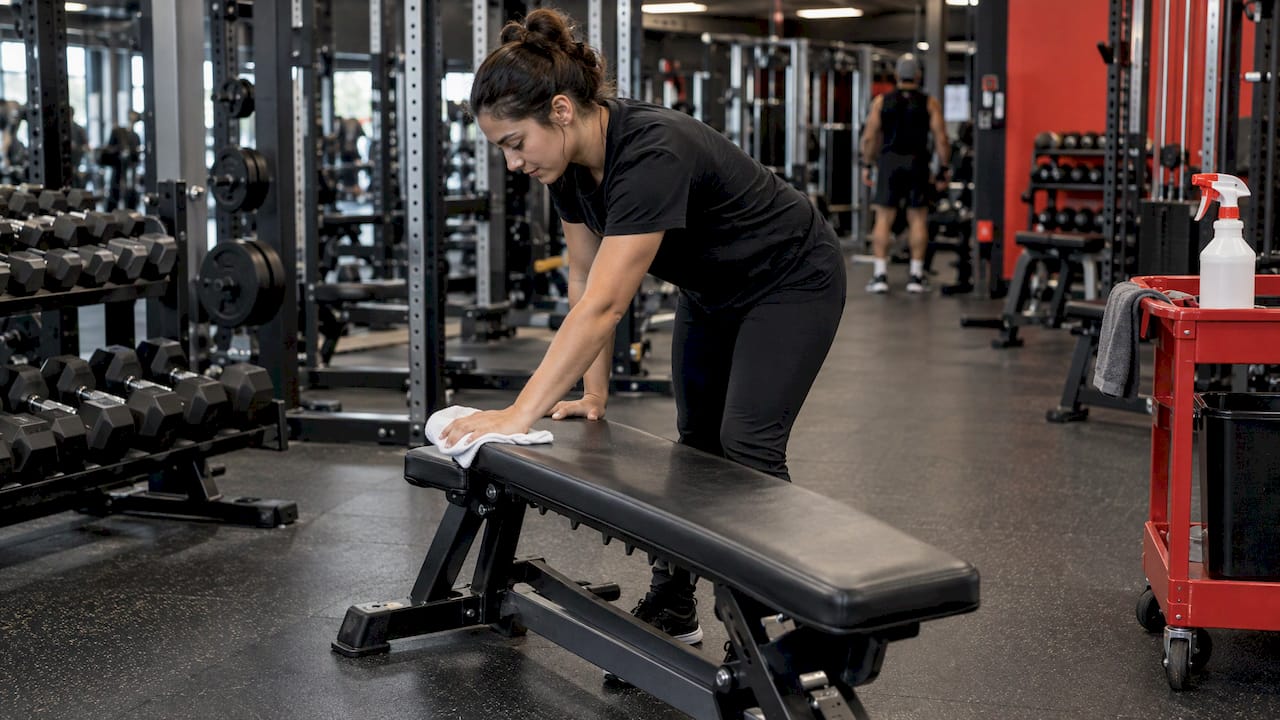
The Centers for Disease Control and Prevention advises cleaning shared equipment after each use. In practice that means the members do the first pass, so your job is to make it easy: stations stocked with wipes or spray bottles and a sign at each zone.
The Los Angeles County Department of Public Health’s guidelines for reducing the spread of staph and MRSA (MRSA is a skin infection bacteria that survives on shared surfaces) tell gyms to make disinfectant spray bottles available to patrons. They also advise repairing or discarding equipment with damaged surfaces, because cracked vinyl cannot be cleaned properly.
There is a practical wrinkle on what goes in those bottles. Athletic Business reported equipment expert advice that mild soap and water (1:10) or diluted vinegar (1:20) suits between-use wiping, because quat disinfectants need five to ten minutes of dwell time that members will not observe and can harm paint, plastics and touchscreens. One club manager quoted there moved from spray bottles to wipes after members over-sprayed screens and heart-rate monitors. Put the strong disinfectant in staff hands, and give members something gentle that cannot hurt the equipment.
Daily tasks for staff
Staff cleaning is a different job from member wipe-downs: it uses a registered disinfectant, follows the label contact time and gets recorded.
The National Strength and Conditioning Association’s safety checklist calls for daily inspection and cleaning of all flooring, upholstery, drinking fountains and skin-contact equipment surfaces. It also lists daily mirror cleaning and a check for equipment damage. Combine those with the Los Angeles County guidance to clean shared equipment daily to remove soil, then disinfect it with an EPA-registered detergent disinfectant used according to its label.
A workable daily list:
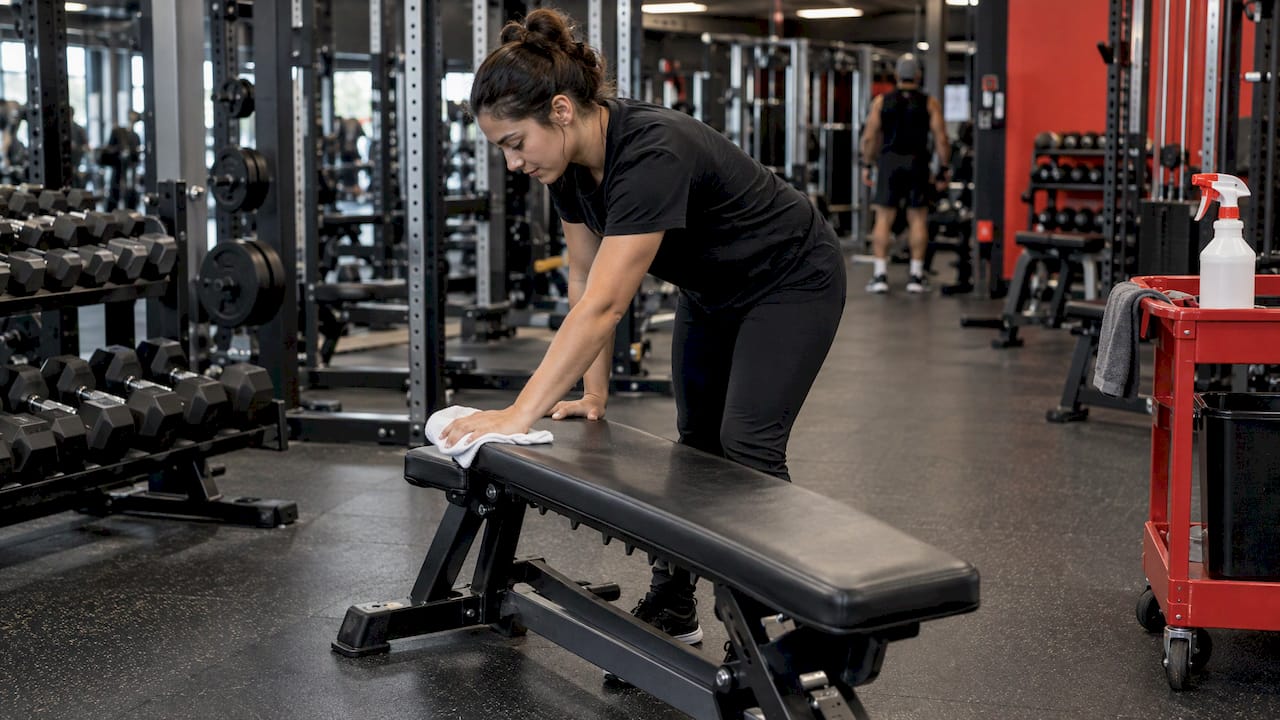
- Disinfect every bench and pad (top and underside), handrails and consoles on cardio machines, dumbbells, barbells, cable attachments and pull-up bar grips.
- Dry-mop or sweep floors, then wet-mop according to the floor type.
- Clean mirrors, glass and drinking fountains.
- Disinfect door handles, check-in kiosks, countertops and pens at the front desk.
- Inspect equipment for torn upholstery or loose parts and tag anything damaged.
- Empty trash and restock soap, paper goods and wipes.
Locker rooms, restrooms and the front desk
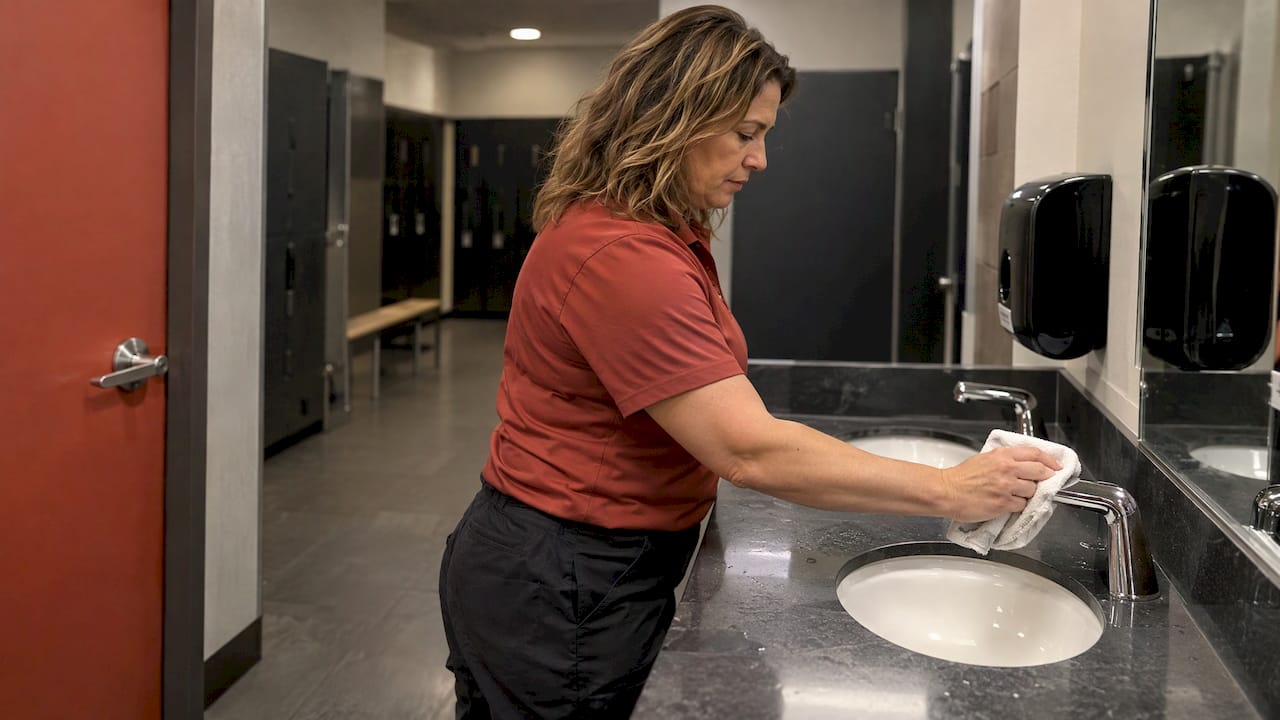
ISSA, the cleaning industry association, says high-contact surfaces should be cleaned at least daily. Equipment that clients touch with their bodies needs it several times a day, and so do locker room and restroom touch points such as door handles, faucets and toilet seats and handles. Bowls, sinks and floors can be done once a day. Build your locker room rounds around that split: frequent touch-point passes, one thorough daily clean.
How staff should disinfect safely
A disinfectant only works if it is applied correctly. The steps below combine ISSA’s guidance with the equipment maker’s instructions.
- Wash hands for at least 20 seconds and put on disposable gloves at minimum, per ISSA. The facility’s risk assessment may call for more protective equipment, as the GBAC STAR fitness center guidelines note.
- Clean first, then disinfect. Equipment maker Matrix’s facility guidance recommends mild dish soap and water at 1:10 or vinegar and water at 1:20, applied to a cloth rather than sprayed onto the machine.
- Follow with an EPA-registered disinfectant and leave it wet for the contact time on the label. Matrix gives 3 to 5 minutes for its approved products. Always read your own product’s label.
- Wipe in one direction and let the surface air dry. Where you use a spray, let it sit for the recommended time before wiping.
- Remove and dispose of gloves, then wash hands again.
The same Matrix guidance says trained staff should disinfect machines once or twice a day depending on traffic. On wood surfaces, the Los Angeles County guidelines say bleach solutions should stay in contact for at least 10 minutes. Keep bleach away from equipment finishes unless the manufacturer allows it.
Weekly, monthly and annual tasks
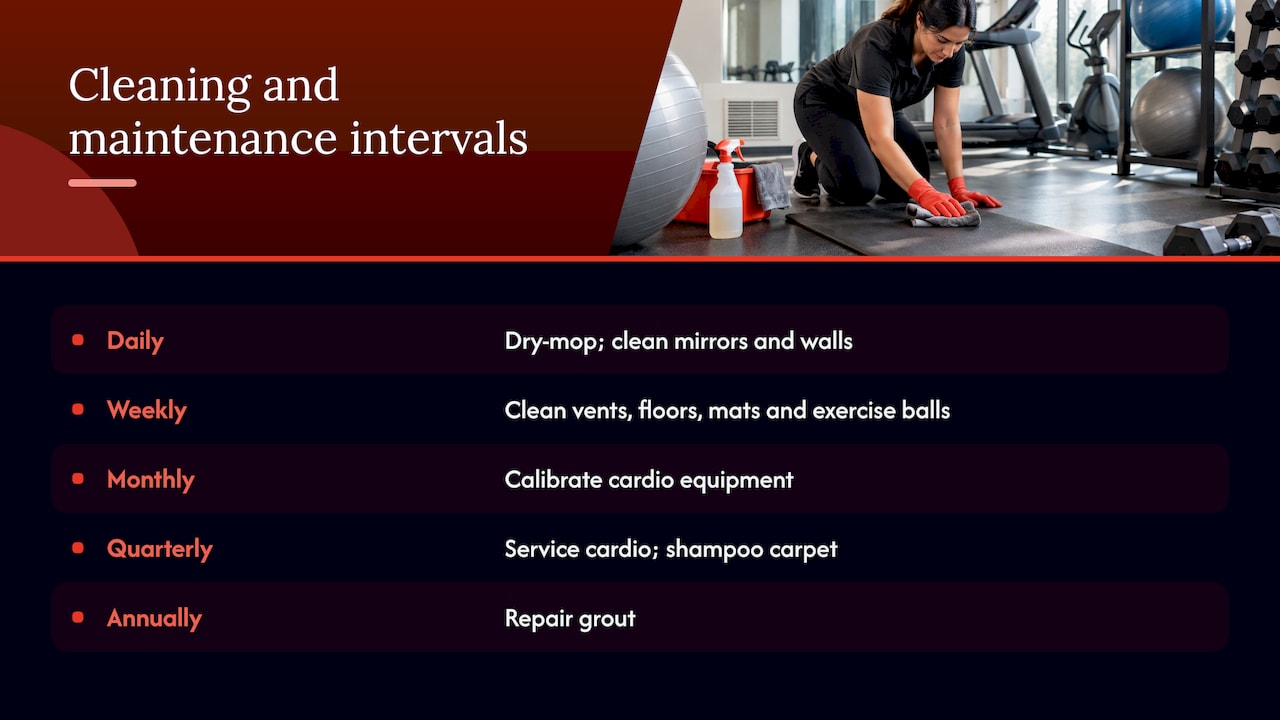
IHRSA’s sample schedule in its cleanliness guide gives a good frame for the longer cycles. Fitness floor staff handle daily dry-mopping, mirror and wall cleaning and picking up loose articles. Weekly work covers light fixtures and vents, wet-mopping or steam-cleaning floors, and scrubbing mats and exercise balls. Cardio equipment is calibrated monthly and serviced quarterly, carpet is shampooed every three months and grout is repaired annually.
The NSCA checklist adds cleaning and lubricating aerobic machines and their guide rods two or three times a week, and dusting ceiling fixtures weekly. Weekly is also the right interval for the places a daily pass skips: vacuuming under cardio machines and dusting the tops of racks and TV mounts.
Equipment servicing belongs on the same calendar as cleaning, since a machine that is dirty is usually also overdue for inspection. Our guides to gym equipment maintenance and the full gym maintenance checklist for daily, weekly and annual care lay out those intervals.
Wet areas and saunas
If your facility has a sauna, it needs its own entries: wipe-downs of benches, ventilation after use and periodic deep care of the wood. This sauna maintenance and care guide covers what that upkeep involves, so you can turn it into recurring weekly and monthly lines on your schedule.
Fit the schedule to your traffic
A fixed clock rarely matches a real gym. Athletic Business interviewed club operators who named the key cleaning windows: after the morning rush, after the lunch rush, before the evening rush, plus a full evening clean. One operator there advised saving heavy cleaning of wet areas for slow or off hours, and noted that a visible, uniformed porter shows members the effort is happening.
GBAC’s guidelines say the same in compliance language: disinfect at least daily, and more often during high-volume times.
A quick way to set your windows:
- Pull your check-in data for the last month and find the three busiest blocks and the quietest two hours.
- Place light sweeps right after each busy block, and heavy work such as steam-cleaning and mat scrubbing in the quiet hours.
- Revisit it each season, since January and summer traffic patterns differ.
Assign owners and keep records
Most cleaning failures are not about technique. They are about nobody being sure whose job it was. The same Athletic Business piece recommends dividing the club into territories with named staff responsible, building checklists with the area, owner, frequency, initials and products used, and having the general manager walk the facility each morning with the full checklist. ISSA recommends a written schedule with assigned staff and time slots, visible initialed cleaning logs and inventory tracking. GBAC adds that completed work should be documented.
You do not need a separate cleaning squad. Stephen Tharrett, a co-editor of ACSM’s facility standards, told IHRSA that cleanliness works when it is part of the club’s value system: a daily checklist, supervisor follow-up and an independent surprise audit once a month that compares results with the daily logs.
The log has a second job. If a member reports an infection or a slip, a dated record is the first thing you will want. Our guides on gym compliance checks and incident reporting show what to inspect, log and fix, and the OSHA records guide covers inspection-ready documentation for U.S. gyms.
Our view: treat cleaning as an operating routine
Owners ask us for a cleaning checklist. The checklist is rarely what is missing. What is missing is the routine around it: who owns the zone, when the task is due, and where the proof lives.
A gym runs on many small recurring duties, and cleaning is one of them next to class scheduling, billing and follow-up with members. When each lives in a different tool or a different notebook, the cleaning duties are the first to slip, because nobody sees them in the same place as everything else.
That is why we built Fitness Flow as one platform for gym operations, with facility management, compliance tools and employee and role management alongside scheduling, billing and the member app. One system means one place to assign duties, see who is responsible and keep records, and it means fewer subscriptions and less admin. Our customers’ gains on those fronts are what we measure: a 27% average increase in member retention and 12 hours saved on administration each week.
Clean floors will not keep members alone, but members who see a gym that is run well tend to stay. Run cleaning with the same discipline as everything else.
Louis
Put the schedule into your gym’s operations
Once you have the template, the work is making it recurring, visible and owned. Fitness Flow brings gym operations into one place: scheduling, staff roles, facility management, compliance tools, billing and a fully branded member app. Plans are Solo at $149 per month and Studio at $349 per month, and Multi-site has no published price. You can see the plans on the Fitness Flow site, or read how the platform fits a gym on the Fitness Flow for gyms page.
If you are moving from spreadsheets and several tools, the software implementation playbook walks through the rollout, and the guide to staff permissions shows how to give each team member access to only what they need.
FAQ
How often should a gym be cleaned?
A gym needs cleaning at several layers. Shared equipment is wiped after each use, high-touch surfaces and locker room touch points are cleaned more than once a day, and floors, mirrors and skin-contact surfaces are done daily. Weekly and monthly tasks cover the areas daily work skips, such as vents, light fixtures and mats.
What should be on a daily gym cleaning checklist?
Start with disinfecting benches, pads, handrails, consoles, weights and cable attachments, then floors, mirrors, drinking fountains and the front desk. Add restroom and locker room restocking, trash removal and a damage inspection of equipment. Staff should initial each line so the record shows who did what.
What disinfectant should a gym use on equipment?
Use an EPA-registered disinfectant and follow the label for contact time, which is how long the surface must stay wet. Clean off visible soil first, and apply cleaner to a cloth rather than spraying screens and consoles. Check your equipment maker’s list of approved cleaners before choosing a product.
Who should clean the gym: members or staff?
Both. Members wipe equipment after each use with supplies you provide, and staff handle disinfection, floors, locker rooms and detail work. Operators interviewed by Athletic Business recommend named staff for each territory and a manager walk-through each morning.
Sources
- IHRSA, Guide to Health Club Cleanliness
- American Spa, Locker Room Cleanliness Could Affect Member Retention
- Centers for Disease Control and Prevention
- Los Angeles County Department of Public Health, Guidelines for Reducing the Spread of Staph/CAMRSA
- Athletic Business, How to Clean Your High-End Fitness Equipment
- NSCA, Exercise Equipment safety checklist
- ISSA, The Best Ways to Effectively Clean and Disinfect Your Gym
- GBAC STAR Fitness Center Guidelines
- Matrix, Approved Cleaners, Disinfectants and Lubricants
- Athletic Business, Optimal Cleanliness = Member Satisfaction