
Recover 15–25% of At Risk Members: Gym Member Surveys for Gym Owners

Use categorized gym member surveys plus a set cadence and a defined routing workflow to surface problems before members quit and cancel quietly. This article gives you copy-paste questions organized by purpose, the timing that gets responses, and the follow-up steps that turn complaints into saves. Run NPS quarterly, pulse checks monthly, route every detractor within 72 hours, and close the loop in public so members see their feedback change something.
TL;DR:
- Running NPS quarterly and pulse surveys monthly helps detect loyalty trends and small issues before they lead to cancellations.
- Sending surveys through SMS yields response rates of 20 to 35 percent, while email averages around 8 to 15 percent, making channel choice critical.
- Limiting survey length to under two minutes and avoiding double-barreled or leading questions ensures more trustworthy and actionable data.
- Responding promptly to detractors with specific follow-up significantly increases the chances of retaining at-risk members.
- Automating survey deployment and response routing through integrated platforms minimizes manual effort and improves follow-up consistency.
Getfitnessflow
Keep Members Engaged Between Visits
Fitness Flow brings scheduling, billing, analytics, and a branded member app together to help gyms strengthen engagement and retention.
Table of Contents
- Which type of gym survey should you run, and when?
- What questions should you actually ask gym members?
- How do you get gym members to actually respond?
- What makes a survey question actually useful?
- How do you turn survey results into action?
- How do you close the loop with unhappy members?
- Can you launch a survey program this month?
- How can gym software automate this whole process?
- Why most gym surveys fail before they’re even sent
- Run your surveys and close the loop without doing it by hand
- Where to go for benchmarks and templates
- Sources
Which type of gym survey should you run, and when?
Five survey types cover nearly every member touchpoint, and each answers a different question.
Net Promoter Score (NPS) measures overall loyalty with one core question: would this person recommend you? It’s a relationship metric, not a moment-in-time check, so run it quarterly. The North American health club NPS benchmark sits around 39, which gives you a rough marker, though your own trend over time matters more than any single score.
Pulse surveys are one or two questions sent monthly or biweekly to catch small frustrations before they become cancellation reasons. Onboarding surveys go out around day 30, right when a new member has enough experience to judge the place but is still early enough to fix a bad first impression. Post-class surveys fire immediately after a session, while the workout is fresh. Exit surveys trigger at cancellation and are the only place you’ll reliably hear the real reason someone left.
- NPS: quarterly, email or in-app, gauges loyalty and predicts referrals
- Pulse: monthly or biweekly, SMS or in-app, catches small issues early
- Onboarding: day 30, email or app push, confirms the new member is settling in
- Post-class: immediate, QR code or app prompt, checks instructor and class quality
- Exit: at cancellation, email or short call, captures the actual reason someone is leaving
Match the survey to the moment. A quarterly NPS sent the week someone joined tells you nothing useful yet, and a two-question pulse check sent to a canceling member misses the real story entirely.
What questions should you actually ask gym members?
Copy these directly into your survey tool and adjust the wording to match your gym’s voice.
Pulse survey (1 to 3 questions). Keep these short enough to answer between sets:
- “How satisfied are you with your visits this month?” (1 to 5 scale)
- “Is there anything getting in the way of your workouts right now?” (open text)
- “How likely are you to keep up your current routine here?” (1 to 5 scale)
Each question targets a different early warning sign. Question one catches general dissatisfaction, question two surfaces friction like scheduling or crowding, and question three flags disengagement before it turns into a cancellation.
NPS plus driver set (5 to 7 questions). Lead with the core NPS question, then add rated drivers so you know why people score the way they do:
- “How likely are you to recommend [gym name] to a friend or colleague?” (0 to 10)
- “How would you rate our group classes and instructors?” (1 to 5)
- “How would you rate the condition and availability of equipment?” (1 to 5)
- “How would you rate the cleanliness of the facility?” (1 to 5)
- “How would you rate the value for what you pay?” (1 to 5)
- “How would you rate our app and digital booking experience?” (1 to 5)
- “What’s one thing we could improve?” (open text)
Guides recommend this exact structure. A 5 to 7 question NPS-plus-driver format is short enough to finish while walking to the parking lot, but detailed enough to point you toward a fix.
Post-class questions. “How would you rate today’s class?” and “Was the instructor clear and engaging?” are enough. Don’t add more.
Exit survey questions. “What’s the main reason you’re canceling?” (multiple choice with an “other” field), “Was there anything we could have done differently?” (open text), and “Would you consider returning in the future?” (yes/no/maybe) give you both quantitative categories and the verbatim detail that a checkbox alone won’t capture.
How do you get gym members to actually respond?
Channel choice affects response rates more than question wording does. Send the wrong survey through the wrong channel and you’ll get a trickle of replies from your most engaged members and nothing from everyone else.
- SMS works best for short pulse checks. It gets read fast and typically returns 20 to 35 percent response rates.
- Email is the default for NPS and longer driver surveys, but response rates run lower, around 8 to 15 percent, so plan your sample size accordingly.
- In-app prompts reach your most engaged members at 15 to 25 percent response, which makes them a solid channel for onboarding and quarterly NPS since app users tend to be your longer-term crowd.
- QR codes or paper handed out post-class can hit 30 to 50 percent when a staff member actively distributes them right after the session ends.
Response rates by channel: SMS 20 to 35%, in-app 15 to 25%, email 8 to 15%, post-class QR or paper 30 to 50%.
On incentives, a monthly prize draw across all respondents works because it doesn’t skew who answers. Paying per response backfires: it attracts people answering fast for the reward rather than answering honestly, and it quietly biases your data toward whoever has the most free time to fill out surveys.
What makes a survey question actually useful?
Bad survey design produces data you can’t trust, and untrustworthy data leads to fixes that don’t fix anything.
Keep the whole survey under two minutes and tell members that up front. “This takes about 90 seconds” outperforms no time estimate at all because it removes the guesswork that makes people abandon halfway through. Avoid double-barreled questions like “Are the classes and instructors good?” since a member might love the classes and dislike one instructor, and you’ll never know which half they meant. Leading questions (“How much do you love our new equipment?”) poison the response before it’s given.
- Use a 0 to 10 scale for NPS only, never for driver questions
- Use a 5-point Likert scale for satisfaction drivers and keep the polarity consistent (1 always bad, 5 always good) across every question
- Use conditional logic to skip class-related questions for members who never attend classes
- Cap open-ended fields at one or two per survey; more than that and completion rates drop fast
Pro Tip: Run your own survey on your own phone before sending it. If it takes longer than you told members it would, cut a question before you launch, not after the low completion rate rolls in.
How do you turn survey results into action?
Net Promoter Score is your promoters (9 to 10 raters) minus your detractors (0 to 6 raters), expressed as a percentage of total respondents. One quarter’s number tells you almost nothing on its own. Three quarters of movement, up or down, tells you whether your fixes are working.
Driver analysis is where the real prioritization happens. Cross-reference each driver rating against whether that member is a promoter or detractor. If your detractors consistently rate “equipment” low while promoters rate it fine, you’ve found your highest-leverage fix. Combining NPS with rated drivers lets you chase the changes that actually move loyalty instead of the loudest complaint in your inbox.
Segment results by tenure (under 90 days versus over a year), visit frequency, and membership tier. New members and veterans often flag completely different problems, and averaging them together hides both.
MetricWhat it tells youReview cadence
Response rate
Whether your channel and timing are working
Monthly
NPS trend
Direction of overall loyalty, not a single snapshot
Quarterly
Recovery rate
Percent of flagged detractors who improved after follow-up
Monthly
Driver correlation
Which specific factors separate promoters from detractors
Quarterly
How do you close the loop with unhappy members?
A detractor score sitting unread in a spreadsheet does nothing. Fewer than 4% of dissatisfied members complain directly; the survey is often the only signal you’ll get before they cancel.
- Route every detractor score to a manager or retention staffer promptly when it comes in.
- Make first contact within a few days with a short, specific message: reference their actual complaint, not a generic “we’re sorry to hear.”
- Log the outcome and follow up again in two weeks to confirm the fix held.
- Review pulse results weekly and NPS results monthly, with one named owner accountable for each.
Templates that route detractors immediately report recovering 15 to 25 percent of at-risk members who would otherwise have quietly left. Post a visible “you asked, we acted” note on a bulletin board or in the app when you fix something a survey flagged. It’s the single cheapest thing you can do to keep response rates from decaying over time.
Pro Tip: Assign detractor follow-up to whoever the member actually knows: their regular instructor beats a front-desk staffer they’ve never met.
Can you launch a survey program this month?
Yes, and you don’t need custom software to start.
- Pick one micro-survey (1 to 2 questions), one NPS-plus-driver survey (5 to 7 questions), and one exit survey.
- Define your target cohort: everyone, or a segment like members past 90 days.
- Set up your channel: SMS for pulse, email or in-app for NPS, a form link for exit.
- Assign a routing owner for detractor responses before you send anything.
- Brief front-desk and coaching staff so they know a survey is going out and why.
- Test two subject lines against each other before committing to one
- Try sending on a Tuesday versus a Saturday to see which day pulls better response
- Test with and without a prize-draw mention to measure incentive lift
How can gym software automate this whole process?
Running this manually across spreadsheets and email blasts works for a while, then breaks down as your member count grows. An integrated platform can trigger surveys directly from a branded member app, fire a webhook the moment someone books their first class or lets a streak lapse, and tag responses automatically by tenure, tier, or visit frequency without a staffer copying data by hand.
Automated retention data illustrates the kind of gains automation can produce: gyms using such platforms report a notable increase in member retention and significant time saved weekly on administrative tasks, freeing staff time for the actual follow-up calls that recover detractors.
When evaluating any platform for this, prioritize:
- Automated routing that flags detractor scores to a staff member instantly
- Cohort segmentation by tenure, tier, and attendance
- In-app survey prompts timed to real member moments, not blanket blasts
- Analytics export so driver correlation and NPS trend live in one dashboard
Why most gym surveys fail before they’re even sent
The biggest mistake isn’t question wording. It’s launching a survey with no one assigned to read the results.
Fix the culture problem before the survey problem. Put five minutes of survey review into your weekly staff huddle. Announce fixes publicly, even small ones like restocking a specific dumbbell weight, and give the credit to the staffer who acted on it. Members notice when feedback dies in a form. They notice even more when it visibly doesn’t.
— Louis
Run your surveys and close the loop without doing it by hand
Building a survey program from scratch means stitching together a form tool, a spreadsheet for routing, and a separate system for the member app, then hoping nothing falls through the cracks between them. A single system can replace that patchwork: survey triggers built into a branded member app, automatic detractor routing to the right staffer, and cohort tagging that happens the moment a response lands, not a week later when someone finally opens the spreadsheet.
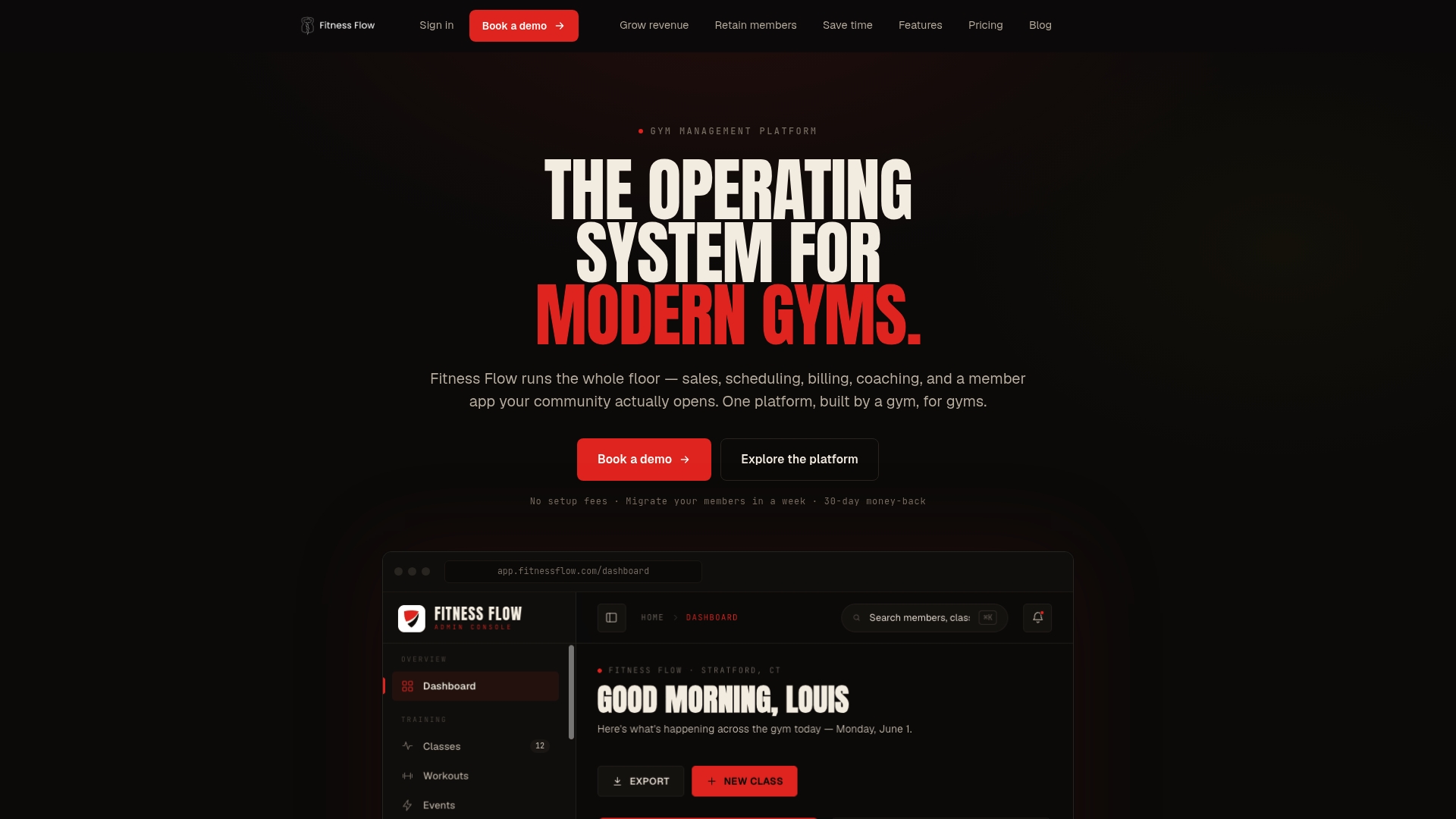
That’s the gap most gyms hit once they pass a few hundred members: the manual process that worked at launch stops scaling, and detractor scores start sitting unread. Retention workflows can be built specifically to catch that before it costs members. If you want to see how a survey template, automated routing, and the analytics dashboard fit together, book a demo of Fitness Flow and bring your own question set. It is possible to start running an automated pulse survey quickly.
Where to go for benchmarks and templates
For deeper benchmarking and ready-made structures beyond what’s covered here, three resources are worth bookmarking. The member feedback loop guide breaks down silent churn data and response-rate ranges in more depth. The free gym member survey template gives you a ready NPS-plus-driver structure you can adapt directly. And the list of 20-plus gym survey questions is a solid source if you want more phrasing options for specific driver categories like equipment or cleanliness.