

Member App Engagement: How Gyms Get Members to Use the App

Member app engagement is the share of your members who use the app to do something useful, such as booking a class, checking in, or managing an account, and keep doing it week after week. Installs and app opens don’t measure it. To improve it, track real actions, make the first booking easy, send timely and relevant messages, and use the drop-off in activity as a cue for staff to reach out personally.
This guide is for gym owners and studio managers who already have an app, or are about to launch one, and want members to use it. It covers the definition, the metrics worth tracking, the features that work between visits, notification rules, the link to retention, and the privacy basics for U.S. operators.
Getfitnessflow
Keep Members Engaged Between Visits
Fitness Flow’s branded member app connects clients with live classes and gamified features, supporting engagement beyond the gym floor.
TL;DR
- Engagement means members complete useful actions in the app (bookings, check-ins, plan progress), not just that they installed it.
- Track a funnel: download, sign-in, first booking, repeat use. Flag members who go quiet for two weeks or more.
- Personal, timely notifications tied to a member’s own routine beat broad blasts.
- Challenges, progress tracking and community give members a reason to open the app on days they aren’t in the building.
- Health-related app data in the U.S. often sits outside HIPAA, so get clear consent before you share it with third parties.
Table of Contents
- What member app engagement means for a gym
- Measure actions, not opens
- Features that keep members active between visits
- Notifications without the noise
- Challenges, progress and community
- App engagement and retention
- Privacy and consent for U.S. gyms
- Our perspective
- Run your member app on one platform
- FAQ
- Sources
What member app engagement means for a gym
The simplest definition comes from how clubs describe it. In a September 2026 piece, Club Solutions Magazine frames engagement as members using the app for tasks that help them do what they already intended to do: check in, register for group exercise, reserve a court or swim lane, and access their account. The app earns its place by removing friction, not by demanding attention.
That has a practical consequence. A member who opens the app four times a week to scroll has not necessarily engaged. A member who books Tuesday’s 6 a.m. class from the couch on Monday night has. The second action is tied to a visit, and a visit is what you are really after.
The same publication, in a January 2025 article, quotes Gold’s Gym SoCal’s vice president of IT describing what members want from an app: account management, payment setup, personal-training scheduling, and timely notifications. Notice what is on that list. It is mostly self-service. Members want to handle the boring parts of membership quickly, and to hear from you when it matters.
A wider view treats the app as a hub. Chuze, for instance, describes its app as a central hub rather than just a scheduling tool, according to the 2026 Club Solutions Magazine piece. In practice that means one place for classes, billing, progress, messages and community, rather than five logins.

Why “installed” is not “engaged”
A branded app on a member’s phone costs you nothing once it’s there, and it also earns nothing until it is used. The gap between installs and active use is where most gym apps stall. Treat the download as the start of onboarding, not the finish line.
Measure actions, not opens
The metrics that matter are the ones that show the product worked. Count the following per week and per month:
- Classes booked through the app
- Check-ins submitted
- Workouts or sessions logged
- Training plans or challenges completed
- Payments or account changes handled without staff
App opens and time on screen are weaker signals. They are easy to inflate with notifications and tell you little about whether a member is building a routine. If you reward your team or your vendor for opens, you risk optimizing for the wrong thing.
A simple adoption funnel
Follow members through four steps and see where they drop out:
- Download: the member installs the app.
- Sign-in: they complete login successfully. Failed logins are a quiet killer, so check the numbers.
- First action: usually a first class booking.
- Repeat use: a second and third booking, within a few weeks.
Our own guide on member app adoption recommends watching weekly active users, repeat booking rates, and dormant users, meaning members who have had no app activity for two weeks or more. That dormant list is your most useful weekly report, because each name on it is a member with a conversation waiting to happen.
Pair app data with attendance data
App activity is one half of the picture. The other half is whether members actually walk in. If you want a method for the in-building side, our posts on gym attendance tracking and class attendance tracking lay out what to count and when to act. For the broader set of numbers, see member retention metrics, and for a no-extra-software approach to reporting, gym analytics for owners.
There’s one more angle on measurement worth keeping in mind: what members do in the building can drive what they do in the app. Small in-club touches, like the gym membership perks a facility offers on site, give members a reason to check in and log the visit. Whatever you offer, tie it to an action you can count, such as a check-in, and judge it by that action rather than by screen time.
Features that keep members active between visits
The hard part of engagement is the 160 hours a week members are not at your gym. Features that work in that gap tend to fall into four groups.
Convenience
Booking, waitlists, reminders, and account management are the core. If a member can book, cancel and pay in under a minute, they will do it. If it needs a phone call, they may not.
Progress and performance tracking
World Gym’s app, described by Athletic Business in 2024, pairs with most wearables and lets members earn achievement points, book classes, track personal progress, and compete in challenges. The company also cites convenience, push notifications, community building, performance monitoring, and customized training as part of its app engagement approach.
World Gym’s Tom Dievart frames this as one member journey: technology should make it easy to engage both remotely and in the club. That framing is useful. The app is not a replacement for the gym floor. It is the thread that connects one visit to the next.
Gamification and habits
Streaks, points, and badges work when they reward the behavior you want, which is showing up. They work badly when they reward opening the app. Tie every point to a booking, a check-in or a completed workout. Our post on habit tracking features for gym owners goes through six that we think make the biggest difference to churn.
Content on demand
Live and on-demand classes give members something to do on days they can’t travel to you. They also keep the relationship warm for members on vacation, injured, or traveling for work, who are otherwise the most likely to drift away.
Notifications without the noise
Notifications are the lever most operators over-pull. The model to copy is personal and timely. Gold’s Gym SoCal’s Taylor described, in the January 2025 Club Solutions Magazine piece, notifications built around check-ins or classes that members regularly attend, plus practical information such as closure notices.
A few rules follow from that:
- Tie messages to the member’s own routine. A reminder for the class they book every Wednesday is welcome. A generic promotion is not.
- Send operational information first. Closures, schedule changes and waitlist offers are things members are glad to receive.
- Cap the frequency. Decide a weekly ceiling per member and stick to it. If you need to send more, cut something else.
- Let members choose. Offer simple notification settings so a member who wants fewer messages turns some off instead of turning all of them off.
- Stop when the member acts. If someone has already booked, do not remind them to book.
Watch opt-out rates after any change. A rise is a sign you have crossed from useful to noisy.
Challenges, progress and community
Challenges give members a shared goal and a deadline. Progress tracking gives them proof they are improving. Community gives them people who notice when they are absent. World Gym’s app, per the same Athletic Business article, combines achievement points, personal progress tracking, and competitive challenges, and treats community building as part of the engagement picture.
Some ways to put this to work without much overhead:
- Run one short challenge per quarter built around attendance, such as visits in four weeks, rather than weight or performance, so beginners can take part.
- Show members their own streak or visit count on the home screen of the app.
- Recognize members by name in a community feed, and have coaches comment on milestones.
- Make it easy to invite a friend into a challenge, since social accountability is the whole point.
Keep the stakes light. The goal is a habit, not a leaderboard that makes newer members feel behind.
App engagement and retention
The logic is straightforward even if the proof is thin. Members who stop using the app often stop visiting soon after, and members who stop visiting are the ones who cancel. An engagement dip is therefore an early warning, and you can act on it while the member is still paying.
Be careful about how far you push the claim, though. Cincinnati Sports Club told Club Solutions Magazine in September 2026 that drops in visits or registrations can signal a chance for staff to reconnect, but that it does not yet have enough app behavioral data to link engagement to retention or revenue. That honesty is a good model. Use engagement data to start conversations, and test the link in your own numbers rather than assuming it.
The same operator makes a second point worth repeating: automation should support human relationships, not replace them. A practical routine looks like this:
- Each Monday, pull the list of members with no app activity or bookings for two weeks.
- Sort by tenure. New members in their first 90 days come first.
- Have a coach or front-desk staffer send a short, personal message or make a quick call.
- Log what happened, and check a month later whether those members came back.
For the first-90-days work, our member retention playbook goes into more detail, and the cohort analysis guide shows how to check which early behaviors predict who stays.
Privacy and consent for U.S. gyms
App data can include workouts, body measurements, location and health-related details. In the U.S. there is no single comprehensive law covering all of it. A federal advisory committee report on health information privacy beyond HIPAA notes that health data outside HIPAA generally lacks HIPAA protections and, for the most part, is not covered by specific statutory privacy regulation. Most gyms are not covered entities, so assume your member app data is in that group.
That doesn’t mean anything goes. The FTC has shown it will act on misleading data practices. In its 2021 settlement with a fertility-tracking app, the proposed order required the app to get users’ consent before sharing their health information with third parties. The principle carries over: say plainly what you collect, and ask before sharing it.
Safe-use habits for your gym:
- Write a plain-language privacy notice and link it inside the app.
- Ask for explicit consent before sharing member health or fitness data with any outside party.
- Collect only what you use. If you never use a body measurement, do not ask for it.
- Ask your attorney to review your notice and your marketing consent language, since state laws differ.
Our perspective
We built Fitness Flow on a simple belief: a member app should do a job, and the job is getting people to their next visit.
Most gyms we talk to run several tools: one for billing, one for scheduling, another for messaging, and a separate app that members barely open. The data is scattered, so nobody sees the moment a member starts to drift. When the app is part of the same platform as bookings, billing and the member record, engagement stops being a vanity number. It becomes a signal your team can act on this week.
That is why our fully branded member app sits on top of the same system that runs your schedule and payments. Members book, check in, join live classes and take part in gamified challenges under your name, and you see who is active and who has gone quiet. Our own results, an average 27% increase in member retention and about 12 hours saved on admin each week, come from that connection between the app and the operations behind it.
Our advice: pick two or three actions that prove the app is working, watch them weekly, and let your people do the human part when the numbers dip.
Louis
Run your member app on one platform
If you’re juggling separate tools for scheduling, billing and your member app, Fitness Flow puts them in one place. You get class booking, recurring billing, a fully branded member app, live and on-demand classes, gamified retention features, and reporting that shows who is engaging and who is slipping.
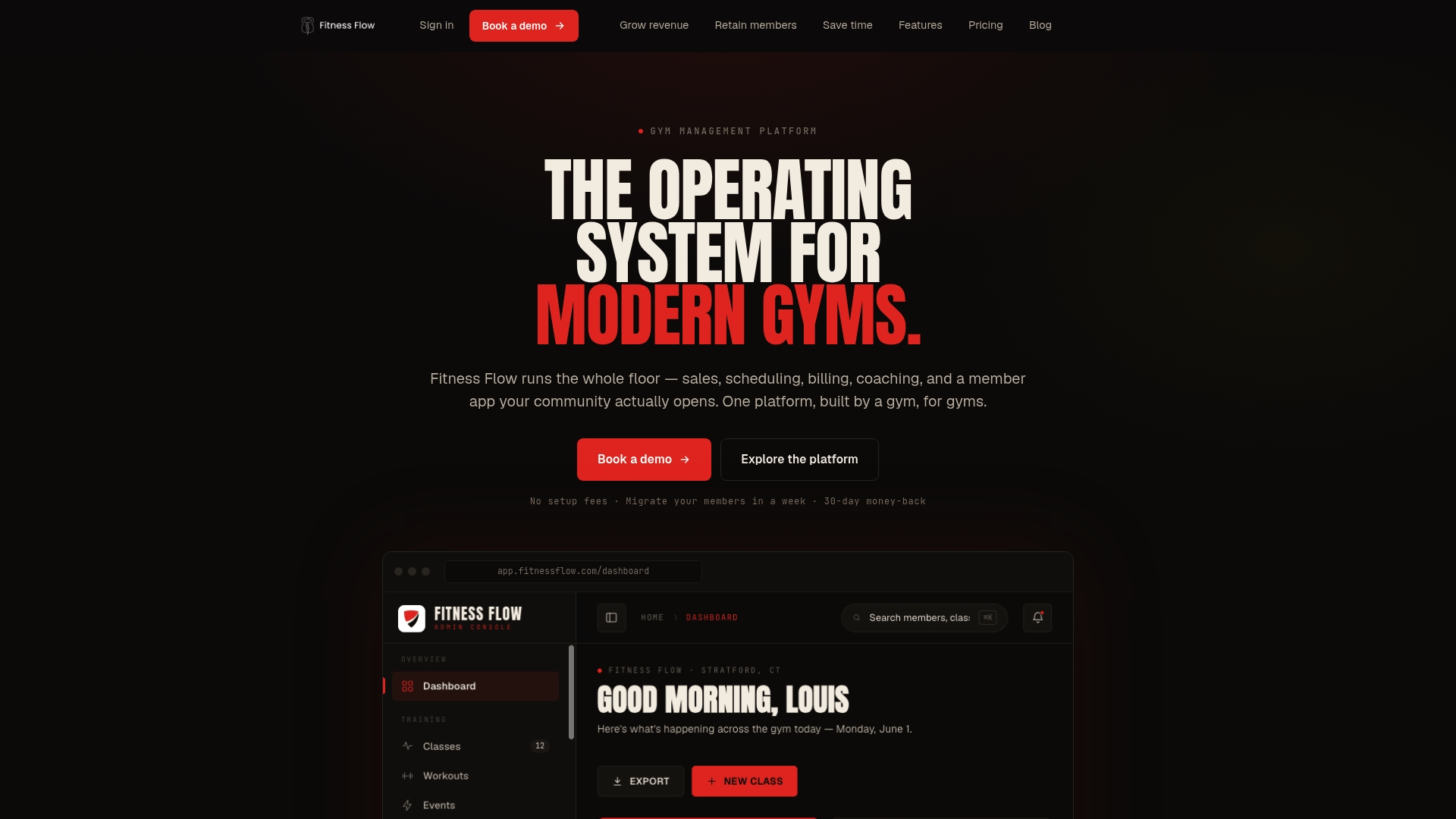
Plans start with Solo at $149 per month and Studio at $349 per month. Multi-site pricing is not published. See the details on the Fitness Flow pricing and plans page, or look at what Fitness Flow does for gyms.
FAQ
What is a good way to measure member app engagement?
Track actions rather than opens. Count weekly active users, classes booked, check-ins, and repeat bookings, and keep a list of members with no activity for two weeks. Compare these against attendance so you can see whether app use turns into visits.
How often should a gym send push notifications?
There is no universal number, so set a weekly ceiling per member and watch opt-outs. Prioritize messages tied to a member’s own routine, such as a reminder for a class they regularly attend, and operational notices like closures. Stop sending a reminder once the member has acted.
Does app engagement reduce cancellations?
It is a useful early warning, because drops in visits or registrations give staff a reason to reach out before a member leaves. Some operators say they don’t yet have enough data to prove a direct link to retention or revenue, so test it against your own cancellations.
Do gyms need member consent to use app data?
In the U.S., health-related data outside HIPAA is largely not covered by specific statutes, but regulators such as the FTC have required consent before sharing health information with third parties. Ask clearly before you share member data, publish a privacy notice, and have your attorney check state requirements.
Sources
- More Than a Check-In: Rethinking the Role of Mobile Apps in Health Clubs, Club Solutions Magazine (2026)
- Boosting Member Engagement Through Mobile Apps, Club Solutions Magazine (2025)
- How Joe Gold’s World Gym Has Embraced Technology to Improve the Member Experience, Athletic Business (2024)
- Health Information Privacy Beyond HIPAA, NCVHS report (2018)
- FTC press release on the 2021 fertility-tracking app settlement