3 OSHA Fixes U.S. Gym Owners Must Make Now for Inspection Ready Records
OSHA applies to nearly every U.S. gym with employees, and most owners are unprepared for what an inspector will actually ask to see. Fix three things now: log recordable injuries if you have more than 10 employees, inventory your cleaning chemicals with Safety Data Sheets on hand, and put your Emergency Action Plan and staff training records in writing. A handful of rules, like AED and CPR mandates, shift by state, but the federal core is non-negotiable and easy to verify with a short checklist.
TL;DR:
- Gyms with more than 10 employees must record injuries on OSHA 300 logs and post a summary from February 1 to April 30 annually.
- A hazard communication program and Safety Data Sheets are mandatory for all chemicals, including disinfectants and pool chemicals, with proper labeling and training required.
- OSHA standards include maintaining a written Emergency Action Plan, daily walking surface inspections, and appropriate PPE for chemical handling and bloodborne pathogen exposure.
- Consistent documentation of training, incident reports, maintenance logs, and SDS access is critical, with digital tools like Getfitnessflow helping reduce audit workload.
- State-specific rules for AEDs, CPR, and ventilation varies, so multi-site operators must maintain compliance matrices and verify equipment, training, and inspections regularly.
Table of Contents
- Does OSHA Apply to Your Gym? Quick Compliance Checklist
- Recordkeeping and Reporting: OSHA 300, 300A, and Reporting Deadlines
- Hazard Communication: Cleaning Chemicals, SDS, and Labeling
- Bloodborne Pathogens and First-Aid Cleanup Policies
- Walking-Working Surfaces: Preventing Slips, Trips, and Falls
- Training Requirements and Documentation Owners Actually Need
- Emergency Action Plans, AEDs, and State-Specific Rules
- Preparing for an OSHA Inspection and the Citations Gyms Actually Get
- How Digitized Records Cut Your Compliance Workload
- PPE Requirements Specific to Gym Environments
- Ventilation and Indoor Air Quality Standards for Gyms
- Ergonomics and Safe Equipment Use Protocols
- Noise Exposure Standards in Gym Settings
- Electrical Safety for Gym Equipment and Facilities
- Priorities for Small Gyms vs. Multi-Site Operators
- Getfitnessflow: Centralize the Records Inspectors Ask For
- Sources
Does OSHA Apply to Your Gym? Quick Compliance Checklist
If you employ staff, front desk workers, trainers, cleaning crew, OSHA covers your facility the same way it covers a warehouse or a restaurant kitchen. The agency doesn’t carve out fitness centers as a special category, and that surprises a lot of owners who assume gyms are somehow exempt because the “hazards” feel more athletic than industrial.
Run through this before you do anything else:
- Confirm your headcount. More than 10 employees means you must keep an OSHA 300 log of recordable injuries and illnesses.
- Build a Hazard Communication program covering every cleaning product, disinfectant, and chemical in your supply closet, with matching Safety Data Sheets.
- Draft a bloodborne pathogens exposure control plan if any staff member ever cleans up blood, wipes down equipment after an injury, or handles used bandages.
- Inspect walking and working surfaces daily. Wet locker room floors and loose mats are the single most common source of member and staff injuries.
- Write an Emergency Action Plan, train staff on it, and store the signed documentation somewhere you can retrieve it in minutes.
Pro Tip: Keep every one of these documents in one digital folder organized by category, not scattered across email threads and filing cabinets. When an inspector or insurance auditor asks for proof, retrieval speed matters as much as the paperwork itself.
Recordkeeping and Reporting: OSHA 300, 300A, and Reporting Deadlines
The recordkeeping threshold trips up more gym owners than any other requirement. If your facility employs more than 10 people, you’re required to maintain an OSHA 300 log of every work-related injury or illness, and post the annual 300A summary in a visible location for staff between February 1 and April 30.
Certain low-hazard industries are partially exempt from routine logging, but fitness centers aren’t automatically on that exemption list, so don’t assume you’re clear without checking your NAICS classification.
Separate from annual logs, severe incidents carry their own reporting clock:
- Report any fatality to OSHA within 8 hours.
- Report an inpatient hospitalization, amputation, or loss of an eye within 24 hours.
- Keep incident reports even for events that don’t meet the reporting threshold. Patterns matter during an inspection.
RequirementTriggerDeadline
OSHA 300 log
More than 10 employees
Ongoing, calendar year
300A summary posting
Same threshold
February 1 to April 30
Fatality reporting
Any work-related death
Within 8 hours
Severe injury reporting
Hospitalization, amputation, eye loss
Within 24 hours
Assign one person, not “whoever’s around,” as your designated recordkeeper. A digital log with timestamped entries holds up far better under audit than a notebook someone updates when they remember.
Hazard Communication: Cleaning Chemicals, SDS, and Labeling
Every disinfectant spray, degreaser, and pool chemical in your building falls under OSHA’s Hazard Communication standard. That standard requires a written HazCom program, an up-to-date Safety Data Sheet for every hazardous product, proper container labeling, and documented employee training.
Gyms tend to underestimate how many products qualify. Glass cleaner, mat disinfectant, chlorine tablets for a pool or hot tub, even some laundry detergents used on towels count as hazardous chemicals under the standard.
Here’s what actually needs to happen operationally:
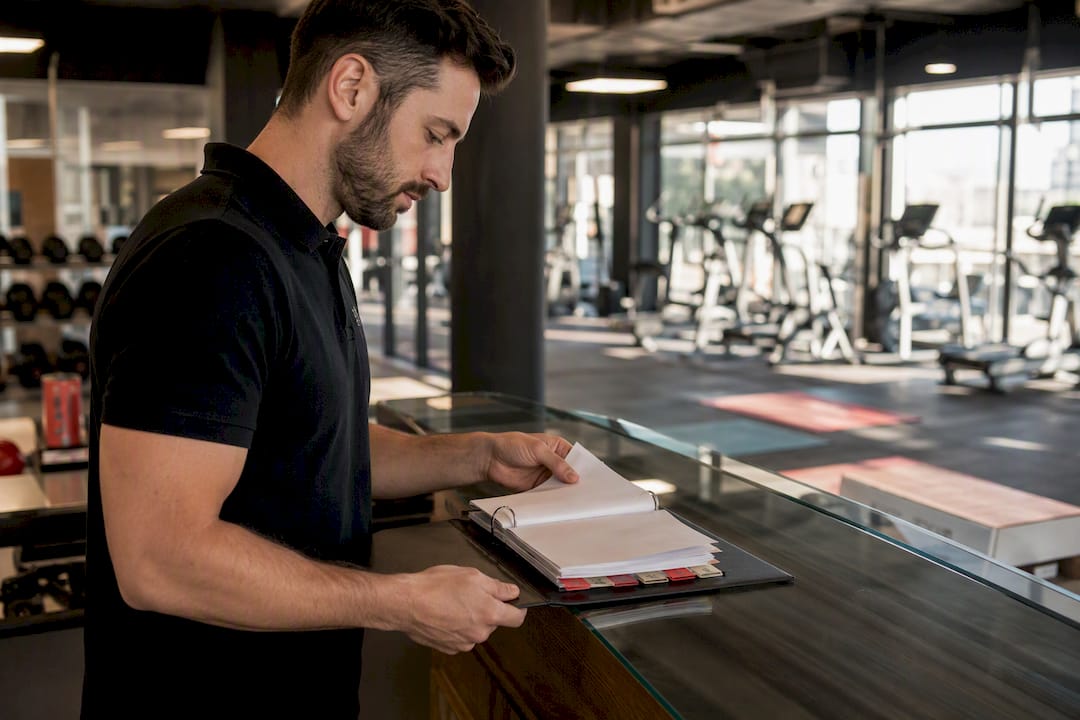
- Build a master SDS binder or, better, a centralized digital SDS system staff can access from any device during a shift.
- Label every secondary container (spray bottles filled from bulk chemicals) with the product name and hazard warnings.
- Train new hires on chemical hazards before their first cleaning shift, then refresh that training annually.
- Provide gloves and eye protection to staff assigned to chemical cleaning duties.
Pro Tip: Photograph your SDS binder’s table of contents and store it in your phone. When a chemical delivery arrives, you can check in seconds whether you already have the matching sheet on file.
Bloodborne Pathogens and First-Aid Cleanup Policies
The Bloodborne Pathogens standard kicks in the moment an employee has reasonably anticipated contact with blood or other potentially infectious material. In a gym, that’s not hypothetical. A front desk staffer applying a bandage after a treadmill fall, a trainer cleaning a barbell after a nosebleed, or a housekeeper laundering a bloodied towel all trigger coverage.
OSHA’s own interpretation letters on fitness centers confirm that non-healthcare employers aren’t automatically exempt just because treating injuries isn’t their primary business.
Once you’re covered, the obligations are specific:
- Write an exposure control plan naming which job roles face exposure risk.
- Offer the Hepatitis B vaccine, at no cost, to any employee with occupational exposure.
- Supply gloves and disposal bags for anyone handling contaminated materials.
- Establish a sharps policy even if you don’t expect needles on-site; first-aid kits sometimes include lancets or test strips.
- Document every exposure incident, including the employee’s post-exposure evaluation.
Treat contaminated laundry as biohazard waste, not regular towels headed for the wash cycle with everything else.
Walking-Working Surfaces: Preventing Slips, Trips, and Falls
Wet locker rooms, sweaty rubber flooring, and cables snaking across a group fitness studio are exactly what 29 CFR 1910.22 targets. The rule requires floors and walkways to stay clean, dry, and free of hazards, and it’s one of the most frequently cited standards across all industries, not just fitness.
Build these habits into daily operations rather than treating them as occasional cleanup:
- Assign a specific staff member to check locker rooms and cardio floors every two hours during peak times.
- Post wet floor signage immediately after mopping, and remove it as soon as the surface dries.
- Keep an inspection log with initials and timestamps. That log becomes your proof of a good-faith safety program if something goes wrong.
- Route equipment cables and mats so they never cross a primary walking path.
Pro Tip: Put a laminated inspection log clipboard right at the janitorial closet. Staff are far more likely to fill it out consistently when the form is physically in their hands during rounds, not buried in a shared drive.
Training Requirements and Documentation Owners Actually Need
OSHA doesn’t hand gyms a single training checklist. Instead, its education and training guidance requires that training match the specific hazards employees face and be delivered in language and terms they genuinely understand. More than 100 individual OSHA standards contain their own training components, and several apply directly to fitness facilities.
For most gyms, the core training topics break down to:
- Hazard Communication basics for anyone handling cleaning chemicals.
- Bloodborne pathogens training for staff who might clean injuries or handle contaminated laundry.
- Hazard recognition walkthroughs covering equipment pinch points and floor conditions.
- Emergency Action Plan drills, including evacuation routes and AED location.
- PPE use for cleaning crews and maintenance staff.
Documentation is where most gyms fall apart during an audit. Verbal-only training with no signed acknowledgment or test record leaves you with nothing to show an inspector. Attach an expiration date to every training record and tie renewal reminders to your HR calendar, not a sticky note on someone’s monitor.
Emergency Action Plans, AEDs, and State-Specific Rules
Every gym needs a written Emergency Action Plan under 29 CFR 1910.38, covering evacuation procedures, exit routes, an assigned point person during emergencies, and how staff report medical incidents.
Federal OSHA doesn’t mandate AEDs or specific CPR certifications, but that gap gets filled at the state level, and requirements vary widely depending on where you operate. Multi-state operators should treat this as a state-by-state compliance checklist rather than a single national standard.
Regardless of state mandates, keep these documented:
- Monthly visual inspection and battery checks for every AED on-site.
- CPR and first aid certification renewal dates for all trainers and front desk staff.
- Signed proof that new hires reviewed the EAP during onboarding, not just during their first week on the floor.
- A quarterly fire drill or evacuation walkthrough, logged with attendance.
Preparing for an OSHA Inspection and the Citations Gyms Actually Get
Inspections rarely come out of nowhere. They’re usually triggered by an employee complaint, a reported injury, or a referral following a workers’ compensation claim, though programmed inspections in high-injury industries happen too. Whatever the trigger, the inspector’s first move is almost always a records request.
Here’s the sequence that plays out most often:
- The inspector asks for your OSHA 300 log and 300A summary, even if you’re below the 10-employee threshold, since you’ll need to explain the exemption.
- They request your written HazCom program and SDS access log.
- They ask to see training documentation tied to specific employee names, not a generic policy binder.
- They walk the facility, checking walking surfaces, exit routes, and electrical panels.
OSHA publishes its top cited standards annually, and hazard communication violations, along with general duty clause citations for unaddressed hazards like unguarded equipment or blocked exits, show up consistently across industries that include fitness facilities. The General Duty Clause fills the gap when no specific standard exists, and in a gym that often means pinch points on cable machines or propped-open emergency exits.
Build a physical or digital “inspection binder” containing every document listed above, organized by standard, so you can hand it over without scrambling.
How Digitized Records Cut Your Compliance Workload
The gap between gyms that pass an audit smoothly and gyms that scramble almost always comes down to documentation, not actual safety performance. Verbal-only training and undocumented SDS inventories are the most common gaps auditors flag, and both are entirely solvable with a centralized system rather than more paperwork.
The workflows that benefit most from digitization are the ones you’d otherwise chase down manually:
- SDS storage searchable by product name instead of a three-ring binder.
- OSHA 300 summaries stored with timestamped entries instead of a spreadsheet nobody remembers updating.
- Training schedules with automatic expiration alerts tied to each employee’s file.
- Equipment maintenance logs proving routine inspection, not just a memory of “someone checked it.”
Gyms using Getfitnessflow to centralize scheduling and staff records report saving 12 hours of administrative work weekly, time that often goes straight into safety walkthroughs and documentation instead of chasing paper trails. When an audit request lands, pulling a training history or maintenance log takes minutes instead of a full afternoon.
PPE Requirements Specific to Gym Environments
Personal protective equipment in a gym looks different from a construction site, but the obligation is the same: match the gear to the actual hazard, not a generic list copied from another industry.
Cleaning staff handling disinfectants and degreasers need gloves rated for the specific chemicals in use, since not every glove material resists every solvent. Employees who might contact blood or bodily fluids, front desk staff applying first aid, trainers cleaning up after an injury, need nitrile gloves stocked at multiple stations, not locked in a single supply closet.
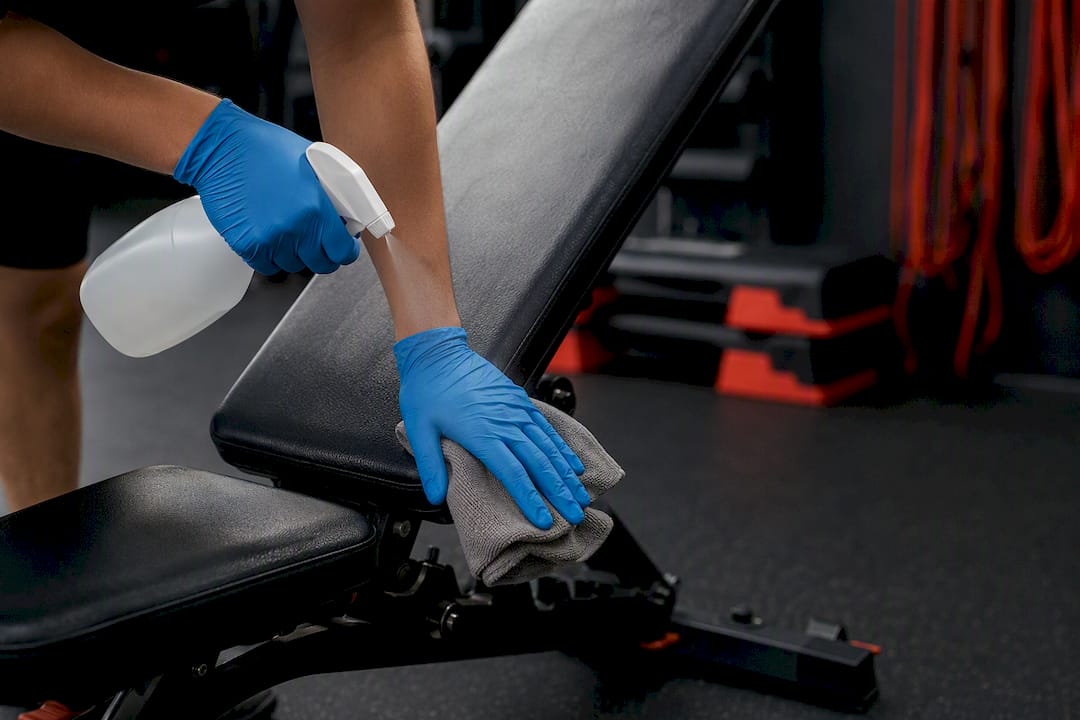
Maintenance staff servicing cardio equipment or working near electrical panels need eye protection and, depending on the task, insulated gloves. Pool and spa maintenance crews handling chlorine or pH adjustment chemicals need respiratory protection appropriate to the product’s SDS instructions, along with goggles rated for chemical splash.
Where PPE requirements often get missed is documentation. OSHA expects employers to assess which roles need protective equipment and to train employees on correct use, not just supply the gear and assume common sense takes over. A trainer who’s never been shown how to properly remove contaminated gloves without touching the outer surface is still a training gap, even if the gloves themselves are on hand.
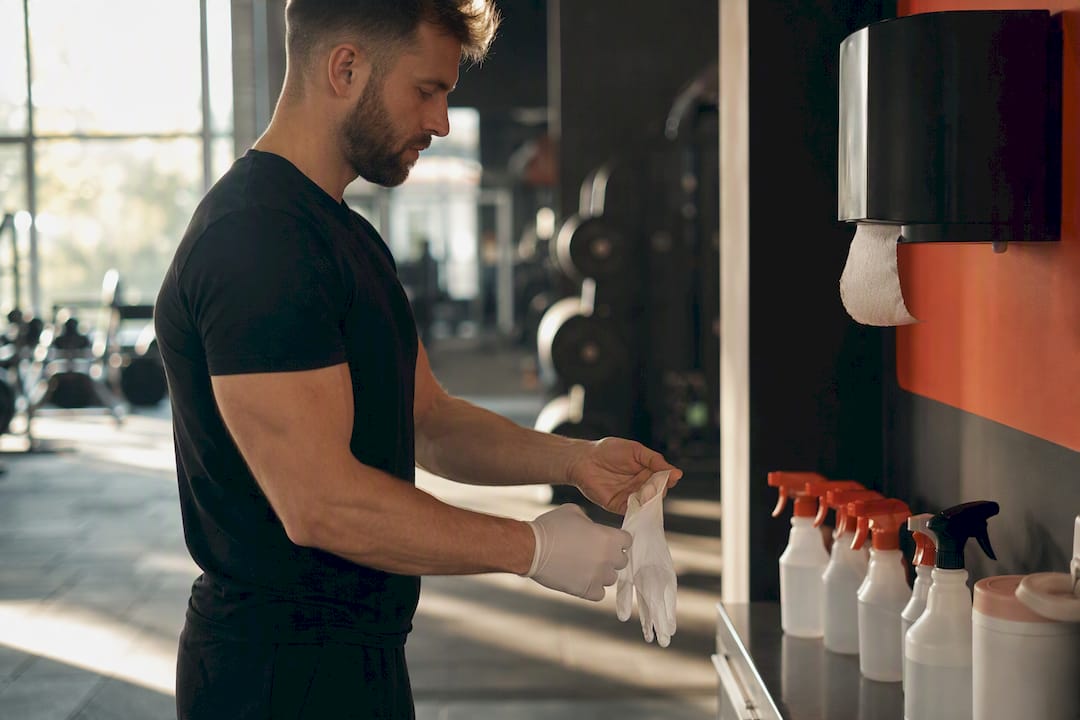
Stock PPE at the point of use, not a central closet three rooms away. Staff skip protective steps far more often when getting the gear costs them a two-minute walk during a busy shift.
Ventilation and Indoor Air Quality Standards for Gyms
OSHA doesn’t maintain a fitness-specific ventilation standard, but general indoor air quality obligations still apply through the General Duty Clause when poor ventilation creates a recognized hazard. Gyms present a particular challenge here: heavy breathing, sweat, and enclosed studio spaces concentrate humidity and airborne particulates faster than most workplaces.
Group fitness rooms running high-intensity classes back to back need mechanical ventilation sized for peak occupancy, not average occupancy. A studio that feels fine during a slow Tuesday morning class can become genuinely uncomfortable, and potentially hazardous for staff working full shifts, during a packed evening rotation.
Chemical storage areas need separate consideration. Chlorine-based pool chemicals, ammonia-based cleaners, and aerosol disinfectants all off-gas, and mixing incompatible chemicals in a poorly ventilated closet has caused real injuries in fitness facilities nationwide. Store chemicals according to their SDS compatibility guidance, and never in a sealed closet with no air exchange.
Humidity control matters beyond comfort. Excess moisture in locker rooms and pool areas accelerates mold growth, which becomes a respiratory hazard for staff working those areas daily. Regular HVAC maintenance logs double as both a facilities record and a piece of documentation worth having if an employee ever raises an air quality complaint.
Ergonomics and Safe Equipment Use Protocols
Ergonomic hazards in a gym hit employees differently than they hit members. Trainers spend hours demonstrating movements, spotting heavy lifts, and adjusting equipment, repetitive strain that adds up over a full workweek in ways a member’s occasional visit doesn’t.
Front desk and maintenance staff face their own ergonomic risks: repetitive reaching to rack weight plates, awkward postures cleaning under fixed equipment, and lifting heavy dumbbells or kettlebells back onto racks dozens of times per shift.
Build equipment layout with clearance in mind. Machines placed too close together force staff into awkward angles during maintenance or spotting, and OSHA’s General Duty Clause covers recognized ergonomic hazards even without a dedicated standard.
Practical steps that reduce injury risk:
- Train staff on proper lifting mechanics for racking heavy equipment, not just member-facing coaching cues.
- Rotate trainers through different class formats rather than having one person teach the same repetitive-motion class every shift.
- Inspect adjustable equipment (cable machines, benches) for smooth range of motion; sticking mechanisms force compensatory strain on the person adjusting it.
- Provide anti-fatigue matting in areas where staff stand for extended periods, like the front desk or a group class instructor’s spot.
Equipment manufacturers publish weight limits and maintenance intervals for a reason. Skipping scheduled maintenance on cable systems or resistance machines doesn’t just risk mechanical failure, it often creates the exact ergonomic strain that leads to a workers’ comp claim months later.
Noise Exposure Standards in Gym Settings
Group fitness studios running music at motivating volumes can genuinely approach levels that matter under OSHA’s noise exposure rules, particularly for instructors who spend eight-hour shifts teaching back-to-back classes in the same room.
OSHA’s permissible exposure limit sits at 90 decibels averaged over an 8-hour workday, with lower thresholds triggering hearing conservation obligations at prolonged exposure above that range. A single high-energy cycling or HIIT class rarely creates a violation on its own, but an instructor teaching five classes daily in a room with speakers cranked for member energy can accumulate exposure that adds up over a full shift.
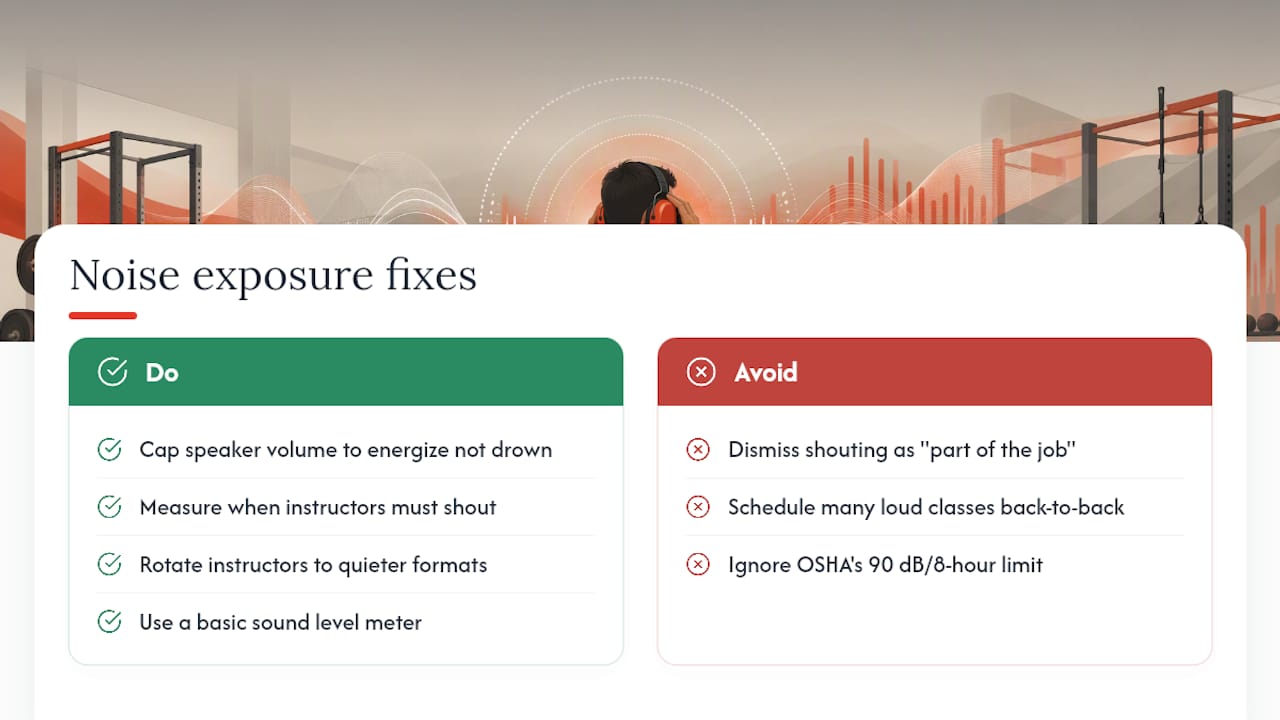
The practical fix isn’t complicated. Cap studio speaker volume at a level that stays energizing without requiring instructors to shout over the music to cue movements. If staff regularly report needing to raise their voices to be heard across a group fitness room, that’s a signal worth measuring with a basic sound level meter, not dismissing as just part of the job.
Rotate instructors across quieter formats (yoga, mobility, recovery classes) alongside louder ones when scheduling allows. It’s a simple scheduling adjustment that limits any one employee’s daily noise exposure without changing your class programming at all.
Electrical Safety for Gym Equipment and Facilities
Cardio equipment draws serious power, and a row of treadmills, ellipticals, and rowing machines running simultaneously puts real demand on a facility’s electrical system. Overloaded circuits, frayed power cords, and equipment plugged into daisy-chained extension cords are recurring hazards inspectors flag in fitness facilities.
Every piece of powered equipment needs its cord and plug inspected regularly. Cords that run under floor mats or across walking paths, common in gyms retrofitting space for new equipment, create both a trip hazard and a fire risk if the insulation wears through from foot traffic.
Ground fault circuit interrupter protection matters anywhere water and electricity share proximity: pool areas, spa rooms, and any electrical outlet near a locker room shower zone. Confirm your GFCI outlets trip correctly during routine maintenance checks, not just when they’re installed.
Equipment maintenance logs should include electrical checks alongside mechanical ones. A cable machine with a worn motor cord is just as much a documented hazard as a wobbly leg press, and both belong in the same maintenance record an inspector might ask to review.
Priorities for Small Gyms vs. Multi-Site Operators
Small, single-location gyms should stop overthinking this and start with what’s cheap and fast: fix visible slip hazards this week, get an SDS binder organized this month, and name one person as your official recordkeeper today. Most compliance gaps at small gyms come from nobody owning the task, not from the requirements being genuinely hard to meet.
Multi-site operators face a different problem entirely. The federal core stays consistent across locations, but state-level AED and CPR rules don’t, so a standardized program that assumes one state’s rules apply everywhere is a real liability. Centralize your documentation across sites and build a location-by-location compliance matrix for anything state-dependent.
Either way, a monthly walkthrough and a genuine internal audit beat scrambling once a year before the 300A posting deadline. Compliance built into routine operations holds up. Compliance assembled the week before an inspector arrives usually doesn’t.
— Louis
Getfitnessflow: Centralize the Records Inspectors Ask For
Getfitnessflow is the practical alternative to juggling spreadsheets, paper binders, and separate apps for training records and maintenance logs. Instead of hunting through email threads when an inspector requests documentation, you pull training history, incident logs, and maintenance checklists from one dashboard.
The platform’s employee and facility management tools cover the exact workflows compliance depends on: scheduled training reminders tied to expiration dates, centralized incident and maintenance logging, and role-based access so the right staff member can update SDS records without digging through a shared drive. Gyms running their operations through Getfitnessflow report an increase in member retention and save time weekly on administrative work, hours that translate directly into time spent on safety walkthroughs instead of paperwork reconstruction.
If you’re tired of assembling compliance documentation from scratch every time a renewal deadline or inspection request hits, visit the Getfitnessflow product page to see how centralized records fit into your daily operations, and request a demo to walk through your specific facility’s setup.