

Avoid State Audits: Itemize Sales Tax on U.S. Gym Memberships

Whether a gym membership gets taxed depends entirely on where the facility sits and what the fee actually pays for. Roughly half of U.S. states tax gym or health club memberships in some form, and the other half don’t touch them, with plenty of variation on what counts as access versus instruction. If your state taxes fitness charges, you need to register with your state’s Department of Revenue and start collecting now.
TL;DR:
- Over half of U.S. states tax gym memberships, focusing mainly on access fees rather than instruction or ancillary products.
- State rules vary greatly, with some taxing only facilities, others taxing classes and personal training separately, and local surcharges adding complexity.
- Proper classification of each fee—such as access, instruction, or tangible goods—is crucial for compliance and can often be done in about twenty minutes per revenue stream.
- Online subscription services may create tax obligations due to economic nexus rules, especially if subscribers or sales activity occur in other states.
- Using itemized billing and maintaining accurate records, including registration and state-specific tax codes, is essential for avoiding penalties and simplifying audits.
Getfitnessflow
Simplify Gym Billing Management
Fitness Flow brings billing, member engagement, scheduling, and analytics together in one platform for modern gym owners.
Table of Contents
- In-Person Access vs. Online Memberships: Why the Charge Type Matters
- How New York, Ohio, Minnesota, and Other States Classify Fitness Fees
- A Simple Way to Classify Every Charge on Your Invoice
- When Online Fitness Subscriptions Create Tax Obligations in Other States
- Registering, Collecting, and Remitting: The Compliance Checklist
- Why Itemized Billing Is Your Best Defense in an Audit
- Where to Verify Your State’s Exact Rules
- What Gym Owners Consistently Get Wrong
- Automate Your Billing So Tax Compliance Isn’t a Guessing Game
- Sources
In-Person Access vs. Online Memberships: Why the Charge Type Matters
Not every dollar a member pays gets treated the same way by tax authorities. States that tax fitness services generally focus on admissions or amusement-style access, meaning the fee that gets someone through the front door and onto the equipment floor. Instructional services, like a standalone yoga class or a nutrition coaching package, often get a separate tax treatment entirely, and in some states they’re exempt where general facility access is not.
Digital memberships complicate things further. A live-streamed class subscription or an on-demand workout app can trigger tax obligations in states where you have no physical presence at all, thanks to economic nexus rules that keep evolving as states catch up to subscription-based fitness models.
Here’s how the distinction typically plays out:
- Open gym access and monthly dues: usually taxable where fitness services are enumerated.
- Bottled water, branded apparel, or supplements sold at the front desk: taxable as tangible goods almost everywhere.
- A class prescribed by a physician for a documented medical condition: potentially exempt, but only under narrow, well-documented circumstances.
- A general “wellness” class with no medical prescription: typically taxed the same as regular admission.
Pro Tip: Don’t assume your online-only class packages are safe just because you don’t have a location in a taxing state. If you’re shipping content to paying subscribers in a state with an active economic nexus threshold, you may already owe tax there.
How New York, Ohio, Minnesota, and Other States Classify Fitness Fees
State rules read like they were written by five different committees that never spoke to each other, because in practice, they were. New York draws a hard line between “athletic clubs” and standard health and fitness facilities. Athletic club dues are taxable under state law, and New York City tacks on a local sales tax on top of charges from health and fitness facilities. A gym that looks identical to its neighbor on Yelp can have a completely different tax bill depending on how it’s legally structured.
Ohio takes a broader swing. Rule 5703-9-62 taxes physical fitness facility services outright, covering initiation fees, membership dues, and renewal fees under one umbrella. Minnesota’s approach sits in between: its Sales Tax Fact Sheet 124 lists exercise facility fees and memberships as taxable, but carves out separately stated classes and personal training charges as non-taxable when properly itemized.
A few things to check before you assume your state matches any of these:
- Does your state statute define “athletic club” or “fitness facility” differently from how you operate?
- Are classes, personal training, or nutrition coaching itemized separately from general dues in your billing?
- Does your city or county add a local surcharge on top of the state rate?
Texas, Florida, and other states handle this differently still, so pull your own state DOR bulletin before making any assumptions.
A Simple Way to Classify Every Charge on Your Invoice
Most gym owners get into trouble not because they ignored sales tax, but because they never sat down and classified every line item on their invoice. Here’s a workflow that takes about twenty minutes per revenue stream:
- Identify what the fee actually buys. Does it grant open facility access, pay for instruction, or cover a tangible product like merchandise or a smoothie?
- Check whether your state taxes that category. Access fees, instructional fees, and goods often fall under different rules even within the same state.
- Separate bundled charges wherever legally possible. If a membership fee includes a locker rental, a towel service, and open gym access all rolled into one number, some auditors will tax the entire bundle unless you can show a reasonable split.
- Apply the correct rate to each classified line. Initiation fees, monthly dues, class-only fees, personal training sessions, and merchandise sales can each carry different treatment.
Pro Tip: A membership that bundles gym access with a “free” smoothie every month isn’t actually free from a tax standpoint. If the bundle isn’t itemized, the whole charge often gets swept into the taxable side of the ledger.
When Online Fitness Subscriptions Create Tax Obligations in Other States
Economic nexus means you owe sales tax in a state because of your sales volume or activity there, even without a gym location in that state. Thresholds vary, but they’re usually set by revenue or transaction count over a rolling twelve-month period, and states are actively rewriting these rules as digital fitness subscriptions become more common.
Watch for these common nexus triggers:
- Selling a streaming or on-demand class subscription to members physically located in another state.
- Employing remote trainers, contractors, or affiliates who work from a different state.
- Using third-party servers or fulfillment centers for merchandise shipped across state lines.
- Crossing a state’s revenue or transaction threshold for remote sales, even without a single employee there.
If you run digital classes alongside a physical location, track subscriber addresses by state quarterly. That habit alone catches most nexus problems before they become audit problems.
Registering, Collecting, and Remitting: The Compliance Checklist
Once you know your fees are taxable, the mechanics come down to registration, correct billing setup, and clean records. Gyms act as tax collection agents for the state, and skipping registration doesn’t make the liability disappear, it just adds penalties on top of it.
- Register for a sales tax permit through your state Department of Revenue before you collect a single taxable dollar.
- Set up your billing system to itemize taxable access fees separately from exempt classes, training, or nonprofit-qualifying charges.
- Apply the correct local rate based on your facility’s tax situs, since city and county add-ons stack on top of the state rate.
- Remit on your assigned schedule, whether that’s monthly, quarterly, or annually depending on your registered volume.
Beyond the mechanics, keep clean records:
- Save itemized receipts for every transaction, not just a lump membership charge.
- Document any nonprofit or medical exemption claims with the paperwork your state requires.
- If you find past mistakes, look into your state’s voluntary disclosure program before an auditor finds them first.
Why Itemized Billing Is Your Best Defense in an Audit
Automating your billing doesn’t just save time, it builds the paper trail that keeps an audit from turning into a nightmare. Systems that generate itemized receipts automatically, tag each line item with a service code, and centralize reporting make it far easier to prove which revenue was taxable and which wasn’t.
Fitness Flow customers report an average 27% increase in member retention and 12 hours saved weekly on administrative tasks, time that often gets redirected toward exactly this kind of billing cleanup.
A few implementation habits worth adopting regardless of what software you run:
- Map every product and service to a specific tax code before your next billing cycle.
- Reconcile point-of-sale transactions against membership invoices monthly, not annually.
- Schedule a quarterly nexus check if you sell any digital subscription content.
Pro Tip: Reconciling POS and membership billing monthly catches misapplied tax codes while they’re still a five-minute fix, not a five-figure correction.
Where to Verify Your State’s Exact Rules
State bulletins are the binding authority here, not blog posts, including this one. Start with your own state’s Department of Revenue site, and cross-check with these primary sources:
- New York’s health and fitness facility guidance for athletic club distinctions.
- Ohio Rule 5703-9-62 on physical fitness facility services.
- Minnesota’s Fact Sheet 124 on exercise facility fees.
- IRS Publication 502 and related guidance for the narrow medical deduction exception.
What Gym Owners Consistently Get Wrong
The mistake I see most often isn’t ignorance of the law, it’s treating sales tax as a one-time setup instead of a recurring check. States rewrite their fitness rules more often than owners assume, and a business model that was compliant three years ago can drift out of compliance the moment you launch a streaming class add-on. Register first, itemize everything, and bring in a tax professional for anything that looks borderline.
— Louis
Automate Your Billing So Tax Compliance Isn’t a Guessing Game
An all-in-one gym management platform can provide gym owners with itemized billing structure that state auditors may want to see, reducing reliance on manual spreadsheet work. Every membership charge, class fee, and retail sale gets tagged and tracked separately, which means you’re not stuck reconstructing six months of invoices when a state DOR letter shows up.
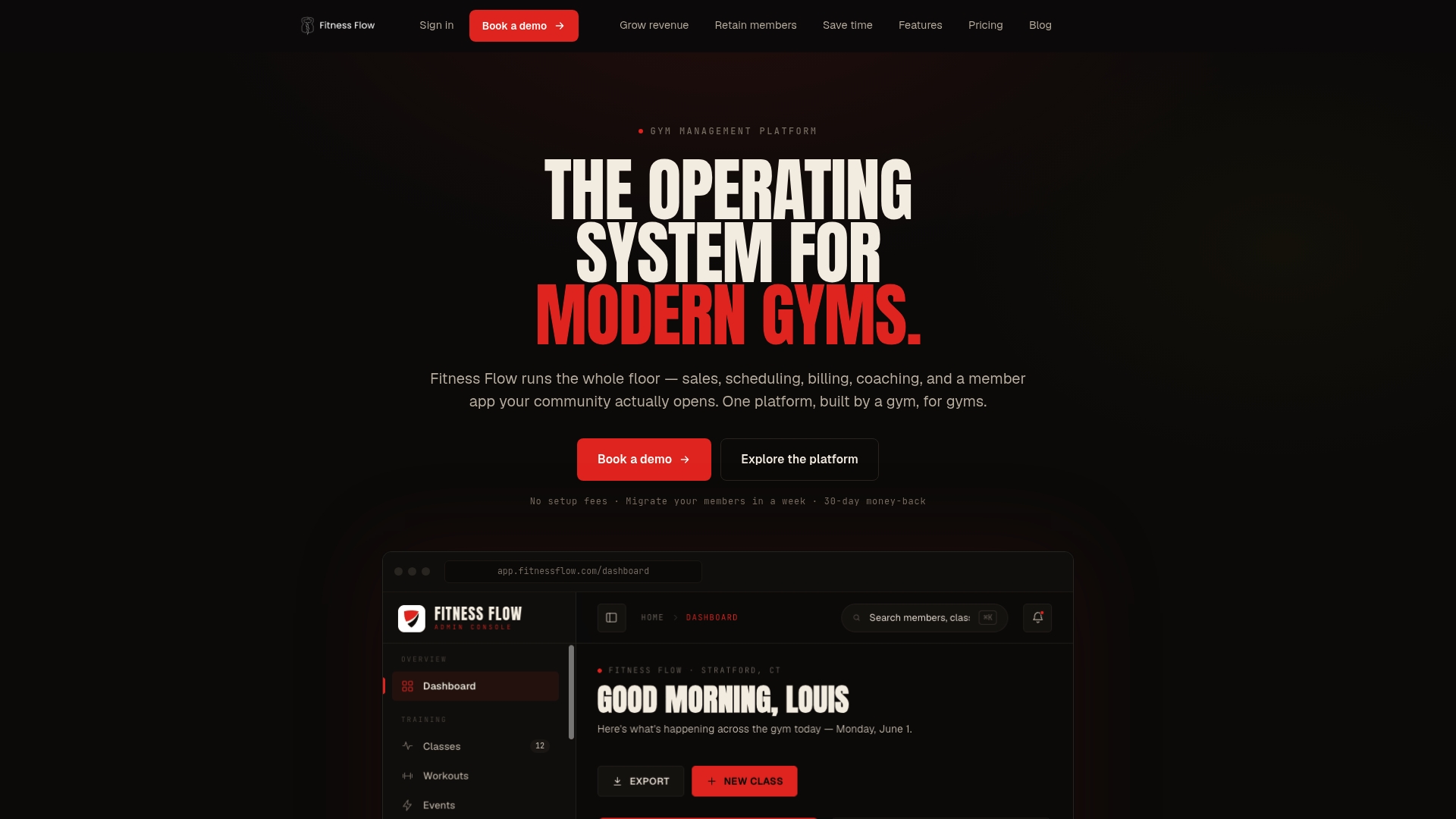
Such platforms often centralize payment reconciliation and reporting with scheduling, CRM, and member engagement tools, helping keep billing setup and compliance records unified rather than spread across multiple apps. If you’re currently piecing together taxability by hand, book a demo of Fitness Flow and see how automated, itemized receipts fit into your existing billing workflow before your next filing deadline.
This article is general information, not a substitute for advice from a qualified financial advisor. Consult a qualified financial professional about your own circumstances before acting on anything here.